If you are searching for the Anantha Padmanabha Vratham Telugu PDF, begin with the date. In 2026 the vratham falls on Friday, 25 September, so note that before anything else. Many pages still show a date in early September, because nobody updated them after last year. Overall that is a gap of almost three weeks.
Please note: Sri Vyasa Pooja is an independent devotional guide. We are not affiliated with any temple or trust, and we do not accept bookings, poojas, donations or payments. So use the official temple portal for anything official. Also confirm every muhurat with your family purohit or a local panchangam.
Anantha Padmanabha Vratham Telugu Guide at a Glance
Here is the Anantha Padmanabha Vratham Telugu summary in one place, so you can check the essentials before reading further.
- Date in 2026: Friday, 25 September 2026 (Bhadrapada Shukla Chaturdashi).
- Chaturdashi tithi: begins 11:18 PM on 24 September, ends 11:06 PM on 25 September (IST, Delhi reference).
- Also called: Anantha Chaturdashi, Ananta Padmanabha Vratam, Anant Chaudas.
- Deity: Lord Vishnu as Ananta Padmanabha, resting on Adisesha.
- Core ritual: tying the anantha sutram, a thread of fourteen knots.
- Same day: Ganesh Nimajjanam, since Vinayaka Chavithi ends on this tithi.
- Where it is done: at home, not as a temple booking or paid seva.
Anantha Padmanabha Vratham Telugu Date and Muhurat in 2026
The Anantha Padmanabha Vratham Telugu observance falls on Friday, 25 September 2026. Chaturdashi tithi begins at 11:18 PM on 24 September and ends at 11:06 PM on 25 September, so the whole of Friday carries the tithi. Because the tithi runs all day, families have a wide window rather than a narrow muhurat. Drik Panchang lists the Delhi pooja window as 06:11 AM to 11:06 PM.
| Detail | 2026 timing (IST) |
|---|---|
| Vratham day | Friday, 25 September 2026 |
| Chaturdashi tithi begins | 11:18 PM, 24 September 2026 |
| Chaturdashi tithi ends | 11:06 PM, 25 September 2026 |
| Pooja window (Delhi reference) | 06:11 AM to 11:06 PM |
| Vinayaka Chavithi 2026 | Monday, 14 September 2026 |
| Ganesh Nimajjanam | Same day as the vratham |
Sunrise shifts by city, so Hyderabad, Vijayawada and Bengaluru start a few minutes later than Delhi. Still, the tithi end at 11:06 PM stays the same across India, because tithi is an astronomical position rather than a clock time.
Why the 2026 date moved almost three weeks
In 2025 this vratham fell on 6 September, while in 2026 it falls on 25 September. That jump confuses many readers, so here is the reason. The Hindu calendar added an adhika masam in 2026, an extra lunar month known as Adhika Jyeshtha Masam, running from 17 May to 15 June. Because that month was inserted, every Bhadrapada festival after it shifted later by roughly nineteen days.
This is exactly why copying last year’s date forward fails. If a Telugu vratham PDF or blog still shows early September for 2026, then it was never recalculated after the adhika masam. Always check the tithi for the specific year instead of trusting a date carried over.
How Vinayaka Chavithi and this vratham connect
Vinayaka Chavithi 2026 falls on Monday, 14 September, since it sits on Bhadrapada Shukla Chaturthi. This vratham sits on Chaturdashi of the same bright fortnight, so the two are ten tithis apart. In 2026 that works out to eleven calendar days later. Older articles describe it loosely as “the eleventh day of Vinayaka Chavithi”, although the reliable anchor is the tithi, not a day count.
Ganesh Nimajjanam happens on this same day across Telangana, Andhra Pradesh and Maharashtra. So one household may be immersing the Ganapati idol while the neighbours tie the anantha sutram indoors. Both observances share the tithi without clashing.
What a Good Anantha Padmanabha Vratham Telugu PDF Contains
A usable Anantha Padmanabha Vratham Telugu PDF should carry the sankalpam, the shodashopachara pooja sequence, the thoram grandhi mantras, the vratha katha and the udyapana note. Many free files online carry only the katha, so devotees reach the pooja stage and stop. Before you print anything, check that all five parts are present.
Download the Telugu PDF linked in this post and open it fully before the vratham day. Print it if you can, because scrolling a phone with wet hands during pooja is genuinely awkward. Also keep a second copy, since one page torn on the day can stall the whole sequence.
How to spot a Telugu vratham PDF that will not work
Not every file that ranks for this search is complete. Check for these four warning signs before you rely on one.
- No year-specific date. If it names a date but not the tithi, then it goes stale every year.
- Katha only. A story without the pooja sequence cannot guide an actual vratham.
- Scanned images with no text. These are unreadable on small screens, especially for elders.
- A fee or a form. No genuine vidhanam PDF asks for payment or personal details.
That last point matters most. Several sites now gate ordinary devotional PDFs behind a payment page or a data form, although the same content circulates freely. Never share your phone number, address or card details to download a vratha vidhanam.
Pooja Samagri for the Anantha Padmanabha Vratham Telugu Vidhanam
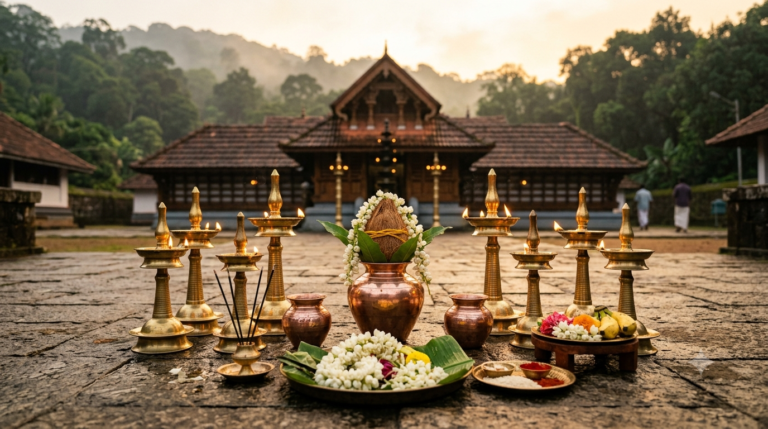
Arrange the samagri a day earlier, because shops near temples get crowded once Ganesh Nimajjanam processions start. The list below covers a standard Anantha Padmanabha Vratham Telugu setup at home.
| Item | Purpose |
|---|---|
| Anantha sutram (red or yellow thread) | Tied after pooja with fourteen knots |
| Darbha grass | Shaped into a seven-hooded Sesha form |
| Kalasam, coconut, mango leaves | Invoking Ananta Padmanabha |
| Turmeric, kumkum, akshatalu | Archana and sankalpam |
| Tulasi leaves and flowers | Pushpa archana to Lord Vishnu |
| Panchamrutham and fruits | Snanam and naivedyam |
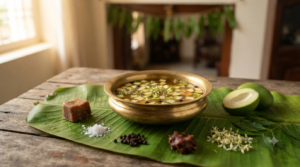
| Apoopalu (sweet wheat cakes) | Traditional naivedyam, often made in fourteens |
| Deepam, camphor, agarbatti | Deepa aradhana and harathi |
Families differ on the apoopalu count. Some prepare twenty-eight and share half, while others simply offer fourteen. Follow whichever practice your family has kept, since both are accepted.
Anantha Padmanabha Vratham Telugu Pooja Vidhanam, Step by Step
The Anantha Padmanabha Vratham Telugu pooja follows shodashopachara, the sixteen-fold service. Below is the sequence most Telugu households follow at home.
- Bathe early and clean the pooja space before sunrise, then wear fresh clothes.
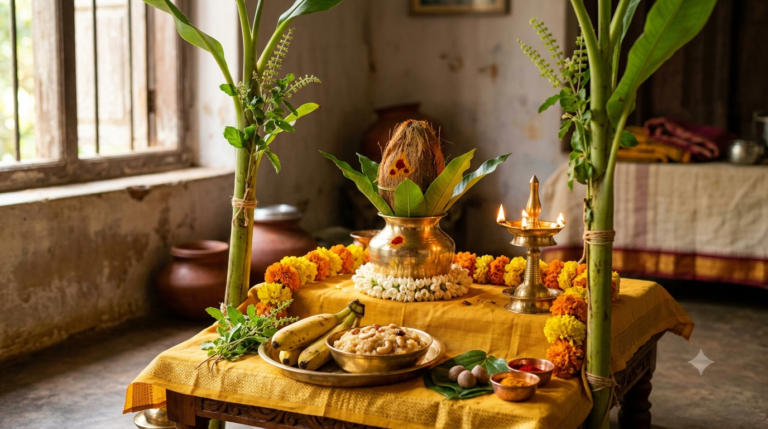
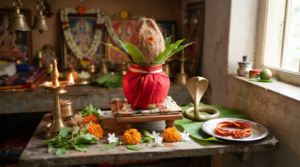
- Set the kalasam on rice, place the coconut and mango leaves, and light the deepam.
- Shape darbha grass into the seven-hooded Sesha and place it before the kalasam.
- Do sankalpam, naming your gotram, the tithi and the purpose of the vratham.
- Perform shodashopachara pooja, moving through avahanam, snanam, vastram, gandham and pushpam.
- Place the fourteen-knot thoram beside the kalasam and worship it along with the Lord.
- Recite Vishnu Sahasranamam if you can, or the Ananta Padmanabha Ashtottaram if time is short.
- Offer naivedyam, then do harathi and pradakshina namaskaram.
- Read the vratha katha aloud so everyone present hears it.
- Finally, tie the anantha sutram and distribute prasadam.
If you want the full Sahasranamam text, our Vishnu Sahasranamam Telugu PDF works alongside this vratham. Keep both open, because the archana becomes smoother when the text is ready.
The anantha sutram and its fourteen knots
The anantha sutram carries fourteen knots, and each knot stands for one of the fourteen lokas described in the Puranas. Men traditionally tie it on the right arm, while women tie it on the left. Practice varies by family, so follow your elders rather than an internet rule.
Keep the thread on until it wears away naturally or until next year’s vratham. When you remove it, immerse it in a river, a tank or clean water at home. Do not throw it into household waste, since devotees treat it as a worshipped object.
The darbha Sesha and the kalasam
Darbha grass is folded into a serpent form with seven hoods, representing Adisesha on whom the Lord reclines. Some families instead use a small silver or copper Sesha, although darbha remains the traditional choice. Place it in front of the kalasam before sankalpam begins.
The Anantha Padmanabha Vratham Telugu Katha in Short
Every vratham carries a katha explaining who performed it first. In this vratham the story centres on Sushila and sage Kaundinya. Sushila learned the vratham from women performing it in a forest, so she observed it with faith and prospered.
Later Kaundinya noticed the thread on her wrist and, in anger, threw it into the fire. Wealth and peace left the household almost immediately. After long wandering and penance, he understood his mistake and returned to the vratham. The Mahabharata also links this vratham to the Pandavas, who performed it during their exile on Lord Krishna’s advice.
Devotees treat these outcomes as matters of faith and tradition rather than guaranteed results. The Anantha Padmanabha Vratham Telugu PDF gives the katha in full, while our Kannada vratha katha page covers the same story for Kannada readers.
Fasting Rules in the Anantha Padmanabha Vratham Telugu Tradition
Most devotees observe upavasam from morning until the pooja finishes, then take prasadam. Others keep phalaharam through the day, eating fruit, milk and light sattvic food. Both are accepted, so choose what suits your household.
Please use judgement here. If you have diabetes, low blood pressure, kidney or heart conditions, or if you are pregnant, elderly or recovering from illness, speak to your doctor before fasting. Phalaharam is a valid traditional option when a strict fast is not safe. A vratham is an act of devotion, and it should never put your health at risk.
How Many Years, and What Udyapana Means
Tradition holds that this vratham is taken for fourteen years and then completed with udyapana. Udyapana is the formal conclusion, done with a larger pooja and daanam. Families who cannot continue for fourteen years often perform udyapana earlier after consulting a purohit.
Nothing is automatically broken if a year is missed. Because circumstances change, most purohits advise resuming the following year rather than abandoning the vratham. Ask your family priest, since sampradayam differs between regions and lineages.
Mistakes Devotees Make in the Anantha Padmanabha Vratham Telugu Pooja
These are the errors that come up most often, and each one is easy to avoid.
- Using last year’s date. After an adhika masam year, the date shifts sharply.
- Skipping sankalpam. The vratham formally begins there, not at the archana.
- Tying the thoram before pooja. The thread is worshipped first, then tied.
- Discarding the old thread carelessly. Immerse it in water instead.
- Treating it as a temple seva. This is a household vratham, so no booking exists for it.
- Fasting despite medical advice. Phalaharam is always available as an option.
The last two cause the most confusion. Some devotees search for a paid booking, although this vratham has no online seva to reserve. If you want temple darshan around the same period, our Thiruvananthapuram temple timings guide covers that separately.
What to Do If You Cannot Perform It on the Day
The official-sounding pages rarely answer this, although it is the most common real problem. Here is what actually works.
You missed the morning. The tithi runs until 11:06 PM on 25 September 2026, so an evening pooja is still within the tithi. Complete it before the tithi ends rather than pushing it to the next day.
You missed the day entirely. There is no substitute date within the same year for this vratham. Most purohits advise resuming at the next year’s Chaturdashi instead of improvising a replacement date.
No purohit is available. This has always been a household vratham, so families perform it themselves. The Telugu vidhanam PDF exists precisely for this situation.
You are travelling or in a hostel. A simplified version works: a kalasam substitute, a deepam, the thoram, the katha and namaskaram. Do what your space allows, since intent carries the vratham.
The thread broke or was lost. Immerse whatever remains in clean water and continue normally. Tie a fresh thoram at the next year’s vratham rather than mid-year.
Before You Begin
Fix the date first, because that single fact decides everything else. For 2026 the Anantha Padmanabha Vratham Telugu observance is on Friday, 25 September, with the tithi ending at 11:06 PM. Download the Telugu PDF, read it once fully, and arrange the samagri a day earlier.
Then keep the vratham simple, honest and within your physical capacity. If a Tamil version suits your household better, our Tamil vratham PDF page covers the same observance.
Frequently Asked Questions
When is the Anantha Padmanabha Vratham Telugu observance in 2026?
It falls on Friday, 25 September 2026. Chaturdashi tithi begins at 11:18 PM on 24 September and ends at 11:06 PM on 25 September. Because the tithi covers all of Friday, the pooja can be done any time that day.
Why do some websites show early September 2026?
Those pages carry the 2025 date, which was 6 September. An adhika masam in 2026 pushed Bhadrapada festivals later by about nineteen days. So the correct 2026 date is 25 September, not early September.
Is this vratham done at a temple or at home?
It is a household vratham performed at home. No temple sells a booking or a seva for it, although you may visit a Vishnu temple that day. Any site offering to “book” this vratham for you is not describing a real temple service.
Which arm should the anantha sutram be tied on?
Men usually tie it on the right arm, while women tie it on the left. Some families follow a different practice, so ask your elders. The thread carries fourteen knots representing the fourteen lokas.
Can I perform the vratham without a purohit?
Yes. This has always been a family vratham, so an Anantha Padmanabha Vratham Telugu PDF with mantras and the katha is enough. If you are new to it, then do a practice read the previous evening.
What do I do with last year’s thread?
Remove it and immerse it in a river, a tank or clean water at home. Do not put it in household waste, since it was worshipped during the pooja. Many families remove the old thread just before tying the new one.
Do I have to fast the whole day?
A full upavasam until the pooja is traditional, although phalaharam is equally accepted. Choose based on your health rather than pressure. If you have any medical condition, consult your doctor before fasting.
Is the vratham compulsory for fourteen years?
Tradition suggests fourteen years followed by udyapana, though families adapt this. If circumstances change, most purohits allow an earlier udyapana. Nothing is considered broken by a missed year.
Where can I read more about the deity and the temple?
The Sree Padmanabhaswamy Temple Trust covers the Thiruvananthapuram shrine, while Ananta Chaturdashi gives the wider festival background. For tithi timings, Drik Panchang publishes year-wise data.