The six Arupadai Veedu temples form the most sacred Murugan pilgrimage circuit in Tamil Nadu, yet most travel guides get their order, distances, and darshan timings wrong. If you plan to visit all six abodes of Lord Murugan in one trip, you need an accurate route map, real timings, and honest distances. This guide hands you exactly that. You will find each temple, its legend, its darshan hours, and the smartest way to cover the whole circuit without zig-zagging across the state.
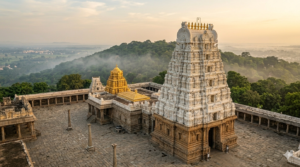
Arupadai Veedu Temples at a Glance
- What they are: the six “battle camps,” or sacred abodes, of Lord Murugan.
- Where: all six lie within Tamil Nadu, stretching from Thiruthani near Chennai down to Thiruchendur on the southern coast.
- The correct order: Thiruparankundram, Thiruchendur, Palani, Swamimalai, Thiruthani, and Pazhamudircholai.
- Total travel: roughly 900 km if you start and finish at Madurai.
- Entry cost: general darshan is free at every temple, so you only pay for special darshan or sevas.
What Are the Arupadai Veedu Temples?
The Arupadai Veedu temples are the six holiest shrines of Lord Murugan, named in the Sangam-era Tamil poem Thirumurugatruppadai. In Tamil, “aru” means six, while “padai veedu” means a battle camp. Each temple marks a stage in Murugan’s divine journey, so devotees believe visiting all six grants courage, wisdom, and peace.
Tamil tradition treats the circuit as one continuous pilgrimage, not six separate trips. Murugan, also called Subramanya, Kartikeya, or Skanda, appears in a different form at each site. Because the shrines sit far apart, planning matters far more here than at any single temple.
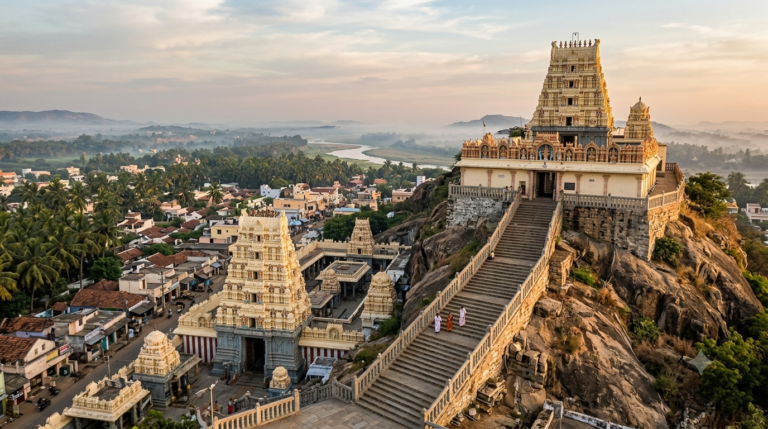
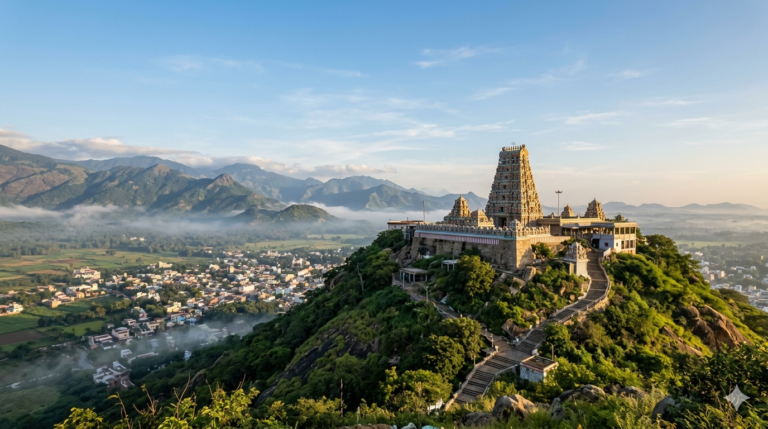
The six Arupadai Veedu temples of Lord Murugan span Tamil Nadu from Thiruthani in the north to Thiruchendur on the southern coast, covering around 900 km in a single circuit.
The Six Arupadai Veedu Temples in Order
Below are the six abodes in their traditional sequence. Each entry gives the location, the form of Murugan worshipped there, and the practical details you actually need before you go.
1. Thiruparankundram Murugan Temple (Madurai)
Thiruparankundram is the first abode, located about 8 km south-west of Madurai city. The Pandyas carved this rock-cut shrine into the hillside between the 6th and 8th centuries. Here Murugan married Deivanai, the daughter of Indra, so the temple celebrates divine marriage.
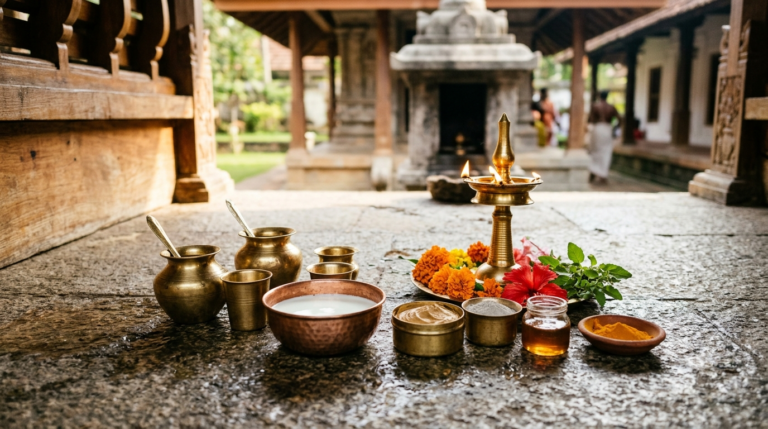
This is also the only abode where the abhishekam (sacred bath) is offered to the Vel, Murugan’s spear, rather than to the idol itself. Priests perform eight poojas a day. The temple usually opens around 5:30 AM and stays open until about 9 PM, with a midday break, although festival timings shift.
2. Thiruchendur Murugan Temple (Thoothukudi)
Thiruchendur is the second abode and the only one of the six set by the sea. It stands on the shore of the Bay of Bengal in Thoothukudi district, roughly 165 km south of Madurai. Murugan defeated the demon Surapadman here, an event re-enacted during the famous Soorasamharam festival.
The temple opens early, around 5 AM, and closes about 9 PM. Because it lies on the coast, rituals use sacred sea water. For full booking and seva details, see our guide to Thiruchendur Murugan Temple darshan timings before you travel.
3. Palani Murugan Temple (Dindigul)
Palani, the third abode, sits atop a hill in Dindigul district, about 120 km from Madurai. Murugan is worshipped here as Dhandayuthapani, the renunciant who left Kailash after losing the fruit of wisdom to his brother Ganesha. Around seven million pilgrims visit each year.
You reach the sanctum by climbing the stone steps, or by rope car or winch train. Many sites quote “689 steps,” but the figure commonly cited today is closer to 693, so treat any exact count with caution. The temple opens at 5:45 AM and closes at 9 PM, with a short midday break. Our detailed Palani Murugan Temple darshan timings guide covers rope-car fares and special darshan.
4. Swamimalai Murugan Temple (Kumbakonam)
Swamimalai is the fourth abode, located about 5 km from Kumbakonam in Thanjavur district, on the banks of the Cauvery. Here Murugan taught the meaning of “Om” to his own father, Lord Shiva, earning the title Swaminatha, the guru. So this shrine represents knowledge and humility.
A flight of 60 steps leads to the sanctum, one for each year of the Tamil sixty-year cycle. The temple opens around 5 AM, closes at noon, then reopens from 4 PM until 9 PM. The ten-day Tirukarthikai festival in November or December draws the largest crowds.
5. Thiruthani Murugan Temple (Tiruvallur)
Thiruthani, the fifth abode, rests on a calm hill in Tiruvallur district, about 84 km from Chennai. After his victory over evil, Murugan is said to have rested here in peace. The shrine has 365 stone steps, one for each day of the year, so some guides wrongly call them “12 months” steps.
The Tamil Nadu Hindu Religious and Charitable Endowments (HR&CE) Department manages the temple. General darshan is free, while special darshan costs ₹100 and VIP darshan ₹200. Doors open around 5:30 to 6 AM and close near 8:30 to 9 PM. Aadi Krithigai is the biggest festival, and a special step festival falls on 31 December.
6. Pazhamudircholai Murugan Temple (Madurai)
Pazhamudircholai is the sixth abode, set in dense forest on Solaimalai hill, about 21 km north of Madurai and just above the Azhagar Kovil. Also called Solaimalai Murugan Temple, it is linked to the legend of the poet Avvaiyar, whom Murugan humbled with a riddle about a fruit.
The Lord gives Visvarupa darshan from about 5 AM, while the day ends with the Rakkalam pooja near 8 PM. A natural spring called Noopura Gangai flows nearby. Because it sits among hills and springs, this is the greenest and quietest of all the abodes.
Comparison Table: The Six Abodes
This table lets you compare all six at a glance. Note the critical numbers in prose too: Palani has around 690 steps, Swamimalai has 60, and Thiruthani has 365.
| Temple | District | Special Feature | Approx. Darshan Hours |
|---|---|---|---|
| Thiruparankundram | Madurai | Rock-cut; Vel abhishekam | 5:30 AM – 9 PM |
| Thiruchendur | Thoothukudi | Only seaside abode | 5 AM – 9 PM |
| Palani | Dindigul | Hilltop; rope car & winch | 5:45 AM – 9 PM |
| Swamimalai | Thanjavur | 60 steps; Murugan as guru | 5 AM–12, 4–9 PM |
| Thiruthani | Tiruvallur | 365 steps | 5:30 AM – 9 PM |
| Pazhamudircholai | Madurai | Forest hill; spring | 5 AM – 8 PM |
Timings shift on festival days, so always confirm with the temple before you set out. Because crowds swell during Thaipusam, Skanda Sashti, and Panguni Uthiram, those windows can run almost round the clock.
Best Route to Cover All Arupadai Veedu Temples
The smartest route to cover all six Arupadai Veedu temples starts and ends at Madurai, since two abodes sit there. From Madurai, swing south to Thiruchendur, then north-west to Palani, east to Swamimalai, and finally north to Thiruthani. This loop runs roughly 900 km and avoids backtracking.
Here is a practical four-to-five day plan if you drive or hire a taxi:
- Day 1 – Madurai base: Cover Thiruparankundram (8 km) in the morning and Pazhamudircholai (21 km) by afternoon.
- Day 2 – Thiruchendur: Drive south about 165 km for coastal darshan, then return or stay overnight.
- Day 3 – Palani: Head north-west around 120 km from Madurai to the hill shrine.
- Day 4 – Swamimalai: Continue east near 200 km to Kumbakonam and the guru shrine.
- Day 5 – Thiruthani: Travel north about 250 km, finishing close to Chennai for your exit.
If you begin from Chennai instead, simply run the loop in reverse and start at Thiruthani. Pilgrims short on time often split the trip into a southern pair (Madurai temples plus Thiruchendur) and a separate northern leg later.
Darshan Timings at the Arupadai Veedu Temples
Darshan at the Arupadai Veedu temples broadly runs from early morning, around 5 to 6 AM, until about 8 to 9 PM. Most shrines close for a midday break, while Pazhamudircholai winds down earliest at roughly 8 PM. General darshan is free everywhere, so you pay only for special darshan or specific sevas.
Early morning is the best time to visit, since queues are shortest and the hill climbs feel cooler. Tuesdays and Krithika star days are especially auspicious for Murugan, so expect heavier crowds then. During Thaipusam and Skanda Sashti, plan for long waits and extended hours.
What Most Pilgrims Get Wrong
A few honest lessons can save you a wasted day. These are the mistakes I see repeated on most other guides and trips.
- Treating Palani and Swamimalai as close: they look near on a map, yet the drive runs around 200 km.
- Trusting one fixed step count for Palani: sources differ between 689 and 693, so do not plan your climb around an exact number.
- Skipping Pazhamudircholai: because it sits in forest, some pilgrims drop it, but it completes the circuit and is the most peaceful stop.
- Arriving at midday: several shrines shut for a break, so a noon visit can leave you waiting at a locked sanctum.
- Ignoring dress codes: men often must remove shirts at the inner shrine, while women are advised to wear sarees or salwar.
Before You Plan Your Trip
The six Arupadai Veedu temples reward careful planning more than any other Tamil Nadu pilgrimage, because the distances are real and the timings vary. Start at Madurai, follow the loop south then north, and keep early mornings for the hill temples. Book special darshan online where it is offered, and always reconfirm timings during festival months. For official updates, check the HR&CE portal at hrce.tn.gov.in, the Palani Devasthanam site at palanimurugan.hrce.tn.gov.in, and Tamil Nadu Tourism for travel routes.
Frequently Asked Questions
What are the six Arupadai Veedu temples?
The six Arupadai Veedu temples are Thiruparankundram, Thiruchendur, Palani, Swamimalai, Thiruthani, and Pazhamudircholai. All six lie in Tamil Nadu and are dedicated to Lord Murugan. Tradition treats them as one sacred circuit, with each shrine marking a stage of Murugan’s divine journey.
In what order should I visit the Arupadai Veedu temples?
The traditional order is Thiruparankundram, Thiruchendur, Palani, Swamimalai, Thiruthani, and Pazhamudircholai. For travel efficiency, though, most pilgrims start at Madurai, cover the two local temples, then loop south to Thiruchendur and north through Palani, Swamimalai, and Thiruthani.
How many days are needed to cover all six abodes?
Four to five days is realistic if you drive or hire a taxi. The full loop runs around 900 km, so rushing it in two or three days leaves little time for darshan. Splitting the circuit into a southern leg and a northern leg works well for those with limited time.
Which Arupadai Veedu temple is by the sea?
Thiruchendur is the only seaside abode, set on the Bay of Bengal shore in Thoothukudi district. The other five sit on or near hills. Thiruchendur marks the spot where Murugan defeated the demon Surapadman, an event honoured during the Soorasamharam festival.
Is there an entry fee for the Arupadai Veedu temples?
General darshan is free at all six temples. You only pay for special darshan or particular sevas. At Thiruthani, for example, special darshan costs ₹100 and VIP darshan ₹200. Palani and other shrines also offer paid quick-darshan and pooja options that you can often book online.
How many steps does each hill temple have?
Swamimalai has 60 steps, Thiruthani has 365 steps, and Palani has around 690, with sources varying between 689 and 693. Palani also offers a rope car and a winch train for those who cannot climb. Thiruparankundram and Thiruchendur need little or no climbing.
What is the best time to visit the Arupadai Veedu temples?
Early morning, soon after opening at 5 to 6 AM, is best because queues are short and the hill climbs feel cooler. The cooler months from October to February suit long travel days. Avoid major festival peaks unless you specifically want the grand celebrations and can handle heavy crowds.
Are the Arupadai Veedu temples open all year?
Yes, all six remain open every day of the year, with regular morning and evening darshan windows and a usual midday break. Timings extend during festivals such as Thaipusam, Skanda Sashti, and Panguni Uthiram. Always reconfirm hours with the temple or the HR&CE portal before travelling.