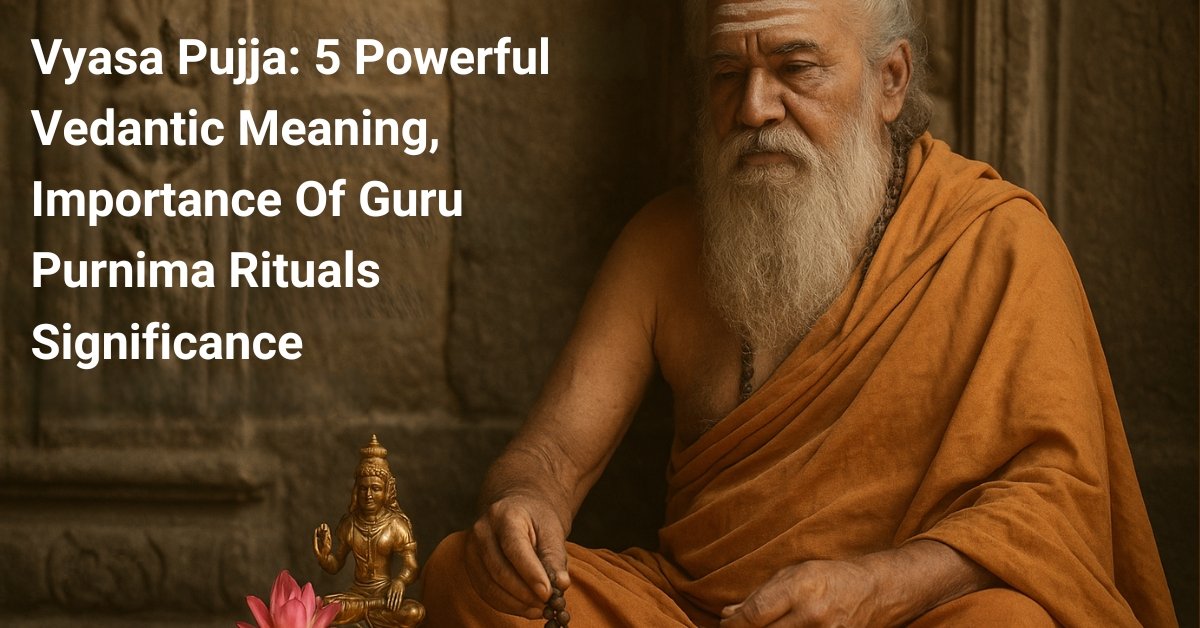
Discover the true Vyasa Puja—its 5 Powerful Vedantic meaning, rituals, and Significance why Guru Purnima honors the divine Guru and eternal wisdom.
Vyasa Puja: 5 Powerful Vedantic Meaning, Importance Of Guru Purnima Rituals & Significance
Every year, on the full moon day of Ashadha month, devotees across India celebrate Vyasa Pournami, also known as Vyasa Puja or Guru Purnima. This sacred day honors Sage Veda Vyasa, the divine compiler of the Vedas, Puranas, and the Mahabharata.
It is not merely a festival—it’s a day to express gratitude to the Guru, who removes ignorance and illuminates the path of wisdom.
Who is Sage Vyasa?
Sage Veda Vyasa is considered one of the greatest spiritual teachers in Hinduism. Born to Sage Parashara and Satyavati, Vyasa’s divine mission was to compile and preserve the eternal wisdom of the Vedas for humanity.
He organized the Rig, Yajur, Sama, and Atharva Vedas, authored the Mahabharata, and composed 18 Puranas—making him the eternal symbol of knowledge and devotion.
Vyasa is not just a person; he represents the eternal Guru principle that exists in every age.
Vedantic Meaning of Vyasa Puja
From a Vedantic perspective, Vyasa Puja signifies the realization of the Guru Tattva (Principle of the Guru)—the guiding light of inner awakening.
- Vyasa represents the universal intellect (Mahat)—the faculty of divine wisdom.
- Puja symbolizes the act of surrendering ego and receiving enlightenment.
- Celebrating Vyasa Pournami is an acknowledgment that all knowledge flows from the Divine Guru Consciousness.
Rituals and Traditions of Vyasa Puja
Performing Vyasa Puja at home or in temples involves both devotion and discipline.
1. Purification and Setup
- Clean the Puja area and decorate it with flowers and rangoli.
- Place a picture or idol of Sage Vyasa or your spiritual Guru on an altar.
2. Offering and Worship
- Offer flowers, fruits, incense, sandalwood paste, and Prasad.
- Chant Guru Stotram, Vyasa Ashtottara Shata Namavali, or Guru Gita.
- Perform Aarti with deep devotion, visualizing your Guru as Vyasa himself.
3. Acts of Gratitude
- Read from sacred texts such as the Bhagavad Gita or Mahabharata.
- Donate food, clothes, or books to the needy — symbolizing the spreading of knowledge.
- Visit your Guru or spiritual center to offer respects.
The Spiritual Essence of Vyasa Pournami
Vyasa Pournami transcends ritual—it is a reminder to recognize and honor the inner teacher.
Vedanta teaches that every being holds divine consciousness, and through the Guru’s grace, one awakens to that truth.
- The Guru removes ignorance (Avidya).
- The Disciple attains knowledge (Jnana).
- Together, this bond reflects the essence of Sanatana Dharma.
The Guru is Brahma, Vishnu, and Maheshwara — the embodiment of all divine forces guiding the soul to liberation.
Why Vyasa Puja is Also Called Guru Purnima
In modern tradition, Vyasa Pournami is celebrated as Guru Purnima—a universal festival honoring teachers, mentors, and Gurus who shape our lives.
From spiritual teachers to academic guides, every Guru represents the wisdom of Vyasa.
Thus, Guru Purnima reminds us that learning never ends, and gratitude is the highest offering.
Useful Links
- Vyasa Pooja in Tirupati: A Sacred Celebration of the Great Sage
- Vyasa-Puja: The Appearance Day of the Spiritual Master
- Guru Purnima Archives
- Hindu Festivals – Britannica
- Vedanta Society – Teachings of Veda Vyasa
FAQS
Q1: What is the main purpose of Vyasa Puja?
To honor Sage Veda Vyasa and express gratitude to one’s spiritual Guru, symbolizing the worship of divine wisdom.
Q2: What mantras are chanted during Vyasa Puja?
Devotees often recite Guru Stotram, Vyasa Ashtottara Namavali, and Guru Gita verses.
Q3: Can Vyasa Puja be done at home?
Yes, with devotion and a simple setup, one can perform Vyasa Puja at home by invoking the Guru’s blessings.
Q4: Why is it called Vyasa Pournami?
It is celebrated on the full moon (Pournami) day of Ashadha month, marking Sage Vyasa’s birth and his divine contribution to Vedic knowledge.


+ There are no comments
Add yours