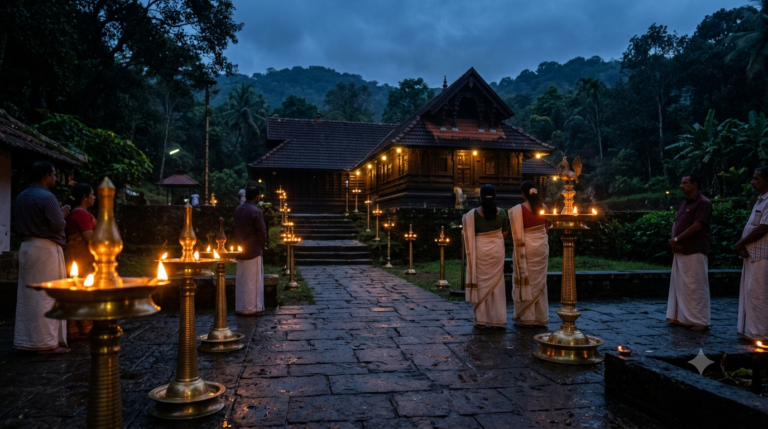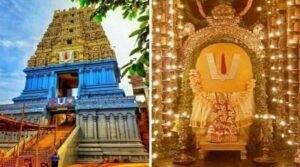
Simhachalam darshan timings run from about 4:00 AM to 9:00 PM every day. Darshan stays open across most of that long window. The morning begins with the pre-dawn Suprabhata Seva, while the night ends with the Ekanta Seva, when priests put the deity to rest. So if you reach the hill any time between sunrise and late evening, you will usually find a queue moving. Yet several popular blogs still print a flat “closed 4 PM to 6 PM” note, and that line does not match the temple’s own ritual schedule. This guide sorts out the real hours first. After that, it covers the history, the sandalwood mystery, the sevas, and the travel details that no single official page collects in one place.
Simhachalam Temple at a Glance
- Deity: Sri Varaha Lakshmi Narasimha Swamy, a combined Varaha and Narasimha form of Lord Vishnu.
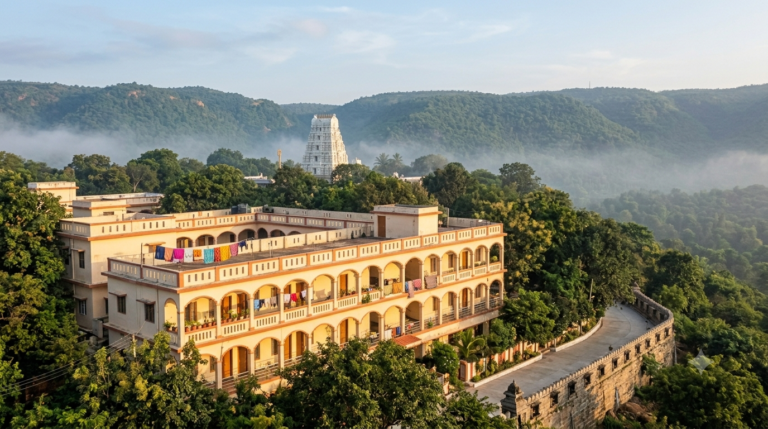
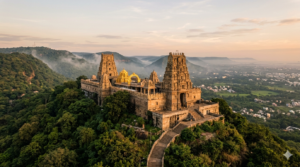
- Location: Simhachalam Hill, about 300 metres above sea level, near Visakhapatnam, Andhra Pradesh.
- Open daily: roughly 4:00 AM to 9:00 PM, since darshan follows the daily seva schedule.
- Free darshan (Sarva Darshanam): mainly 6:30 AM to 11:30 AM, and again in the evening.
- Famous for: the idol stays covered in sandalwood paste all year, while the true form shows only on Akshaya Tritiya.
- Managed by: the Simhachalam Devasthanam, under the Andhra Pradesh Endowments Department.
Simhachalam Darshan Timings: Daily Opening and Closing Hours
The Simhachalam darshan timings open at roughly 4:00 AM with the Suprabhata Seva and close near 9:00 PM after the Ekanta Seva. Between these points, the shrine runs an almost continuous cycle of rituals and darshan. There is no long mid-day shutdown, although a short ritual pause happens in the early afternoon.
For most pilgrims, two windows matter. The free morning darshan, called Sarva Darshanam, usually runs from 6:30 AM to 11:30 AM. After the mid-day offerings, darshan reopens through the afternoon and evening until the night sevas begin. Because the hill priests follow a fixed ritual order, the exact minutes shift slightly from day to day.
Simhachalam Darshan Timings: Full Daily Seva Schedule
Here is the working daily order of rituals at the shrine. Treat the timings as indicative, since festival days and special poojas push them around.
| Ritual / Seva | Approx. Timing | Notes |
|---|---|---|
| Suprabhata Seva | 4:00 AM – 4:30 AM | Temple wakes the deity |
| Suprabhata Darshanam | 4:30 AM – 5:00 AM | Ticketed early darshan |
| Morning Aradhana | 5:00 AM – 6:30 AM | Main morning worship |
| Sarva Darshanam (free) | 6:30 AM – 11:30 AM | General queue for all |
| Rajabhogam | 11:30 AM – 12:30 PM | Mid-day food offering |
| Mid-day Darshanam | 12:30 PM – 2:30 PM | Darshan continues |
| Short ritual pause | ~2:30 PM – 3:00 PM | Brief cleaning break |
| Evening Darshanam | 3:00 PM – 7:00 PM | Afternoon to dusk queue |
| Night Aradhana / Dhoop Seva | 7:00 PM – 8:30 PM | Evening worship |
| Late free darshan | 8:30 PM – 9:00 PM | Last entry of the day |
| Ekanta Seva (Pavalimpu) | ~9:00 PM | Temple closes for the night |
So the practical takeaway is simple. You can have darshan from early morning until about 9:00 PM, with only a brief pause around 2:30 PM. Always confirm the latest order on the official Simhachalam Devasthanam page, because the schedule changes on festival and eclipse days.
The 4 PM Closure Myth in Simhachalam Darshan Timings
Many travel pages claim the Simhachalam darshan timings include a full closure from 4:00 PM to 6:00 PM. That claim does not match the daily seva list, where the evening darshanam actually runs from about 3:00 PM to 7:00 PM. In other words, the late afternoon is one of the active darshan stretches, not a shutdown.
This error likely spread because one site copied another without checking. So you may have planned around a gap that never existed. The only genuine breaks are the short ritual pause in the early afternoon, plus the natural changeovers between sevas. If you want certainty for a specific date, call the temple helpline or check the official site before you travel.
Simhachalam Darshan Timings on Festival Days
On major festival days, the normal Simhachalam darshan timings stretch much longer. During Chandanotsavam, the shrine stays open through the night so that lakhs of devotees can file past in twelve hours. Darshan lines on these days can take several hours, even with a special ticket.
The temple also closes fully during a solar or lunar eclipse, in line with Vaishnava ritual rules. After the eclipse ends, priests perform a cleansing ritual before reopening. Therefore, never plan a Simhachalam visit on an eclipse date without checking the eclipse timing first.
Darshan Types and Seva Tickets
Simhachalam offers a free general darshan and several paid options that cut your waiting time. Free Sarva Darshanam suits unhurried pilgrims who can spare a few hours. The Special or Sheegra Darshanam, priced around ₹100 per person, moves you through a faster queue. So the right choice depends on how much time you have and how heavy the crowd looks.
Several arjitha sevas let devotees take part in worship directly. Popular ones include the Nitya Kalyanam around 9:30 AM, and the Swarna Pushparchana held on Thursdays from 7:00 AM. Ticket prices are revised from time to time, so confirm current rates before booking.
| Darshan / Seva | Indicative Ticket | Best For |
|---|---|---|
| Sarva Darshanam (general) | Free / ₹10 nominal | Flexible pilgrims |
| Sheegra / Special Darshanam | ~₹100 per person | Faster entry |
| Suprabhata Seva | ~₹30 onwards | Early risers |
| Nitya Kalyanam | ~₹1,000 per couple | Family rituals |
| Swarna Pushparchana (Thu) | ~₹1,116 | Special worship |
You can book Special Entry Darshan and arjitha sevas online, usually two to sixty days ahead. Visit the Andhra Pradesh temples portal, register once, then select Sri Varaha Lakshmi Narasimha Swamy, Simhachalam. For a fuller walkthrough, see our guide on how to book a Simhachalam darshanam ticket.
History of the Simhachalam Temple
The Simhachalam temple carries more than a thousand years of recorded history. Its earliest known inscription dates to the 11th century, during the reign of the Chalukya Chola king Kulottunga I. So the hill was already a living shrine long before the present stone temple rose.
The structure you see today took shape in the 13th century. The Eastern Ganga king Narasimhadeva I of Odisha built the central temple, and later rulers added mandapams and gateways. A Velanati chief, Gonka III, is credited with covering the deity in gold during the 12th century. Because so many dynasties contributed, the temple blends several building traditions.
For centuries, the Pusapati Gajapati royal family of Vizianagaram have served as hereditary trustees. Even now, the royal family receives the first true-form darshan on the sandalwood-removal day. To read the legend and lineage in depth, see our history and significance of the Simhachalam temple.
The Deity and the Sandalwood Tradition
The presiding deity is Varaha Lakshmi Narasimha, a rare combined form. The icon shows a boar’s features blended with the lion-man Narasimha, standing in a slightly bent tribhanga posture. According to the Sthala Purana, Lord Vishnu took this form to save the child devotee Prahlada from his father Hiranyakashipu.
Because the Narasimha form was so fierce, priests keep the idol coated in a thick layer of chandanam, the cooling sandalwood paste. So what devotees normally see looks like a smooth lingam-shaped mound, not a detailed figure. The paste is believed to calm the deity’s intense energy through the year.
Chandanotsavam and Nijaroopa Darshanam
Nijaroopa Darshanam is the rare sight of the deity’s original carved form, visible only on Akshaya Tritiya. On this single day, priests remove the entire sandalwood layer at dawn during the Chandanotsavam festival. The true form then stays open for darshan for about twelve hours before fresh paste goes back on.
Akshaya Tritiya usually falls in late April or early May, while the exact date is notified each year by the Andhra Pradesh Endowments Department. Crowds swell into the lakhs, so plan travel and stay well ahead. Our piece on the significance of Simhachalam Chandanotsavam explains the ritual in full.
Temple Architecture
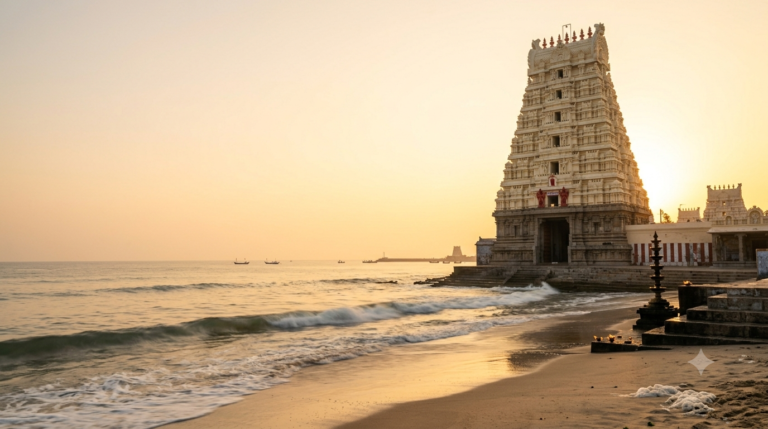
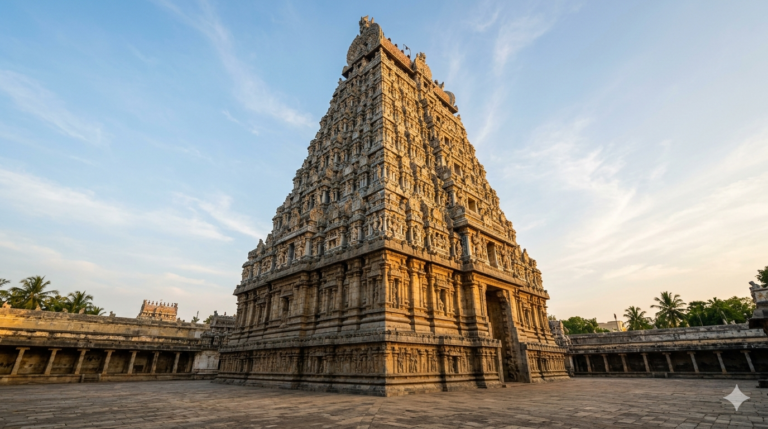
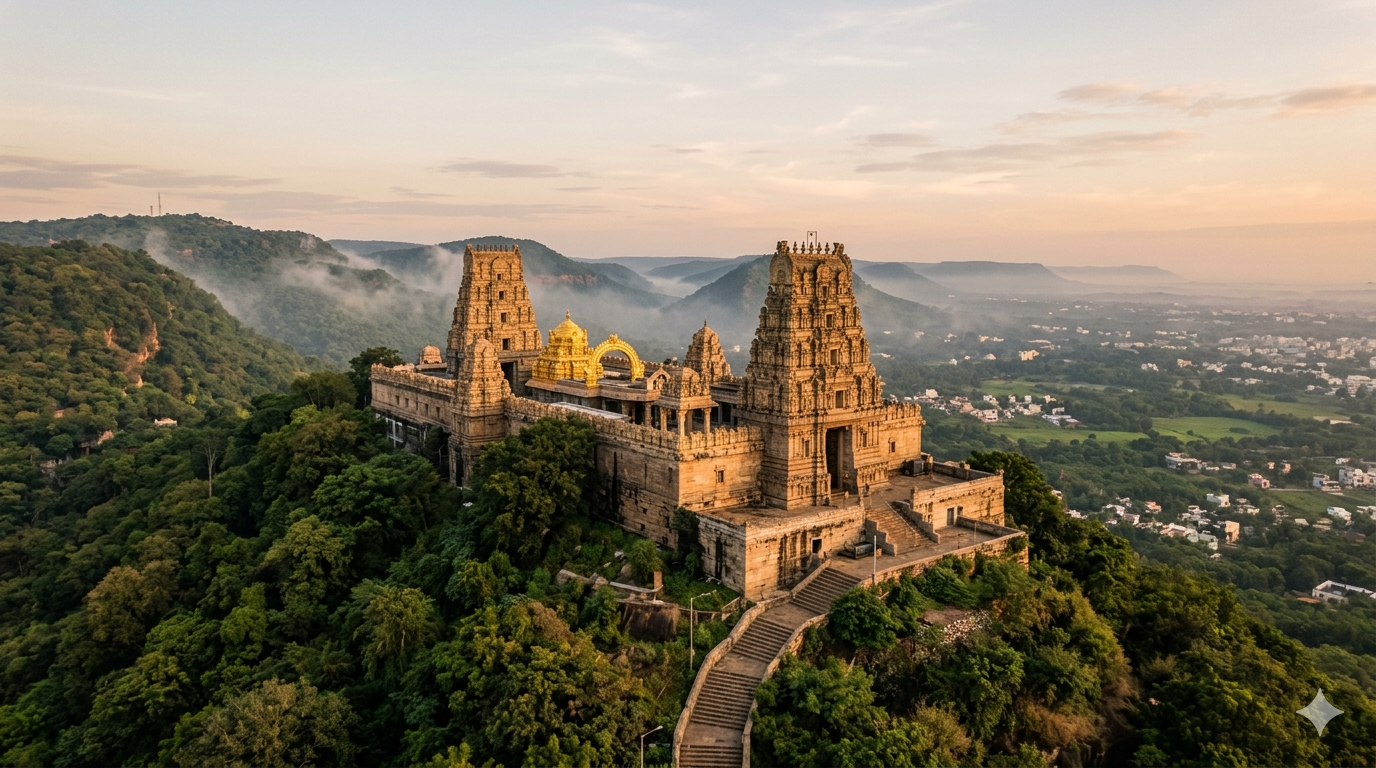
Simhachalam follows the Kalinga style of Odisha, with touches of Chalukya, Kakatiya and Chola design. Unusually, the temple faces west rather than the common east. A five-tiered Raja Gopuram guards the entrance, while a gold-plated arch crowns the vimana above the sanctum.
Inside, devotees pass a sixteen-pillared Natya Mandapa and a grand ninety-six-pillared Kalyana Mandapa. The carvings show elephants, dancers and floral motifs, and some panels recall the artistry of Konark. A sacred tank called Swami Pushkarini sits near the shrine, while the Gangadhara stream flows at the foot of the hill.
How to Reach Simhachalam Temple
Simhachalam sits about 16 kilometres from Visakhapatnam railway station and roughly 14 to 16 kilometres from Visakhapatnam International Airport. So the hill is easy to reach from anywhere in the city. Trains, flights and buses all connect well to Vizag.
- By air: Fly into Visakhapatnam (VTZ), then take a taxi to the foothill, since cabs run readily.
- By train: Alight at Visakhapatnam or the small Simhachalam station, after which autos and buses are available.
- By road: APSRTC and the temple’s own Simhadri buses climb the ghat road to the top.
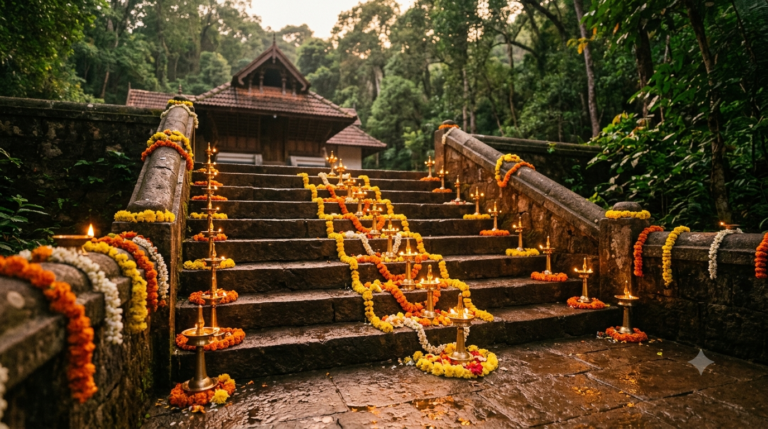
- On foot: A stepped pathway leads up the hill, although the climb is steep and best done early.
If you drive up, the ghat road brings you close to the main entrance. Devotees who prefer the traditional climb should carry water, because the steps tire most first-time visitors.
What Most Guides Get Wrong About a Simhachalam Visit
Beyond the timing myth, a few practical points trip up first-time pilgrims. Knowing them saves real hours on the ground.
- Dress code: Wear modest traditional attire, since shorts and sleeveless tops draw objection at the gate.
- Phones: Mobile use is restricted near the sanctum, so respect the signage rather than risk your phone being held.
- Weekends: Saturday and Sunday queues run far longer, while early weekday mornings stay calm.
- Festivals: During Giri Pradakshina and Narasimha Jayanti, book ahead because spot tickets vanish fast.
- Accommodation: The Devasthanam runs guest rooms on and below the hill, yet they fill quickly on festival weekends.
Major Festivals at Simhachalam
Chandanotsavam on Akshaya Tritiya is the grandest event, since it is the only day of true-form darshan. Kalyanotsavam, the celestial wedding, also draws large crowds through the year. Narasimha Jayanti marks the deity’s appearance day with special poojas.
The Giri Pradakshina festival falls on a full-moon day, when devotees circle the Simhachalam and Kailasagiri hills on foot. A single round covers nearly 40 kilometres, so pilgrims start before dawn. These festival dates follow the lunar calendar, and the Devasthanam announces them each year.
Before You Go: Planning Around Simhachalam Darshan Timings
Simhachalam rewards an early start and a little planning. Aim for a weekday morning slot, since the free Sarva Darshanam runs smoothly from 6:30 AM and the crowds stay light. Ignore the false “4 PM to 6 PM closed” claim, because the temple keeps an active evening darshan instead. For festival visits, especially Chandanotsavam, book your darshan online in advance and confirm the schedule on the official Andhra Pradesh temples portal. Do that, and your trip to the sandalwood-clad Narasimha on the hill will run without a hitch.
Frequently Asked Questions
What are the Simhachalam darshan timings?
Simhachalam darshan timings run from about 4:00 AM to 9:00 PM daily. The day opens with the Suprabhata Seva and closes after the Ekanta Seva at night. Free Sarva Darshanam is mainly available between 6:30 AM and 11:30 AM, with darshan continuing through the afternoon and evening.
Do Simhachalam Darshan Timings Include an Afternoon Break?
No, the temple is not closed for a long afternoon block. Despite the widely shared “closed 4 PM to 6 PM” claim, the seva list shows evening darshanam running from about 3:00 PM to 7:00 PM. The only real gap is a short ritual pause around 2:30 PM.
Is there free darshan at Simhachalam temple?
Yes, free Sarva Darshanam is open to everyone, though some days carry a nominal ₹10 charge. It runs mainly from 6:30 AM to 11:30 AM in the morning. For faster entry, the Special or Sheegra Darshanam costs around ₹100 per person.
When can you see the deity’s original form?
The deity’s true form, called Nijaroopa Darshanam, is visible only on Akshaya Tritiya during Chandanotsavam. Priests remove the year-round sandalwood paste at dawn, and the original idol stays open for darshan for about twelve hours. After that, fresh paste is applied again.
How much is the special darshan ticket at Simhachalam?
The Special or Sheegra Darshanam ticket costs roughly ₹100 per person, which lets you skip the long free queue. Other sevas, such as Nitya Kalyanam at about ₹1,000 per couple, carry separate fees. Prices change periodically, so verify current rates on the official portal before booking.
How do you reach the hilltop temple?
You can reach the hilltop by ghat road or by foot. APSRTC and Simhadri buses, plus taxis and autos, climb the road to the main entrance. A stepped pathway also leads up for devotees who prefer the traditional climb, although it is steep.
Is there a dress code at Simhachalam temple?
Yes, the temple expects modest traditional clothing. Men commonly wear dhoti or trousers with a shirt, while women prefer sarees or salwar suits. Shorts, sleeveless tops and other western casual wear are best avoided at the sanctum.
Does Simhachalam temple close during eclipses?
Yes, the temple closes fully during a solar or lunar eclipse, following Vaishnava ritual custom. Priests perform a cleansing ritual once the eclipse ends, before reopening for darshan. So always check the eclipse timing if your visit falls on such a date.