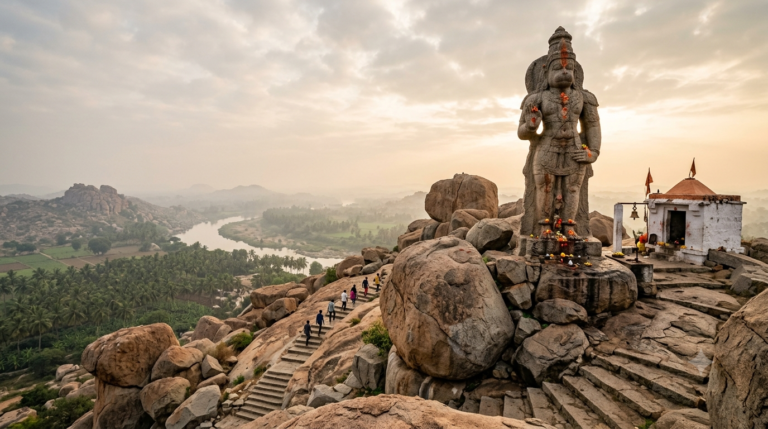
The Yantrodharaka Hanuman Temple timings run right through the daylight hours, so a little planning turns a hot Hampi trek into an easy morning visit. This small shrine sits on a granite hill beside the Tungabhadra River, tucked just behind the Kodandarama Temple. Because it holds one of the most unusual Hanuman idols in all of India, many pilgrims put it near the top of their Hampi list. Yet most online guides get one key detail wrong, and that single mistake sends visitors up the wrong hill entirely.

Before we go further, a quick note. Sri Vyasa Pooja is an independent devotional guide, and we are not affiliated with the temple, the Archaeological Survey of India, or any trust. We take no bookings, donations, or payments, so please use the official sources linked below for anything involving money or entry.
Yantrodharaka Hanuman Temple Timings at a Glance
Here are the essentials before you set out, since a quick scan usually answers most travel questions. Keep these Yantrodharaka Hanuman Temple timings and key facts handy while you plan.
- Timings: broadly morning to evening — roughly 7:00 AM onward, with a reported midday break, closing near 6:00 PM. Confirm locally.
- Entry fee: free, because there is no ticket for darshan.
- Location: Hampi, near Chakratirtha, behind Kodandarama Temple, about 2 km from Virupaksha Temple.
- Climb: a short walk plus a few steps — not a long staircase.
- Best time: October to February, early morning.
- Time needed: 30 to 60 minutes.
Yantrodharaka Hanuman Temple Timings and Entry Fee
The Yantrodharaka Hanuman Temple timings generally cover the daylight hours, and entry is completely free. Because this is an open shrine inside the Hampi heritage zone, it does not run on strict ticketed slots like a big managed temple. Local listings most often report opening around 7:00 AM, a midday pause between roughly 1:00 PM and 3:00 PM, and closing near 6:00 PM.
That said, a few aggregator pages quote a much wider 6:00 AM to 9:00 PM window. Those figures usually belong to a different temple, so treat them with caution until you check on the ground. Since exact hours shift with the priest’s schedule and the season, confirm on the day before any long detour.
No entry fee applies, and there is normally no charge for photography outside the sanctum. However, avoid flash near the idol, and always follow whatever the attending priest requests.
Yantrodharaka Hanuman Temple Timings by Time of Day
Early morning wins, and it wins easily. The Yantrodharaka Hanuman Temple timings favour early risers most of all. When you arrive soon after opening, the granite is still cool, the river light is soft, and the resident monkeys stay calmer.
After about 10:00 AM the sun climbs hard over the open boulders, so the walk turns tiring fast. Weekends and Tuesdays also draw bigger crowds, since Tuesday is an auspicious day for Hanuman across India.
Dress code, pooja, and darshan tips
Dress modestly, as you would at any active shrine. Cover your shoulders and knees, and remove footwear before stepping onto the temple platform. Because the Yantrodharaka Hanuman Temple timings include a midday break, an early slot also gives you a calmer, less crowded darshan.
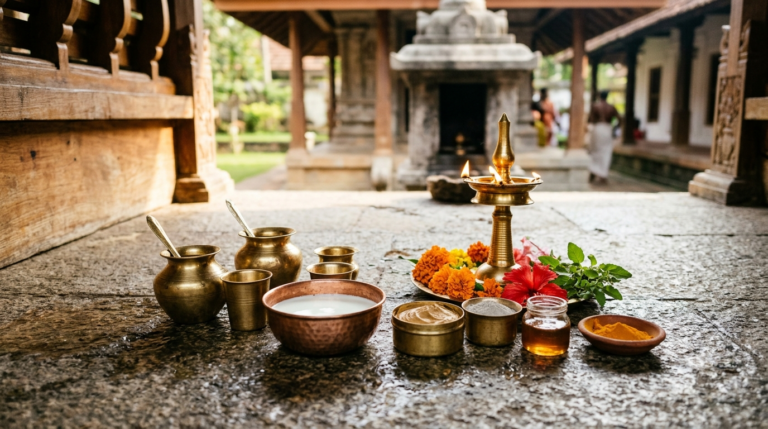
Coconuts, bananas, and simple pooja items are usually sold near the entrance, so you need not carry offerings from town. The priest performs regular worship through the day, while Tuesday and Saturday see the most devotees. Keep your voice low inside, and let others finish their prayers in peace.
The Mistake Almost Every Guide Makes
Here is the single biggest confusion in Hampi, and correcting it can save you hours. Many websites claim you must climb about 570 steps to reach this shrine. That is simply wrong, because those steps belong to a completely different temple.
The Yantrodharaka Hanuman Temple sits on a low granite hill behind the Kodandarama Temple, on the Hampi side of the river. To reach it, you walk roughly 1.5 to 2 km from the Virupaksha parking area, then climb only a short flight of steps. Most elderly visitors manage it comfortably, so do not let the “570 steps” myth scare you off.
That long staircase actually belongs to Anjanadri Hill, across the Tungabhadra in Anegundi. That hill is believed to be Hanuman’s birthplace, and it needs around 575 steps to reach the top. In short, these are two different temples with two very different climbs, although countless guides blur them into one. Karnataka’s official tourism board lists the shrine near Chakratirtha behind Kodandarama, exactly where you will find it.
This quick comparison of the two temples clears up the mix-up for good.
| Feature | Yantrodharaka Temple | Anjanadri Hill Temple |
|---|---|---|
| Where | Hampi side, behind Kodandarama | Anegundi, across the river |
| Climb | Short walk plus a few steps | About 575 steps |
| Known for | Yantra idol by Sri Vyasaraja | Believed birthplace of Hanuman |
| From Hampi Bazaar | About 2 km | About 23 km by road |
Yantrodharaka Hanuman Temple Timings and How to Reach
Getting here is easy once you aim for Hampi’s Virupaksha area. Because the shrine sits inside the protected heritage zone, you park near Virupaksha Temple and cover the last stretch on foot. Plan your arrival around the Yantrodharaka Hanuman Temple timings so you finish before the midday heat.
By train: Hosapete Junction, often called Hospet, is the nearest railway station at about 13 km. It connects well to Bengaluru, Hyderabad, Hubballi, and many other cities. From the station you can take a bus, an auto-rickshaw, or a taxi onward to Hampi.
By air: The closest airport is Jindal Vidyanagar Airport near Toranagallu, roughly 33 to 40 km away. Hubballi (Hubli) Airport lies about 145 km out, while Kempegowda International Airport in Bengaluru is around 340 km. Taxis run from all three toward Hospet and Hampi.
By road and the last mile: KSRTC and private buses reach Hospet from Bengaluru, Hubballi, and Ballari. After that, frequent local buses and autos cover the 13 km to Hampi. From Hampi Bazaar you can hire an auto, rent a scooter, or even cycle to the Virupaksha end, then walk the final stretch to the temple.
| Mode | Nearest point | Approx. distance |
|---|---|---|
| Train | Hosapete (Hospet) Junction | ~13 km |
| Air (closest) | Jindal Vidyanagar Airport | ~33-40 km |
| Air (regional) | Hubballi Airport | ~145 km |
| Air (metro) | Bengaluru (Kempegowda) | ~340 km |
What Makes the Idol So Unusual
The idol is the reason this shrine feels unlike any other Hanuman temple. Here, Hanuman does not stand tall with a raised arm. Instead, he sits calmly in padmasana, the lotus posture, at the centre of a shatkona — a six-cornered geometric yantra.
Around him, twelve small monkey figures hold one another’s tails in a ring. Each one marks a day of the twelve days that Sri Vyasaraja is said to have prayed here. The whole design is carved into a single granite boulder, so it reads as one continuous sacred diagram. Because the deity is bound within a yantra, the temple earns its name: Yantrodharaka, meaning the one upheld through the yantra.
History Behind the Yantrodharaka Hanuman Temple
The story reaches back about five centuries, to the golden age of the Vijayanagara Empire. Sri Vyasaraja, also called Vyasatirtha or Vyasaraya, lived from 1480 to 1539 and served as the Rajaguru of the empire. He consecrated this shrine, and tradition counts it as the first of 732 Hanuman idols he installed across the region.
One well-loved legend explains the yantra. Each day Sri Vyasaraja would sketch Hanuman in charcoal on the rock, yet each day the image vanished once his prayers ended. This happened for twelve days in a row. Finally, so the story goes, he drew a yantra around the figure to hold the Lord in place, and the idol we see today took form.
Another tradition ties the site to the Ramayana. Many believe Lord Rama and Hanuman met here for the first time, near the Malyavan hill. The neighbouring Kodandarama Temple, dedicated to Rama, is seen as a marker of that sacred meeting.
The Yantrodharaka Hanuman Stotram
Sri Vyasaraja composed the famous Yantrodharaka Hanuman Stotram at this very spot. Devotees hold that chanting it thrice a day for six months, with full faith, can help fulfil a sincere wish. These blessings are matters of devotional tradition rather than proven outcomes, so treat them as faith.
If you plan to chant here, arrive early while the shrine is quiet. Many visitors say the blend of river breeze and soft chanting is the real reward of a dawn visit.
Yantrodharaka Hanuman Temple Timings by Season
October to February is the sweet spot, since Hampi’s summers turn brutally hot. During winter the days stay mild, the light is lovely, and the walking is pleasant. The Yantrodharaka Hanuman Temple timings stay the same across the year, though the comfort of the walk certainly does not. Monsoon months can leave the boulder paths slippery, so tread carefully if you visit between July and September.
Pack light, but pack smart. Carry water and wear sturdy, non-slip footwear, because the last stretch runs over uneven granite. Since many monkeys roam the shrine, keep food, spectacles, and phones secured, as they snatch loose items quickly. If you are elderly, pregnant, or managing a health condition, the short Yantrodharaka climb is usually fine, while the strenuous 575-step Anjanadri Hill is the one to weigh carefully.
Temples and Sites Near the Shrine
One of the joys here is how much sits within walking distance. Because Hampi packs its monuments close together, you can easily fold several stops into one morning.
- Kodandarama Temple — right at the foothill, with Rama, Sita, Lakshmana, and Sugriva.
- Chakratirtha — the sacred river bend just below the shrine.
- Virupaksha Temple — Hampi’s living, active temple, about 2 km away.
- Vijaya Vittala Temple — famous for the stone chariot and musical pillars, around 2.5 km.
- Anjanadri Hill — Hanuman’s believed birthplace, across the river, for those who want the bigger climb.
For more shrines in the same tradition, our guide to the famous Hanuman temples in South India and the Panchamukhi Anjaneya Temple near Mantralayam make natural follow-up reads.
Before You Go
This shrine rewards an early start, a modest walk, and an open mind. Because the Yantrodharaka Hanuman Temple timings suit an early visit, aim to arrive soon after the morning opening. Skip the “570 steps” panic, and give yourself time to sit with the unusual yantra idol.
Because entry is free and the site is compact, it slips neatly into any Hampi itinerary. For live hours and event days, check with the priest on-site or an official Hampi tourism source before you travel.
Frequently Asked Questions
What are the Yantrodharaka Hanuman Temple timings?
The Yantrodharaka Hanuman Temple timings broadly cover daylight hours. Local listings report opening around 7:00 AM, a midday break near 1:00 PM to 3:00 PM, and closing by about 6:00 PM. Since hours can vary, confirm locally before a long trip.
Is there an entry fee?
No. Entry and darshan are free, and there is normally no separate charge for photography outside the sanctum.
How many steps are there to the temple?
Only a short flight. You walk about 1.5 to 2 km from Virupaksha, then climb a few steps behind Kodandarama. The 570-step climb people mention belongs to Anjanadri Hill, a different temple across the river.
Where exactly is the shrine located?
It stands on a small granite hill near Chakratirtha, just behind the Kodandarama Temple in Hampi, Karnataka. It is roughly 2 km from the Virupaksha Temple.
Which is the nearest railway station and airport?
Hosapete (Hospet) Junction is the nearest railway station at about 13 km. Jindal Vidyanagar Airport, around 33 to 40 km away, is the closest airport, followed by Hubballi and Bengaluru.
What is special about the idol?
Hanuman sits in a lotus posture inside a six-cornered yantra, ringed by twelve monkeys. Sri Vyasaraja carved it on a single boulder, and many call it the finest tantric Hanuman image in Hampi.
Do the Yantrodharaka Hanuman Temple timings change on festivals?
They can. On busy days like Tuesdays, Saturdays, and Hanuman Jayanti, the shrine draws larger crowds and worship may run longer. Since there is no fixed festival schedule online, confirm the day’s hours locally before you set out.
What is the best time to visit?
Plan for October to February and arrive early in the morning. The weather is cool, the crowds are thin, and the riverside light is at its best.