The Mantralaya Matha history stretches back nearly six centuries. So this monastery is far older than the riverside town most pilgrims picture. It began life hundreds of kilometres away. It also carried several other names before it settled on the banks of the Tungabhadra. Understanding that journey changes how you see the shrine, because the Brindavana you queue for today sits at the end of a long spiritual chain.
Most travel pages jump straight to darshan timings and skip the story. Here, though, we trace the full Mantralaya Matha history. So you arrive knowing exactly why this place carries such weight for Madhwa devotees.
Sri Vyasa Pooja is an independent devotional guide. We are not affiliated with, endorsed by, or the official website of Sri Raghavendra Swamy Matha, Mantralayam. We accept no bookings, donations, or payments. For seva reservations and official notices, please use the Matha’s own official website.
Mantralaya Matha History at a Glance
Before we dig into the detail, here is the short version for readers who want the essentials first.
- What it is: Sri Raghavendra Swamy Matha, one of the three premier Dvaita Vedanta monasteries known jointly as the Mathatraya.
- Where it sits: Mantralayam, on the Tungabhadra river, in Adoni taluk of Kurnool district, Andhra Pradesh.
- Its origin: descended from Sri Madhvacharya through Sri Jayatirtha and Sri Vibudhendra Tirtha, with roots in the 15th century.
- Its most famous pontiff: Sri Raghavendra Tirtha, born as Venkatanatha in 1595, who entered his Brindavana here in 1671.
- Why devotees come: the belief that Rayaru remains present in subtle form, guiding and protecting those who seek him.
Where Mantralaya Matha Stands Today
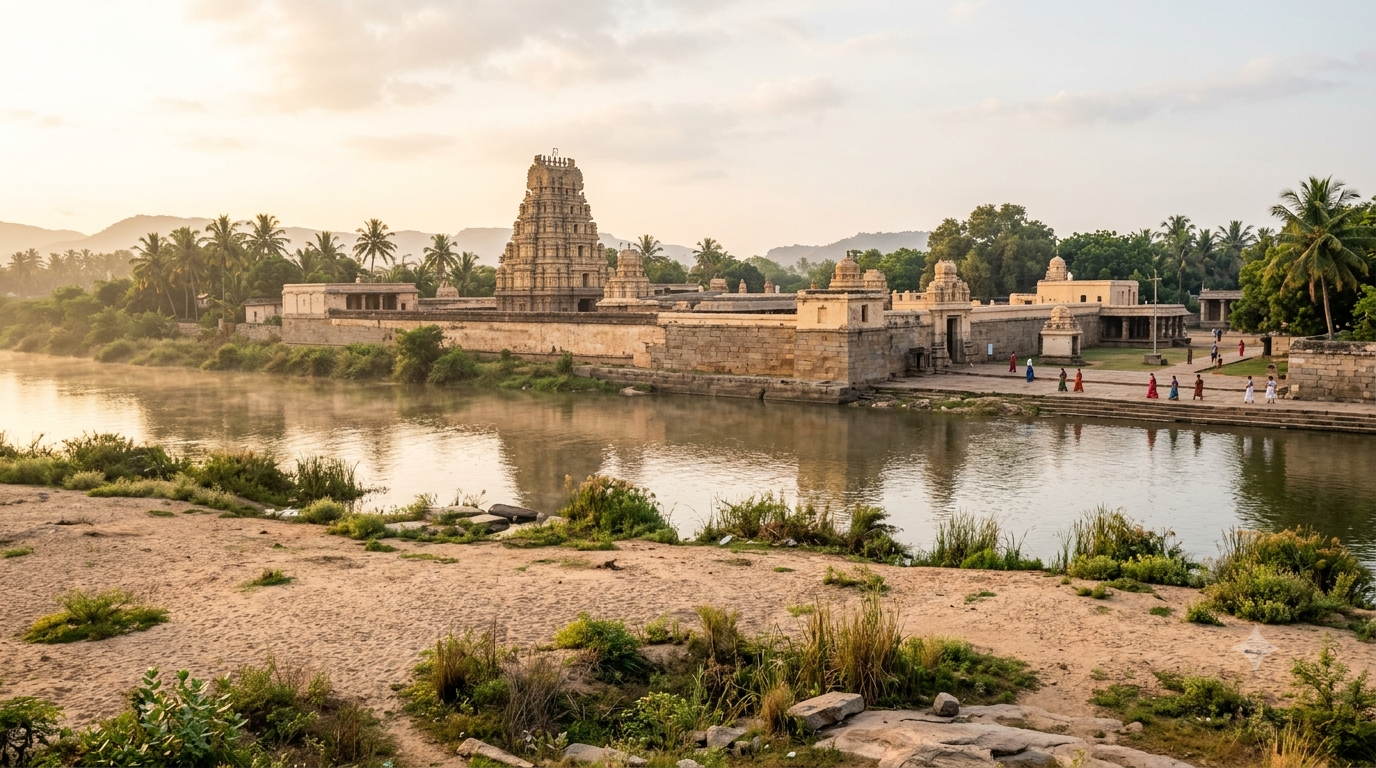
Mantralayam is a small town on the Tungabhadra. It sits right where Andhra Pradesh meets the Karnataka border. The Matha stands at its heart, so the whole settlement effectively grew around the shrine. Locals also call the place Manchale, after Manchalamma, the village goddess.
The institution here is far more than a single temple. It is a living monastery, so it preserves centuries of Dvaita philosophy, ritual practice, and Sanskrit scholarship.
It descends directly from Madhvacharya. Because of that, it ranks among the most authoritative seats of the tradition, alongside the Uttaradi Matha and the Vyasaraja Matha. The Ministry of Tourism also lists Mantralayam among India’s notable pilgrimage sites on its official Utsav portal.
Mantralaya Matha History: A Lineage Older Than the Town
The Mantralaya Matha history does not start in Mantralayam at all. Its spiritual lineage flows from Jagadguru Sri Madhvacharya, the founder of the Dvaita school. It then passes through his successors down to Sri Vibudhendra Tirtha. According to the Matha’s own records, this line came into existence in the 15th century, long before Rayaru was born.
For centuries this monastery went by other names. It first sat at Kumbhakonam in Tamil Nadu, so scholars often called it the Kumbhakona Matha. After the celebrated Sri Vijayendra Tirtha, people knew it as the Vijayendra Matha.
From Kumbhakonam to Nanjanagud to Mantralayam
The name kept shifting as the seat moved. In the early 19th century, after Sri Subodhendra Tirtha, the Matha stayed at Nanjanagud in Karnataka. So it also carried that town’s name for a while. Only in more recent decades did the institution firmly establish its headquarters at Mantralayam.
This part of the Mantralaya Matha history matters, because many visitors assume the Matha was always here. In truth, the shrine became the permanent centre only when Rayaru chose to enter his Brindavana on this spot. The timeline below lays out the key stages clearly.
| Stage | Period | What happened |
|---|---|---|
| Lineage founded | 15th century | Descends from Madhvacharya through Vibudhendra Tirtha |
| Kumbhakonam seat | 16th–17th century | Based in Tamil Nadu, later called Vijayendra Matha |
| Rayaru’s pontificate | Early 1620s–1671 | Sri Raghavendra Tirtha leads and shapes the Matha |
| Brindavana | 1671 | Rayaru enters Jeeva Samadhi at Mantralayam |
| Nanjanagud seat | Early 19th century | Matha stationed in Karnataka for a period |
| Mantralayam HQ | Recent decades | Permanent headquarters set at the Brindavana |
What Mantralaya Matha History Owes to Sri Raghavendra Swamy
No single figure shaped this monastery more than Sri Raghavendra Tirtha. Devotees lovingly call him Rayaru.
He was born as Venkatanatha in 1595 at Bhuvanagiri, in present-day Tamil Nadu. His family were Kannada Madhva Brahmins of scholars and musicians. From childhood, he showed a rare gift for Sanskrit and Vedanta.
He took sanyasa under his guru Sri Sudhindra Tirtha. He then became pontiff of the Kumbhakonam Matha in the early 1620s.
As a scholar, he was extraordinary. Tradition credits him with around 45 Sanskrit works. So he earned the title Sudha Parimalacharya for his commentaries on Madhva, Jayatirtha, and Vyasatirtha.
Rayaru was also a fine veena player. He composed devotional songs under the name Venu Gopala. This blend of philosopher, musician, and guide is exactly why devotees revere him.
The Years at Panchamukhi and Bichali
Before settling at Mantralayam, Rayaru spent deeply significant time nearby. Tradition holds that he meditated at Panchamukhi, near Raichur in Karnataka. There, Hanuman is said to have appeared to him in a five-faced form. That site, roughly 20 km away, remains a major pilgrimage stop even now.
He also stayed for years with his devoted disciple Sri Appannacharya at Bichali. This village sits on the Tungabhadra, about 20 km from Mantralayam. Appannacharya composed the famous Sri Raghavendra Stotra, which devotees still chant daily. These two places form an essential part of Rayaru’s story, yet many guides mention neither.
Brindavana Pravesha: A Turning Point in Mantralaya Matha History
In 1671, Rayaru entered his Brindavana at Mantralayam through Jeeva Samadhi. This is a state of conscious entombment.
Before doing so, he assured his followers of something remarkable. He would remain present in subtle form, or Tejoroopa, for 700 years. This promise is the spiritual centre of everything at the shrine today.
Because of that vow, devotees do not treat the Brindavana as a tomb. Instead, they approach it as the living presence of a guru who still listens. That single belief explains the intensity you feel around the sanctum.
Why the Brindavana Anchors Mantralaya Matha History
The Brindavana is a modest stone structure, yet its pull is immense. Pilgrims circle it in pradakshina, the clockwise walk around a shrine. As they walk, they chant the Raghavendra Stotra and the Vishnu Sahasranama. Lakhs of devotees arrive every year seeking relief from illness, worry, and life’s uncertainties.
Devotees often call Rayaru Kalpavriksha Kamadhenu. The words mean the wish-fulfilling tree and the sacred cow. Many describe leaving Mantralayam lighter than they arrived. These are matters of faith and Vedic tradition rather than proven outcomes, and the Matha itself frames them that way.
Manchalamma and a Land Grant in Mantralaya Matha History
First-time visitors often miss an important local custom. Manchalamma is the presiding deity of Manchale village. So tradition asks devotees to pray to her before entering Rayaru’s Matha. It is a small courtesy that longtime pilgrims never skip.
The land itself carries history too. Records say Nawab Siddi Masud Khan of Adoni granted the barren stretch along the Tungabhadra to the Matha.
A well-loved legend also tells of Sir Thomas Munro, a British collector. He is said to have spoken with the invisible saint. Writers set that account down more than a century later, so it survives as cherished tradition rather than documented fact.
Deities and Worship in Mantralaya Matha History
The Matha does not honour Rayaru alone. It safeguards the sacred idol of Sri Moola Rama, worshipped through the Madhwa parampara since ancient times. Alongside it stand Sri Digvijaya Rama and Sri Jaya Rama. Madhvacharya once worshipped the first, while Sri Jayatirtha worshipped the second.
Daily life here runs on a strict ritual clock. Mangala Aarti, Panchamruta Abhisheka, and Moola Rama Devara Pooja anchor the routine. Sevas such as Tulasi Archana and Annadana serve visiting devotees. The current pontiff, His Holiness Sri Subudhendra Teertha Swamiji, leads the tradition, so many arrive hoping for his blessings.
Once a year the town transforms for the Aradhana Mahotsava. This festival marks Rayaru’s Brindavana Pravesha. It falls in Shravana masa, usually around late August. In 2026 the observance lands in the final days of that month, when two to three lakh devotees can gather across a few days.
Myths That Cloud Mantralaya Matha History
Because the shrine is so popular, plenty of shaky claims circulate online. Sorting fact from repetition is where the real Mantralaya Matha history becomes useful. So here are the corrections that matter most.
- “He was a 16th-century saint.” Rayaru was born in 1595, yet his major work and his Brindavana Pravesha belong to the 17th century, in 1671.
- “The Matha was always at Mantralayam.” It moved from Kumbhakonam and Nanjanagud. It settled here permanently only in recent times.
- “Timings are fixed at exact hours.” Aggregator pages quote conflicting slots. In reality, darshan runs in morning and evening sessions that shift on Thursdays, Ekadashi, and festival days.
- “You can book through any portal.” Only the official Matha website handles genuine seva and room bookings, so treat other sites with caution.
Planning a Visit: Timings, Dress Code and How to Reach
Darshan at Mantralayam is free, and the shrine opens in two sessions, roughly morning and evening. Published timings vary widely and change on special days. So always confirm the current schedule on the official Matha portal before you travel. Queues also lengthen on Thursdays, weekends, and during the Aradhana.
The dress code follows Madhwa tradition. Men usually wear a dhoti and remove the shirt for close darshan at the Brindavana. Women wear a saree or salwar kameez. Photography near the inner sanctum is not allowed, so keep phones away there.
Reaching the town is straightforward. The nearest railhead is Mantralayam Road station, a short drive from the shrine. Buses connect the town to Raichur, Kurnool, and Bellary. The closest major airport is Hyderabad, roughly 250 km away.
One practical word of care matters here. Summers on the Tungabhadra plains turn very hot. So carry water, cover your head, and pace elderly or unwell pilgrims gently during long queues.
Rayaru is revered for grace and healing in devotional tradition. Even so, that faith is never a substitute for medical treatment, so anyone unwell should still consult a doctor.
A Rayara Circuit Worth Building
Here is planning value no single official page offers. Mantralayam works beautifully as the centre of a three-point Rayara circuit.
Add Panchamukhi, where he meditated. Then add Bichali, where Appannacharya composed the Raghavendra Stotra. Together they trace his final years in the order they unfolded.
Devotees who love this lineage often extend the trail further. Sri Vyasaraja installed the Yantrodharaka Hanuman temple at Hampi, which sits within the same Dvaita story. That link matters, since tradition holds Rayaru to be a later form of that great saint.
Insider Notes Most Guides Skip
A few small habits make a Mantralayam trip smoother and more meaningful.
- Reach the Brindavana early, because mornings are cooler and the queues move faster before the crowds build.
- Greet Manchalamma first, so you honour the local custom before entering the main Matha.
- Plan around Ekadashi and eclipse days, since special sevas pause then even though darshan continues.
- Download the Matha’s panchangam if you follow Madhwa observances, as it lists tithis, festivals, and auspicious dates.
For readers who track those dates closely, our guide to the Sri Raghavendra Swamy Matha panchangam explains how the almanac is released and what it holds.
Before You Set Out
The lasting lesson of the Mantralaya Matha history is simple. This shrine is the end of a long spiritual journey, not a sudden creation. A monastery born in the 15th century, carried through Kumbhakonam and Nanjanagud, found its home where Rayaru chose to remain. That continuity is exactly what devotees feel before the Brindavana.
Are you planning a first visit? Read the story before you go, and confirm timings on the official site. Build in Panchamukhi and Bichali if time allows. You will then experience far more than a quick darshan, because you will understand what you are looking at.
Frequently Asked Questions
What is Mantralaya Matha and why is it famous?
Mantralaya Matha is the Sri Raghavendra Swamy Matha at Mantralayam. It is one of the three premier Dvaita Vedanta monasteries. It is famous because Sri Raghavendra Tirtha, or Rayaru, entered his Brindavana here in 1671. Devotees believe he remains present in subtle form.
How old is the Mantralaya Matha history?
The Mantralaya Matha history traces its lineage to Sri Madhvacharya and the 15th century. The monastery existed for roughly two centuries under other names. Rayaru then made Mantralayam its permanent centre in 1671.
Who was Sri Raghavendra Swamy?
He was born as Venkatanatha in 1595 at Bhuvanagiri, in present-day Tamil Nadu. A brilliant Dvaita scholar and veena player, he became pontiff in the early 1620s. Tradition credits him with around 45 Sanskrit works.
Why did the Matha have different names?
The monastery’s seat shifted over time, so its name changed with its location. People knew it as the Kumbhakona Matha, then the Vijayendra Matha. It later carried the name of Nanjanagud before settling at Mantralayam.
What are the darshan timings at Mantralayam?
Darshan is free and runs in morning and evening sessions. Published timings differ and change on Thursdays, Ekadashi, and festival days. So confirm the current schedule on the official Matha website before travelling.
Should I visit Manchalamma temple first?
Yes, tradition asks devotees to pray to Manchalamma, the presiding deity of Manchale village, before entering Rayaru’s Matha. It is a long-standing local custom that most pilgrims follow.
When is the Raghavendra Swamy Aradhana held?
The annual Aradhana Mahotsava marks Rayaru’s Brindavana Pravesha. It falls in Shravana masa, usually around late August. In 2026 it lands in the final days of August, so check the official panchangam for the exact tithi.
How do I reach Mantralayam?
The nearest railway station is Mantralayam Road, a short drive from the shrine. Buses connect Raichur, Kurnool, and Bellary. The closest major airport is Hyderabad, about 250 km away.