The Ayudha Pooja procedure is simpler than most people think, yet the meaning behind it runs deep. On Mahanavami, the ninth day of Navaratri, families across South India clean and worship the tools, books, vehicles, and machines that earn their living. If you have searched for a clear, honest guide to the significance and the exact steps, this page gives you both in one place. You will get the legends behind the ritual, a step-by-step method for home, shop, and office, and the practical details that older guides skip.
Sri Vyasa Pooja is an independent devotional guide. We share tradition and method, and we point you to a priest or an authentic panchang for anything tied to your city or your muhurat.
Ayudha Pooja at a Glance
Here is the quick summary before the full detail, so you can plan even in a hurry.
- What it is: the worship of tools, instruments, vehicles, and books that support your work and study.
- When: Mahanavami, the ninth day of Sharad Navaratri, usually in September or October.
- In 2026: Ayudha Pooja falls on Tuesday, 20 October 2026, though the muhurat shifts with your city.
- Also called: Ayudha Puja, Shastra Puja, and Astra Puja, and in the South it often merges with Saraswati Puja.
- Who observes it: students, drivers, farmers, artisans, traders, and IT professionals alike.
- Core spirit: gratitude, because the tool that feeds you deserves respect and care.
What Is Ayudha Pooja and Why It Matters
Ayudha Pooja is the Hindu festival of honouring the instruments of one’s livelihood, observed on Mahanavami during Navaratri. The word blends “ayudha,” meaning weapon or tool, with “pooja,” meaning worship. So the day treats every implement, from a farmer’s plough to a coder’s laptop, as worthy of reverence and thanks.
The idea sounds small, yet it carries a large lesson. When you bow to the tool before you use it, you approach your work with care instead of carelessness. That attitude, more than the ritual itself, is the real gift of the day.
The Meaning Behind Worshipping Tools
In Indian tradition, the divine is not distant from daily life. It lives inside the plough, the pen, the loom, and the machine. Because of this belief, people clean and decorate their tools once a year and offer gratitude for the work those tools make possible.
The three goddesses invoked are Saraswati for knowledge, Lakshmi for prosperity, and Parvati for strength. Together they represent skill, reward, and the power to keep working. This is why students place their books before the Goddess while traders place their ledgers and machines.
The Legends That Shaped the Festival
Two epics give Ayudha Pooja its story. In the Mahabharata, Arjuna hid the Pandava weapons inside a Shami tree during the year of exile. When the exile ended, he retrieved and worshipped those weapons before returning to battle, and that act became a model for the ritual.
The Ramayana adds another layer, since Lord Rama is said to have honoured his bow and arrows before the war against Ravana. Alongside these, the festival marks Goddess Durga’s victory over the demon Mahishasura after a nine-night struggle, a triumph reflected in the daily Navaratri alankaram forms of the Goddess. Each legend carries the same message, because courage and respect for one’s tools lead to success. You can read more on the festival’s history and regional variations on Wikipedia.
Ayudha Pooja and Saraswati Puja
In Tamil Nadu, Karnataka, Andhra Pradesh, Telangana, and Kerala, Ayudha Pooja usually falls on the same day as Saraswati Puja observed during Navaratri. Students worship books, pens, and musical instruments, while workers worship the tools of their trade. Both flow from one idea, that knowledge and effort together bring victory over ignorance.
There is a subtle point most pages miss here. While popular calendars mark Saraswati Puja on Mahanavami with Ayudha Pooja, many Dharma Shastras place Saraswati Puja on the Purva Ashadha nakshatra. So if your family follows the shastra timing, confirm the exact hour with your priest rather than a generic online chart.
When Is Ayudha Pooja Celebrated
Ayudha Pooja is observed on Navami tithi, the ninth lunar day of Sharad Navaratri, which usually lands in September or October. Because the Hindu calendar is lunar, the Gregorian date changes every year. The one constant is that it comes just before Vijayadashami, the tenth day.
In 2026, the Navami tithi begins around 10:50 AM on 19 October and ends near 12:49 PM on 20 October, so Ayudha Pooja is celebrated on Tuesday, 20 October 2026. Many families perform the worship in the morning or early afternoon while Navami is active. Since the auspicious window depends on your local sunrise and nakshatra, always check your city’s timing on an authentic source such as Drik Panchang for the exact muhurat. For the current year’s confirmed date and muhurat, see our dedicated Ayudha Puja date guide.
Mahanavami and Vijayadashami Are Not the Same Day
People often confuse the two, so this correction matters. Ayudha Pooja happens on Mahanavami, the ninth day, when the tools are worshipped and rested. Vijayadashami, the tenth day, is when the blessed tools return to use and new ventures begin.
Ayudha Pooja Procedure: Step by Step
The full Ayudha Pooja procedure follows a clear order, and you can scale it up or down to suit your home, shop, or factory. Below is the traditional sequence that priests generally follow. Read it once fully, then gather your items before you begin.
- Clean and arrange: wash every tool, instrument, book, or vehicle you plan to worship, then place them together neatly.
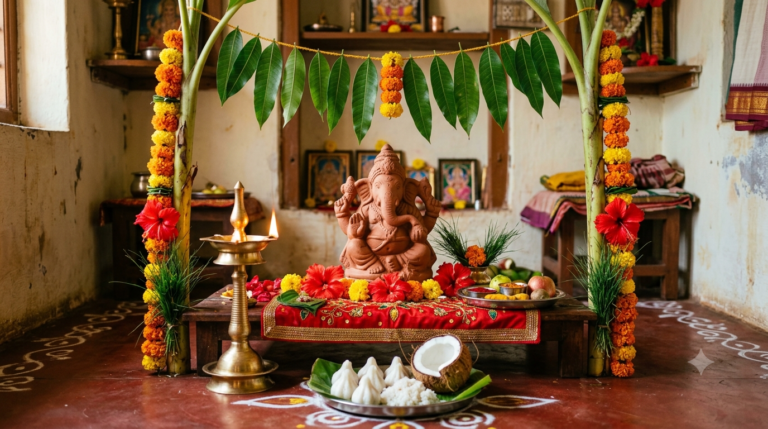
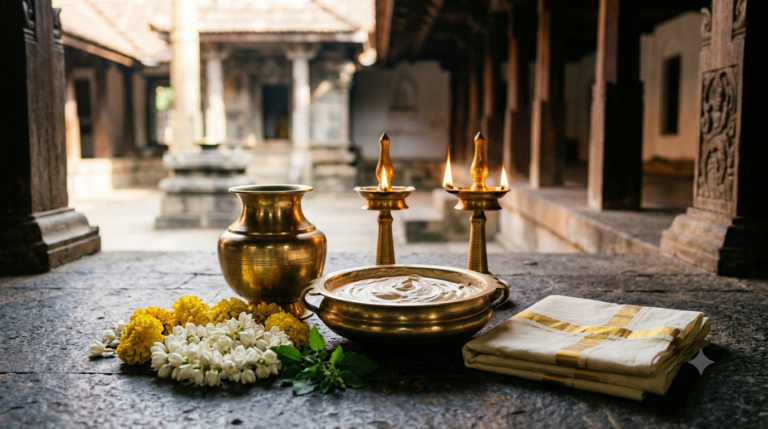
- Set the altar: keep images of Ganesha, Saraswati, and Lakshmi, along with a lamp, near the arranged items.
- Sankalpa: light the lamp and take a short vow, stating that you worship these tools for knowledge, safety, and success.
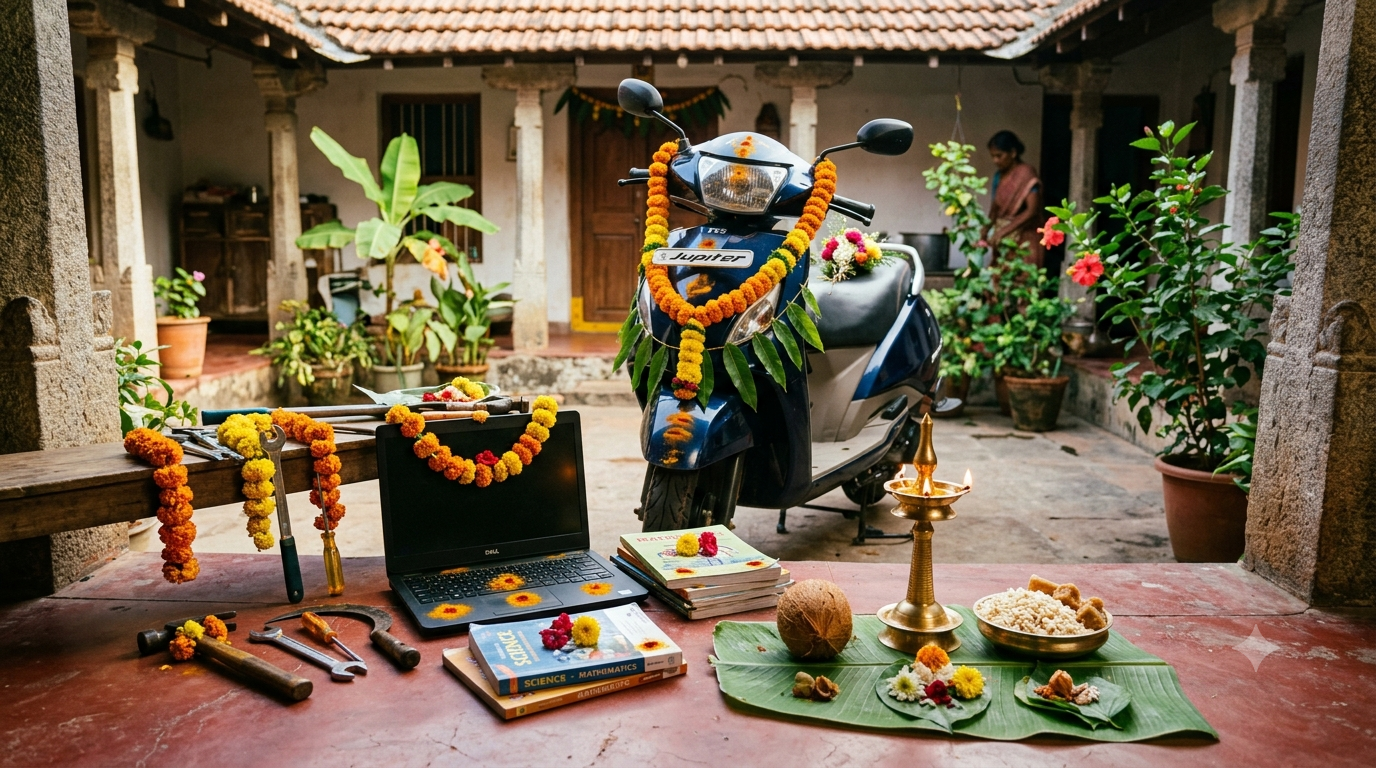
- Decorate the tools: apply turmeric and kumkum, then tie flowers, mango leaves, or fresh garlands onto the implements.
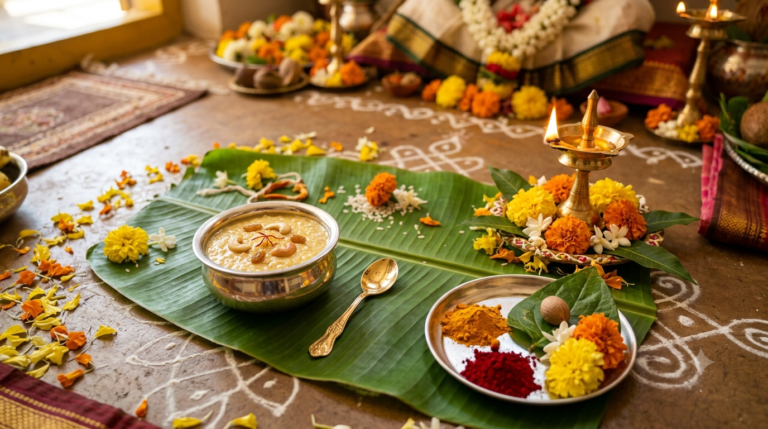
- Invoke and offer: chant Ganesha and Saraswati mantras, then offer flowers, incense, fruits, jaggery, and puffed rice.
- Break a coconut: offer a coconut and sprinkle sacred water over the tools to seek protection and steady service.
- Aarti and rest: wave camphor in aarti, distribute prasadam, and let the tools rest untouched for the day.
Ayudha Pooja Samagri You Will Need
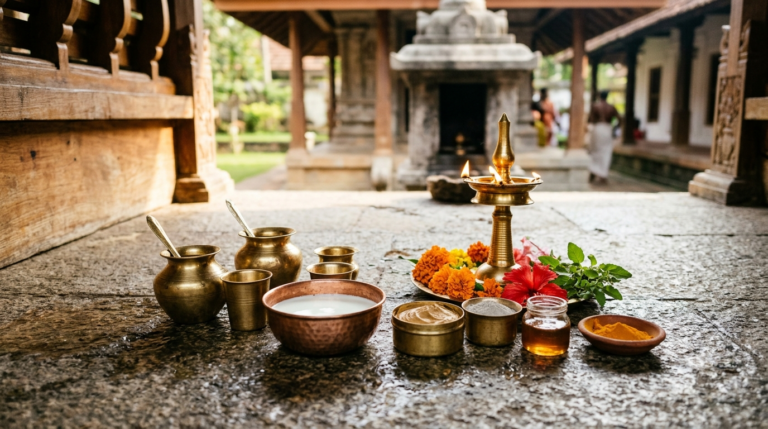
Keep the items ready in advance so the worship flows without a pause. Most households already have the basics at home. The list below covers a simple home setup.
| Item | Purpose |
|---|---|
| Turmeric and kumkum | Marking and decorating the tools |
| Flowers and mango leaves | Garlanding the implements |
| Puffed rice (aval/pori) and jaggery | Traditional naivedyam offering |
| Coconut, betel leaves, fruits | Offerings and the closing ritual |
| Lamp, camphor, incense | Deepam and aarti |
| Sandalwood paste | Anointing tools and books |
Ayudha Pooja Procedure at Home
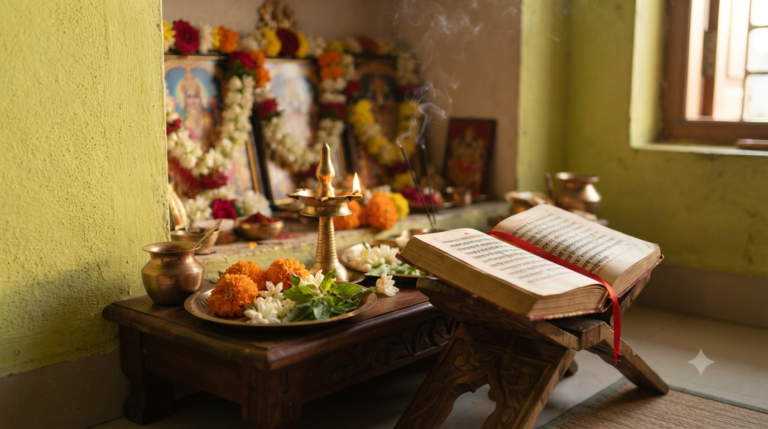
At home, the Ayudha Pooja procedure stays warm and simple. Gather your kitchen tools, study books, laptop, two-wheeler keys, and any craft equipment in one clean spot. Decorate them with turmeric, kumkum, and flowers, then light the lamp and offer a short prayer.
Children can join happily, because cleaning and decorating teaches them to value what helps the family. After the offering, share sweets and let the tools rest. The devotion you bring matters far more than an elaborate setup.
Ayudha Pooja Procedure for Shops, Offices, and Vehicles
For a shop or office, the Ayudha Pooja procedure extends to machines, ledgers, computers, and counters. Traders clean the shop, decorate the billing systems and account books, and worship them before shutting for the day. This practice, called Vahana Pooja for vehicles, is one of the most visible parts of the festival.
Drivers wash the car, bus, or bike, then garland it and apply a kumkum mark on the front. A coconut is broken before the vehicle to seek safe journeys through the year. Since heavy machinery and vehicles are involved, keep the ritual calm and unhurried.
What Most Guides Get Wrong About Ayudha Pooja
Many pages repeat old errors, so a few corrections will help you observe the day well. These points also carry practical value for first-time worshippers who want the Ayudha Pooja procedure done right. A little clarity here saves you from copying mistakes that circulate online.
- It is not only about weapons. Although “ayudha” means weapon, the modern festival honours every tool, book, and device you use for a living.
- The muhurat is not one fixed time nationwide. Many sites copy a single city’s timing, yet the auspicious window shifts with your local sunrise and nakshatra.
- It is not a magic remedy. The ritual expresses gratitude and focus, so treat it as tradition and devotion, never as a cure for real problems.
- Ayudha Pooja is not Vishwakarma Puja. Both honour tools, but they fall on different dates and belong to different regional customs.
Ayudha Pooja vs Saraswati Puja vs Vishwakarma Puja
These three festivals share a spirit of honouring skill and tools, yet they differ in focus and timing. The table makes the difference clear at a glance.
| Aspect | Ayudha Pooja | Saraswati Puja | Vishwakarma Puja |
|---|---|---|---|
| Main focus | Tools, vehicles, weapons | Books, learning, arts | Machines, craftsmanship |
| Timing | Mahanavami of Navaratri | Navaratri or Vasant Panchami | Mid-September, fixed solar date |
| Strong in | South India | Across India | East and North India |
A Quick Safety Note
Because the Ayudha Pooja procedure involves vehicles, blades, and heavy machines, handle every item with care. Break the coconut on a firm surface and keep children back while you do it. When you garland a vehicle or machine, keep decorations clear of moving parts, wheels, and electrical points before anyone drives or switches on. A calm, unhurried ritual keeps the day both auspicious and safe.
The Bottom Line
Ayudha Pooja turns an ordinary tool into a symbol of gratitude and purpose. The Ayudha Pooja procedure asks little of you, yet it gives back a steady sense of care for your craft. Clean your implements, decorate them with love, offer a simple prayer, and let them rest for the day.
Whether you honour a laptop, a lathe, or a schoolbook, the meaning stays the same, because respect for your work is respect for the life it supports. Confirm your city’s muhurat with a trusted panchang or priest, then celebrate with a clear and thankful heart.
Frequently Asked Questions
What is the significance of Ayudha Pooja?
Ayudha Pooja honours the tools, instruments, and vehicles that support your livelihood. It expresses gratitude and seeks blessings for skill, safety, and success. The day also marks the victory of good over evil during Navaratri.
What is the correct Ayudha Pooja procedure at home?
Clean your tools and books, arrange them near a lamp and images of Saraswati and Lakshmi, and take a short sankalpa. Decorate the items with turmeric, kumkum, and flowers, then offer fruits, coconut, and prasadam. Finish with aarti and let the tools rest for the day.
When is Ayudha Pooja in 2026?
Ayudha Pooja falls on Tuesday, 20 October 2026, on the Mahanavami tithi of Sharad Navaratri. The exact muhurat depends on your city, so check a local panchang. The worship is usually done in the morning or early afternoon.
Is Ayudha Pooja the same as Saraswati Puja?
In South India they usually fall on the same day and are celebrated together. Ayudha Pooja focuses on tools and vehicles, while Saraswati Puja focuses on books and learning. Both share the theme of knowledge and effort bringing success.
What items do I need for Ayudha Pooja?
You need turmeric, kumkum, flowers, mango leaves, a lamp, camphor, and incense. Keep puffed rice, jaggery, fruits, and a coconut ready for offerings. Sandalwood paste and betel leaves complete a simple home setup.
Can I use my tools after Ayudha Pooja?
Yes, and doing so is considered auspicious. Tradition suggests resting the worshipped tools on the day itself as a mark of respect. From Vijayadashami, the tenth day, the blessed tools return to regular use for a fresh start.
Should I worship every tool I own?
No, that is not required. You may worship whatever you genuinely use for work, study, or travel, such as books, a laptop, a vehicle, or trade equipment. Sincerity matters more than the number of items.
Do I need a priest for Ayudha Pooja?
A priest is not mandatory for a simple home worship, which any family member can perform with devotion. For an elaborate office or factory pooja, some prefer to invite a priest for the full vidhi. Either way, the gratitude behind the ritual is what counts.