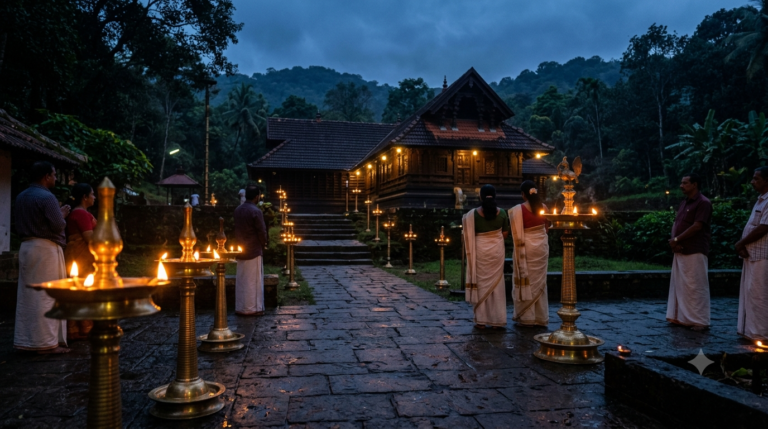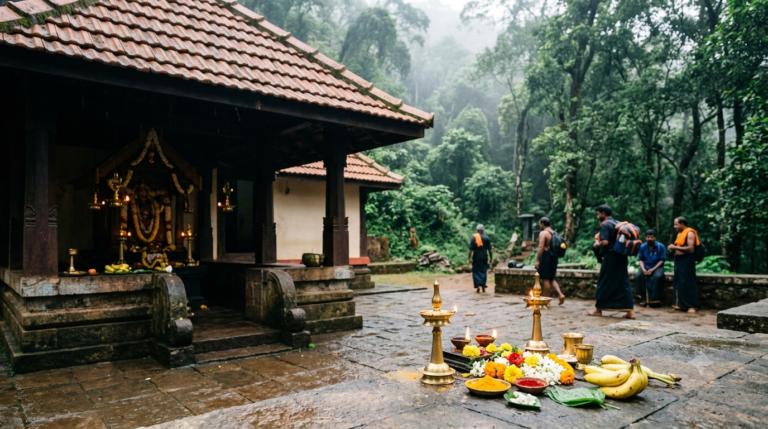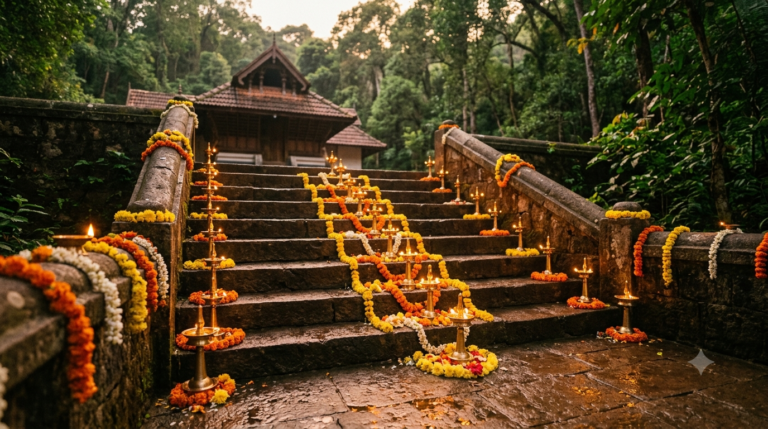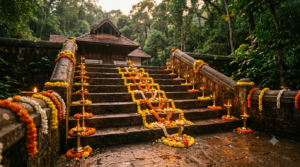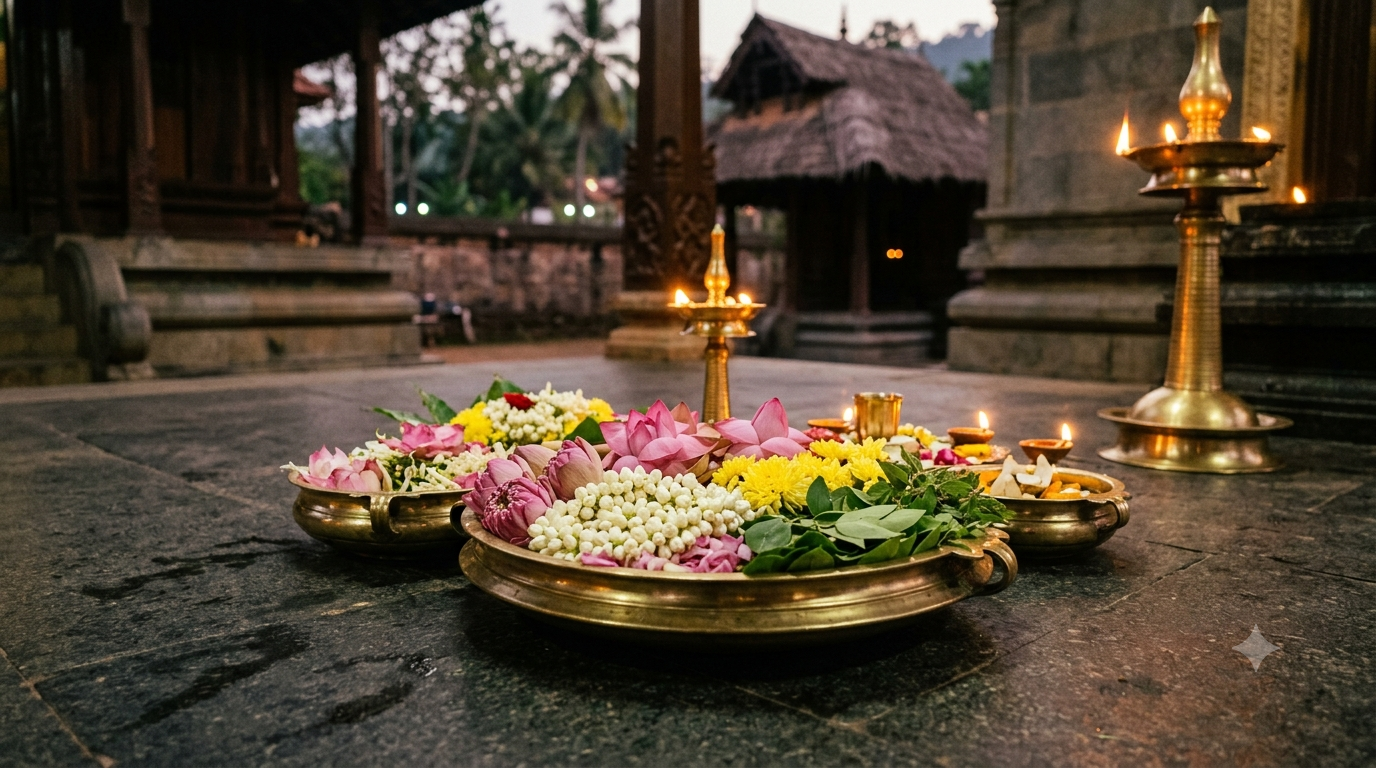
Sabarimala Pushpabhishekam is a special flower offering to Lord Ayyappa, and devotees must arrange it separately from darshan. The ritual has an advance-booking requirement, but a Virtual-Q pass does not reserve it. Before making plans, distinguish the ritual facts that official pages confirm from current booking details that still need checking.
This is an independent pilgrimage guide, not the official Sabarimala temple or Travancore Devaswom Board website. We accept no bookings, payments, donations or personal information. Use the official channels linked below for all temple services.
Sabarimala Pushpabhishekam at a Glance
- Ritual: A ceremonial shower of flowers and sacred leaves on Lord Ayyappa.
- Authority: The Travancore Devaswom Board (TDB) oversees the temple and its offerings.
- Advance arrangement: Kerala Tourism states that interested devotees must book ahead.
- Darshan: The Sabarimala Virtual-Q system manages the pilgrim queue; it is not a Pushpabhishekam receipt.
- Current details: Fees, exact timing, group rules and live availability need confirmation from TDB.
The most useful rule is simple: a darshan confirmation and a flower-offering confirmation are two different things. Keep them separate when you check your plans.
What Is Sabarimala Pushpabhishekam?
Sabarimala Pushpabhishekam is a form of abhishekam, or ceremonial offering, in which flowers and sacred leaves shower Lord Ayyappa’s idol. Kerala Tourism describes the rite as a special pooja that needs advance booking. Devotees sponsor Sabarimala Pushpabhishekam as an expression of faith, while temple authorities control its performance.
The Malayalam term pushpam means flower, while abhishekam describes a ceremonial offering or bathing. Here, the distinctive material is flowers rather than ghee. For devotees, the act expresses reverence and surrender, not a promise of a measurable result.
Sabarimala Pushpabhishekam is also different from placing a small garland near a shrine. This is a formal temple service, so the priests follow the established ritual sequence. A pilgrim cannot create an equivalent booking merely by carrying flowers to the entrance.
Which Flowers and Leaves Are Traditionally Used?
According to the Kerala Tourism special-poojas guide, Sabarimala Pushpabhishekam uses jasmine, tulsi, chrysanthemum, lotus and bilva leaves. Kerala Tourism identifies the ritual materials and the advance-booking requirement on the same page. These details explain the worship rather than providing a personal shopping list.
Do not purchase or transport a large quantity of flowers on the assumption that pilgrims must supply them. First ask TDB whether the current booking includes materials and whether any devotee-supplied items are allowed. Temple staff may control the type, quantity and handling of offerings.
Why Pushpabhishekam Booking Is Separate from Virtual-Q
The Kerala Police pilgrim-management page identifies Virtual-Q as the system for reserving darshan queue slots. Follow current official notices for entry requirements. Sabarimala Pushpabhishekam, by contrast, is a special offering that needs its own arrangement.
Think of these as two separate checks, not two names for the same reservation. Even a confirmed visit date cannot prove that a special pooja slot exists. Likewise, an offering receipt should not replace the darshan entry process the Board requires.
| Service | Main purpose | What it does not prove |
|---|---|---|
| Virtual-Q | Manages the pilgrim’s darshan queue entry | A Pushpabhishekam booking |
| Pushpabhishekam | Arranges a particular flower-offering ritual | Automatic Virtual-Q registration |
| General pooja portal | Shows supported temple services | That this exact offering has a live slot |
Use the Board’s published Sabarimala offering page to check the pooja context. For darshan, the Kerala Police information page identifies the official Virtual-Q service. A darshan screenshot alone cannot confirm the flower offering.
How to Check Sabarimala Pushpabhishekam Booking
Begin with TDB’s published offering list, which links to Online TDB for pooja bookings. A general booking website is not evidence of a live Pushpabhishekam slot. Check the named ritual and the date before treating any transaction as available.
- Start with a readable source. Read Kerala Tourism’s ritual description and TDB’s published offering page.
- Check the named service. Use Online TDB only if it displays Sabarimala and the exact Pushpabhishekam offering.
- Check the date. Look for a confirmed ritual date, not merely a general temple-opening day.
- Check the terms. Verify the present fee, timing, group rules and required details before paying.
- Use authorised payment only. Follow a TDB-operated payment flow or an official instruction from temple authorities.
- Retain the acknowledgment. Keep the issued receipt and any instructions for reporting or participating.
- Plan darshan separately. Use the Virtual-Q service identified by Kerala Police and follow current official notices.
If the offering does not appear online, that does not prove it has ended permanently. It also does not prove that an unofficial agent can obtain it. Seek the Board’s latest instructions through its official contact page or authorised temple staff.
Can Sabarimala Pushpabhishekam Be Booked Online?
TDB has an online pooja platform, but its existence does not establish live online booking for every special ritual. Check whether Sabarimala Pushpabhishekam itself appears as a selectable service with an available date and official payment flow. Without that confirmation, online availability remains unverified.
Search pages may show a booking button even when the actual provider is a private intermediary. For that reason, reach the pooja system from TDB’s own website whenever possible. Avoid sharing identity documents or payment details with an unrelated booking page.
Sabarimala Pushpabhishekam Fee: Historical Record and Current Cost
The accessible TDB revised rate schedule lists ₹12,500 for Sabarimala Pushpabhishekam, effective from 10 April 2022. This is a dated historical tariff, not a confirmed price for the next available booking. No live amount was independently verified during this review.
| Item | Verified information | What to do now |
|---|---|---|
| TDB published tariff | ₹12,500 from April 2022 | Treat as historical only |
| Present offering fee | Not confirmed | Check official checkout or TDB staff |
| Current availability | Not confirmed | Ask for an authorised date |
An older Kerala state rate page could not be reopened reliably during this review. Therefore, this guide does not use its cached figures as evidence of the current fee. A historical TDB amount should also never become a promise of today’s cost.
A Sabarimala Pushpabhishekam charge is not automatically a fee per person. Do not multiply an old total by your party size. Equally, avoid assuming that one payment lets any number of relatives attend. Therefore, the booking terms must explain what the amount covers.
What Time Is Sabarimala Pushpabhishekam Performed?
The TDB pooja timing page, last updated on 13 March 2024, groups Padi Pooja and Pushpabhishekam beside 6:45 PM. This is a published historical schedule entry, not proof of the exact reporting or start time for a new booking. The current time remains unconfirmed.
The older Kerala state timetable could not be reopened reliably during this review, so this guide avoids reproducing its figures. Pilgrims should not choose a travel date or arrival hour from an inaccessible page. For the wider evening worship context, see our Sabarimala Harivarasanam guide.
Therefore, avoid building a tight arrival plan around a single published hour. Ask TDB when the sponsor must report, where to report and whether that day’s ceremony is scheduled. A confirmed instruction matters more than an old general timetable.
How Many People Can Join One Pushpabhishekam?
A historical TDB rate schedule for Sabarimala Pushpabhishekam mentions special darshan for five people alongside Pushpabhishekam. That detail appears in the 2022 tariff, not in a verified live booking confirmation. It does not establish today’s group allowance, attendance rules or participant access.
There is a second distinction here: a number attached to special darshan does not necessarily describe who may stand near the ritual. Ritual participation and darshan arrangements may have different conditions. So the Board must clarify both before a family relies on them.
If you travel with relatives or a guru swamy group, ask exactly which names must appear on the receipt. Also confirm whether the sponsor and other attendees need individual Virtual-Q registrations. Never assume that an archived provision overrides present crowd-control instructions.
What Happens During the Flower Offering?
The core act of Sabarimala Pushpabhishekam is the ceremonial showering of flowers and leaves over Lord Ayyappa. Kerala Tourism describes the offering but does not guarantee that every sponsoring pilgrim can handle the flowers personally. Treat the rite as temple-led worship rather than a do-it-yourself activity.
Any approved participant should follow the priests’ instructions about where to stand and when to move. Because arrangements can change, the temple’s current instructions govern where participants may watch. An offering receipt should not be interpreted as unrestricted access to the sanctum or the ritual area.
Devotees may wish to pray quietly while the offering takes place. The significance rests in faith and reverence; it does not depend on obtaining a photograph. Respect any restrictions on cameras, movement and standing areas that temple staff communicate on the day.
What If an Official Website Shows an Access Error?
An official Sabarimala Pushpabhishekam page can time out, block automated checks or show a maintenance message. During the editorial review, an older Kerala government Sabarimala offering-rates page displayed a temporary-unavailable notice. That website failure does not mean Pushpabhishekam has stopped, and it cannot confirm any live fee or slot.
If a source does not open, start with the Kerala Tourism ritual description for the meaning of the ceremony. Check the TDB published offerings for its dated historical schedule. For a current transaction, use only official services or follow the Board’s published contact route.
When those options also fail, postpone the payment decision until TDB can verify the service. Do not substitute a search snippet, archived screenshot or third-party advertisement for a current booking confirmation. Website access errors and real ritual availability are different questions.
If Sabarimala Pushpabhishekam Is Unavailable
A Sabarimala Pushpabhishekam booking is never guaranteed just because the temple will open or your Virtual-Q slot exists. A chosen date may have no bookable ritual allocation. The online platform may also omit the service, while current conditions could differ from older website instructions.
- Recheck TDB’s offering channel. Look for another officially selectable date, if the platform provides one.
- Ask the official authority. Use TDB’s published contact routes to confirm whether it accepts this offering through another authorised process.
- Separate the pilgrimage decision. If the pooja is unavailable, decide whether you still wish to undertake ordinary darshan.
- Change dates only on official advice. Do not travel again solely because an agent claims a special quota exists.
There may be no same-day fallback. This is especially important if the family has already arranged transport. Until TDB issues a real reservation, treat Pushpabhishekam as a request to investigate, not a secured part of the journey.
Planning Darshan and Pushpabhishekam on the Same Trip
Start with the Sabarimala Pushpabhishekam date because an ordinary darshan reservation cannot create a flower-offering slot. If TDB confirms a Pushpabhishekam date, compare its reporting requirement with your separate Virtual-Q reservation. Leave enough room for the trek, queues and staff directions.
The journey from Pamba towards Sannidhanam demands walking and may become tiring in large crowds. Allow a margin rather than promising relatives a precise arrival time. Keep official confirmation details accessible, but do not rely on a weak mobile signal as your only record.
When planning with a group, agree on a meeting plan outside congested areas. Elderly pilgrims and people with health conditions should consider the physical demand before committing. Carry essential medicines and water where permitted, and seek medical guidance if a strenuous climb poses a risk.
Should You Bring Your Own Flowers?
Do not presume that a booking requires you to carry lotus, jasmine or other flowers to Sabarimala. The official descriptions list ritual materials, but they do not settle current supplier arrangements for every booking. Confirm those details with TDB first so your group avoids waste and unnecessary baggage.
If the authority gives material instructions, follow those precisely. A symbolic personal offering does not replace the scheduled temple ritual. Also, buying flowers from an outside seller does not grant a booking. This distinction saves both money and disappointment.
Mistakes to Avoid When Arranging the Offering
The first mistake is treating a Virtual-Q pass as an all-inclusive temple package. The second is trusting an older cost figure without checking the live rate. A third is reading a historical group provision as a present promise of special access.
Some misleading pages also combine Sabarimala Pushpabhishekam with Padi Pooja because both may appear in evening schedules. Yet Padi Pooja honours the eighteen sacred steps, while Pushpabhishekam showers flowers on Lord Ayyappa. Booking one should never count as booking the other.
Finally, avoid anyone promising guaranteed slots through a private number or direct transfer. Genuine confirmation should come from the relevant official channel. If payment instructions seem unrelated to TDB, stop and verify the source before doing anything further.
Before You Finalise Your Pilgrimage
Sabarimala Pushpabhishekam is a distinct flower-offering ritual that needs advance arrangement. The official descriptions explain the worship, but older fees, timing tables and group provisions cannot settle current conditions. Confirm the exact service with TDB, obtain a valid acknowledgment and handle Virtual-Q independently. A regular darshan remains a separate pilgrimage decision if the special offering is not available.
Frequently Asked Questions
Is Sabarimala Pushpabhishekam the Same as Virtual-Q?
No. Pushpabhishekam is a flower-offering ritual, while Virtual-Q organises darshan queue entry. A Virtual-Q pass does not pay for or reserve the ritual. Check both arrangements separately through TDB’s official channels.
Is Advance Booking Necessary for Pushpabhishekam?
Yes. Kerala Tourism states that devotees wishing to take part should book in advance. However, its general description does not promise an open slot on any particular date. Confirm the current application route with TDB.
What Is the Latest Sabarimala Pushpabhishekam Price?
The current payable price has not been independently confirmed. A TDB schedule effective in April 2022 listed ₹12,500, but that amount is a historical reference. Check an active official checkout or seek TDB’s current instructions before paying.
Can Families Attend Together?
The current family or group allowance remains unconfirmed. TDB’s 2022 schedule mentions special darshan for five people, but those older terms may not still apply. Ask the Board about named participants, access and separate Virtual-Q requirements.
Does One Booking Include Special Darshan?
Do not assume so. An older tariff links the offering with a special-darshan provision, yet a historical listing cannot establish current entitlements. Only a current official acknowledgment and instructions can clarify what your booking includes.
Is Pushpabhishekam Available Every Day?
Daily Sabarimala Pushpabhishekam availability has not been verified. A temple-opening date or an evening pooja timetable does not prove that a sponsor slot exists. Look for a current official allotment before arranging travel around the ritual.
Can I Pay an Agent if Online Booking Is Missing?
No private agent should be treated as an alternative official booking channel. Check the Board’s platform and contact information instead. If TDB cannot confirm a date, there is no basis to assume an intermediary can secure one.
Is Pushpabhishekam Different from Neyyabhishekam?
Yes. Pushpabhishekam uses flowers and sacred leaves, while Neyyabhishekam centres on ghee. Both belong to Sabarimala worship, but they are distinct offerings with separate procedures and booking questions.
What Should I Do if My Preferred Date Is Full?
Check for another date through the official TDB channel and ask about any authorised alternative process. Do not assume a waitlist or same-day counter quota exists. If no date is offered, plan darshan separately or choose a later pilgrimage.