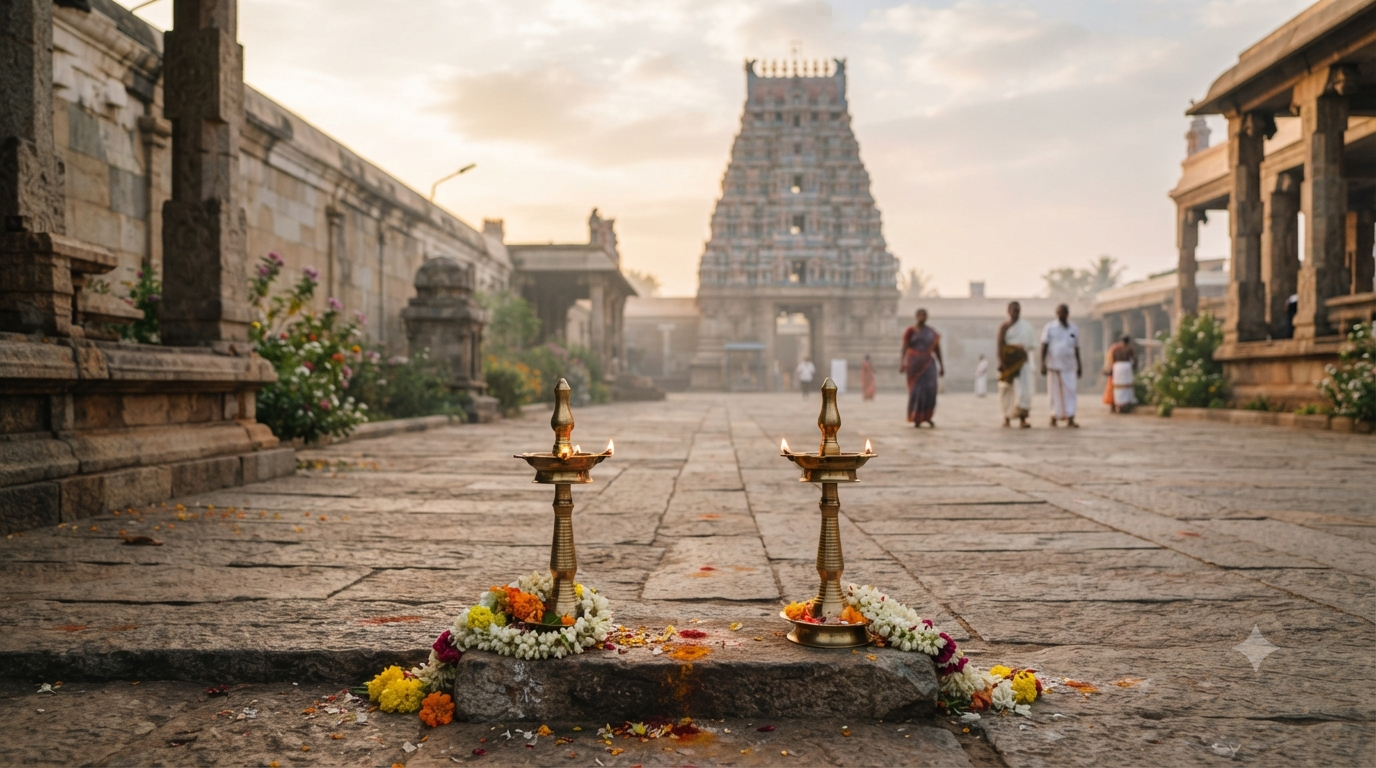
Dwaraka Tirumala temple significance comes from a rare combination: a self-manifested form of Lord Venkateswara, a second complete idol in the same sanctum, and the shrine’s long identity as Chinna Tirupati. The temple stands in Dwaraka Tirumala, Eluru district, Andhra Pradesh, and devotees visit it as an important Venkateswara kshetram. Its fame is therefore not based on size alone. It rests on a distinctive form of worship, temple legend, and living Vaishnava tradition.
Sri Vyasa Pooja is an independent pilgrimage guide and is not affiliated with Sri Venkateswara Swamy Vari Devasthanam, the Andhra Pradesh Endowments Department, or Tirumala Tirupati Devasthanams (TTD). We do not take bookings, donations, or payments; use official portals for all temple services.
Dwaraka Tirumala Temple Significance at a Glance
The clearest way to understand Dwaraka Tirumala is to look at the features that make it different from a general Venkateswara shrine. Government tourism material identifies the temple as Chinna Tirupati and connects its name with Sage Dwaraka. It also records the self-manifested deity and the unusual presence of two forms of Lord Venkateswara within the sanctum.
- Presiding deity: Lord Sri Venkateswara Swamy, worshipped as a form of Lord Vishnu.
- Popular name: Chinna Tirupati, meaning Little Tirupati.
- Core temple tradition: Temple lore says Sage Dwaraka found the swayambhu form after penance.
- Signature feature: Devotees worship two forms of Lord Venkateswara within the same sanctum.
- Ritual tradition: Worship follows the Vaikhanasa Agama tradition.
- Major celebrations: The temple tradition includes festival cycles in Vaisakha and Aswayuja, along with other Vaishnava observances.
- Administration: Dwaraka Tirumala is separate from TTD and appears in the Andhra Pradesh Endowments Department temple system.
For most readers, Dwaraka Tirumala temple significance begins with this two-form worship and the Chinna Tirupati tradition. That last point also matters for pilgrims. The phrase Chinna Tirupati describes religious identity and devotion, not administrative control by TTD. For current sevas, accommodation, or payments, use the Andhra Pradesh Endowments Department portal or the Dwaraka Tirumala Devasthanam website.
Why Dwaraka Tirumala Temple Significance Makes It Famous
Dwaraka Tirumala is famous mainly because devotees worship Lord Venkateswara here in two forms under one sanctum arrangement. Devotees revere one form as swayambhu, or self-manifested. A second complete form supports the full ritual worship described in temple tradition. This unusual pairing defines Dwaraka Tirumala temple significance more clearly than any comparison with a larger shrine.
The name Chinna Tirupati adds another layer. Devotees across the Telugu states have long regarded the temple as a major Venkateswara pilgrimage centre closer to the Godavari-Krishna region. However, that devotional comparison does not make this shrine part of Tirumala’s administration, ticketing system, or facilities.
| Famous feature | What it means | Why it matters |
|---|---|---|
| Swayambhu Venkateswara | A self-manifested form linked to Sage Dwaraka | Forms the centre of the temple’s origin tradition |
| Second complete idol | A complete Venkateswara form in the sanctum | Supports full ritual worship including the Lord’s feet |
| Chinna Tirupati | Popular devotional name | Links the shrine with Telugu Venkateswara worship |
| Festival cycles | Celebrations linked with both sacred forms | Shows how the two-idol tradition shapes temple life |
| Distinct architecture | South-facing Rajagopuram and Nagara-style Vimana | Adds a recognizable architectural identity |
Why Dwaraka Tirumala Temple Significance Centres on Two Idols
The two-idol arrangement is the feature most worth understanding before a visit. According to temple tradition, Sage Dwaraka discovered the self-manifested Lord Venkateswara in a valmikam, or anthill. The visible sacred form did not present the Lord’s feet for the complete mode of worship expected in the Vaikhanasa tradition.
Therefore, tradition says priests installed a second, complete image of Lord Venkateswara behind the original form. This allowed worship of the full form while preserving the swayambhu deity as the heart of the shrine. Government tourism material also highlights the presence of the self-manifested and installed forms together.
This is more than an architectural curiosity. Dwaraka Tirumala temple significance depends heavily on this two-form worship, because it shapes both devotion and ritual life. It also helps explain the paired festival traditions associated with the shrine.
What does the swayambhu form represent?
In Hindu temple language, swayambhu means a sacred form that devotees believe manifested by itself rather than through ordinary human installation. At Dwaraka Tirumala, this belief belongs to the temple’s devotional tradition. It should therefore be understood as a matter of faith, not as an archaeological claim.
Devotee traditions often connect the swayambhu form with moksha, or spiritual liberation. Traditional explanations link the complete installed form with the other aims of life, including dharma, artha, and kama. These symbolic meanings explain how worshippers interpret the two forms together.
The Story of Sage Dwaraka and the Temple Name
The Ministry of Tourism’s Utsav portal explains that the pilgrimage centre takes its name from the sage Dwaraka. Temple legend says he performed severe penance and located the self-manifested image of Lord Sri Venkateswara in an anthill. People then called the pilgrimage centre Dwaraka Tirumala after the sage.
This legend is important because the sage is not a side character in the story. His name became the name of the pilgrimage town itself. The temple’s religious identity therefore joins three ideas: the sage, the hill shrine, and the manifestation of Venkateswara.
Some older retellings also connect the shrine with figures from the Ramayana tradition, including King Aja. Such accounts belong to sacred narrative rather than datable history. An evergreen guide should preserve that distinction instead of presenting every legend as a verified historical event.
Dwaraka Tirumala Temple Significance in the Chinna Tirupati Tradition
Chinna Tirupati literally means Little Tirupati, and the name reflects devotion to the same Lord Venkateswara worshipped at Tirumala. The comparison is spiritual and cultural. It does not mean Dwaraka Tirumala is a branch of the Tirumala Tirupati Devasthanams.
This distinction prevents a common planning mistake. Dwaraka Tirumala has its own temple administration within the Andhra Pradesh Endowments system. As a result, pilgrims should not assume that TTD darshan tickets, room portals, or Tirumala procedures apply here.
If you are planning the practical side of the trip, use our separate Dwaraka Tirumala travel guide. For stays, the Dwaraka Tirumala temple rooms guide explains the accommodation system without mixing it up with TTD.
Architecture and Dwaraka Tirumala Temple Significance
The temple’s architecture gives physical form to Dwaraka Tirumala temple significance. The Government of India’s tourism material describes a five-storied main Rajagopuram facing south, with three other gopurams on the remaining sides. It also identifies the Vimana above the sanctum as Nagara in style.
That detail is useful because generic descriptions often label the entire complex simply as Dravidian architecture. The broader complex clearly belongs to a South Indian temple setting, yet the official tourism description is more precise about the Vimana. It also notes Alwar shrines around the prakara, or temple enclosure.
The south-facing orientation carries its own traditional explanation. Temple lore connects it with the direction in which Lord Venkateswara appeared before Sage Dwaraka. Again, this is best read as sacred tradition. The visible south-facing entrance and temple plan are physical features, while the reason given for them belongs to belief.
Festivals and Dwaraka Tirumala Temple Significance
Daily worship follows the Vaikhanasa Agama system, and the temple calendar includes Venkateswara-focused sevas and festivals. Here, Dwaraka Tirumala temple significance also appears in the festival calendar. Traditional temple accounts describe major celebrations in both Vaisakha and Aswayuja for the two sacred forms.
Recent Andhra Pradesh tourism material also highlights the Aswayuja Brahmotsavam, including Dhwajarohanam, Vahana Sevas, Chakra Snanam, and the closing Dhwajavarohanam. Vaisakha celebrations are likewise observed for the swayambhu form. Exact dates change each year, so pilgrims should always check the official temple calendar rather than copying an old schedule.
Why are there two major Kalyanotsavam periods?
The paired celebrations reflect the temple’s two-form tradition. One festival cycle honours the swayambhu form, while the other honours the installed complete form. This makes the annual calendar another expression of the same feature that defines the sanctum.
Do not confuse these major annual celebrations with the daily Nitya Arjitha Kalyanam seva. If that seva is the reason for your trip, our Dwaraka Tirumala Kalyanam guide covers current booking routes and planning details. Always confirm the final schedule on the official portal before travel.
What Dwaraka Tirumala Is Not
Dwaraka Tirumala is not the Tirumala hill temple near Tirupati, even though both centres worship Lord Venkateswara. It is also not managed through the TTD system. Treating the two temples as interchangeable can send pilgrims to the wrong booking portal or create false expectations about rooms and darshan procedures.
The temple is also not famous merely because it resembles Tirupati. Its strongest independent identity comes from the Sage Dwaraka tradition, the swayambhu form, the second complete image, and the festival life built around those forms. That makes Chinna Tirupati a meaningful devotional name rather than a claim that this is a smaller copy of Tirumala.
Finally, avoid private sites that present themselves as official booking agents. The AP Endowments portal is the safest starting point for official online services. The Government of India’s Utsav listing for Dwaraka Tirumala is also useful for official tourism context.
What First-Time Visitors Should Notice
A first visit becomes more meaningful when you know what to look for. First, remember that the sanctum’s importance lies in the two forms of the same Lord. Do not reduce the experience to a quick comparison with Tirumala.
Next, notice the temple’s south-facing approach and the gopuram arrangement. Then look for the wider Vaishnava setting, including the Alwar shrines mentioned in government tourism material. These details connect the main deity with the larger devotional tradition around Lord Vishnu.
Festival days can change the entire pace of a visit, so avoid assuming an ordinary-day schedule. If you prefer a calm visit, choose a non-festival weekday and check current darshan information before leaving home. Elderly pilgrims and families with small children should also allow extra time for queues and hill movement.
How to Plan a Visit Without Mixing Up the Two Tirupatis
Start by confirming that every booking page names Dwaraka Tirumala in Eluru district. Then check whether the payment path belongs to the temple or Andhra Pradesh Endowments system. If a page redirects you to TTD’s Tirumala booking flow, you are looking at the wrong system for this temple.
- Read the official temple or AP Endowments page for current services.
- Check the festival calendar before choosing your travel date.
- Use a separate travel plan for transport because Dwaraka Tirumala is not Tirumala near Tirupati.
- Confirm accommodation through official channels or the temple counter system.
- Keep your visit flexible because darshan flow may change on festival and high-crowd days.
This simple separation prevents most planning errors. It also keeps this article focused on Dwaraka Tirumala temple significance while the linked travel, rooms, and Kalyanam pages handle changing operational details.
Why the Temple Remains Important to Devotees
The enduring appeal of Dwaraka Tirumala comes from continuity. Dwaraka Tirumala temple significance joins an old sacred narrative, a living ritual system, and a distinctive form of Venkateswara worship. The two-idol sanctum gives that continuity a visible centre.
For many families, the Chinna Tirupati identity also makes the shrine part of a wider pattern of vows and Venkateswara devotion across Andhra Pradesh and Telangana. Beliefs about blessings, fulfilment of vows, or spiritual merit should be understood as matters of faith. They are meaningful within the tradition, but they are not guaranteed outcomes.
That distinction strengthens rather than weakens the story. The temple does not need exaggerated claims to be remarkable. Its documented identity as a major Venkateswara shrine, together with the two sacred forms and the Sage Dwaraka tradition, already explains why it holds such a strong place in regional pilgrimage culture.
Before You Go
Dwaraka Tirumala temple significance is easiest to remember through four ideas: Sage Dwaraka, the swayambhu Venkateswara, the second complete idol, and the Chinna Tirupati tradition. Those features give the shrine an identity of its own rather than making it a substitute version of Tirumala.
Use official sources for current timings, sevas, festival dates, and payments because those details can change. For the spiritual and historical context, focus on what has remained constant: the temple’s two-form worship and its place in the living Venkateswara tradition of Andhra Pradesh.
Frequently Asked Questions
Why is Dwaraka Tirumala called Chinna Tirupati?
Dwaraka Tirumala is called Chinna Tirupati because Lord Venkateswara is the presiding deity and the shrine holds a major place in Venkateswara devotion. The name expresses a devotional relationship with Tirumala, but the two temples have separate administrations and booking systems.
What is special about Dwaraka Tirumala temple?
The temple is especially known for two forms of Lord Venkateswara within the same sanctum. Devotees revere one as swayambhu, while a second complete form supports full ritual worship. This arrangement is central to the shrine’s identity.
Who is the main deity at Dwaraka Tirumala?
Lord Sri Venkateswara Swamy, a form of Lord Vishnu, is the presiding deity. Devotees also refer to the Lord here through names associated with the wider Venkateswara and Srinivasa tradition.
Why are there two Venkateswara idols at Dwaraka Tirumala?
Temple tradition says the original swayambhu form did not reveal the Lord’s feet for complete ritual worship. Therefore, tradition says priests installed a second complete image behind it according to the Vaikhanasa tradition. Devotees now worship the two forms together within the sanctum.
Is Dwaraka Tirumala managed by TTD?
No. Dwaraka Tirumala is separate from Tirumala Tirupati Devasthanams. The temple appears within the Andhra Pradesh Endowments Department system, so pilgrims should use the appropriate Dwaraka Tirumala or AP Endowments channels for official services.
What is the story behind the name Dwaraka Tirumala?
The temple tradition links the name to Sage Dwaraka. Government tourism material says the sage located the self-manifested Venkateswara after severe penance in an anthill, or valmikam. The pilgrimage centre took his name.
Does Dwaraka Tirumala have two Brahmotsavam celebrations?
Traditional temple accounts describe major festival cycles in Vaisakha and Aswayuja, connected with the two sacred forms. Because festival dates follow the religious calendar, check the current official schedule before planning a trip around either celebration.
What should pilgrims verify before visiting Dwaraka Tirumala?
Check current darshan hours, festival changes, seva availability, and accommodation only through official channels. This is especially important because old schedules and TTD-related information are often copied incorrectly onto third-party pages.