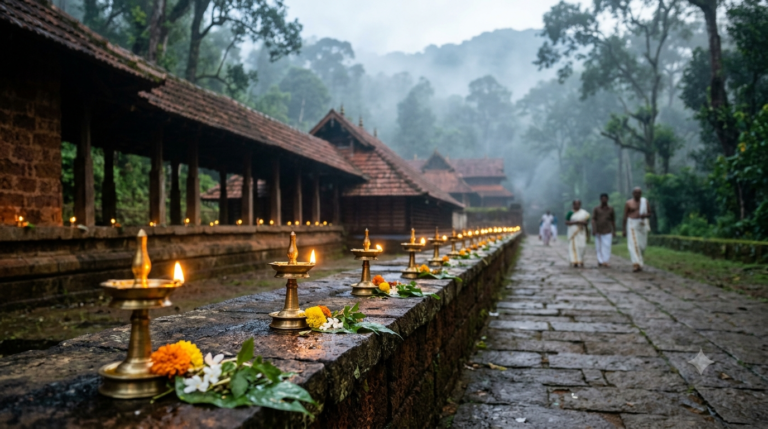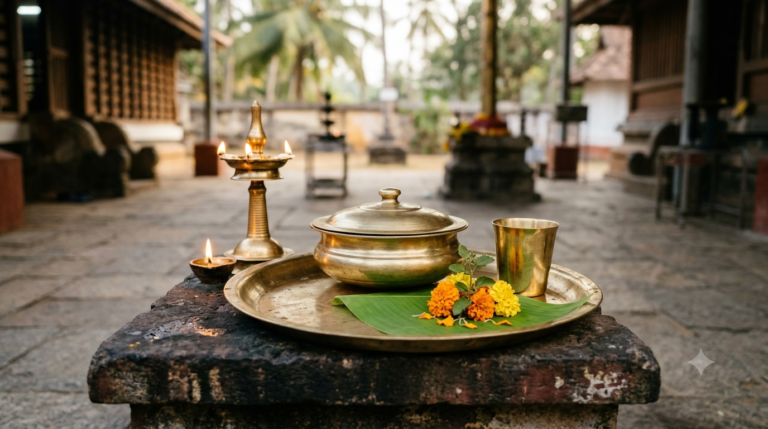
Sabarimala Ucha Pooja is the midday worship of Lord Ayyappa at Sannidhanam, distinct from the early Usha Pooja. The Travancore Devaswom Board (TDB) lists the noon ritual at 12:30 PM. That published hour explains the worship schedule, but it does not reserve an offering, guarantee darshan or grant a visitor entry to the ceremony.
Independent guide: Sri Vyasa Pooja is not affiliated with Sabarimala Temple or TDB. We take no bookings, donations, payments or personal information. Use the Board’s official Sabarimala service page for authoritative directions.
Sabarimala Ucha Pooja at a glance
Ucha Pooja is a named midday rite in the temple’s order of worship. It follows other morning rituals and comes before the published afternoon closure. Devotees can enquire about the separately listed offering, although current fees, availability and participation terms still require direct confirmation.
- Deity: Lord Ayyappa, also called Sree Dharma Sastha.
- Location: Sabarimala Sannidhanam, Kerala.
- Published Ucha Pooja time: 12:30 PM on the TDB schedule.
- Published midday closure: 1:00 PM on that schedule.
- Not the same ritual: Usha Pooja appears at 7:30 AM.
- Offering status: Current charge, date availability, request method and personal attendance are unconfirmed.
- Queue registration: Virtual-Q concerns darshan arrangements, not automatic approval of an Ucha Pooja offering.
These times come from the TDB pooja timetable. However, check the official notices for your actual temple-opening period before making a trip.
What happens during midday worship?
Ucha Pooja is part of the scheduled worship of Lord Ayyappa at Sabarimala. The official ritual sequence places it after the morning observances and before the temple’s midday closure. The published information names the rite but does not provide a visitor-facing minute-by-minute account of every priestly action.
So avoid descriptions that promise a particular chant, viewpoint or chance to stand near the sanctum. The Tantri and other temple priests conduct worship under temple practice. A pilgrim’s personal prayer during the midday period is not the same as joining the formal rite.
The timing does not give a complete account of the ceremonies performed inside the shrine. The Board publishes a schedule of named observances, not instructions for a visitor to join the priestly proceedings. When asking about a personal offering, request the exact terms from the temple office rather than relying on a general description of worship.
Sabarimala Ucha Pooja versus Usha Pooja
Sabarimala Ucha Pooja and Usha Pooja are different rituals, even though their names look similar. Usha refers to the morning worship at 7:30 AM. Ucha refers to the midday worship at 12:30 PM. TDB lists them separately in its timetable and its published offering information.
| Point | Usha Pooja | Ucha Pooja |
|---|---|---|
| Part of day | Early morning | Midday |
| Published time | 7:30 AM | 12:30 PM |
| Place in sequence | After early worship | Before midday closure |
| Offering enquiry | Ask for Usha Pooja | Ask for Ucha Pooja |
| Access conditions | Confirm with TDB | Confirm with TDB |
The practical lesson is simple: state the complete ritual name when making an enquiry. A request for “morning pooja” could mean something different from noon worship. Our Sabarimala Usha Pooja guide covers that morning rite in greater detail.
Where Ucha Pooja fits in the temple day
The Board’s published sequence starts with Nirmalyam and other early rituals. Neyyabhishekam, the ghee offering associated with Lord Ayyappa, appears in the morning schedule. Usha Pooja follows the earlier worship, while later rites lead towards Ucha Pooja.
On the TDB timetable, midday worship appears at 12:30 PM and the temple closes at 1:00 PM. The Board identifies that webpage as last updated on 13 March 2024. These are published reference times, not instructions to enter the queue at 12:30 PM.
For your chosen opening period, look for a newer official notice or on-site direction before relying on any hour. A ritual schedule cannot tell you how long the approach or darshan queue will take. Plan enough flexibility to follow the actual instructions on the day.
Does Ucha Pooja happen every day?
Do not assume that Sabarimala Ucha Pooja operates for visitors on every calendar date. The Sabarimala shrine follows designated opening periods, including monthly and major pilgrimage openings. A published ritual schedule describes what happens during applicable temple operations, not a year-round public booking calendar.
Check the Board’s Sabarimala section for its temple calendar and notices. When you have a proposed date, confirm the shrine opening first. Only then should you ask whether the named offering is available on that date.
How Sabarimala Ucha Pooja offering enquiries work
An Ucha Pooja offering enquiry is separate from the ritual’s public timetable. The official TDB vazhipadu list includes a named Ucha Pooja entry. However, that published entry alone cannot establish today’s payment amount, an available date or permission to attend the ceremony.
The Board also links to an online pooja service from its Sabarimala page. Still, the existence of that service does not prove that this precise offering has a live online checkout. Start with the authority and confirm the present route before sharing any details or making a payment.
- Identify the right rite. Ask specifically about Ucha Pooja, not Usha Pooja or a general midday darshan ticket.
- Confirm the visit date. Check the official temple-opening calendar and the applicable worship schedule.
- Check the authorised channel. Follow the pooja service or instructions linked by TDB, not an advertisement or intermediary.
- Request the full terms. Ask about availability, the present total charge, proof of payment and any reporting requirements.
- Clarify attendance separately. Ask whether the offering includes any viewing or darshan condition before assuming access.
- Keep official evidence. Retain only the confirmations and receipts that the authorised service issues.
If the website does not list the offering, use the TDB contact directory to find the official Sabarimala office. Do not infer that an unlisted offering is sold out or available offline.
Why the current offering fee remains unconfirmed
The current payable amount for Sabarimala Ucha Pooja remains unconfirmed here. The Board’s published vazhipadu schedule identifies Ucha Pooja as a named offering and gives its list an effective date in 2022. It is a dated published record, not confirmation of a live charge for your proposed visit.
The published list also contains a historical reference to special darshan. Do not treat that wording as a guarantee of present-day access. Ask TDB what a current accepted request includes, whether any attendance condition applies, and what official receipt the authority will issue.
Do not pay a private individual who quotes an “urgent noon pooja” price or promises a reserved position near the sanctum. A verified official receipt and clearly stated terms matter more than a low advertised rate. Until the authority confirms the details, treat fee and entitlement claims as unverified.
Does Virtual-Q include Sabarimala Ucha Pooja?
No automatic Ucha Pooja offering follows from a Virtual-Q registration. TDB presents Virtual-Q as a pilgrim darshan queue arrangement, while its vazhipadu information lists named ritual offerings separately. A queue confirmation may support your pilgrimage entry plan, but it is not proof of sponsorship, payment or ritual participation.
TDB’s homepage says Virtual-Q booking is mandatory for Sabarimala pilgrims. Therefore, check its current instructions even if you are already enquiring about Ucha Pooja. The Board provides the official Virtual-Q route through its Sabarimala page.
A useful test is to look at what each confirmation actually names. A darshan queue record should not be described as an Ucha Pooja receipt. Similarly, an offering acknowledgement does not remove other pilgrim-entry requirements unless TDB expressly says so.
Can you watch or take part in Ucha Pooja?
Personal viewing or participation in Ucha Pooja cannot be promised from the published timetable. The scheduled worship is a temple ritual, while devotees follow the access and crowd rules set by the authorities. Even an offering listing does not establish where the sponsor may stand or who may accompany them.
Ask the Board what its current arrangement includes, if anything. For example, clarify whether the offering carries an allotted date, a receipt, a darshan provision or no viewing right. Do not treat a priestly ritual as a public event with unrestricted seats.
Devotees may pray with faith during their visit, but religious blessings are matters of belief. A payment or an offering request cannot guarantee a particular personal result. Your safest plan rests on the authority’s stated access conditions.
Keep Ucha Pooja separate from other named offerings
Ucha Pooja is one named entry in the Board’s worship and offering information. Neyyabhishekam concerns the ghee offering to Lord Ayyappa, while Udayasthamana Pooja is a different named observance. The timetable alone does not establish that requesting any one of these provides the others.
This matters because broad phrases such as “special pooja at noon” do not identify an exact service. Use the official name shown in TDB records when making an enquiry. If your intention involves ghee, read our Neyyabhishekam guide instead of assuming that the noon worship includes it.
For a longer-form worship enquiry, our Udayasthamana Pooja guide covers that separate ritual and its planning questions. Neither article replaces the Board’s present booking terms. Always check the selected service and date with TDB before paying.
Plan for noon without treating 12:30 PM as an arrival slot
For Sabarimala Ucha Pooja, a listed worship time is not a pilgrim reporting time. The approach to Sannidhanam, queue controls and the day’s movement arrangements may affect when you reach the shrine. Therefore, build your plan around official entry guidance rather than trying to arrive at the sanctum just before the noon rite.
First confirm the temple-opening date and your current Virtual-Q requirements. Next check for any travel or crowd instructions. If you want to sponsor the Ucha Pooja offering, seek written clarity from TDB before arranging the trip around it.
Sabarimala involves a hill pilgrimage, so account for the physical effort. Carry drinking water and essential medication as permitted, and follow local safety directions. Anyone with heart, joint or mobility concerns should seek medical advice before a strenuous climb. No desired ritual time should take priority over personal safety.
If the offering option is missing or unavailable
There is no guarantee that an Ucha Pooja request will be accepted for the date you choose. A page may show no selectable slot, the online service may not list the rite, or an official enquiry may not establish a current request process. None of those cases gives a broker authority to arrange a private reservation.
- Check the official calendar again. Make sure the selected day is an actual temple-opening date.
- Ask the Sabarimala office. Use the TDB contact directory to clarify whether the offering accepts requests and through which channel.
- Ask about another date. Consider an alternative only if TDB confirms that a new request or permitted change is possible.
- Keep darshan independent. If the offering cannot be arranged, follow the ordinary authorised pilgrimage process.
Do not assume an offline counter, refund, transfer or priority darshan exists without written official terms. If no allocation is available, the appropriate response is to revise your plans, not buy an unofficial promise.
Mistakes that cause noon-pooja confusion
Several small misunderstandings can disrupt a pilgrimage. The first is confusing Ucha with Usha because the names sound similar. The second is treating a ritual time as a booking window, even though the timetable makes no such claim.
- Using the wrong ritual name: Check whether you mean morning Usha or noon Ucha.
- Assuming a listed fee is current: A dated schedule is not a live payment confirmation.
- Reading Virtual-Q as a pooja ticket: Darshan registration and a named offering serve different purposes.
- Expecting to see the full ceremony: Participation and observation remain subject to official rules.
- Following private payment links: Make payments only through methods TDB currently authorises.
Use precise words when speaking to the temple office: “Sabarimala Ucha Pooja on my proposed opening date.” Then ask what the current official arrangement actually allows. This avoids paying for, or planning around, the wrong service.
Before making your pilgrimage plans
Sabarimala Ucha Pooja is the midday rite, not the morning Usha Pooja and not a Virtual-Q booking. The published 12:30 PM time describes worship, while the Board must confirm any personal offering arrangement. Check the opening calendar, fee, request method and attendance terms before committing to a date.
If an answer remains unclear, rely on TDB’s official channels rather than an agent’s guarantee. That simple distinction protects both your travel plans and the purpose of your devotional visit.
Frequently asked questions
What is Sabarimala Ucha Pooja?
Sabarimala Ucha Pooja is the temple’s named midday worship of Lord Ayyappa. TDB places it near the end of the morning ritual sequence. A published worship schedule does not, by itself, reserve an offering or give a pilgrim access to the ceremony.
What time does Ucha Pooja take place?
The Travancore Devaswom Board lists Ucha Pooja at 12:30 PM and midday closure at 1:00 PM. However, confirm the relevant schedule and notices for your opening period. Neither time should be treated as a personal queue appointment.
What is the difference between Ucha Pooja and Usha Pooja?
Ucha Pooja is the noon rite, while Usha Pooja is the morning rite. TDB lists them at 12:30 PM and 7:30 AM respectively. Use the full name when you ask about an offering because the two are separate entries.
How much is the current Ucha Pooja fee?
The current amount payable for an Ucha Pooja request is unconfirmed. TDB publishes a dated offering list, but this article has not established a live amount for a new request. Ask the Board for its current fee and official payment terms.
Can I book Ucha Pooja online?
Do not assume that a live online Ucha Pooja slot is available. TDB links to an online pooja service, but that does not confirm this offering’s present booking method. Check the named offering with the Board before taking action.
Does a Virtual-Q pass include Ucha Pooja?
No automatic offering entitlement follows from Virtual-Q. The queue system concerns darshan arrangements, while Ucha Pooja appears separately in the Board’s offering information. Follow the current rules for both matters independently.
Can devotees personally attend the Ucha Pooja ritual?
Current personal attendance and viewing conditions remain unconfirmed. The ritual timetable does not promise a place beside the sanctum or permission to take part. Ask TDB about any conditions linked to a specific officially accepted offering.
Is Neyyabhishekam the same as Ucha Pooja?
No. Neyyabhishekam refers to a ghee offering, while Ucha Pooja is the named midday worship. The Board lists them as distinct items. Confirm the exact service you want instead of assuming one request covers both.
What if Ucha Pooja is unavailable on my date?
First confirm that the shrine opens on your chosen day. Then ask TDB whether the named offering accepts requests or permits another date. If no official option exists, keep your regular darshan plan separate and avoid private guarantees.