The Maha Mrityunjaya Homam is a Vedic fire ritual dedicated to Lord Shiva. Families across India turn to it for protection, healing, and relief from the fear of an untimely death. If you want to understand what this ceremony involves, you are in the right place.
This guide explains the meaning, the deeper significance, the full step-by-step procedure, and the honest cost of the ritual. It also corrects a few claims that spread online but do not hold up.
One note before we begin. Sri Vyasa Pooja is an independent devotional guide, not the official website of any temple or Vedic institution.
We do not take bookings or payments through this page. Please arrange the ritual through a qualified priest or a recognised temple, and confirm current dates and costs with them.
Maha Mrityunjaya Homam at a Glance
Here are the essentials before we go deeper into each part.
- Deity: Lord Shiva, worshipped here as Mrityunjaya, the conqueror of death.
- Core mantra: the Maha Mrityunjaya Mantra, also called the Tryambakam or Rudra Mantra.
- Scriptural source: Rigveda 7.59.12, and it recurs in the Yajurveda and the Atharvaveda.
- Best days: Mondays, Pradosham, the month of Shravan, and Maha Shivaratri.
- Typical duration: a few hours for a modest homam, up to a full day for large versions.
- Who performs it: trained Vedic priests, since correct chanting and fire handling matter.
What Is Maha Mrityunjaya Homam?
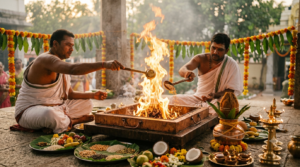
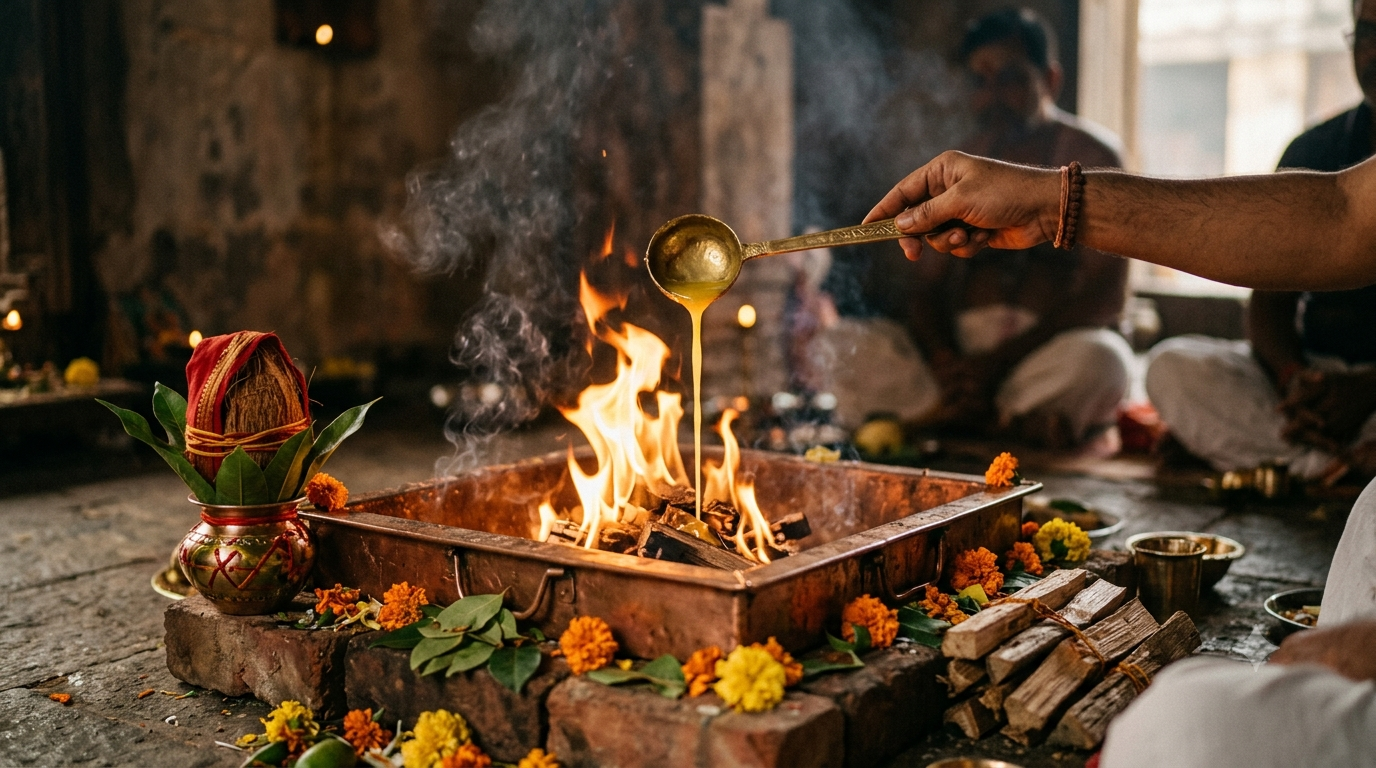
Maha Mrityunjaya Homam is a sacred fire ceremony that honours Lord Shiva as the conqueror of death. During the rite, priests chant the Maha Mrityunjaya Mantra and offer ghee and herbs into a consecrated fire. The word Mrityunjaya joins mrityu (death) and jaya (victory), so the name means victory over death.
People sometimes call it the Mrityunjaya Homam or the Maha Sanjeevani Homam. The heart of it stays the same, because the repeated mantra and the fire offerings carry the devotee’s prayer to Shiva.
A homam, or havan, is a fire-based Vedic ritual. The sacred fire acts as a messenger that carries each oblation, so the priest tends it with great care from the moment it lights.
The Significance of the Ritual
For devotees, the Maha Mrityunjaya Homam is a prayer for courage as much as for long life. Since tradition places Shiva beyond time, worshippers turn to him when illness, grief, or uncertainty shakes the household.
The ritual draws much of its power from the story of Sage Markandeya. According to the Puranas, Markandeya would die at sixteen, yet he worshipped Shiva with total devotion. When Yama, the lord of death, came to claim him, Shiva emerged from the Shiva Linga and saved the boy.
This legend is a matter of faith and sacred tradition, not recorded history. Even so, it explains why the ritual carries such a strong link with protection from an early death.
Where the Maha Mrityunjaya Mantra Comes From
The mantra is one of the oldest verses in the Hindu scriptures. It first appears in the Rigveda (7.59.12), attributed to Rishi Vasishtha. It also recurs in the Yajurveda and the Atharvaveda, so few devotees dispute its authority.
The verse calls on Tryambaka, the three-eyed one, an epithet of Rudra who devotees identify with Shiva. Scholars class it as a moksha mantra, since it prays for liberation rather than mere survival. The Sanskrit runs:
ॐ त्र्यम्बकं यजामहे सुगन्धिं पुष्टिवर्धनम् ।
उर्वारुकमिव बन्धनान् मृत्योर्मुक्षीय मामृतात् ॥Om Tryambakam Yajamahe Sugandhim Pushtivardhanam,
Urvarukamiva Bandhanan Mrityor Mukshiya Maamritat.
In plain words, it means this. We worship the fragrant, three-eyed Lord who nourishes all beings. May he free us from the bondage of death, the way a ripe cucumber loosens from its creeper, and turn us toward immortality. Notice that the prayer asks for release and grace, not for a body that never dies.
Why Devotees Perform Maha Mrityunjaya Homam
People arrange this homam for many reasons, and almost all of them come back to protection and peace of mind. Understanding these intentions helps you decide whether the ritual fits your own situation.
Within tradition, devotees believe the Maha Mrityunjaya Homam guards against untimely death, eases fear and anxiety, and invites longevity. Many families also perform it to reduce the effects of certain doshas, such as Mrityu dosha or Kaal Sarp dosha.
Others turn to it for calm during a hard phase, or for spiritual growth on the path toward moksha. Devotees often schedule it around a birthday or a difficult planetary period, so the timing carries personal meaning.
These benefits are matters of faith and Vedic tradition. They describe why devotees value the ritual, and they are not claims of a guaranteed or measurable outcome.
An Honest Word on Health Claims
Here is where many websites cross a line, so read this part carefully. Some pages claim the homam, or the durva grass offered in it, can cure serious diseases such as cancer. That is not true, and repeating it can cause real harm.
The Maha Mrityunjaya Homam is a devotional practice. It may bring comfort, focus, and hope, yet it cannot replace medical treatment. If you or a loved one faces a health condition, please keep seeing a qualified doctor and continue any prescribed treatment.
Think of the ritual as spiritual support that sits alongside proper medical care, never in place of it. Faith and medicine can walk together, and the safest path keeps both.
When to Perform the Homam
Timing matters in Hindu ritual, so priests usually pick a day that suits both the calendar and the devotee. The most favourable days all belong to Lord Shiva.
Mondays honour Shiva, and they remain the most common choice. Pradosham, which falls twice each lunar month, also counts as highly auspicious. The month of Shravan and the festival of Maha Shivaratri carry special weight too.
Beyond these, a priest may match the date to the beneficiary’s Janma Nakshatra, the birth star. Since this makes the ritual personal, share the correct birth details when you plan ahead.
Maha Mrityunjaya Homam Procedure, Step by Step
The procedure follows a clear order, though small customs vary by region and by tradition. A modest homam runs for a few hours, while an elaborate one can last a full day.
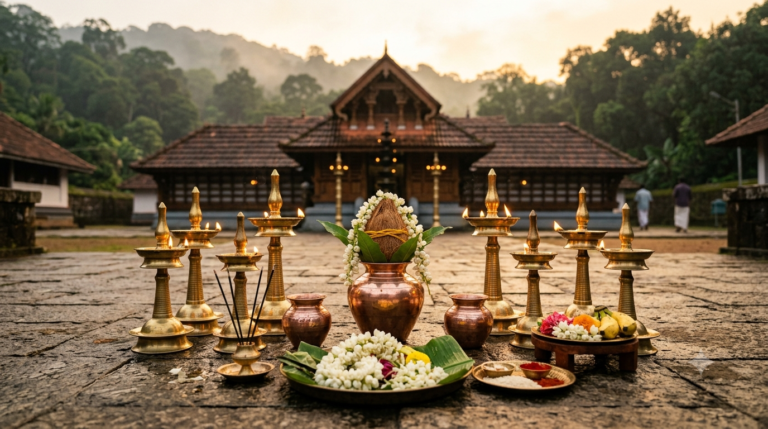
- Preparation: the family cleans the space, gathers the samagri, and engages a qualified priest.
- Achamana and Pranayama: the priest and devotee purify themselves with water and controlled breath.
- Sankalpa: the priest takes a vow, naming the devotee, the gotra, the nakshatra, and the purpose.
- Ganapati Puja: the priest worships Lord Ganesha first, which clears obstacles before the main rite.
- Kalasha Sthapana: the priest installs a sacred pot and invokes Shiva as Tryambaka.
- Agni Pratishthapana: the priest kindles the fire in the homa kunda with camphor, dried coconut, and darbha grass.
- Mantra offerings: priests chant the Maha Mrityunjaya Mantra round after round and pour ghee and herbs into the fire.
- Purnahuti: a final full oblation completes the offerings.
- Deeparadhana and blessings: the priest performs the lamp aarti, then gives holy water and prasad to everyone present.
The chanting forms the core of the whole ceremony. Because a phonetic slip can change a word’s meaning, correct pronunciation matters, and a trained priest leads it for that reason.
What Samagri (Materials) Are Needed
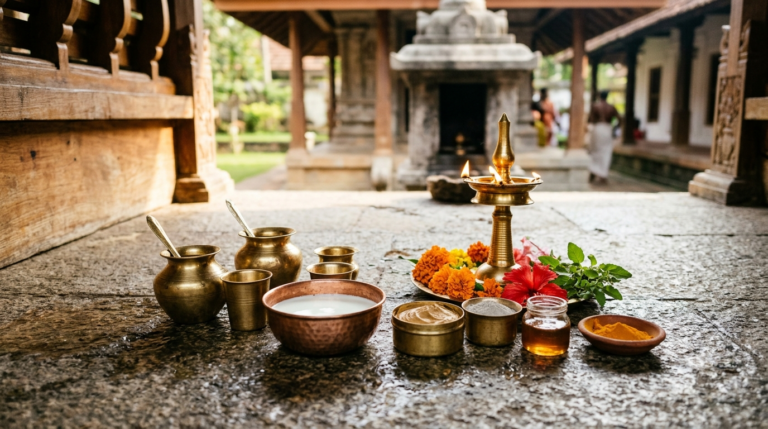
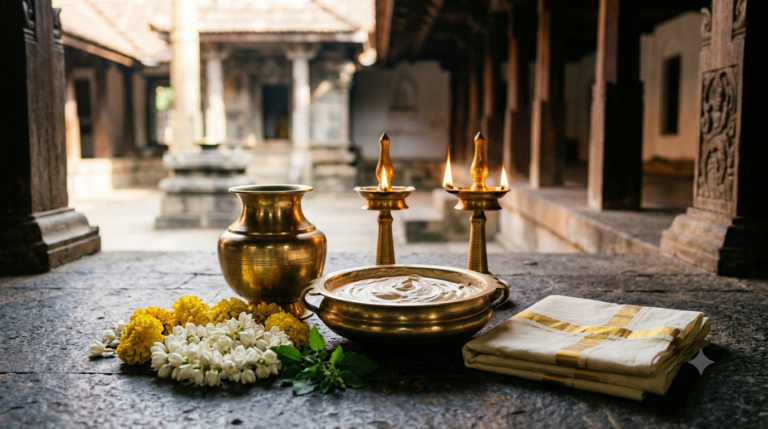
The samagri list is simple, yet each item has a role. Your priest will usually bring most of it, although you should confirm this while booking.
- Ghee and firewood (samidha) for the sacred fire.
- Durva or darbha grass, which stands for good health and long life.
- Bilva leaves and flowers, which Lord Shiva holds dear.
- Camphor, incense, and dried coconut to light and sustain the flame.
- Fruits and other offerings for the final oblation.
How Many Times Is the Mantra Chanted?
The count depends on the scale you choose and on the priest’s guidance. A short homam repeats the mantra 108 times. Larger versions run to 1,008, 11,000, or even 1.25 lakh recitations for a full anushthana.
Priests use a rudraksha mala to keep the count, and they often chant in groups to reach a large target in time. Naturally, the bigger the count, the longer the ritual and the more priests it needs.
Maha Mrityunjaya Homam Cost: What to Expect
There is no single official price for this ritual, and any site that quotes one fixed rate is oversimplifying. The cost shifts with the scale, the number of priests, the materials, and your city.
As a rough guide, a modest household homam with a 108-to-1,008 count often starts from a few thousand rupees. An extended ceremony with several priests can reach ₹15,000 to ₹25,000 or more. A full 1.25 lakh anushthana, spread over days, costs a good deal more.
Treat these figures as indicative ranges rather than quotes, because you and the priest or temple settle the real price privately. Always ask what the package covers, since some include samagri and prasad while others charge extra.
Be wary of any online offer that promises a guaranteed result for a small fee. The ritual is an act of faith, and no honest priest will sell you certainty over death or disease.
At Home or at a Temple: Which Suits You?
Both settings work, so the right choice comes down to your goal and your resources. Each option carries clear trade-offs.
A homam at home feels personal, and it lets the whole family take part in a familiar space. You will still need a priest, proper ventilation, and enough room for a safe fire. A temple homam, by contrast, offers a consecrated setting and priests who perform such rituals often.
For a large anushthana, a temple or a dedicated ritual hall usually works better, because it needs space, several priests, and long hours. For a simple prayer of protection, a well-conducted homam at home can feel just as meaningful.
Practical Tips Most Guides Skip
A few grounded pointers will make the day smoother and safer. These are the details that first-timers tend to miss.
Keep fire safety front of mind, since a homam uses an open flame indoors. Ensure good ventilation, keep children and flammable items away from the kunda, and keep water or sand within reach. Anyone with asthma or a breathing condition should sit where the smoke is thinner.
If the ritual involves fasting, older adults, pregnant women, and people with diabetes should take a doctor’s advice first. A fast should never put anyone’s health at risk.
Choose your priest with care, because skill and sincerity vary. Ask about experience, agree the count and the cost in advance, and avoid anyone who guarantees miracles. To compare rituals, our guides on the Lakshmi Narasimha Homam and the Chandi Homam show how other fire ceremonies differ in purpose and scale.
Before You Arrange the Homam
The Maha Mrityunjaya Homam ranks among the most cherished Shiva rituals, and its appeal is easy to understand. It carries an ancient mantra, a moving legend, and a heartfelt prayer for life and peace. Guided by a good priest, it can bring genuine comfort to a worried family.
Keep your expectations honest and your approach safe. Treat the ritual as faith and support, keep medical care where it belongs, and arrange everything through a trusted priest or temple. Approached this way, the homam becomes a source of strength rather than false hope.
Frequently Asked Questions
What is the main purpose of the Maha Mrityunjaya Homam?
The main purpose is to seek Lord Shiva’s protection from untimely death, illness, and fear. Devotees also perform it for longevity, peace of mind, relief from certain doshas, and spiritual growth. These remain traditional aims of faith, not guaranteed outcomes.
Which mantra is chanted during the homam?
Priests chant the Maha Mrityunjaya Mantra, which begins “Om Tryambakam Yajamahe.” It comes from the Rigveda (7.59.12) and also appears in the Yajurveda and Atharvaveda. They repeat it 108, 1,008, or many more times, depending on the scale you choose.
Can the homam cure diseases?
No. The homam is a devotional ritual, not a medical treatment, and it cannot cure disease. Claims that it or durva grass heals conditions like cancer are false. Always continue proper medical care and follow your doctor’s advice.
What are the best days to perform it?
Mondays, Pradosham days, the month of Shravan, and Maha Shivaratri rank as most auspicious, since all connect to Lord Shiva. A priest may also fix the date using the beneficiary’s birth star for more personal timing.
How long does the ritual take?
A modest homam usually takes a few hours. Larger ceremonies with higher chant counts can run five to six hours. A full 1.25 lakh anushthana may stretch across a full day or several days.
How much does the Maha Mrityunjaya Homam cost?
There is no fixed price. A simple household homam often starts from a few thousand rupees, while an elaborate multi-priest ceremony can reach ₹25,000 or more. Confirm the exact cost, and what it includes, directly with your priest or temple.
Can the homam be performed at home?
Yes, you can hold a homam at home with a qualified priest, good ventilation, and a safe space for the fire. Many families prefer it for a personal touch, though large versions suit a temple or ritual hall better.
Who should perform the chanting?
A trained Vedic priest should lead the chanting, because correct pronunciation and fire handling matter. The mantra’s rhythm and sound carry the prayer, so experienced guidance keeps the ritual proper and safe.