The famous Hanuman temples in South India draw millions of devotees every year. Yet most visitors know only two or three of them by name. This guide maps the ones worth your travel time, because each shrine carries its own legend, idol form, and practical quirks.
You will also learn a fact many listicles skip. A single 15th-century saint, Sri Vyasaraja, is traditionally credited with 732 Anjaneya idols across the region. So the trail of Hanuman temples in South India is not random at all. It follows a devotional map laid down five centuries ago.
Sri Vyasa Pooja is an independent devotional guide. We are not affiliated with, endorsed by, or the official website of any temple, trust, or endowment board. We do not accept bookings, donations, or payments. For darshan, sevas, and official timings, please use the official temple portals linked below.
Hanuman Temples in South India at a Glance
- Most idols face devotees standing or flying, though a rare few, like Hampi’s Yantrodharaka Hanuman, show him seated in meditation.
- Entry is almost always free, and most shrines run on a walk-in queue, so you rarely need an online ticket for Hanuman darshan.
- Tuesdays and Saturdays are the busiest days, since devotees consider both auspicious for Anjaneya worship.
- Several sites involve steps or a forest trek, so carry water and wear proper footwear before you climb.
- The Vyasaraja lineage connects many of these shrines, which is why the region holds such a dense cluster of Anjaneya temples.
What Makes the Hanuman Temples in South India Special?
The Hanuman temples in South India stand apart in form. Devotees here worship him as Anjaneya, and the idols often carry a darker, stone-black look rather than the orange seen up north. They also tie the region to the Ramayana, since the vanara kingdom of Kishkindha sits near modern Hampi.
There is also a philosophical thread. Many shrines belong to the Madhwa (Dvaita) tradition, which reveres Hanuman as Mukhya Prana, the chief life-force. Because of this, devotees honour him as a teacher and guardian, not only as Rama’s messenger. This blend of epic geography and living philosophy gives the southern trail its unusual depth.
Vyasaraja and the 732 Hanuman Temples in South India
The single most overlooked story behind the Hanuman temples in South India is Sri Vyasaraja. Devotees also call him Vyasatirtha, and he lived from 1447 to 1539. He served as Rajaguru of the Vijayanagara Empire and a towering Dvaita philosopher during the reign of Krishnadevaraya.
Tradition holds that Vyasaraja consecrated 732 Anjaneya idols across the south. The first, and most famous, is the Yantrodharaka Hanuman at Hampi. A complete verified list of all 732 has never survived. So treat the number as a devotional tradition, not a documented census.
Still, the pattern is real, because Anjaneya shrines cluster thickly through Karnataka and Andhra wherever Vijayanagara influence reached. If you want the fuller account, our history of the Yantrodharaka Hanuman Temple and Stotram covers the legend in detail.
The Most Famous Hanuman Temples in South India, State by State
Below are the shrines most pilgrims ask about, grouped by state so you can plan a realistic route. Each entry notes the idol, the legend, and the on-ground detail that matters when you actually visit.
Yantrodharaka Hanuman Temple, Hampi (Karnataka)
This is the temple that started the trail. Vyasaraja is said to have sketched Hanuman in charcoal for twelve days. On the twelfth day the Lord appeared, asking to be fixed within a six-cornered yantra.
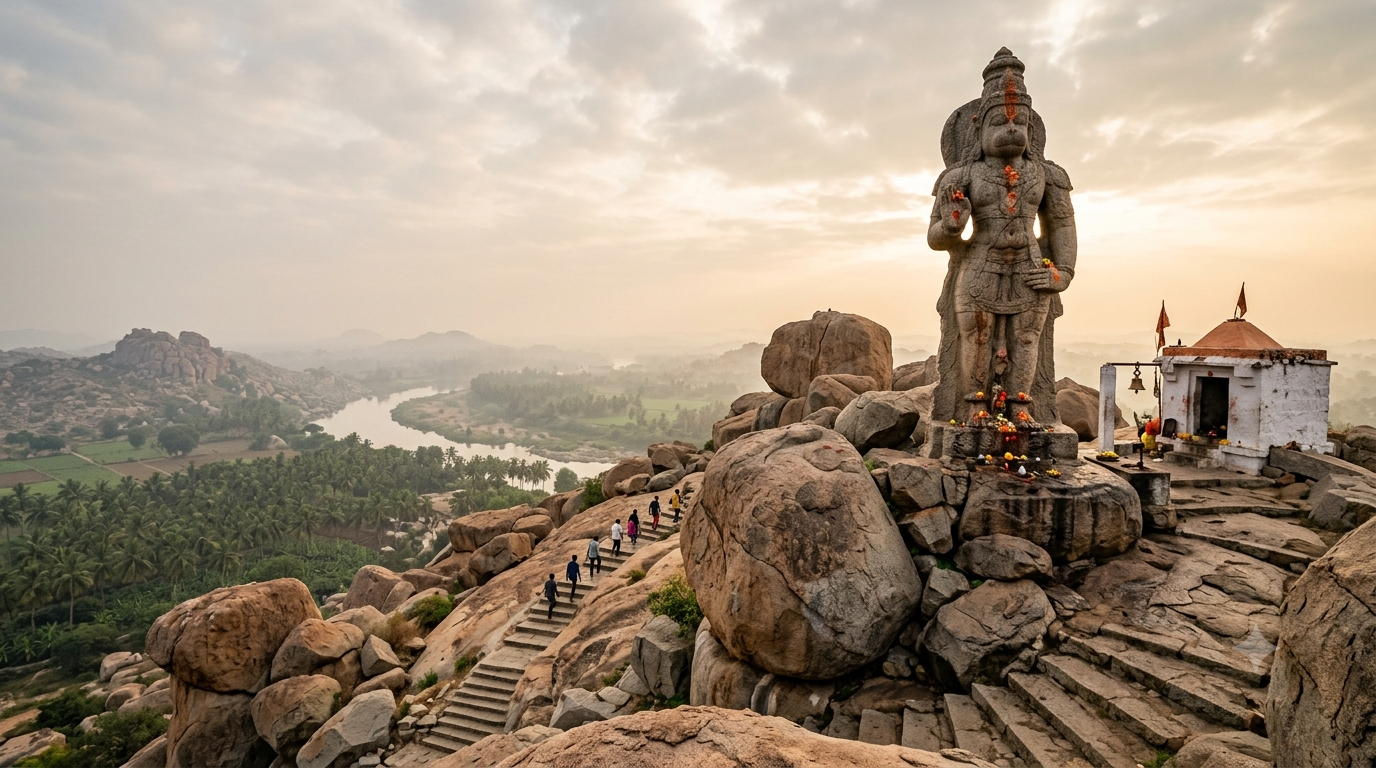
Consequently the idol sits in padmasana, ringed by twelve small monkeys. That makes it the only major southern Hanuman shown in meditation. The temple crowns Anjanadri Hill near the Tungabhadra, so a climb is part of the darshan.
Anjanadri Hill, Anegundi (Karnataka)
Many devotees believe Anjanadri Hill is the birthplace of Hanuman, since it sits in the Kishkindha region of the Ramayana. The claim is traditional and locally cherished, although other sites also claim the birthplace, so it remains a matter of faith rather than settled fact. You reach the white hilltop shrine after climbing more than 570 steps, and the sunrise view over Hampi rewards the effort.
Namakkal Anjaneyar Temple (Tamil Nadu)
The Namakkal Anjaneyar Temple houses an 18-foot idol carved from a single stone. Remarkably, it stands under open sky, with no roof over the sanctum. The legend ties it to Narasimha, whom Hanuman reportedly worships from a fixed axial line.
Timings usually run morning and evening, with a midday closure, so confirm the current hours before you arrive. Our page on Namakkal Hanuman temple timings tracks the seva schedule.
Nanganallur Anjaneyar Temple, Chennai (Tamil Nadu)
Here a 32-foot Anjaneya, sculpted from one piece of granite, rises inside a 90-foot tower. It ranks among the tallest single-stone Hanuman idols in the country. Because the temple sits in a residential Chennai suburb, it is easy to reach and stays busy on weekends. Priests consecrated the idol in 1995, so the shrine is modern even though the devotion runs deep.
Japali Anjaneya Swamy Temple, Tirumala (Andhra Pradesh)
Tucked into the Seshachalam forest near Tirumala, the Japali Anjaneya shrine holds a Swayambhu, or self-manifested, idol of Hanuman. Sage Japali is said to have done penance here, and pilgrims often add it to a Tirumala trip. Reaching it needs a short trek of about a kilometre through the woods, with roughly 150 steps. Entry is free, though timings can vary by season, so check on-site or through our history of Japali Theertham before planning.
Paritala Anjaneya Temple (Andhra Pradesh)
Beside the highway near Vijayawada stands the towering Paritala Anjaneya, a roughly 135-foot statue unveiled in 2003. When it opened, it ranked among the tallest Hanuman statues in the world. Taller ones have since appeared elsewhere.
Entry is free and you need no ticket, so many families stop here while driving through. For the details, see our Paritala Anjaneya darshan timings guide.
Panchamukhi Anjaneya Temple, Mantralayam (Andhra–Karnataka border)
Near Mantralayam, on the Tungabhadra, sits the Panchamukhi Anjaneya, the five-faced form of Hanuman. Sri Raghavendra Swamy reportedly meditated at this spot for twelve years before settling at Mantralayam. So the shrine matters greatly to Madhwa devotees, and it links neatly to the Vyasaraja lineage described above. You can read more on our Panchamukhi Anjaneya Mantralayam timings page.
Kondagattu Anjaneya Swamy Temple (Telangana)
In the hills near Jagtial, the Kondagattu Anjaneya Swamy Temple has drawn devotees for more than three centuries. People visit especially for relief from doshas and negative influences, and the 40-day deeksha here is well known. Because it sits on a hill, plan for some walking. Our Kondagattu Anjaneya guide covers the darshan and sevas.
Hanuman Temples in South India: Timings and Entry Compared
The table below gives a quick, honest snapshot. Timings shift on festival days and by season, so always verify the current schedule on the official portal before you travel.
| Temple | State | Entry | Access |
|---|---|---|---|
| Yantrodharaka, Hampi | Karnataka | Free | Hill climb |
| Anjanadri, Anegundi | Karnataka | Free | 570+ steps |
| Namakkal Anjaneyar | Tamil Nadu | Free | Easy, in town |
| Nanganallur | Tamil Nadu | Free | Easy, city |
| Japali, Tirumala | Andhra Pradesh | Free | 1 km forest trek |
| Paritala Anjaneya | Andhra Pradesh | Free | Roadside, easy |
| Kondagattu | Telangana | Free | Hill, some steps |
Notice the common thread: entry is free almost everywhere. Because these are living devotional sites and not ticketed monuments, you generally walk in and join the queue.
Do You Need to Book Online for Hanuman Darshan?
For most of these shrines, no online booking exists, and you simply join the walk-in queue. This corrects a common myth, since several aggregator sites advertise “online darshan booking” portals that do not actually exist for these temples. The one exception is Tirumala, where the main Venkateswara darshan uses the official TTD system, though the nearby Japali forest shrine stays free and unticketed. When a site asks you to pay a fee to “book” a free temple, treat it as a warning sign.
How to Reach and Plan the Hanuman Temples in South India
Grouping by geography saves days of backtracking. Hampi, Anjanadri, and Mantralayam sit close enough for one Karnataka–Andhra border circuit. Tirumala’s Japali pairs naturally with a Tirupati pilgrimage. Namakkal and Nanganallur fall on a practical Tamil Nadu loop between Salem and Chennai.
Hospet, about 13 km from Hampi, is the rail gateway for the Vyasaraja cluster. Tirupati serves the Tirumala shrines, while Chennai and Salem anchor the Tamil Nadu temples. Because road connectivity is good across the south, a hired car often beats piecing together buses when you visit several shrines in one trip.
Best Time to Visit, Plus a Safety Note
Winter, from November to February, is the most comfortable season, since the southern sun turns harsh by late morning. Hanuman Jayanti and Ram Navami bring huge crowds, so arrive at dawn on those days if you want a calm darshan.
A few of these shrines demand real physical effort. Anjanadri has 570-plus steps, Yantrodharaka sits atop a hill, and Japali needs a forest trek. So carry water, wear grippy footwear, and pace yourself in the heat. Elderly pilgrims, pregnant women, and anyone with heart or knee trouble should weigh the climb honestly.
Monkeys roam many of these sites, so guard food, spectacles, and phones. Faith is the heart of every visit. Yet it is no substitute for medical care, so consult a doctor before a hard climb if your health is fragile.
What Most Temple Guides Leave Out
First, the idol posture tells a story. When you see a rare seated, meditating Hanuman, as at Hampi, you are almost always looking at a Vyasaraja-linked shrine, because that meditative form is his signature.
Second, timing beats luck. Visit early on a weekday, and you skip both the heat and the Tuesday–Saturday rush. Third, look for the Rama connection nearby, since southern Hanuman shrines often sit within walking distance of a Rama or Narasimha temple, and pairing them completes the story. For a wider list, our Mulbagal Anjaneya Swamy guide adds another Vijayanagara-era shrine worth the detour.
Before You Set Out
The Hanuman temples in South India reward planning far more than a rushed checklist. Pick a cluster, verify current timings on the official portal, and build in time for the climbs. If you can visit only one, make it Hampi’s Yantrodharaka, since it anchors the whole southern tradition. Then let the Vyasaraja trail pull you onward to the rest.
Frequently Asked Questions
Which is the most famous of the Hanuman temples in South India?
The Yantrodharaka Hanuman Temple at Hampi is the most historically significant, because it is traditionally the first of Sri Vyasaraja’s 732 Anjaneya installations. Namakkal and Nanganallur are the most famous for their giant idols. Each draws heavy footfall, especially on Tuesdays and Saturdays.
Where is the birthplace of Hanuman in South India?
Many devotees believe Anjanadri Hill near Anegundi and Hampi is Hanuman’s birthplace, since it lies in the Kishkindha region of the Ramayana. However, other locations also claim this honour, so it remains a matter of faith. The Anjanadri shrine needs a climb of over 570 steps.
Are the Hanuman temples in South India free to enter?
Yes, entry is free at almost every major Hanuman shrine in the south. Most run on a walk-in queue, so you rarely need a ticket. Special sevas may carry a small fee, which you pay at the official counter.
Do I need to book darshan online for these temples?
For most Hanuman temples, no online booking exists, and you simply join the queue. Only Tirumala’s main Venkateswara temple uses the official TTD booking system. Be cautious of websites claiming to “book” free temples for a fee.
Which South Indian Hanuman idol is the tallest?
The Paritala Anjaneya near Vijayawada, at about 135 feet, was among the tallest when unveiled in 2003. Namakkal’s 18-foot open-air idol and Nanganallur’s 32-foot single-granite idol are the most celebrated carved forms. Builders have since raised taller statues elsewhere in India.
What is the best time to visit Hanuman temples in South India?
Winter, from November to February, offers the most pleasant weather. Early weekday mornings are ideal, because you avoid both the heat and the Tuesday–Saturday crowds. Hanuman Jayanti is spiritually rich but very crowded.
Why are so many Hanuman temples clustered in Karnataka and Andhra?
The concentration traces to Sri Vyasaraja, the Vijayanagara Rajaguru, who reportedly installed 732 Anjaneya idols. His influence spread across the empire’s heartland in Karnataka and Andhra. As a result, the Vyasaraja trail still shapes the southern Hanuman map today.
Official Sources
For accurate, current information, always rely on official portals. For Tirumala and Japali, use the Tirumala Tirupati Devasthanams (TTD) website. For Tamil Nadu shrines like Namakkal, refer to the Tamil Nadu Hindu Religious and Charitable Endowments (HR&CE) Department. For Hampi and Karnataka temples, see Karnataka Tourism.