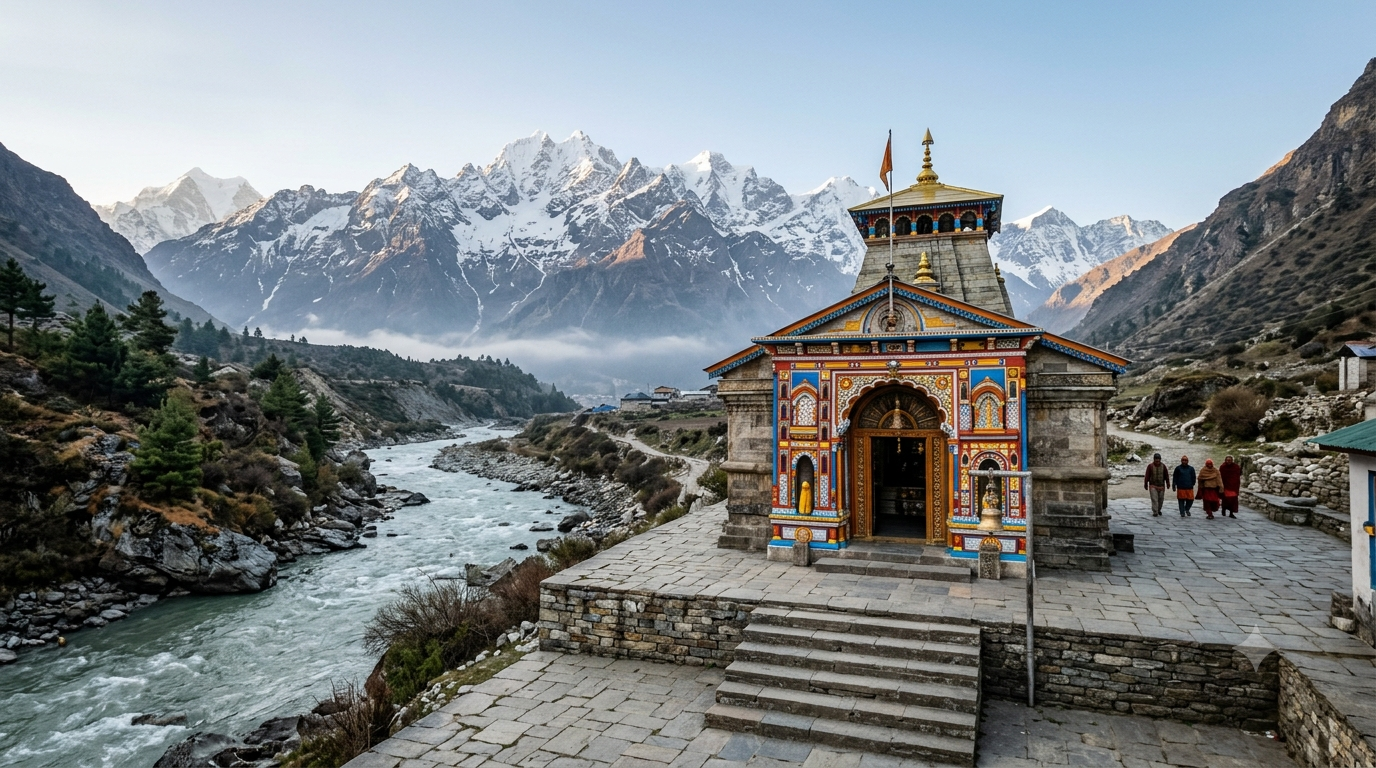
The Badrinath Temple sits at 3,133 metres in the Garhwal Himalayas. For the 2026 season it reopened on 23 April at 6:15 AM. The doors stay open until roughly mid-November, when winter snow seals the valley again.
If you are planning a visit, you mostly want four things. You want to know when it opens, what darshan costs, which special poojas you can book, and the story behind this ancient Vishnu shrine. This guide to the Badrinath Temple answers all four in one place, because most pages online give you only fragments. Worse, several still repeat prices the temple committee no longer charges.
One fact upfront clears up the biggest confusion. General darshan at Badrinath is completely free. You pay only if you choose a special pooja or aarti, and even then the rates are fixed and published by the temple itself.
Badrinath Temple at a Glance
- Location: Chamoli district, Uttarakhand, on the banks of the Alaknanda River.
- Deity: Lord Vishnu as Badri Vishal (Badrinarayan), a black Shaligram-stone idol in meditative pose.
- 2026 season: opened 23 April, closes tentatively 13 November (Bhai Dooj).
- Daily darshan: from 4:30 AM, with a midday break, until the night aarti near 8:30–9:00 PM.
- Entry: free for general darshan; special poojas range from ₹151 to about ₹35,000.
- Registration: mandatory and free, done online before you travel.
Badrinath Temple History and Significance
The Badrinath Temple history stretches back well over a thousand years, though the shrine you see today has been rebuilt many times. According to tradition, the 8th-century philosopher Adi Shankaracharya re-established worship here. He is believed to have recovered a black stone idol of Badrinarayan from the Alaknanda River. He then enshrined it in a cave near the Tapt Kund hot spring.
The site appears in older scriptures too, so its sacred status is far more ancient than the stonework. The Mahabharata links Badrinath to the Pandavas’ final journey, while the Vishnu Purana names it as the penance ground of the twin sages Nar and Narayana. Because Lord Vishnu is said to have meditated here, the valley earned the name Badri Vishal.
Who Built the Present Badrinath Temple?
No single builder created the temple. Adi Shankaracharya revived the worship, and later the Garhwal kings moved the idol to the present structure around the 16th century. After the 1803 Himalayan earthquake damaged the shrine, the King of Jaipur funded its restoration. So the building today is the product of many hands across many centuries.
One tradition has continued unbroken since Shankaracharya’s time. The Rawal, or head priest, must be a Namboodiri Brahmin from Kerala. This southern lineage serving a northern Himalayan shrine is a living thread of Adi Shankara’s pan-Indian vision. It is the same vision behind the Vishnu Panchayatana worship tradition he popularised.
Architecture of the Shrine
The Badrinath Temple rises about 50 feet, built in a Garhwali style of stone and wood with a brightly painted facade. A small cupola tops the conical sanctum roof, finished with a gold-gilt covering. The colourful front, broad stairway, and arched gateway, called the Singhdwar, give the shrine its distinctive look against the snow.
Inside, the Badrinath Temple divides into three parts. The Garbha Griha holds the main idol of Badri Vishal under a gold canopy. Then comes the Darshan Mandap, where the rituals happen.
After it sits the Sabha Mandap, a pillared hall where devotees gather. Smaller shrines to Lakshmi, Kubera, Garuda, and Nar-Narayana fill out the complex.
Badrinath Temple Timings and Aarti Schedule
Badrinath Temple timings run from early morning to night, with a short midday recess. The doors open at 4:30 AM for the Maha Abhishek, the grand morning ritual bathing of the idol. General darshan usually begins around 7:00 AM and continues until about 1:00 PM, when the temple pauses for bhog and rituals.
Darshan resumes in the afternoon and runs through the evening. The day closes with the Shayan Aarti, the bedtime aarti, near 8:30 PM, after which the temple shuts around 9:00 PM. These hours can shift slightly through the season, so confirm on the day if your slot is tight.
| Session | Approx. Time | What Happens |
|---|---|---|
| Temple opens | 4:30 AM | Maha Abhishek begins |
| Morning darshan | 7:00 AM – 1:00 PM | General queue darshan |
| Midday break | 1:00 PM – 3:00 PM | Bhog and rituals |
| Evening darshan | 4:00 PM – 8:30 PM | General darshan resumes |
| Shayan Aarti | ~8:30 PM | Night aarti, then closing |
From experience, the calmest darshan is a weekday slot between 7:00 and 8:00 AM. During peak May and June, queues form before 6:00 AM. An early start matters, because waiting times can cross two hours on the busiest days.
Badrinath Temple Entry Cost: Is There a Fee?
There is no entry fee for general darshan at the Badrinath Temple. Anyone can join the regular queue and see Lord Badri Vishal without paying a single rupee. You spend money only when you choose an optional special pooja, aarti, or path, or if you make a donation. The sanctity of the shrine never depends on a paid ticket.
This matters because many websites blur the line between a free temple and the paid yatra services around it. Helicopter rides, premium tour packages, and special poojas all cost money. Walking in for darshan does not. Keep the two separate when you budget your trip.
Special Pooja and Aarti Rates at Badrinath
If you want a closer ritual experience, the Badrinath-Kedarnath Temple Committee (BKTC) offers a fixed menu of poojas. The money goes into the temple treasury and funds upkeep and pilgrim welfare. Below are the published rates, which the committee revises from time to time.
| Pooja / Aarti | Rate (per person) | Timing |
|---|---|---|
| Maha Abhishek | ₹4,300 | 4:30 – 6:30 AM |
| Abhishek Puja | ₹4,101 | 4:30 – 6:30 AM |
| Geeta Path | ₹2,500 | Daytime |
| Ved Path | ₹2,100 | Daytime |
| Shayan Aarti | ₹3,100 | Evening |
| Vishnusahasranam Path | ₹456 | Daytime |
| Swarna Aarti | ₹376 | Evening |
| Kapoor Aarti | ₹151 | Evening |
| Akhand Jyoti (one day) | ₹1,451 | — |
| Shrimad Bhagwat Saptah Path | ₹35,101 | Multi-day |
To state the headline numbers plainly: the Maha Abhishek costs ₹4,300 per person and the Kapoor Aarti just ₹151. The week-long Shrimad Bhagwat Saptah Path is the priciest at ₹35,101. Only one person is generally allowed per special pooja slot, so book separately for each family member.
Correcting the Pricing Confusion
Here is where many guides go wrong. Several blogs quote the Maha Abhishek at ₹4,700 or even ₹5,500, and some claim a 2026 price hike. The committee’s own published chart, however, lists ₹4,300.
Because rates do change between seasons, treat any figure as indicative. Confirm the live amount on the official portal before you pay. If a page shows a number with no source, be cautious.
Beware of Fake VIP Pass Agents
Every season, agents on WhatsApp and Instagram sell “VIP Badrinath passes” at inflated prices, and many are simply fake. The temple committee publishes its rates openly, so nobody needs a middleman. Book only through the official BKTC website, since fraudulent screenshots fail verification at the gate. If an unsolicited offer reaches you, ignore it.
How to Book a Badrinath Temple Pooja Online
Online pooja booking is straightforward once your yatra registration is done. The official platform is the BKTC portal, and the steps below take only a few minutes.
- Complete the free Uttarakhand yatra registration first, because the temple needs your QR pass.
- Visit badrinath-kedarnath.gov.in and create an account with your mobile number and OTP.
- Choose “Book Puja,” select Badrinath Dham, then pick your pooja and date slot.
- Enter pilgrim details with a photo ID, such as Aadhaar.
- Pay online, then download the QR-coded receipt and keep it on your phone.
All bookings are non-refundable and non-transferable, so confirm your travel dates before you pay. For a deeper walkthrough of the flagship ritual, see this dedicated guide to Maha Abhishek Puja booking at Badrinath.
Registration: The Free Step Many Pilgrims Miss
Yatra registration is mandatory for every pilgrim, yet it is entirely free. You must register before you travel, because checkpoints at Rishikesh and Joshimath verify your QR e-pass before you reach the Badrinath Temple. Register through the Uttarakhand Tourist Care portal or its app, and you receive a scannable pass within minutes.
Do not confuse this free pass with any temple fee. The registration covers crowd control and safety for the whole Char Dham circuit, while pooja charges are a separate, optional matter handled by the BKTC. Both systems run in parallel, so complete the free one and pay only for what you actually choose.
How to Reach Badrinath Temple
The Badrinath Temple is well connected by road, although the mountain drive is long. The nearest airport is Jolly Grant in Dehradun, roughly 317 km away, while the nearest major railhead is Rishikesh, about 295 km from the shrine. From either point, taxis and buses run the rest of the way.
The road route climbs through Rishikesh, Devprayag, Rudraprayag, Karnaprayag, and Joshimath before reaching Badrinath. Because it covers around 320 km from Haridwar over 10 to 12 hours, most pilgrims split the journey with an overnight halt. Helicopter packages also operate from Dehradun for those short on time. Fares run high and change often, so check current rates and road updates on Uttarakhand Tourism before booking.
What First-Time Pilgrims Get Wrong
Altitude is the most underrated risk. At 3,133 metres the air is thin, so give yourself a day to acclimatise and carry basic altitude medicines. Even in summer the morning temperature can drop near 5°C. The famous Tapt Kund hot spring, by contrast, runs scorching hot, so step in carefully before your Badrinath Temple darshan.
Two practical tips save real trouble. First, carry enough cash, since mountain mobile networks are patchy and UPI may fail when you need it. Second, do not rush back after darshan. The village of Mana sits just 3 km ahead, with the Saraswati River’s source, Vyas Gufa, and the rock bridge known as Bheem Pul.
Wear thick socks too, as the stone floors turn freezing at dawn and scorching by noon.
The opening day deserves a note of its own. Crowds on 23 April are enormous, and waiting can stretch past three hours. If you want a peaceful darshan, arrive a few days after the kapat opening rather than on the day itself.
Before You Go
The Badrinath Temple rewards a little planning. Remember that darshan is free and registration is free. Only special poojas carry a fixed, published charge.
So verify dates and rates on the official portals, and book special rituals well ahead for May and June. Budget time to acclimatise as well. The opening this year fell within the auspicious Akshaya Tritiya window. Plan well, travel safe, and the rest is darshan.
Frequently Asked Questions
Is there any entry fee for Badrinath Temple darshan?
No, general darshan at the Badrinath Temple is completely free. You join the regular queue without paying anything. You spend money only if you book an optional special pooja, aarti, or path, or if you make a donation.
What are the Badrinath Temple opening and closing dates in 2026?
For 2026, the temple opened on 23 April at 6:15 AM. The closing date is tentatively 13 November 2026, on Bhai Dooj, with the exact date announced officially on Vijayadashami in October. The shrine stays shut through winter due to heavy snow.
How much does the Maha Abhishek pooja cost at Badrinath?
The published BKTC rate for the Maha Abhishek is ₹4,300 per person, performed between 4:30 and 6:30 AM. Some blogs quote higher figures, so always confirm the current amount on the official badrinath-kedarnath.gov.in portal before paying.
Is registration mandatory to visit Badrinath?
Yes, yatra registration is mandatory for every pilgrim, but it is free. Register online through the Uttarakhand Tourist Care portal before you travel, because your QR e-pass is checked at Rishikesh and Joshimath on the way up.
Where is the idol worshipped when Badrinath is closed?
During the six-month winter closure, the idol of Lord Badri Vishal is worshipped at the Narasimha Temple in Joshimath, about 45 km below Badrinath. Worship continues there until the temple reopens in spring.
How do I reach Badrinath Temple from Delhi or Haridwar?
From Haridwar, Badrinath is roughly 320 km by road, taking 10 to 12 hours via Rishikesh, Rudraprayag, and Joshimath. From Delhi it is about 525 km, so most pilgrims split the drive over two days. The nearest airport is Jolly Grant in Dehradun.
What is the best time to visit Badrinath Temple?
The best windows are mid-May to mid-June and mid-September to late October, when the weather is clearer and roads are safer. Avoid the July–August monsoon, since landslides are common on the mountain routes during that period.
Can I book Badrinath special pooja at the counter instead of online?
Yes, offline booking is available at the designated counter near the temple, subject to slot availability. Carry a valid government photo ID. During peak season, though, online slots and counter slots both fill fast, so booking ahead is safer.