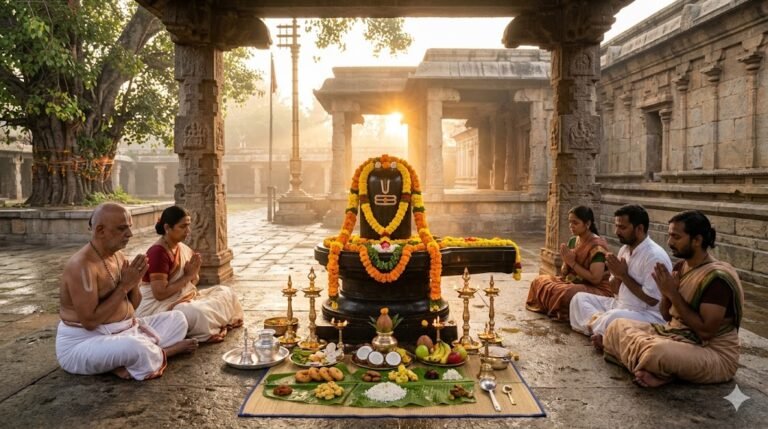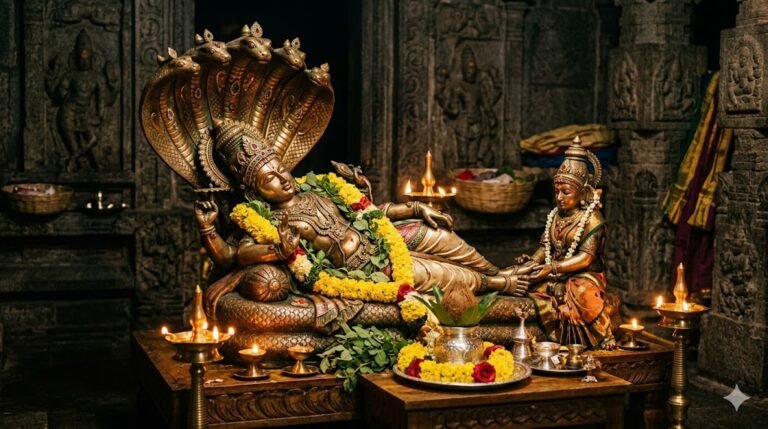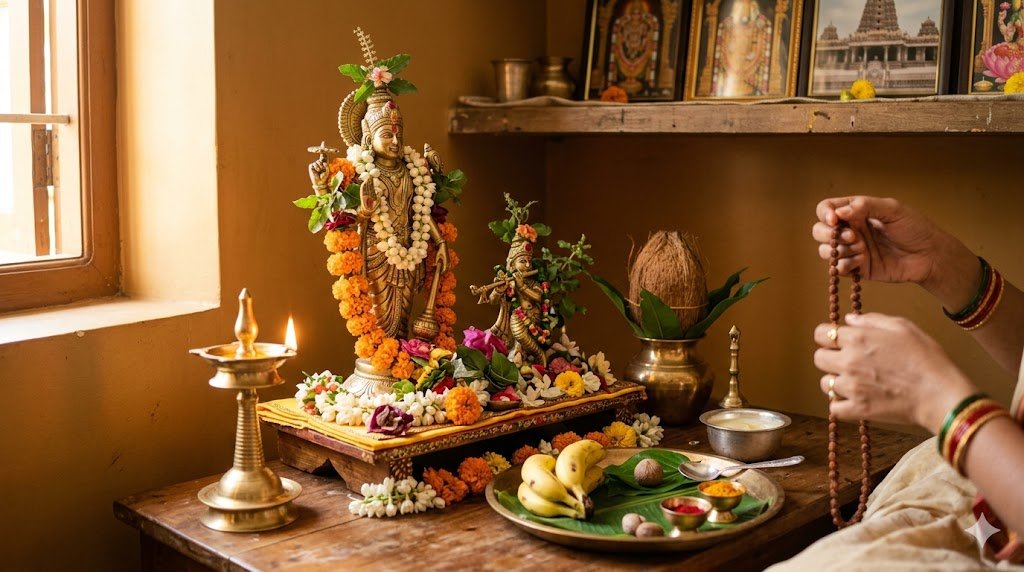
Adhika Maasa Begins Date 2026 is Sunday, May 17, ending Monday, June 15. Find precise tithi, sunrise, end timings & Purushottam Maas vrat rules here.
Adhika Maasa Begins Date in 2026 falls on Sunday, 17 May 2026, marking the start of the rare 13th lunar month known as Purushottam Maas or Mala Maas. The sacred month concludes on Monday, 15 June 2026, spanning a full 30-day window dedicated to Lord Vishnu and Lord Krishna. This year carries unusual weight because Jyeshta Masam appears twice — first as Adhika Jyeshta, then as Nija Jyeshta — making 2026 a 13-month Vikram Samvat year. For devotees in Andhra Pradesh, Telangana, Karnataka, Maharashtra, Gujarat, and across North India, the timing is identical: 17 May to 15 June.
Quick Summary at a Glance
- Adhika Maasa Begins Date 2026: Sunday, 17 May 2026
- End Date: Monday, 15 June 2026
- Adhika Amavasya Tithi: 16 May, 5:11 AM to 17 May, 1:31 AM IST
- Adhika Jyeshta Shukla Padyami at sunrise: 17 May 2026
- Samvatsara: Sri Parabhava Nama Samvatsaram
- Adhika Purnima: Sunday, 31 May 2026
- Adhika Amavasya (closing): 14–15 June 2026
- Presiding Deity: Lord Vishnu (Purushottam form) and Lord Krishna
- Frequency: Once every 32–33 months
Why the Adhika Maasa Begins Date Matters in 2026
Adhika Maasa is the calendar’s correction mechanism. The lunar year runs 354 days while the solar year stretches 365 days, leaving an 11-day gap each year. Therefore, every 32 to 33 months, an extra lunar month is inserted to keep the two systems aligned.
However, this is not a routine adjustment in spiritual terms. Sages dedicated this orphan month to Lord Vishnu, who accepted it as His own. As a result, the month earned the name Purushottam Maas — the month of the Supreme Being.
Significance of the 2026 Adhika Jyeshta
Notably, the 2026 Adhika Maasa coincides with Jyeshta Masam, creating a double-Jyeshta year. Specifically, Adhika Jyeshta runs from 17 May to 15 June, followed by Nija Jyeshta from 17 June to 15 July. Devotees believe every punya act performed during this 30-day stretch yields ten times the standard merit.
Furthermore, the Skanda Purana, Padma Purana, and Bhavishya Purana all describe Purushottam Maas as a “sarva-siddhi-dayini” period — capable of granting all spiritual fulfilments. Hence, pilgrims plan major sevas, parikramas, and Bhagavata recitations around this window.
Adhika Maasa Begins Date 2026: Exact Tithi & Sunrise Timings
The technical transition into Adhika Maasa hinges on the new moon (Amavasya) tithi and the following sunrise. For 2026, the Vaishakha Amavasya tithi begins at 5:11 AM on 16 May and ends at 1:31 AM on 17 May, IST.
Therefore, sunrise on 17 May 2026 falls under Adhika Jyeshta Shukla Padyami — officially marking the start of Purushottam Maas. Across Hyderabad, the sunrise on this day is approximately 5:42 AM IST, while in Tirupati it is around 5:44 AM, and in Vijayawada around 5:35 AM.
City-Wise Sunrise on Adhika Maasa Begins Date 2026
| City | Sunrise (17 May 2026) | Sunset (17 May 2026) |
|---|---|---|
| Hyderabad | 5:42 AM | 6:42 PM |
| Tirupati | 5:44 AM | 6:36 PM |
| Vijayawada | 5:35 AM | 6:32 PM |
| Bengaluru | 5:50 AM | 6:40 PM |
| Chennai | 5:42 AM | 6:30 PM |
| Mumbai | 6:01 AM | 7:05 PM |
| Delhi | 5:28 AM | 7:03 PM |
| Kolkata | 4:53 AM | 6:11 PM |
Specifically, the sunrise time matters because all Purushottam Maas vratas — fasting, sankalpa, and daily Vishnu archana — must commence at or before sunrise on the first day. Pilgrims taking 30-day vows should perform sankalp before 7:00 AM local time on 17 May.
Regional Names and Why the Date Stays the Same
Although the Adhika Maasa Begins Date is uniform across most of India, the month carries different names regionally. For instance, Telugu and Kannada traditions call it Adhika Jyeshta Masam, while Marathi households know it as Adhik Jyeshta. North Indians refer to it as Purushottam Maas or Mal Maas.
Interestingly, four Indian states do not observe Adhika Maasa at all. The reason: Tamil Nadu, Kerala, Odisha, West Bengal, and Assam follow the solar Sauramana calendar, which uses the 365-day year and does not require lunar-solar correction. Consequently, no extra month is inserted in those regional almanacs.
Telugu Calendar Notation
In the Telugu Panchangam, the period is split into two pakshas. Adhika Jyeshta Shukla Paksham runs from 17 May (Padyami) to 31 May (Pournami). Then, Adhika Jyeshta Bahula Paksham runs from 1 June to 15 June (Amavasya).
Key Tithis Inside Adhika Maasa 2026
Several tithis within the month carry exceptional spiritual weight. Below are the dates serious sadhakas should mark.
| Tithi | Date 2026 | Significance |
|---|---|---|
| Adhika Jyeshta Shukla Padyami | 17 May (Sun) | Maasa begins, sankalpa day |
| Padmini Ekadashi | 27 May (Wed) | Most powerful Adhika Maasa Ekadashi |
| Adhika Purnima | 31 May (Sun) | Satyanarayana Vrat, full-moon parana |
| Sankashti Chaturthi | 3 June (Wed) | Ganesha vrat |
| Parama Ekadashi | 11 June (Thu) | Closing Ekadashi of Adhika Maasa |
| Adhika Amavasya | 14–15 June | Maasa ends, ancestor tarpan |
Above all, Padmini Ekadashi and Parama Ekadashi are unique to Adhika Maasa — they appear only once every 32 months. Hence, observing both yields the equivalent of decades of regular Ekadashi merit, according to the Padma Purana.
What to Do During Adhika Maasa: A Practical Checklist
The month favours simplicity and inner discipline over external celebration. Here is a practical day-by-day approach used by traditional households.
- Daily Vishnu archana — recite Vishnu Sahasranama or Purusha Sukta after morning bath
- Chant “Om Namo Bhagavate Vasudevaya” 108 times each day, or a full mala
- Read Bhagavata Purana — many devotees complete a Saptaha (7-day reading) within the month
- Light a deepam with sesame or ghee oil before the Vishnu/Krishna idol every evening
- Offer Tulsi leaves daily — Adhika Maasa is dear to Lakshmi-Narayan
- Donate (daan) 33 items on Padmini and Parama Ekadashi — fruits, grains, jaggery, ghee, or clothes
- Observe one-meal-a-day (ekabhukta) on Ekadashi and Purnima
- Avoid non-vegetarian food, alcohol, garlic, and onion for the full 30 days
Additionally, householders who cannot observe the full month-long vrata can fast on Krishna Paksha Ashtami, Navami, Chaturdashi, and Dwadashi — these days are specifically named in the Adhika Masa Mahatmya as substitute punya days.
What NOT to Do During Adhika Maasa
Just as certain karmas multiply in punya, others are explicitly postponed. The list below is consistent across all major Hindu calendar traditions.
- No marriages — Vivaha muhurats are suspended for the full month
- No Griha Pravesh (house-warming) — postpone to Nija Jyeshta or Ashadha
- No Upanayanam (sacred thread ceremony)
- No Annaprashana (first-rice ceremony) — wait until Nija Jyeshta
- Avoid major real-estate purchases or new business launches
- Do not begin or conclude annual fasts (vrata udyapana)
- Avoid Karna Vedha (ear-piercing for infants)
- No new vehicle purchase or housewarming-linked rituals
That said, daily nitya karmas — Sandhyavandanam, Pitru Tarpan, Sraddha for those whose annual death rites fall in this period — continue without interruption. Furthermore, the death-anniversary Sraddha is performed on the corresponding tithi in Nija Jyeshta, not Adhika Jyeshta, unless explicitly indicated by the family’s Acharya.
Adhika Purnima 2026: The Single Most Powerful Day
The full moon of Adhika Maasa falls on Sunday, 31 May 2026. Specifically, the Purnima tithi begins at 9:57 AM on 30 May and ends at 12:14 PM on 31 May. Because Purnima is considered “sarva-siddhi-dayini” within Adhika Maasa, this single day carries the punya of multiple ordinary full moons.
Devotees observe a full-day fast — either nirjala (without water) or with fruits and milk. In the evening, they offer Arghya to Chandra Deva and break the fast. Furthermore, Satyanarayana Katha recitation on this day is believed to clear ancestral karmic debt and bring family peace.
How to Observe Adhika Purnima at Home
- Wake before sunrise (around 4:30 AM) for Brahma Muhurta bath
- Take sankalpa for Satyanarayana Vrata
- Set up the Satyanarayana mandap with banana leaves, fruits, panchamrita
- Recite all five chapters of Satyanarayana Katha during daytime
- Perform Chandra Arghya at moonrise (~7:30 PM IST in South India)
- Distribute prasadam — sheera (sooji halwa with banana) is traditional
- Break fast only after moon darshan
Pilgrimage Destinations to Visit During Adhika Maasa
Pilgrims believe a single parikrama at Krishna’s tirthas during this month equals one lakh ordinary parikramas. Therefore, certain destinations see massive footfall between 17 May and 15 June.
Top Adhika Maasa Pilgrimage Sites
| Destination | Why It Matters | Key Ritual |
|---|---|---|
| Mathura-Vrindavan | Krishna Janmabhoomi & leelas | Banke Bihari darshan, Yamuna aarti |
| Tirumala | Lord Venkateswara as Vishnu | Suprabhata seva, Tomala seva |
| Dwarka | Krishna’s kingdom | Dhwaja arohan at Dwarkadheesh temple |
| Puri Jagannath | Vishnu in Krishna form | Bhog & Mahaprasad |
| Pandharpur | Vitthala = Vishnu | Chandrabhaga snan |
| Badrinath | Vishnu’s tapobhumi | Reopens 4 May 2026 — full month accessible |
Additionally, Mathura-Vrindavan organises 84-kos Braj parikrama specifically for Adhika Maasa pilgrims. The full circuit takes 7 days. Naturally, pilgrims should book accommodation at least 60 days in advance — guest houses fill rapidly for this once-in-32-months window.
Common Mistakes Devotees Make
Even regular practitioners stumble on a few points. Below are the most frequent ones.
- Confusing Adhika Maasa with Shravana Maasa rules — the previous Adhika in 2023 was Shravana; 2026 is Jyeshta. Specifically, Mondays do not carry the same Shiva-fast significance this year.
- Performing weddings before consulting the family Purohit — some “auspicious” lists circulating online wrongly include May–June 2026 muhurats.
- Skipping Padmini Ekadashi thinking it is a regular Ekadashi — it is not, and it occurs only in Adhika Maasa.
- Eating non-vegetarian food on weekends — the rule applies to all 30 days, not just specific tithis.
- Starting a fast and then breaking it mid-month — udyapana (concluding ritual) is itself prohibited in Adhika Maasa, so plan accordingly.
Sankalpa Mantra for the First Day
On Adhika Maasa Begins Date 2026, after the morning bath, devotees take a sankalpa — a formal vow declaring the intent of the month-long observance. Below is the standard format used in South Indian households.
“Mama upatta samasta duritakshaya dwara Sri Parameshwara preetyartham, Sri Parabhava Nama Samvatsare, Uttarayane, Greeshma Ritau, Adhika Jyeshta Mase, Shukla Pakshe, Pratipat Tithau, Bhanuvasare… Sri Vishno aagnya Adhika Masa Niyama Vratam Karishye.”
Furthermore, the sankalpa should be taken between sunrise and 9:00 AM on 17 May 2026. After this, the devotee commits to the chosen niyamas (rules) for 30 days.
What to Expect After Adhika Maasa Ends on 15 June 2026
Once the Adhika Amavasya passes on 15 June, the regular Nija Jyeshta Masam begins on 16 or 17 June (depending on regional reckoning). At that point, all suspended muhurats reactivate. Specifically, marriage muhurats resume from 17 June 2026 onwards.
Notably, the next Adhika Maasa after 2026 falls in 2029 — Adhika Chaitra Masam, in the Sadharana Nama Samvatsaram. Hence, devotees who miss the 2026 window will wait nearly three years for the next Purushottam Maas opportunity.
Final Thoughts
The Adhika Maasa Begins Date 2026 — Sunday, 17 May — opens a 30-day window that arrives only once every 32 months. For serious devotees, this is the time to consolidate spiritual discipline rather than scatter energy across worldly milestones. Most importantly, plan your sankalpa, mark Padmini Ekadashi (27 May), Adhika Purnima (31 May), and Parama Ekadashi (11 June) on your calendar today. If a Mathura-Vrindavan or Tirumala visit fits your travel plans, book accommodation immediately. The Vikram Samvat year 2083 will not see another Adhika month, so make this one count.
Frequently Asked Questions
What is the Adhika Maasa Begins Date in 2026?
Adhika Maasa Begins Date 2026 is Sunday, 17 May 2026. The month ends on Monday, 15 June 2026, spanning a full 30 days. The previous day’s Amavasya tithi ends at 1:31 AM on 17 May, after which Adhika Jyeshta Shukla Padyami takes over at sunrise.
Why is 2026 called a 13-month year?
Hindu lunar years usually have 12 months, but the lunar calendar is 11 days shorter than the solar year. Therefore, every 32–33 months an extra month is inserted. In 2026, this extra month is Adhika Jyeshta, making the Vikram Samvat year 2083 a 13-month year.
Can weddings happen during Adhika Maasa 2026?
No. All vivaha muhurats are suspended between 17 May and 15 June 2026. Auspicious ceremonies like Griha Pravesh, Upanayanam, and Annaprashana are also paused. Nitya karmas and existing fasts continue, but new beginnings are postponed until Nija Jyeshta Masam from 16 June onwards.
Which Ekadashis fall in Adhika Maasa 2026?
Two unique Ekadashis appear: Padmini Ekadashi on Wednesday, 27 May 2026, and Parama Ekadashi on Thursday, 11 June 2026. Both occur only during Adhika Maasa, making them rare and highly meritorious. Devotees who miss them will not see them again until 2029.
Is Adhika Maasa observed in Tamil Nadu and Kerala?
No. Tamil Nadu, Kerala, West Bengal, Odisha, and Assam follow the Sauramana solar calendar, which uses 365 fixed days and does not need lunar correction. Consequently, no Adhika Maasa is inserted in these regional almanacs, though devotees may still observe it personally.
What is the most important day in Adhika Maasa 2026?
Adhika Purnima on Sunday, 31 May 2026 is considered the most powerful day. The full-moon tithi runs from 9:57 AM on 30 May to 12:14 PM on 31 May. Satyanarayana Vrat, Vishnu archana, and full-day fasting on this day yield the highest punya of the entire month.
When is the next Adhika Maasa after 2026?
The next Adhika Maasa falls in 2029, in the Sadharana Nama Samvatsaram, as Adhika Chaitra Masam. After that, Adhika Bhadrapada Masam comes in 2031. Hence, the 2026 window is the only Purushottam Maas opportunity for the next three years.
You May Also Like
- Padmini Ekadashi 2026: Date, Vrat Vidhi & Phala
- Adhika Purnima 2026: Satyanarayana Vrat Procedure
- Mathura Vrindavan Adhika Maasa Yatra: Complete Travel Guide
- Parama Ekadashi 2026: The Closing Ekadashi of Purushottam Maas