The Rama temples in North India have changed more in the last two years than in the previous two centuries. Most guides you find online are now out of date. Ayodhya’s main shrine now stands complete. The trust also revised its darshan slots in April 2026.
Orchha still runs on seasonal timings that almost nobody publishes correctly. This guide gives you the verified picture, temple by temple, with the official portals you should actually book through.
Sri Vyasa Pooja is an independent devotional guide. We are not affiliated with, endorsed by, or the official website of the Shri Ram Janmbhoomi Teerth Kshetra or any temple trust mentioned here. We do not sell tickets or take bookings, donations, or payments. Use the official portals linked below for every reservation.
Rama Temples in North India at a Glance
- The anchor: Shri Ram Janmabhoomi Mandir, Ayodhya, Uttar Pradesh. Construction formally finished in November 2025.
- Entry cost: free at every temple on this list. No Rama shrine in the north charges for darshan.
- Only official booking portal for Ayodhya: online.srjbtkshetra.org. Nothing else is genuine.
- The rarest ritual: Orchha, where armed police salute Lord Rama daily as a reigning king.
- Biggest festival: Kullu Dussehra, a seven-day gathering of roughly 300 village deities.
- Peak season: Rama Navami in Chaitra month, which usually falls across March or April.
Shri Ram Janmabhoomi Mandir, Ayodhya
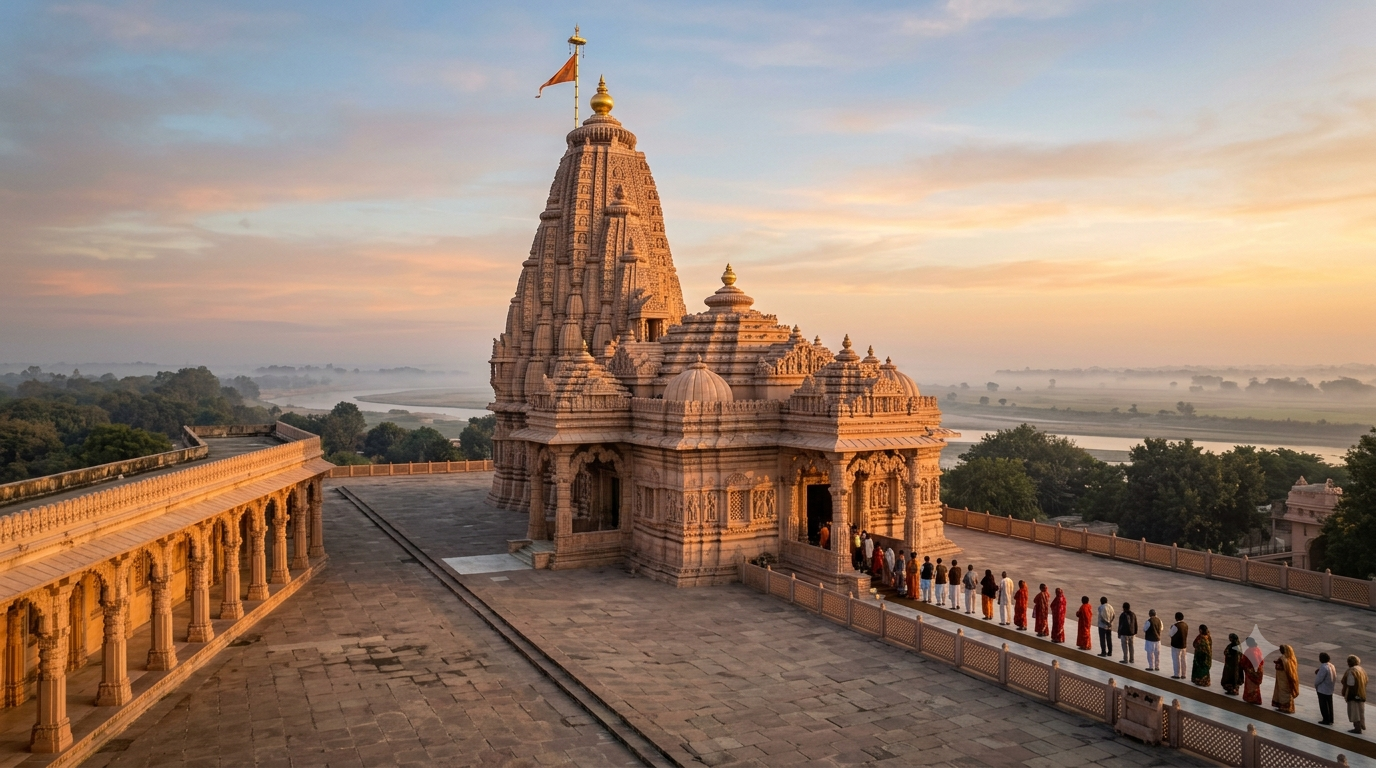
Ayodhya sits on the bank of the Sarayu, and devotees revere it as Rama Janmabhoomi, the birthplace of Lord Rama. The Supreme Court of India settled the long-running title dispute in November 2019. Prime Minister Narendra Modi then performed the bhoomi pujan on 5 August 2020.
The consecration of Ram Lalla followed on 22 January 2024, although the temple remained incomplete at that point. Construction formally concluded on 25 November 2025, when the Prime Minister raised the Dharma Dhwaja on the 161-foot spire. That flag-hoisting marks a temple’s functional opening in Hindu tradition. So Ayodhya joined the fully operational Rama temples in North India only at the end of 2025.
The first floor houses the Ram Parivar idols of Rama, Sita and Hanuman. The complex also holds the Saptmandir, seven shrines honouring Maharshi Vashishtha, Vishwamitra, Agastya and Valmiki, along with Devi Ahilya, Nishadraj Guha and Mata Shabari. Most pilgrims miss these entirely, so keep an extra hour aside.
Ayodhya Darshan Timings and Free Passes
The Shri Ram Janmbhoomi Teerth Kshetra publishes seven free darshan windows on its own site, and these have applied since 18 April 2026. General darshan runs from 7:00 AM to 9:00 PM in blocks, with a closure between 12:00 PM and 1:00 PM.
| Session | Timing |
|---|---|
| Slot 1 | 7:00 AM – 9:00 AM |
| Slot 2 | 9:00 AM – 11:00 AM |
| Slot 3 | 11:00 AM – 12:00 PM |
| Closed | 12:00 PM – 1:00 PM |
| Slot 4 | 1:00 PM – 3:00 PM |
| Slot 5 | 3:00 PM – 5:00 PM |
| Slot 6 | 5:00 PM – 7:00 PM |
| Slot 7 | 7:00 PM – 9:00 PM |
Three aartis carry free passes. The trust lists Mangal Aarti at 4:00 AM, Shringar Aarti at 6:00 AM and Shayan Aarti at 10:00 PM. Reserve those at online.srjbtkshetra.org, since counter passes run out quickly.
The Ayodhya Misinformation Worth Correcting
Dozens of travel pages still print a 6:30 AM Shringar Aarti and a 4:30 AM Mangal Aarti. The trust’s own schedule says 6:00 AM and 4:00 AM. Several sites also claim the temple shuts from 11:30 AM to 2:00 PM, when the published break covers only 12:00 PM to 1:00 PM.
The costlier myth concerns paid entry. The trust states plainly that it charges no fee for aarti and darshan passes. No VIP ticket exists, so any agent selling one for ₹1,500 or ₹5,000 is running a scam. Check the current schedule on srjbtkshetra.org before you travel, because festival days shift these windows.
Kanak Bhawan and the Ayodhya Circuit
Kanak Bhawan, the “golden palace”, stands north-east of Ramkot and honours Rama and Sita together. Its gilded interiors take twenty minutes to see, yet many first-time visitors skip it. Hanuman Garhi sits nearby on a low hill, and tradition holds that pilgrims should greet Hanuman before approaching Rama.
The Sarayu aarti at Ram Ki Paidi runs at sunset and costs nothing. It stays quieter than Varanasi’s Ganga aarti while carrying much the same atmosphere. Use the midday temple closure for Hanuman Garhi and lunch, so your day loses nothing.
Ram Raja Temple, Orchha
Orchha in Madhya Pradesh holds the only shrine in the country where devotees worship Rama as a ruling king rather than solely as a deity. The building began as Rani Mahal, the palace of Queen Ganesh Kunwari, wife of the Bundela king Madhukar Shah. Legend says she carried an idol from Ayodhya, and when it would not move again, the palace itself became the temple.
Madhya Pradesh police provide a daily guard of honour and an armed salute here. Rama holds a sword in one hand and a shield in the other, seated in padmasana with Sita, Lakshmana, Sugriva, Hanuman and Jambavan around him. Devotees try to glimpse the toe of his left foot, since folk belief ties that sight to a wish fulfilled.
Why Orchha Timings Confuse Visitors
Orchha runs on a royal court schedule that changes with the season, which is why published timings contradict each other so often. In the warmer months the darbar generally opens around 8:00 AM and closes by 12:30 PM, reopening in the evening. Winter shifts everything roughly an hour later, with a 9:00 AM opening and a 1:00 PM close.
Reports of the evening reopening range anywhere between 5:00 PM and 8:00 PM depending on the season and the year. Treat every timing you read online as approximate, including this one. Confirm at the temple office or with your hotel on the morning of your visit, because the darbar changes hours without much notice.
Raghunath Temple, Jammu
The Jammu district administration calls Raghunath Temple one of the largest temple complexes in north India. Maharaja Gulab Singh and his son Maharaja Ranbir Singh built it between 1853 and 1860. Many websites date it to 1835 instead, so the official Jammu district portal makes the safer reference.
Seven shrines sit inside the complex, each crowned with its own shikhara. Rama presides here, while the remaining shrines hold other incarnations of Vishnu and a notable shrine to Surya. Three interior walls of the main sanctum carry gold plating.
The complex also runs a library holding roughly 6,000 manuscripts across several Indian languages, including rare Sarada-script texts. Darshan generally runs from about 6:00 AM to 8:00 PM, and entry costs nothing. Security screening is strict here after the 2002 attack, so leave bags and electronics in the cloakroom.
Raghunath Temple, Kullu
Raja Jagat Singh built this Himachal shrine in the seventeenth century. Local tradition says he brought a Rama idol from Ayodhya to lift a curse he had drawn on himself. The temple sits at Sultanpur in Kullu, and Lord Raghunath has served as the presiding deity of the whole valley ever since.
The temple matters most during International Kullu Dussehra. While the rest of India burns effigies on Vijayadashami, Kullu begins a seven-day festival on that day instead. Roughly 300 village deities travel in from surrounding valleys to pay respect, and Hidimba Devi arrives from Manali as a guest.
Devotees pull Lord Raghunath’s chariot from Dhalpur maidan to his temporary camp, and they consider pulling the ropes auspicious. The festival closes with Lanka Dahan beside the Beas, after which the idol returns to Sultanpur. Book accommodation months ahead if you plan to attend, because Kullu fills completely.
Raghunathji Temple, Devprayag
Devprayag in Uttarakhand marks the confluence where the Alaknanda and Bhagirathi become the Ganga. The Raghunathji temple stands uphill from that sangam and counts among the 108 Divya Desams glorified by the Alvar saints. Tradition credits its founding to Adi Shankara in the eighth century, with later expansion under the Garhwal kingdom.
The shrine lies about 73 km from Rishikesh on the Rishikesh–Badrinath highway. Because it falls directly on the Char Dham route, most pilgrims pass within sight of it without stopping. Half an hour here rewards the detour, especially early when the two rivers show their different colours clearly.
Lesser-Known Rama Temples in North India: Varanasi and Chitrakoot
Varanasi’s Tulsi Manas Mandir dates to 1964 and marks the spot where Goswami Tulsidas is believed to have composed the Ramcharitmanas. Verses from that text cover its marble walls, so the building doubles as a readable scripture. Rama Navami celebrations here stay substantial without becoming overwhelming.
Chitrakoot, spread across the Uttar Pradesh and Madhya Pradesh border, is where Rama, Sita and Lakshmana spent a long stretch of their forest exile. Pilgrims walk the Kamadgiri parikrama and bathe at Ram Ghat on the Mandakini. It offers a landscape of many small shrines rather than one grand temple, which suits unhurried visitors.
Rama Temples in North India: Timings and Entry Compared
| Temple | State | Typical Timings | Entry |
|---|---|---|---|
| Shri Ram Janmabhoomi Mandir | Uttar Pradesh | 7:00 AM – 9:00 PM | Free |
| Kanak Bhawan | Uttar Pradesh | Morning and evening sessions | Free |
| Ram Raja Temple, Orchha | Madhya Pradesh | Seasonal; confirm locally | Free |
| Raghunath Temple, Jammu | Jammu & Kashmir | 6:00 AM – 8:00 PM | Free |
| Raghunath Temple, Kullu | Himachal Pradesh | Morning and evening sessions | Free |
| Raghunathji, Devprayag | Uttarakhand | Daylight hours | Free |
Every one of these Rama temples in North India is free to enter, which is worth stating plainly because paid-entry claims circulate widely. Timings shift on festival days at all six, so treat the table as a planning aid rather than a guarantee.
How to Plan a Rama Temples in North India Route
These shrines do not sit on one convenient circuit, so combining them needs a little thought. Ayodhya, Varanasi and Chitrakoot form a natural Uttar Pradesh cluster, and rail connections between them are good. Lucknow to Ayodhya is roughly 135 km, which trains cover in about two hours.
Orchha pairs with Khajuraho and Gwalior rather than with Ayodhya, since it lies well to the south-west. Jammu works as a stop on a Vaishno Devi trip, because the temple sits close to the city bus stand. Kullu and Devprayag belong to separate Himalayan itineraries altogether.
If you have only a week, pick one cluster and travel it properly. Linking Ayodhya, Orchha and Kullu in a single trip means far more time on trains than in temples. Devotees who extend beyond the Rama temples in North India often add southern shrines separately. Good examples include Bhadrachalam in Telangana and the Vontimitta Kodandarama temple in Andhra Pradesh.
Best Time to Visit Rama Temples in North India
October to March suits almost every one of the Rama temples in North India. Northern plains turn uncomfortably hot from April onwards, while the Himalayan shrines get cold but stay accessible. Monsoon travel to Kullu and Devprayag carries landslide risk, so check road conditions first.
Rama Navami falls in Chaitra month, generally across March or April, and dates move each year with the lunar calendar. Confirm the exact date on a trusted panchang before booking anything. Vivaha Panchami in Margashirsha stays quieter and marks the wedding of Rama and Sita, which some devotees prefer for that reason.
Crowds and Health at Rama Temples in North India
Ayodhya draws enormous numbers on festival days, and queues can mean several hours standing in heat. Carry water and any regular medication, and use the early morning slot if you can. Elderly pilgrims, pregnant women, and anyone with a heart or mobility condition should plan rest breaks deliberately.
Hill shrines add altitude and steps to that picture. Kullu and Devprayag both involve uneven ground and climbing, so sturdy footwear helps. This is practical guidance rather than medical advice, so speak to your doctor before a strenuous pilgrimage if you have any health concerns.
Insider Tips for Rama Temples in North India
- Book Ayodhya passes at midnight. Slots release fifteen days ahead, and morning windows disappear within minutes.
- Carry original ID. Gate staff verify the same document you used at booking, so a photocopy will not clear you.
- Leave phones behind at Ayodhya. Electronics stay outside, although free cloakrooms handle them.
- Time Orchha for evening aarti. The guard of honour looks most striking then, so arrive thirty minutes early.
- Reach Jammu’s temple by 7:00 AM. The complex stays calm then, and you can see all seven shrines unhurried.
- Verify every timing twice. Seasonal schedules change quietly, so a phone call beats a wasted morning.
Before You Go
The Rama temples in North India reward pilgrims who plan around official sources rather than around travel blogs. Book Ayodhya passes only at online.srjbtkshetra.org, and remember that no genuine pass ever costs money. Treat published timings for Orchha and the hill shrines as approximate, since both change seasonally.
Pick one regional cluster of Rama temples in North India rather than chasing all of them at once. If you want the single most complete experience, Ayodhya now offers it, because the temple is finally finished and fully open. For a rarer sight, Orchha’s daily royal salute has no equal anywhere in India.
Frequently Asked Questions
Which are the most famous Rama temples in North India?
Shri Ram Janmabhoomi Mandir in Ayodhya draws the most visitors, followed by Ram Raja Temple in Orchha and Raghunath Temple in Jammu. Raghunath Temple in Kullu, Kanak Bhawan in Ayodhya and Raghunathji at Devprayag complete the main list. Tulsi Manas Mandir in Varanasi and the Chitrakoot shrines also draw large numbers.
Is darshan at Ayodhya Ram Mandir free?
Yes. The Shri Ram Janmbhoomi Teerth Kshetra states that it charges no fee for aarti or darshan passes. General darshan needs no booking at all. Anyone selling a paid VIP pass is running a scam, so report it rather than paying.
What are the current Ayodhya Ram Mandir darshan timings?
The trust publishes seven free darshan windows running from 7:00 AM to 9:00 PM, with a break between 12:00 PM and 1:00 PM. These timings applied from 18 April 2026. Festival days can alter them, so check srjbtkshetra.org before travelling.
Where is Rama worshipped as a king?
Only at Ram Raja Temple in Orchha, Madhya Pradesh. Police personnel there perform a daily guard of honour and armed salute, treating Rama as the reigning ruler of Orchha. The tradition predates British rule and continues under the Madhya Pradesh police today.
When is the best time to visit Rama temples in North India?
October to March gives the most comfortable weather across all regions. Rama Navami in Chaitra brings the grandest celebrations, though crowds peak sharply. Avoid the monsoon for Kullu and Devprayag, because landslides frequently disrupt hill roads.
Is Kullu Dussehra connected to Lord Rama?
Yes, closely. Lord Raghunath, a form of Rama, presides over the valley and his chariot procession opens the festival. Unusually, Kullu burns no Ravana effigy and instead runs seven days of deity gatherings, ending with a Lanka Dahan ritual near the Beas.
Do any Rama temples in North India take online bookings?
Only Ayodhya, and only for free aarti and Sugam Darshan passes through online.srjbtkshetra.org. The other Rama temples in North India operate on walk-in darshan without any online system. If a website offers to book Orchha, Jammu or Kullu darshan for you, it is not legitimate.
How many days do I need for the Ayodhya temples?
Two full days cover Ayodhya comfortably. Day one suits the main mandir and the Saptmandir shrines, while day two allows Kanak Bhawan, Hanuman Garhi and the Sarayu aarti. A single rushed day means missing the Saptmandir, which most visitors already overlook.