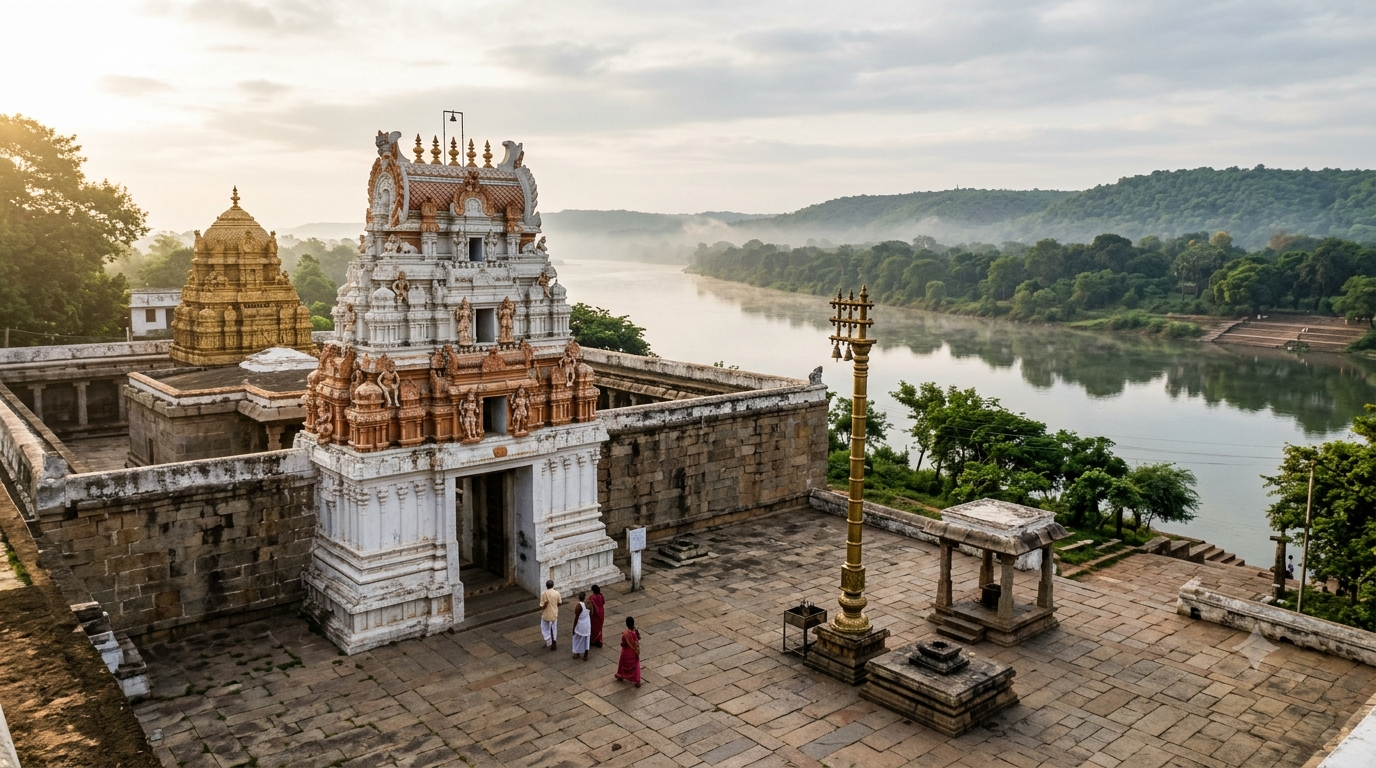
Bhadrachalam temple history is usually told as one story, when it is really two. First there is the Ramayana-era memory of Bhadra Maharshi and the Dandakaranya forest. Then there is the documented seventeenth-century building effort tied to Kancherla Gopanna. Both matter, yet most pages blur them into a single paragraph and move on.
Bhadrachalam temple history makes far more sense once you keep those two layers apart, because the difference changes what you look at in the courtyard. After the history, you also get the practical half: timings, the festival rhythm, routes, a two-day plan, and the mistakes first-time pilgrims usually make.
Sri Vyasa Pooja is an independent devotional guide. We are not affiliated with, endorsed by, or the official website of the Sree Seetha Ramachandra Swamy Devasthanam, Bhadrachalam. We do not sell tickets or take bookings, donations, or payments. Use the official Telangana government portal linked below for every reservation.
Bhadrachalam Temple History and Facts at a Glance
Before the detail, here is the short version of Bhadrachalam temple history and the practical facts around it.
- Temple: Sri Sita Ramachandra Swamy temple, on the banks of the Godavari river.
- Where: Bhadrachalam town, Bhadradri Kothagudem district, Telangana.
- Presiding form: Vaikuntha Rama, four-armed, with Sita and Lakshmana in the same icon.
- Present structure: seventeenth century, linked to Kancherla Gopanna, known as Bhadrachala Ramadasu.
- Popular name: Bhadradri, and often Dakshina Ayodhya, the Ayodhya of the south.
- Biggest festival: Sri Rama Navami Brahmotsavam, in the Chaitra month across March or April.
- Managed by: the Devasthanam under the Telangana Endowments Department.
- Official portal: bhadradritemple.telangana.gov.in.
Dakshina Ayodhya: Where Bhadrachalam Temple History Begins
Bhadrachalam earns the title because devotees treat it as Rama’s southern seat, not merely a temple that honours him. Any account of Bhadrachalam temple history has to start with that geography.
The town sits inside what tradition remembers as Dandakaranya, the forest belt of Rama’s exile. Parnasala, where Sita is believed to have been taken away, lies a short drive upstream. So the whole landscape, and not just the sanctum, carries the story.
That said, the Valmiki Ramayana never names Bhadrachalam. The link is regional tradition, carried in Telugu devotional memory and in Ramadasu’s songs. Honest guides say so plainly. Faith does not weaken when a guide states its sourcing clearly.
Bhadrachalam Temple History: Bhadra Maharshi and the Hill
The older layer begins with a sage named Bhadra, described in tradition as a son of Meru and Menaka. He performed long penance on the Godavari bank, asking for Rama’s darshan. Rama is said to have appeared before him, and the hill took his name. Bhadra plus achalam, meaning an unmoving hill, gives Bhadrachalam.
A second strand of the same layer credits a tribal woman devotee, remembered as Pokala Dammakka, with finding the icons in an anthill in the forest. She is believed to have built a simple thatched shrine there. Later devotion grew around that spot. Because both strands are living oral tradition, temple literature carries them side by side rather than ranking one above the other.
The Icon at the Centre of Bhadrachalam Temple History
Rama is normally shown with two arms, holding a bow. Here he appears as Vaikuntha Rama with four arms, carrying the shankha and chakra of Vishnu. Sita sits beside him and Lakshmana stands alongside, all within one sculpted group. Devotees read this as Vishnu answering Bhadra in his own supreme form rather than only as the prince of Ayodhya.
Look for that detail during darshan, since the queue moves fast and the moment is brief. It is the clearest answer to why this shrine feels different from other Rama temples.
Bhakta Ramadasu: The Turning Point in Bhadrachalam Temple History
The documented layer of Bhadrachalam temple history begins in the seventeenth century with Kancherla Gopanna. He served as the revenue officer for the Bhadrachalam region under Abul Hasan Qutb Shah, the last Sultan of Golconda. Devotion pulled him toward the shrine, so he used collected revenue on the construction work. The state treated that as misappropriation and jailed him in Golconda.
Tradition then supplies the miracle. Rama and Lakshmana are believed to have appeared before the Sultan and repaid the amount in gold, after which Gopanna walked free. He became Bhadrachala Ramadasu, and his keertanas turned the temple into a landmark of Telugu devotional music. Those songs are still sung inside the complex today.
Built or Rebuilt? An Honest Reading
Sources differ on this point of Bhadrachalam temple history, and it is worth saying so. Some accounts credit Gopanna with building the temple outright. Others describe him as the person who rebuilt and expanded an existing shrine on the site. Because the discovery legend already places worship there before him, the second reading fits the sequence better.
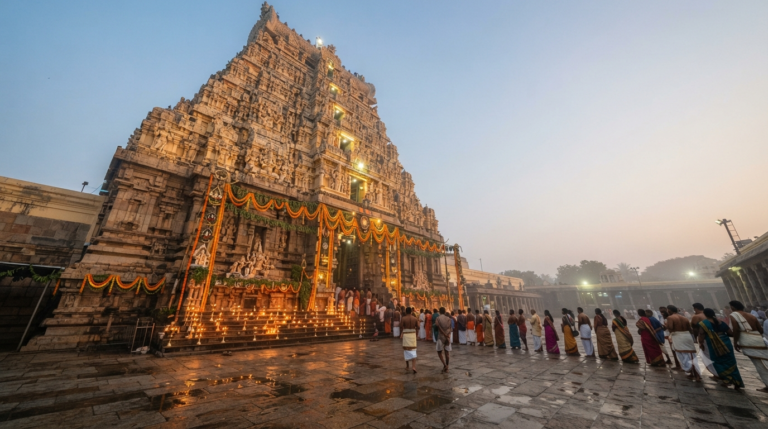
Either way, the seventeenth-century work is what you see now: the compound, the mandapams and the Rajagopuram. The temple also preserves ornaments associated with Gopanna in its exhibition space. Ask at the counter whether the display is open on the day of your visit, since access varies.
Bhadrachalam Temple History Myths Worth Correcting
Several errors about Bhadrachalam temple history and geography repeat across travel pages, and a few of them can waste your time on the ground. Correcting them is the most useful thing a guide can do.
- Wrong district. Many pages still place Bhadrachalam in Khammam district. Telangana reorganised its districts in 2016, so the correct address today is Bhadradri Kothagudem.
- Wrong state. Older articles list it under Andhra Pradesh. Bhadrachalam has been in Telangana since the state was formed in 2014.
- An airport nearby. There is none. Rajahmundry and Vijayawada are the usable airports, and both need a long road transfer.
- Ramayana citation. Bhadrachalam is not named in the Valmiki Ramayana, although the regional tradition is old and widely held.
- Booking middlemen. Only the Telangana government portal issues genuine seva tickets, so any other site charging a fee is not official.
Darshan Timings and the Shape of a Temple Day
The shrine opens very early, generally around 4:30 AM on most days and about 4:00 AM on Sundays, when Suprabhatam wakes the deity. Morning sevas and general darshan then run through the forenoon. A midday closure follows, usually in the early afternoon. Evening darshan resumes and continues until the last seva of the night.
Published closing times differ between sources, falling somewhere between 8:30 PM and 9:00 PM. Treat every figure below as approximate. Confirm the current schedule on the official portal before you travel, because festival days shift the whole timetable.
| Part of day | Typical window | What happens |
|---|---|---|
| Early morning | Around 4:00 to 4:30 AM | Suprabhatam, temple opening |
| Morning | Until early afternoon | Abhishekam, archanas, Nithya Kalyanam, general darshan |
| Midday | Roughly 1:00 to 3:00 PM | Closure for offerings and rest |
| Evening | 3:00 PM onward | Darshan, Vendi Radha Seva, Alaya Chuttu Seva |
| Night | Around 9:00 PM | Pavalimpu Seva, closing |
General darshan is free, so no ticket is needed for a simple visit. If you want a specific ritual, book it in advance through our Bhadrachalam online pooja booking guide, which lists the seva table and the official process. Reach your reporting counter about thirty minutes early, since slots are time-bound.
Sri Rama Navami Brahmotsavam: How the Festival Unfolds
Rama Navami is the temple’s grandest occasion, and the celestial wedding is its centre. Because Bhadrachalam follows the lunar calendar, the date moves each year within Chaitra, across March or April. The Devasthanam publishes the full Brahmotsavam schedule a few weeks ahead. For the tithi itself, a reliable panchang such as Drik Panchang is the simplest cross-check.
The sequence stays broadly stable from year to year, even though the dates move. Knowing the shape helps you pick a day that suits your energy and your crowd tolerance.
| Stage | Ritual | What to expect |
|---|---|---|
| Opening | Ankurarpanam, Dwajarohanam | Seed rite and flag hoisting; crowds still moderate |
| Build-up | Edurukolu, Chathusthanarchana | Ceremonial welcome; town begins to fill |
| Peak day | Sita Rama Kalyanam | The wedding on Rama Navami; heaviest rush |
| Day after | Maha Pattabhishekam | Coronation rite; grand yet calmer than Kalyanam |
| Later days | Vahana sevas, Theppotsavam | Processions and the float festival on the river |
| Closing | Vasanthotsavam, Chakra Theertham | Spring rite and the concluding sacred bath |
If the Kalyanam day feels too crowded, Maha Pattabhishekam the next day is the smart alternative. You still witness a major ritual, yet the pressure eases noticeably. Vaikuntha Ekadashi in the Margashira month is the other big draw, when devotees pass through the Vaikuntha Dwaram. Devotees in Andhra Pradesh who cannot reach Bhadrachalam often attend the Vontimitta Rama Navami Brahmotsavam instead.
Best Time to Visit Bhadrachalam
Devotees drawn by Bhadrachalam temple history arrive in every season, yet comfort varies sharply. October to February is the easy window, because the Godavari plain cools down. March to May turns genuinely hot, and Rama Navami usually lands inside that stretch. Monsoon months bring green forest roads, although river activities can pause when the water runs high.
For crowds, weekdays beat weekends by a wide margin. Early morning also beats late morning, since the first two hours after opening stay relatively calm. If you want the festival atmosphere without the peak crush, aim for the opening days of the Brahmotsavam rather than Rama Navami itself.
How to Reach Bhadrachalam
Road is the practical answer for almost everyone. Telangana State Road Transport buses connect the town with Hyderabad, Khammam, Kothagudem, Warangal and Vijayawada. Private taxis and shared cabs are easy to find, because pilgrim traffic runs all year.
| Mode | Nearest point | Approximate distance |
|---|---|---|
| Road | Hyderabad | About 310 to 330 km, roughly 6 to 8 hours |
| Road | Khammam | About 110 to 120 km |
| Rail | Bhadrachalam Road station, Kothagudem | About 40 km, then bus or taxi |
| Air | Rajahmundry airport | Roughly 180 to 205 km by road |
| Air | Vijayawada airport | Roughly 230 to 260 km by road |
Distances vary by route, so treat these as planning figures and check a live map. Only a handful of trains serve Bhadrachalam Road, so most pilgrims still choose a bus or a car. During festival week, book your return seat early.
Places That Complete the Bhadrachalam Temple History Trail
Parnasala sits roughly 32 to 35 km away, and tradition marks it as the exile hut of Rama and Sita. The site is modest, yet it completes the story you came for. Abhaya Anjaneya Swamy temple in the town itself is an easy second stop after darshan. The Ministry of Tourism also profiles the area on its Incredible India Bhadrachalam page.
Boat operators run Godavari cruises toward Papikondalu, the gorge where the river narrows between forested hills. Trips depend on water levels, so confirm locally on the morning you plan to go. Downstream, the Godavari finally meets the sea near the Antarvedi Narasimha Swamy temple, which pairs well with a longer river-route pilgrimage.
A Two-Day Plan Built Around Bhadrachalam Temple History
Two days let you take in Bhadrachalam temple history without rushing the darshan. Day one works best as an early arrival and an unhurried temple day. Reach by mid-morning, rest briefly, then take an evening darshan when the lamps are lit. Keep any booked seva for the following morning, since a tired first day rarely goes to plan.
Day two starts before dawn. Take the Godavari bath if you wish, complete your morning seva, and finish the main darshan by about nine. Drive to Parnasala afterward, because the light is still soft and the road is quiet. That leaves the afternoon free for the return journey or a river outing.
Health, Heat and Crowd Safety
Summer temperatures on the Godavari plain climb sharply, and festival queues mean long standing hours. Carry water, a cap and any regular medication. Elderly pilgrims, pregnant women and anyone with a heart or knee condition should avoid the midday peak entirely.
The riverbank looks calm, yet currents strengthen after rain upstream. Bathe only at designated ghats, and keep children within arm’s reach. This is practical travel guidance and not medical advice, so speak to your doctor before a long temple day if you have any health concern.
Dress Code and Temple Etiquette
The temple expects traditional attire inside the complex. Men usually wear a dhoti, or trousers with a shirt, while women wear a saree, half-saree or salwar kameez. Shorts and sleeveless tops are best avoided near the sanctum.
Footwear comes off before you enter, and phones stay silent. Photography rules vary by area, so check the signage instead of assuming.
What First-Time Visitors Usually Get Wrong
- Arriving between one and three. The midday closure is strictly observed, so plan around it.
- Booking on a copycat site. A genuine booking address ends in telangana.gov.in, and nothing else counts.
- Skipping Parnasala. The temple makes far more sense once you have seen the exile site nearby.
- Treating the icon as ordinary. Look for the four arms and the shankha and chakra before the queue moves you on.
- Planning Rama Navami late. Rooms in town sell out weeks ahead, so lock accommodation early.
- Carrying too much. Cloakroom queues are slow, therefore travel light on darshan day.
Bhadrachalam Temple History: Before You Go
Bhadrachalam rewards a visitor who knows which part of Bhadrachalam temple history belongs to which century. Read the Bhadra and Dammakka traditions as devotional memory, and read the Ramadasu chapter as documented history. Then plan the visit around cool months, early hours and a confirmed timetable from the official portal. If you can spare two days, add Parnasala and the river, because the landscape is half the pilgrimage.
Frequently Asked Questions
What should I know about Bhadrachalam temple history before visiting?
Bhadrachalam temple history has two layers: a Ramayana-era tradition around Bhadra Maharshi, and a seventeenth-century building chapter under Kancherla Gopanna. The icon is Vaikuntha Rama, four-armed and unusual. Knowing both makes the darshan far more meaningful.
How old is the Bhadrachalam temple?
The present structure dates to the seventeenth century and is tied to Kancherla Gopanna, or Bhadrachala Ramadasu. Worship at the site is remembered as older, through the Bhadra Maharshi and Pokala Dammakka traditions. So the building is roughly four centuries old, while the sacred site is held to be far older.
Who built the Bhadrachalam temple?
Kancherla Gopanna, the Golconda-era revenue officer later known as Bhadrachala Ramadasu, is credited with the seventeenth-century construction. Some accounts describe him as rebuilding and expanding an earlier shrine rather than founding one. Golconda jailed him for using state revenue, and tradition holds that Rama himself repaid the amount.
Why is Rama shown with four arms at Bhadrachalam?
The presiding icon is Vaikuntha Rama, a form in which Rama carries the shankha and chakra of Vishnu alongside the bow. Devotees understand it as Vishnu appearing in his supreme form to answer Bhadra’s penance. Sita and Lakshmana form part of the same sculpted group.
What are the Bhadrachalam temple timings?
The temple generally opens around 4:30 AM, closes for a midday break in the early afternoon, and shuts by about 9:00 PM after the night seva. Published figures differ slightly between sources. Confirm the current timetable on bhadradritemple.telangana.gov.in before travelling, especially during festivals.
How far is Parnasala from Bhadrachalam?
Parnasala lies roughly 32 to 35 km from the temple town, and the drive takes under an hour on normal days. Tradition marks it as the forest dwelling of Rama, Sita and Lakshmana during the exile. Most pilgrims combine it with the temple on a two-day trip.
Is Bhadrachalam in Telangana or Andhra Pradesh?
Bhadrachalam is in Telangana, within Bhadradri Kothagudem district. It sat inside Andhra Pradesh until the 2014 bifurcation. Pages that still list it under Khammam district are working from the pre-2016 district map.
When is Sri Rama Navami celebrated at Bhadrachalam?
Sri Rama Navami falls on Navami tithi in the Chaitra month, which lands in March or April depending on the year. The Brahmotsavam runs for several days around it, ending with Chakra Theertham. Check the official portal or a trusted panchang for the exact dates each year.
Can I book sevas at Bhadrachalam online?
Yes, Arjitha Sevas and special darshan are bookable on the Telangana government portal at bhadradritemple.telangana.gov.in. A few small archanas remain counter-only. Never pay a service fee to a private website, because the temple issues tickets only through its own channels.