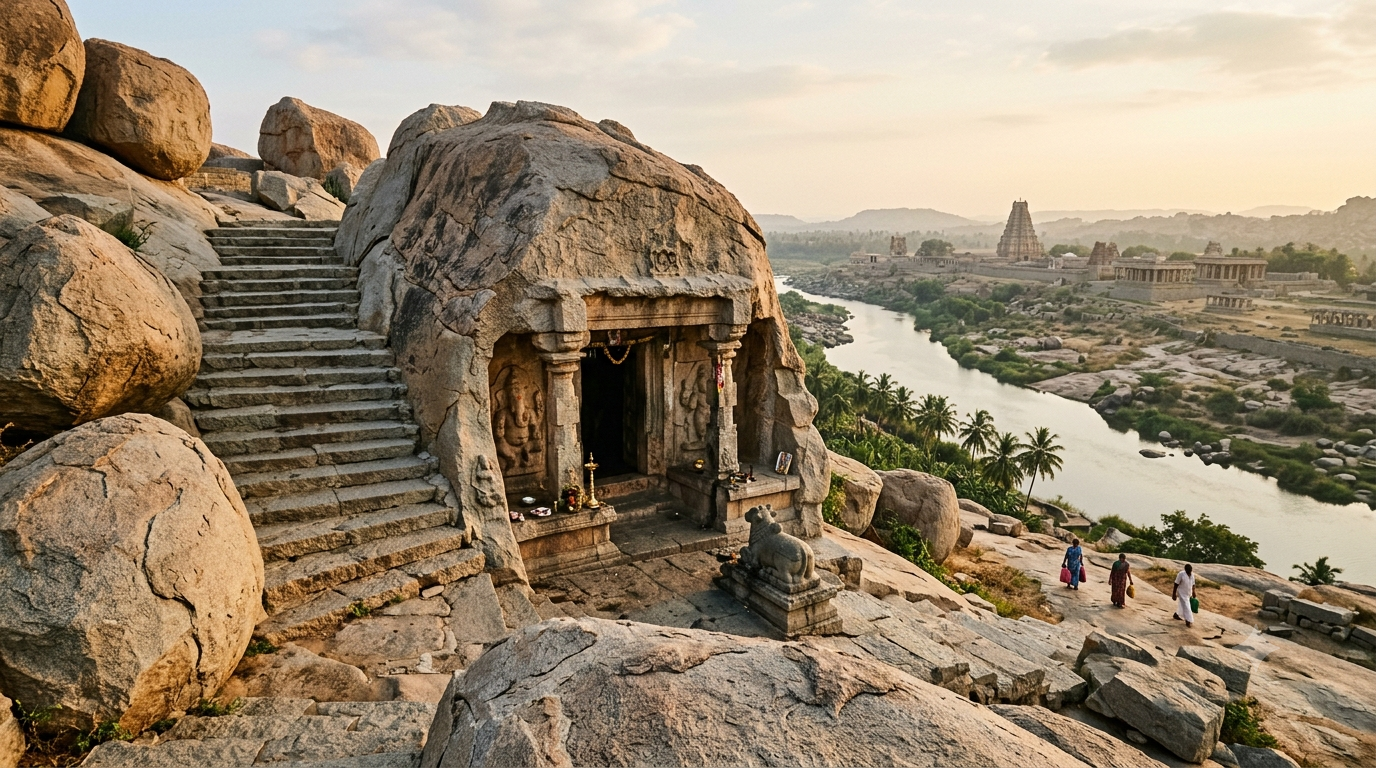
The Yantrodharaka Hanuman Temple in Hampi holds a rare sight. It is the only image of Lord Hanuman shown seated in deep meditation, locked inside a sacred geometric diagram. That single detail sets it apart from every other Anjaneya shrine in the region.
Most guides rush past this and simply call it a “monkey temple.” Yet the real story is far richer, because this shrine was the very first Hanuman idol consecrated by the great Dvaita saint Sri Vyasaraja. On this page you will find its verified history, the yantra legend, and the meaning of the famous stotram. You will also get clear directions that separate it from the birthplace hill it is so often confused with.
Sri Vyasa Pooja is an independent devotional guide. We are not affiliated with any temple trust or government body, and we take no bookings, donations, or payments. This temple is a free, open heritage site with no ticketing; use the official heritage links below for planning.
Yantrodharaka Hanuman Temple at a Glance
Because pilgrims plan visits differently, here are the core facts first. The deeper history and legend follow below.
- Location: A small rocky hillock near Chakratirtha, on the banks of the Tungabhadra River, Hampi, Karnataka.
- Deity: Hanuman, worshipped here as Pranadeva, seated in a meditative posture.
- Established by: Sri Vyasaraja (Vyasatirtha), Rajaguru of the Vijayanagara Empire, in the early 16th century.
- Entry fee: None. There is no official ticketing or online booking for this shrine.
- Timings: Roughly dawn to dusk; sources differ, so confirm locally (see the timings note below).
- Nearest station: Hosapete (Hospet) Junction, about 13 km away.
- Best season: October to February, when Hampi is cool enough for the climb.
The History of the Yantrodharaka Hanuman Temple
The Yantrodharaka Hanuman Temple was founded by Sri Vyasaraja, also known as Vyasatirtha (1447–1539). He was a champion of the Dvaita school and the royal preceptor of the Vijayanagara Empire. He served as guru to Emperor Krishnadevaraya, whose reign ran from 1509 to 1529.
Historians place the shrine’s consecration in that early-16th-century window. Therefore it is roughly five hundred years old, and it also carries a special distinction. Devotees and heritage records agree on its status, including Karnataka Tourism. It was the first of the 732 Hanuman idols that Vyasaraja installed across South India.
So it is not merely one shrine among many. Instead, it is the seed from which a vast devotional network grew. That origin story is a large part of why the site still draws pilgrims today.
In the Dvaita tradition that Vyasaraja upheld, Hanuman is revered as Mukhyaprana. This is the chief vital force and the first among the great devotees of Lord Vishnu. Later saints such as Sri Raghavendra Swamy of Mantralayam carried the same tradition forward.
That is why the deity here is called Pranadeva, and the temple is sometimes listed as the Pranadeva Temple. Understanding this background helps explain the unusual, contemplative form of the idol.
The Legend Behind the Yantrodharaka Hanuman Temple
The origin legend of the Yantrodharaka Hanuman Temple centres on a daily ritual and a stubborn image. While meditating on the banks of the Tungabhadra, Vyasaraja would sketch a figure of Hanuman on the rock in charcoal. He did this each day before his prayers. Every time he finished, the drawing vanished.
This happened for twelve days in a row. On the twelfth day, the saint finally pleaded with the Lord to remain visible. According to the legend, Hanuman then appeared before him. The Lord asked the saint to bind him within a yantra, a sacred geometric design, so his energy would stay at that spot.
Vyasaraja followed the instruction and carved the idol inside a six-cornered yantra. The twelve monkeys ringing the figure represent those twelve days of devotion. Many devotees also believe this hillside is where Lord Rama and Hanuman first met. That meeting belongs to the Kishkindha episode of the Ramayana, since Hampi is traditionally identified with that ancient kingdom.
Why the Idol Is So Unusual
Across India, most Hanuman idols show him standing, one arm raised, ready for action. Here, however, the form is entirely different, and that contrast is exactly what makes this shrine special. The Lord sits in padmasana, the lotus posture, in calm meditation rather than motion.
The figure is carved on a single flat granite boulder roughly eight feet high. Around Hanuman runs a shatkona, a six-pointed yantra. Twelve small monkeys hold each other’s tails and face outward.
Seed syllables, the bija mantras, cover the surrounding rock. His right hand rests in the teaching gesture, while his left holds the meditation gesture. So the whole composition reads as devotion frozen in stone.
Just a few minutes away sits a modest shrine to Lord Srinivasa, a form of Vishnu. Tradition credits its idol to Vyasaraja too. Snake stones rest under a fig tree near the Hanuman shrine, venerated by local devotees. Together these details show how carefully the saint shaped this whole pocket of Hampi.
The Yantrodharaka Hanuman Stotram
The Yantrodharaka Hanuman Stotram is a short Sanskrit hymn that Vyasaraja composed at this very spot. Its verses praise Hanuman as the protector who lifts devotees out of difficulty. That idea is folded into the word “Yantrodharaka” itself.
By tradition, devotees chant this stotram three times a day for six months. They do so with full concentration and sincere intent, as a devotional discipline.
This is a matter of faith and practice, not a guaranteed outcome. So it is best understood as a spiritual observance rather than a promise of results. Many pilgrims recite it simply for focus, courage, and inner strength, qualities long linked with Hanuman.
Yantrodharaka Hanuman Temple vs Anjanadri Hill: Clearing the Confusion
Here is the single biggest error repeated across travel sites. Correcting it is the most useful thing this guide can do. Many pages describe the Yantrodharaka Hanuman Temple as the “birthplace of Hanuman” reached by climbing 570 steps. That description actually belongs to a completely different shrine.
The birthplace hill is Anjanadri (Anjaneyadri), which sits across the Tungabhadra River in Anegundi, within Koppal district. That is the temple with the long stone staircase of around 575 steps, as documented on Incredible India, the official tourism portal. Vyasaraja’s Yantrodharaka shrine, by contrast, stands on the Hampi side near Chakratirtha and needs only a short climb. Mixing them up can wreck a pilgrim’s plan, since the two sit on opposite banks.
| Feature | Yantrodharaka Hanuman Temple | Anjanadri Hill Temple |
|---|---|---|
| What it is | First Hanuman idol installed by Vyasaraja | Believed birthplace of Hanuman |
| Side of river | Hampi side, near Chakratirtha | Anegundi side, across the river |
| Climb | Short climb behind Kodandarama Temple | Around 575 stone steps |
| District | Vijayanagara / Ballari (Hampi) | Koppal (Hanumanahalli) |
| Idol form | Meditative, inside a yantra | Standing rock-carved Hanuman |
So if your goal is Vyasaraja’s meditative Hanuman inside the yantra, you want the Hampi-side shrine on this page. If you want the steep birthplace climb, that is Anjanadri, a separate half-day trip.
How to Reach the Yantrodharaka Hanuman Temple
Reaching the Yantrodharaka Hanuman Temple is straightforward once you know the landmark. The entrance sits just behind the Kodandarama Temple, close to the Chakratirtha bathing ghat. It lies about 700 metres from the Hampi Bus Stand. From the famous Virupaksha Temple, it is roughly a 2 km walk along the boulder-strewn riverside path.
For travellers arriving from farther away, the nearest railway station is Hosapete (Hospet) Junction, about 13 km from Hampi. Autos and taxis wait outside the station. The closest airport is at Jindal Vidyanagar, around 33 km away, while Hubballi airport offers wider connections a few hours out. Because the final approach is on foot over uneven rock, wear proper walking shoes rather than sandals.
A brief safety note matters here. Although the climb is short, Hampi gets extremely hot from March onward, so carry water and start early. Monkeys are common around all Hampi shrines, so keep food, spectacles, and offerings zipped away. Elderly pilgrims and anyone with mobility limits should take the rock steps slowly.
Best Time to Visit and What to Expect
The best window runs from October to February, when the weather cools and the light over the ruins turns golden. Early morning is ideal, both for the gentle temperature and for the quiet the shrine is known for. Meanwhile, sunset from the nearby rocks is stunning, although you should plan your descent before dark.
On timings, be aware that published hours vary between sources. Some list the shrine as open roughly 6:00 AM to 6:00 PM. Others report a midday break around 1:00 PM to 3:00 PM. Since no official authority publishes fixed hours for this open heritage shrine, treat any timing as approximate and confirm on the ground.
There is no entry fee and no online booking. So treat anyone claiming to sell “tickets” or “special darshan” for this temple with caution. Genuine access here is simple, free, and open to every visitor.
Before You Go
The Yantrodharaka Hanuman Temple rewards visitors who understand what they are seeing. This is not a grand gopuram, but a quiet, powerful shrine carved by a saint who shaped Hampi’s spiritual life.
So come for the history, the meditative idol, and the calm. Give yourself time to sit with the stotram tradition rather than rushing through, and also pair the visit with the nearby Kodandarama and Srinivasa shrines. Above all, remember the key distinction: this is Vyasaraja’s Hampi-side shrine, not the Anjanadri birthplace climb across the river.
Frequently Asked Questions
Who built the Yantrodharaka Hanuman Temple?
Sri Vyasaraja, also called Vyasatirtha, built the Yantrodharaka Hanuman Temple in the early 16th century. He was the Rajaguru of the Vijayanagara Empire and guru to Emperor Krishnadevaraya. Devotees consider this shrine the first of the 732 Hanuman idols he installed across South India.
Why is Hanuman shown meditating here?
According to legend, Hanuman asked Vyasaraja to fix him within a yantra so his energy would stay at the spot. As a result, Vyasaraja carved the idol seated in padmasana, the lotus posture, inside a six-cornered yantra. This meditative form is rare and makes the shrine unique in Hampi.
Is the Yantrodharaka Hanuman Temple the birthplace of Hanuman?
No, and this is a common mix-up. The birthplace is Anjanadri Hill across the Tungabhadra River in Anegundi, reached by about 575 steps. The Yantrodharaka shrine sits on the Hampi side near Chakratirtha and needs only a short climb.
What is the Yantrodharaka Hanuman Stotram?
It is a short Sanskrit hymn that Vyasaraja composed at this temple in praise of Hanuman. Traditionally, devotees chant it three times daily for six months as a devotional discipline. It is a matter of faith and practice rather than a guaranteed outcome.
How many steps are there at the Yantrodharaka Hanuman Temple?
The Yantrodharaka Hanuman Temple involves only a short climb up a rocky hillock behind the Kodandarama Temple. The “570 steps” figure repeated online actually refers to Anjanadri Hill, a different temple across the river. Do not plan for a long staircase here.
What are the temple timings and is there an entry fee?
There is no entry fee, and no official body publishes fixed hours. Reported timings range from about 6:00 AM to 6:00 PM, sometimes with a midday break, so confirm locally. Because it is a free, open heritage shrine, there is no ticketing or online booking.
How do I reach the temple from Hospet?
Hosapete (Hospet) Junction is about 13 km away, with autos and taxis outside the station. From the Hampi Bus Stand, the shrine is roughly 700 metres, just behind the Kodandarama Temple near Chakratirtha. From the Virupaksha Temple, it is about a 2 km riverside walk.
What else can I see nearby?
A short walk away lies a small Srinivasa shrine whose idol tradition also credits to Vyasaraja, along with venerated snake stones under a fig tree. The Kodandarama Temple sits right at the foot of the approach. Serious pilgrims often pair the visit with Anjanadri Hill on a separate day, or with famous Hanuman shrines such as the Nanganallur Anjaneyar Temple in Chennai.