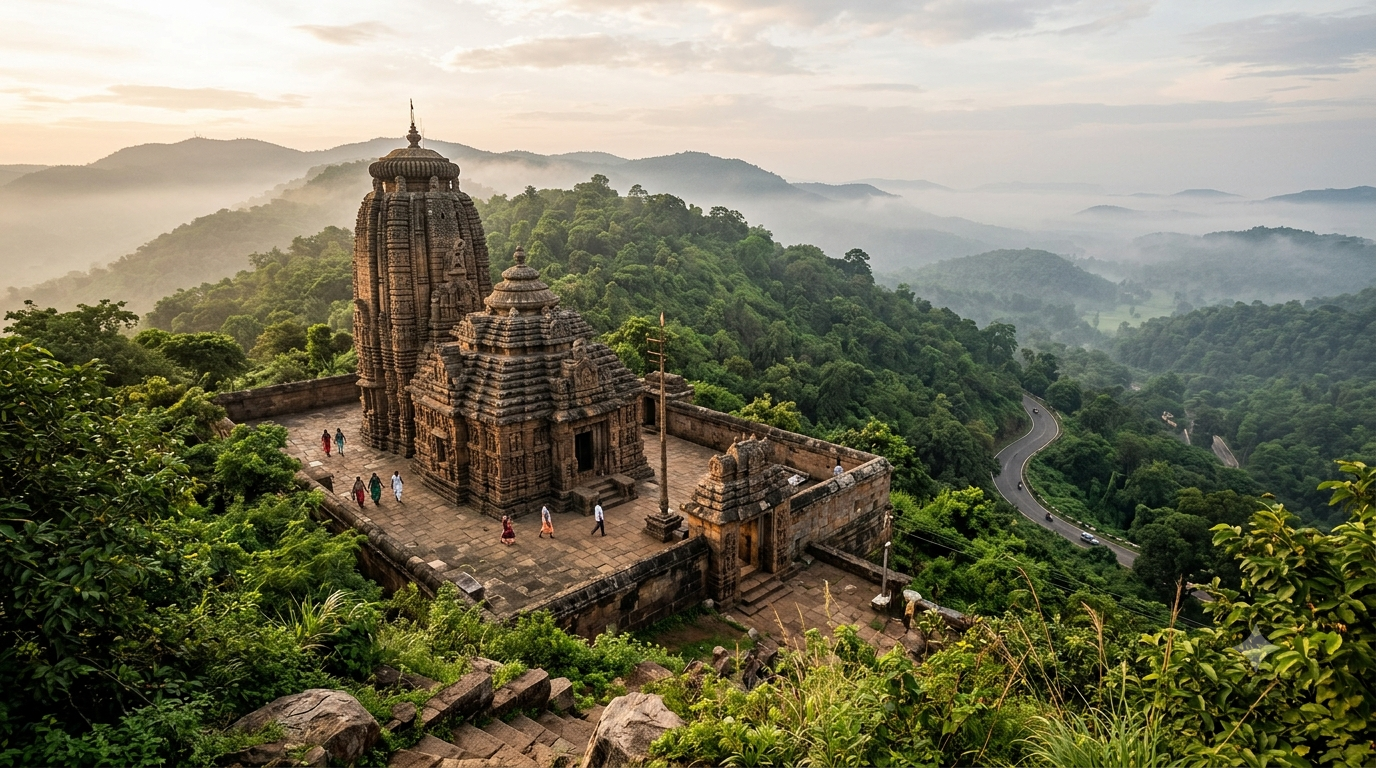
The Sri Varaha Narasimha temple at Simhachalam is one of the oldest Vishnu shrines in Andhra Pradesh. Its story is unlike any other hill temple in the south. Perched on the Simhachalam hill near Visakhapatnam, this thousand-year-old temple hides its main deity under thick sandalwood paste for almost the whole year.
Devotees see the true form only once each year. So the history behind it draws as many curious travellers as it does pilgrims.
Sri Vyasa Pooja is an independent pilgrim guide. We are not affiliated with the Simhachalam Devasthanam or the Andhra Pradesh Endowments Department, and we are not their official website. We take no bookings, donations, or payments. Always use the official portal linked below for darshan, sevas, and current information.
Sri Varaha Narasimha Temple at a Glance
- Deity: Lord Varaha Lakshmi Narasimha Swamy, a combined boar-and-lion form of Vishnu
- Location: Simhachalam hill, Visakhapatnam district, Andhra Pradesh
- Managed by: Simhachalam Devasthanam, under the Andhra Pradesh Endowments Department
- Present stone temple: raised by the Eastern Ganga king Narasimhadeva I, consecrated in 1268 CE
- Famous for: the deity stays covered in sandalwood paste for most of the year
- True form seen: only on Chandanotsavam, which falls on Akshaya Tritiya
- Rank: the second highest earning temple in Andhra Pradesh, after Tirumala
What Makes the Sri Varaha Narasimha Temple Unique
The Sri Varaha Narasimha temple is famous for one striking tradition. For most of the year, priests keep the main idol fully covered in thick sandalwood paste. So devotees never see the actual sculpture underneath. This paste also cools and protects the deity, according to temple custom.
The real form appears only on one special day. Because of this, the darshan of the uncovered idol carries huge devotional weight. Many pilgrims therefore plan their whole journey around that single morning.
The idol itself neatly blends two avatars of Vishnu, since it honours both. It shows a boar’s head, a human body, and a lion’s tail. Together these stand for the Varaha and Narasimha incarnations. Carvings of the goddesses Sridevi and Bhudevi flank the deity, each holding a lotus.
The Real History of the Sri Varaha Narasimha Temple
The history of the Sri Varaha Narasimha temple stretches back nearly a thousand years. The earliest firm evidence comes from an inscription of the Chola king Kulottunga I. Historians date it to the late 11th century CE. So while local legend runs much older, the recorded temple history begins around that time.
After the Cholas, the Eastern Ganga dynasty took charge. In time, they gave the shrine its grand stone form. The king Narasimhadeva I raised the present temple, and his son Bhanudeva I consecrated it in 1268 CE. Because the Gangas ruled the Kalinga region, the temple carries their distinctive architectural stamp.
Control later passed to the Gajapati kings after the Eastern Gangas declined. Then the Vijayanagara empire extended its reach here.
Its most famous ruler, Krishnadevaraya, visited and endowed the temple in the early 16th century. History remembers him for gifting valuable jewellery, since he treated Simhachalam as a major seat of worship. Devotees today still compare its scale with the far larger Tirumala Tirupati temple complex.
Later, the temple came under the state Endowments Department in 1949. Today the Pusapati Gajapati family of the former Vizianagaram estate continues as hereditary trustees. The family has held that role for generations.
A Quick Timeline of the Temple’s History
| Period | Ruling power | What happened |
|---|---|---|
| Late 11th century CE | Chola (Kulottunga I) | Earliest dated inscription at the site |
| 13th century, 1268 CE | Eastern Ganga | Present stone temple raised and consecrated |
| 14th–15th century | Gajapati kings | Continued patronage and repairs |
| Early 16th century | Vijayanagara | Krishnadevaraya’s visit and rich endowments |
| 1949 onward | State Endowments | Devasthanam administration; Pusapati family as trustees |
Significance of the Sri Varaha Narasimha Temple
The significance of the Sri Varaha Narasimha temple comes from the Sthala Purana, the temple’s own sacred legend. According to it, Vishnu appeared here in the combined Varaha-Narasimha form. He came to protect his young devotee Prahlada from a tyrant father, Hiranyakashipu. So devotees see the hill as the very spot where compassion defeated cruelty.
Naturally, this legend gives the shrine its emotional pull. Pilgrims come to seek protection, courage, and relief from fear. Tradition holds that the deity guards sincere devotees. These benefits remain matters of faith and tradition rather than guaranteed outcomes.
The temple also holds enormous practical weight in the region. By revenue, it ranks second only to Tirumala among Andhra Pradesh temples. Because of that scale, it draws lakhs of pilgrims every year. It also supports a busy calendar of daily rituals and festivals.
Chandanotsavam at the Sri Varaha Narasimha Temple
Chandanotsavam is the single most important festival at Simhachalam. On this day alone, priests fully remove the year-old sandalwood coating. They then reveal the original stone form of the deity, called the nija roopam, for a few hours. This is the moment every devotee hopes to witness.
The festival falls on Akshaya Tritiya, which is an auspicious day in the Vaishakha month. It usually lands in April or May. Because the exact date shifts each year with the Hindu calendar, always confirm the current year’s date on the official portal or a trusted panchang before you travel.
Expect enormous crowds if you plan a Chandanotsavam visit. Lakhs of pilgrims arrive for this darshan, so accommodation fills months ahead. Queues can stretch for many hours. Priests then reapply fresh sandalwood, and the deity stays covered again until the next year.
Darshan Timings at the Sri Varaha Narasimha Temple
The temple generally opens early in the morning and stays open until night. A short closure follows in the afternoon for rituals. Reported timings place general darshan roughly from early morning until about 9:00 PM. Since these hours change on festival days and can shift, confirm the current schedule on the official portal before you set out.
Meanwhile, morning is the calmest window for a peaceful darshan. Weekday mornings, roughly between 7:00 and 9:00 AM, tend to have shorter queues. Weekends and festival days see a heavy rush. So arrive early if you want to avoid a long wait.
Sri Varaha Narasimha Temple Sevas and Booking
Simhachalam offers free general darshan alongside faster paid darshan and various arjitha sevas. General darshan is usually free, or it may involve only a small nominal donation. A special or seegra darshan ticket lets you skip much of the queue for a modest fee.
Reported special-darshan tickets sit around ₹100 to ₹150, but the temple revises prices from time to time. So treat these figures as indicative and confirm the current amount officially.
You can book online through the Andhra Pradesh government temple portal. The Endowments Department runs advance booking for special darshan and sevas at aptemples.ap.gov.in. You register once, then select the Simhachalam temple, your darshan type, and a slot.
You can book prasadam and some sevas there too. For the wider administration, see the AP Endowments Department site.
Be careful about where you book, because fake portals do circulate online. Therefore, book only through the official government website. Avoid any private site or agent that demands extra “processing” charges. As an independent guide, we never take bookings ourselves, and we simply point you to the official channel.
How to Reach the Sri Varaha Narasimha Temple
The Sri Varaha Narasimha temple sits close to Visakhapatnam, so reaching it is fairly easy. The hill lies roughly 16 km from the city centre, though the exact distance depends on your starting point. Vizag connects well by air, rail, and road. That makes Simhachalam a comfortable day trip.
By air: Visakhapatnam International Airport is the nearest airport, with taxis available for the onward drive. By train: Visakhapatnam and Simhachalam railway stations both serve the area, after which you take a bus or cab. By road: APSRTC city buses and shared autos run to the foot of the hill.
Vehicles can also drive up the ghat road to the temple. Many devotees pair the trip with the hill shrine of Kanaka Durga at Vijayawada on a longer Andhra tour.
Because the shrine sits on a hill, plan a little extra time for the climb or the ghat drive. Elderly pilgrims and anyone with mobility concerns should prefer the road route to the top rather than the steps.
Dress Code, Rules and Safety
The temple expects modest traditional attire, and it often enforces this at the entrance. Typically, men wear a dhoti or trousers with a shirt. Women wear a saree or salwar. Avoid shorts and sleeveless tops.
Mobile phones are usually not allowed inside, so use the cloakroom for phones and footwear.
Some devotees perform the Giri Pradakshina. This long circumambulation around the sacred hills can run well over 30 km and take many hours on foot. If you attempt it, carry water, wear comfortable footwear, and go slowly. Anyone who is elderly, pregnant, or managing a health condition should consult a doctor first, since the terrain is demanding.
Best Time to Visit and Insider Tips
The cooler months from October to February suit a Simhachalam trip best, since Visakhapatnam summers get hot and humid. Early mornings stay calm year-round, so an early start rewards you with a smoother darshan. A few practical tips help you dodge the common first-timer mistakes.
- Arrive early: reach by 7 AM on weekdays for the shortest queues.
- Plan around Chandanotsavam: book your stay months ahead for the nija roopam darshan, because rooms vanish fast.
- Leave phones behind: carry as little as possible, since gadgets go into the cloakroom anyway.
- Combine your trip: pair the temple with Vizag’s beaches and hills for a fuller day.
- Confirm live details: check timings, fees, and festival dates on the official portal before travelling.
Before You Go
The Sri Varaha Narasimha temple rewards travellers who learn its history before they arrive. The Prahlada legend, the 1268 CE stone temple, and the sandalwood tradition turn a quick darshan into a richer experience.
For a peaceful visit, choose a weekday morning. For the rare true-form darshan, plan carefully around Chandanotsavam. Verify the current timings, ticket prices, and festival date on the official Andhra Pradesh portal, and you are set for a smooth pilgrimage.
Frequently Asked Questions
Why does the Sri Varaha Narasimha temple keep the deity covered in sandalwood?
Priests keep the idol covered in thick sandalwood paste for almost the entire year, following a long-standing tradition. Devotees believe the paste cools and protects the deity. They reveal the original form only on Chandanotsavam.
When can I see the deity’s original form?
You can see the uncovered nija roopam only on Chandanotsavam, which falls on Akshaya Tritiya. This usually happens in April or May, but the date shifts yearly with the Hindu calendar. Confirm the exact date officially before travelling.
How old is the Simhachalam temple?
The recorded history goes back nearly a thousand years, to an 11th-century Chola inscription. The Eastern Ganga king Narasimhadeva I raised the present stone structure, and priests consecrated it in 1268 CE. Local legend traces the site back much further.
How do I book darshan or sevas at Simhachalam?
Book online through the official Andhra Pradesh temple portal at aptemples.ap.gov.in. Register once, select the Simhachalam temple, and choose your darshan type and slot. General darshan is usually free, while special darshan and sevas carry a fee.
What are the darshan timings?
The temple generally opens early morning and closes around 9:00 PM, with a short afternoon break. Timings change on festival days, so always confirm the current schedule on the official portal. Weekday mornings stay the calmest.
How far is the temple from Visakhapatnam?
The temple lies roughly 16 km from Visakhapatnam city, on the Simhachalam hill. You can reach it by bus, cab, or auto, and vehicles can drive up the ghat road. It makes an easy half-day trip from the city.
Is there a dress code at the temple?
Yes, the temple expects modest traditional clothing and often enforces it. Men wear a dhoti or trousers with a shirt, while women wear a saree or salwar. Avoid shorts and sleeveless tops.
Which is the second richest temple in Andhra Pradesh?
Simhachalam’s Sri Varaha Narasimha temple ranks as the second highest earning temple in Andhra Pradesh, after Tirumala. Its large pilgrim footfall and endowments support this ranking. Indeed, millions of devotees visit every year.