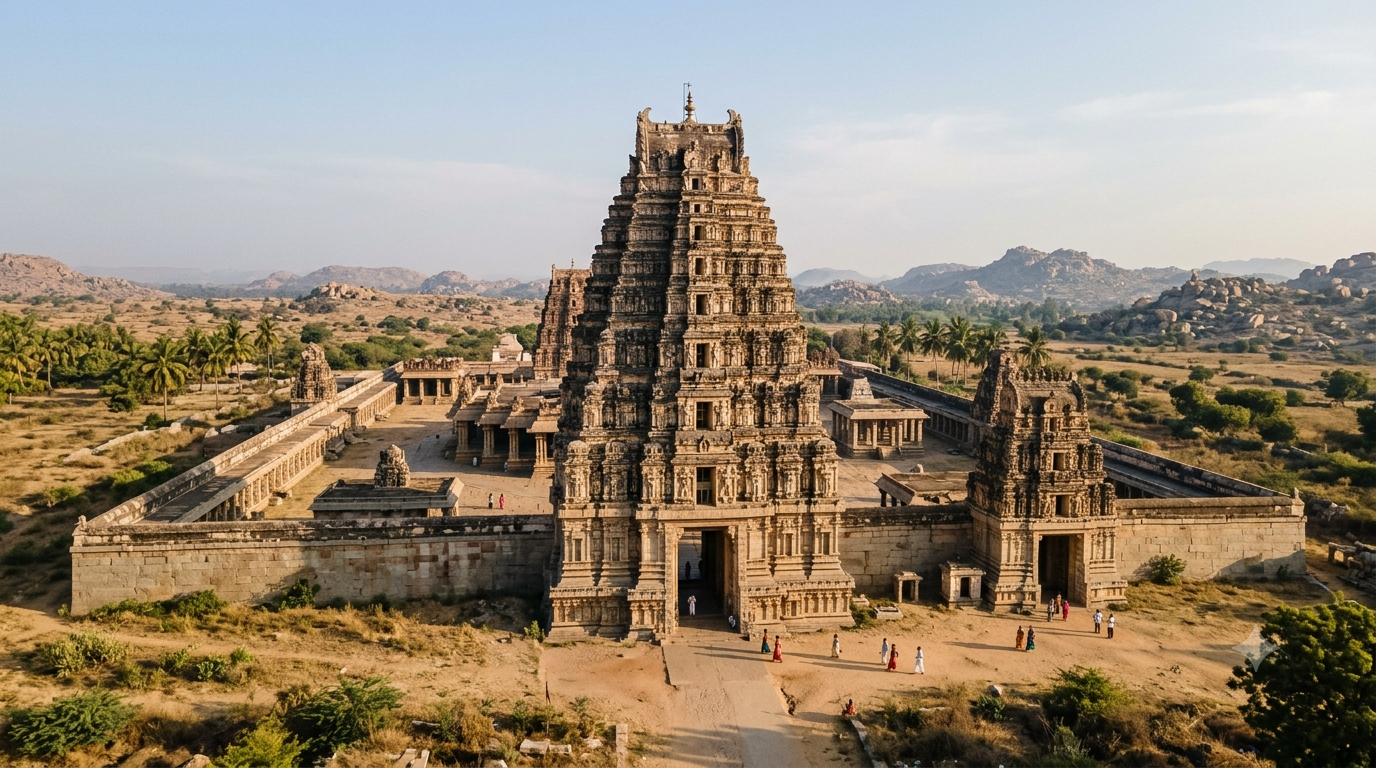
Vontimitta temple history reaches back to the 16th century. Vijayanagara-era builders raised one of South India’s grandest shrines to Lord Rama here, on the dry plains of Kadapa district. Locals call it the Sri Kodandarama Swamy Temple. This monument blends legend, literature and stone-carving mastery into one living heritage site.
It is famous for idols of Rama, Sita and Lakshmana sculpted from a single rock. Today it also serves as the state venue for Andhra Pradesh’s Sri Sita Rama Kalyanam. Because so much myth surrounds it, this guide separates real Vontimitta temple history from legend and adds practical visiting basics.
Sri Vyasa Pooja is an independent pilgrim guide. We are not the official website of the Vontimitta temple, the TTD, or the Archaeological Survey of India. We hold no affiliation with them. We take no bookings, donations or payments — please use the official channels linked below.
Vontimitta Temple at a Glance
- Deity: Lord Rama, with Sita and Lakshmana (Kodandarama form)
- Location: Vontimitta village, Rajampet taluk, YSR Kadapa district, Andhra Pradesh
- Built: Attributed to Chola and Vijayanagara kings; dated mainly to the 16th century
- Style: Vijayanagara architecture, Sandhara order, three gopurams
- Heritage status: ASI centrally protected Monument of National Importance
- Administration: Tirumala Tirupati Devasthanams (TTD)
- Signature feature: Rama, Sita and Lakshmana carved from a single stone (ekasila)
Vontimitta Temple History: Origins and Age
The dynastic layer of Vontimitta temple history begins with its builders. Most historians credit the Chola and Vijayanagara kings, and they date the surviving structure mainly to the 16th century. The work also happened in phases. So some scholars trace early activity to the 13th and 14th centuries, before the sanctum rose.
The heritage status of the temple lifts it from a regional shrine to a national treasure. The temple and its adjoining buildings rank as a centrally protected Monument of National Importance under the Archaeological Survey of India. That protection explains why the carvings survive so cleanly, since the ASI has stabilised the stonework for decades. The Tirumala Tirupati Devasthanams (TTD) now administers daily worship, after a board decision in 2015.
The site drew admiration long before modern tourism arrived. When the French traveller Jean-Baptiste Tavernier passed through in 1652, he reportedly praised the shrine as one of India’s grandest pagodas. Later centuries brought spells of neglect. Yet the monument endured, because successive rulers valued its pilgrimage economy.
The Legend of Vontudu and Mittudu
Local tradition gives the village and temple their name. Two devotees named Vontudu and Mittudu supposedly built the shrine out of pure devotion to Rama. Although the legend says they were once robbers, they later turned to faith and finished the temple together. That tale of robbers turned saints gives the shrine much of its warmth.
When their work was done, both are said to have turned to stone at the entrance. Pilgrims still cherish this as a symbol of surrender. Another story ties the idols to the Ramayana itself, since devotees hold that Jambavantha, the bear king who aided Rama, installed the images here.
These remain matters of faith and oral tradition rather than documented history. So we present them as the beloved legends they are. Still, they explain why the temple feels alive rather than museum-like.
The Architecture Behind Vontimitta Temple History
The stonework is the clearest evidence in Vontimitta temple history. Builders worked in mature Vijayanagara style, so the complex sits inside a walled rectangular courtyard. Three towering gopurams face east, north and south. While the east-facing central gopuram rises as a five-tiered structure, the other two stand three tiers tall.
The tallest tower soars well over 100 feet. Its tiers taper upward in the classic Dravidian manner. Together these gateways give the temple a commanding silhouette across the flat Rayalaseema landscape.
At the heart of the complex stands the Madhya Ranga Mandapam, a hall of 32 finely carved pillars. Apsaras, deities and mythological scenes cover the columns. Because the mandapa leads straight to the sanctum, pilgrims pass through a gallery of sculpture on their way to darshan.
Two sacred tanks, Rama Theertham and Lakshmana Theertham, lie within the precincts. Temple lore says these springs once quenched a visiting king and his army. So the site became a natural resting point on old routes, and the tanks still frame its serene mood.
The Single-Stone Idol and What Sets It Apart
The temple’s most celebrated feature is its ekasila vigraham. Sculptors carved Rama, Sita and Lakshmana from one continuous rock. Artisans and archaeologists alike still marvel at the feat. This is the detail most first-time visitors come to see, so it deserves a clear explanation.
A widely repeated online claim says devotees here worship Rama “without Sita.” That is inaccurate. Sita stands beside Rama in the single-stone idol. What is actually absent from this sanctum is Hanuman.
Since Anjaneya does not appear in the ekasila, the temple keeps a separate shrine for him nearby. Correcting this common error matters, because it shapes what visitors expect from Vontimitta temple history at the sanctum.
Literary Heritage and the Pothana Debate
Vontimitta sits at the centre of a real literary debate, and this is where many guides get the facts wrong. Countless pages state flatly that Bammera Pothana was born here. They add that the poet of the Telugu Maha Bhagavatam composed his masterpiece at this temple. Because the reality is more contested, it is worth setting out honestly.
Mainstream scholarship places Pothana in Bammera village near Warangal, in present-day Telangana. In his own writing he mentions living in Bammera, then travelling to “Ekasilanagaramu” to compose the Bhagavatam. His contemporary Koravi Goparaju identified Ekasilanagaramu as Warangal, so the Telangana case is strong.
A minority view still argues for Vontimitta, partly because land near the temple was once called “Bammera manyalu.” Yet the weight of evidence points to Telangana. So this birthplace claim is best treated as local tradition, not settled fact.
One literary link, however, is well documented. The scholar Vavilakolanu Subba Rao earned the title “Andhra Valmiki” for translating Valmiki’s Ramayana into Telugu. He was also deeply devoted to this shrine. So the real literary strand of Vontimitta temple history runs through Subba Rao and the wider Rama-bhakti tradition of Rayalaseema.
Why Vontimitta Temple History Still Matters
The reach of Vontimitta temple history extends well beyond its walls today. The 2014 bifurcation of Andhra Pradesh placed the famous Bhadrachalam temple inside the new state of Telangana. So the Andhra Pradesh government chose Vontimitta for its state-sponsored Sri Sita Rama Kalyanam during Sri Rama Navami. That decision gave the temple fresh prominence, and it now draws tens of thousands of pilgrims each year.
The Kalyanam here carries an unusual twist. While most Rama temples perform the celestial wedding at noon, priests at Vontimitta hold it at night. They choose the Chaitra Sukla Chaturdasi, a day before the full moon. Tradition explains that Rama loved the moon as a child, so he blesses devotees in moonlight.
This night-time wedding is one of the temple’s most distinctive living customs. The shrine also anchors an emerging pilgrimage circuit linking Tirupati and the Rayalaseema temples. Because it lies on the Kadapa–Rajampet–Tirupati road, many devotees fold a visit into a wider journey, which you can plan through Andhra Pradesh Tourism.
Planning a Visit: Timings, Access and a Safety Note
Most sources list darshan from about 6:00 AM to 1:00 PM, and again from 2:00 PM to 8:00 PM. A few reports give slightly different hours. Because timings shift on festival days and can change without notice, treat these as approximate and confirm locally. General darshan is free, while a small fee of around ₹50 is commonly cited for inner-sanctum (Antaralaya) darshan.
One correction saves disappointment. The temple offers no online booking. So treat any site selling Vontimitta darshan or Kalyanam tickets online with caution, since staff manage entry at the counter only. For festival dates and travel logistics, see our detailed Vontimitta Seetha Rama Kalyanam timings and travel guide.
You can also check the annual Sri Rama Navami Brahmotsavam dates before planning. Dress modestly, as at any temple, and leave footwear at the stands outside the complex.
Vontimitta lies about 25 km from Kadapa, close to Rajampet. The nearest railway stations sit at Vontimitta and Kadapa, while buses run often on the Kadapa–Tirupati route. Because Rayalaseema summers turn harsh, carry water and avoid the midday heat between May and June. The pleasant October-to-March window suits most pilgrims, especially elderly travellers.
Temples and Sights Near Vontimitta
Vontimitta pairs well with other Rayalaseema landmarks. Gandikota, often called the “Grand Canyon of India,” sits within Kadapa district and rewards a short day trip. The ancient Pushpagiri temple cluster, on the Pennar river, lies within easy reach for temple lovers. Because these sights cluster around Kadapa, a two-day base there covers them comfortably.
Many pilgrims also continue toward Tirupati, roughly 110 kilometres away. So a Vontimitta stop slots neatly into a larger Rama and Venkateswara circuit. Plan distances in advance, since public transport thins out after dark. If you drive, the Kadapa–Rajampet–Tirupati road keeps the whole route straightforward.
Before You Go
Vontimitta rewards the traveller who understands what they are seeing. The single-stone idols, the 32-pillar mandapa and the ASI-protected gopurams make this one of Andhra Pradesh’s most important Rama temples. Its night-time Kalyanam and contested literary lore give it a rare character. So Vontimitta temple history is both artistic and cultural.
Verify current timings, plan around the weather, and route any bookings only through official channels. Do that, and a visit becomes a walk through five centuries of devotion, art and Telugu heritage.
Frequently Asked Questions
Who built the Vontimitta Kodandarama temple?
Historians attribute the temple to the Chola and Vijayanagara kings, and date the surviving structure mainly to the 16th century. Local legend credits two devotees, Vontudu and Mittudu, whose names gave the village its identity. Scholars treat the dynastic attribution as the documented layer and the Vontudu–Mittudu story as tradition.
What is special about the Vontimitta temple idols?
Sculptors carved Rama, Sita and Lakshmana from a single stone, known as the ekasila vigraham. Unlike many Rama temples, Hanuman is absent from this main sanctum and has a separate shrine nearby. The single-rock craftsmanship remains the temple’s most admired feature.
Is Vontimitta temple history tied to poet Pothana?
The link is disputed. Mainstream scholarship places Bammera Pothana in Bammera village near Warangal in Telangana, though a minority view claims Vontimitta as his birthplace. The temple’s better-documented literary figure is Vavilakolanu Subba Rao, the “Andhra Valmiki.”
Why is Sita Rama Kalyanam performed at night here?
At Vontimitta, priests hold the celestial wedding at night, a day before the full moon, rather than at noon. Tradition says Rama, who loved the moon as a child, blesses devotees in moonlight. This custom makes the Vontimitta Kalyanam distinct from most other Rama temples.
What are the Vontimitta temple darshan timings?
Darshan generally runs from around 6:00 AM to 1:00 PM, and again from 2:00 PM to 8:00 PM. Reports vary, and festival days differ. Because hours can change without notice, confirm locally before travelling.
Can I book Vontimitta darshan or Kalyanam tickets online?
No. The temple offers no online booking, and staff handle entry at the counter. Be cautious of any website claiming to sell official Vontimitta tickets online, since these are not genuine channels.
How do I reach Vontimitta temple?
Vontimitta lies about 25 km from Kadapa and close to Rajampet, on the Kadapa–Tirupati road. The nearest railway stations are Vontimitta and Kadapa, while regular buses serve the route. Tirupati, roughly 110–135 km away, is the nearest major airport gateway.
What is the significance of Vontimitta temple history?
Vontimitta temple history matters because the shrine is an ASI-protected Vijayanagara monument, a single-stone Rama idol site, and the state venue for Andhra Pradesh’s Sita Rama Kalyanam. Because the temple follows the lunar calendar, its Brahmotsavam dates around Sri Rama Navami shift each year, so confirm the current schedule before you travel.