Malikappuram Devi worship at Sabarimala forms an important part of the pilgrimage after Lord Ayyappa darshan. The nearby shrine honours Malikappurathamma, whom devotees revere as Bhagavathi and a powerful form of the Divine Mother. Yet many visitors reach the hilltop without knowing the difference between her traditions and the main Ayyappa temple’s rituals.
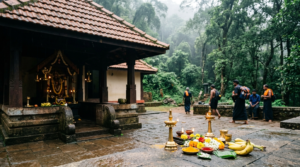
This independent guide explains whom pilgrims worship, which offerings have traditional support, and how to plan a respectful visit. Sri Vyasa Pooja is not affiliated with the Travancore Devaswom Board or the temple. We accept no bookings, donations, payments or personal details; use official channels for current arrangements.
Malikappuram Devi Worship at a Glance
- Deity: Malikappurathamma, revered as Bhagavathi and, in the tantric understanding recorded by the official Sabarimala site, Adiparasakthi.
- Location: The Malikappuram shrine stands within the Sabarimala Sannidhanam pilgrimage complex in Kerala.
- Usual visit order: Devotees traditionally offer respects to Malikappurathamma after Lord Ayyappa darshan.
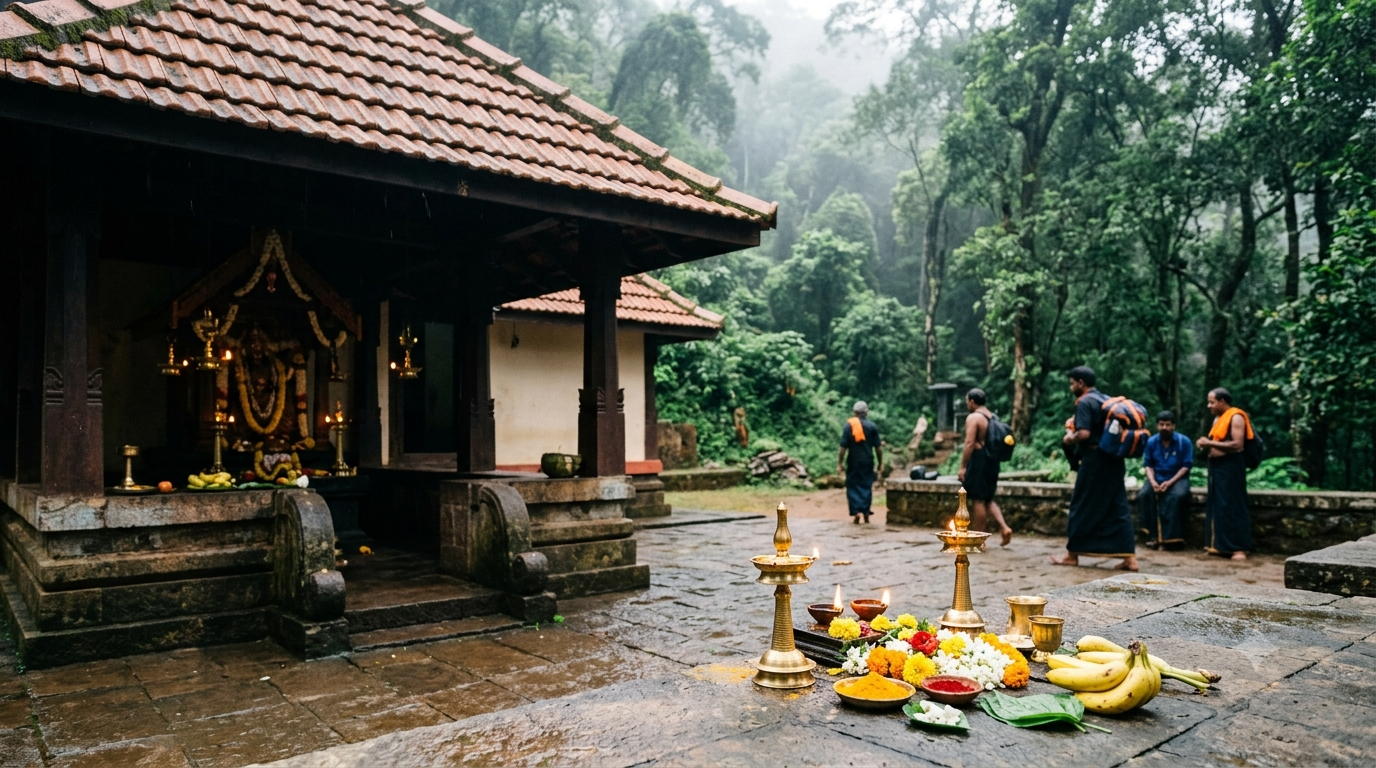
- Traditional offerings: Turmeric, kumkum, jaggery, honey, plantain and red silk appear in the official shrine description.
- Major ceremonial connection: Guruthi and Kalamezhuthu feature in the Makaravilakku observances.
- Important caution: Check the day’s shrine access, accepted offerings and any charges with temple staff. No separate current Malikappuram timetable or price is confirmed here.
Who Is Malikappurathamma at Sabarimala?
Malikappurathamma is the revered goddess of the Malikappuram shrine near Lord Ayyappa’s sanctum at Sabarimala. The Kerala Government’s Sabarimala information describes her as an important upadevatha, or associated deity. Kerala Tourism also places her worship within the customary journey of an Ayyappa pilgrim.
Devotees address her as Amma, a respectful name for the Divine Mother. The shrine is not another Ayyappa sanctum. Instead, Malikappuram Devi worship adds a distinct goddess tradition to the pilgrimage.
The official Sabarimala account also connects her with Adiparasakthi in a tantric interpretation. In plain terms, this identifies the Devi with the primordial divine feminine power. It is a theological understanding, not a claim that every regional story uses the same language.
Kerala Tourism additionally records a tradition linking Malikappurathamma to Madurai Meenakshi through the Pandya heritage. Together, these associations show why the goddess matters deeply in local worship.
Why Malikappuram Devi Worship Follows Ayyappa Darshan
For many Sabarimala pilgrims, the journey does not end immediately after praying to Lord Ayyappa. Kerala Tourism describes paying respects to Malikappurathamma on the return from the main darshan as part of the traditional observance. This makes her shrine a meaningful final stop within the hilltop complex.
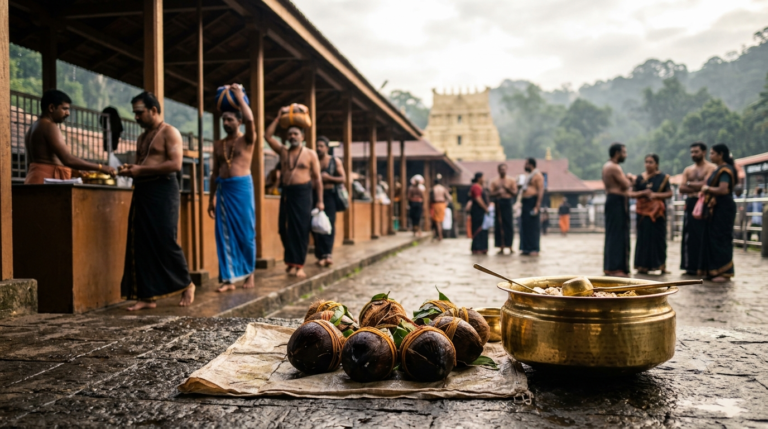
The sequence also helps explain why devotees treat the two shrines with distinct offerings. Ghee-filled coconuts have a special role in Ayyappa’s Neyyabhishekam. Meanwhile, the Devi’s customary offerings reflect the worship of Bhagavathi.
A pilgrim should not assume that both rituals share one queue, ticket or counter. Temple access and crowd-control routes can change, especially during the busy season. Therefore, follow the current signs and instructions after completing the main darshan.
The Stories Behind Malikappuram Devi Worship
To understand Malikappuram Devi worship, there is no need to choose one legend and erase the others. The official Sabarimala website and Kerala Tourism both acknowledge more than one tradition about Malikappurathamma. Each story offers a devotional understanding rather than a verified historical biography.
The Mahishi Tradition
One familiar legend connects Malikappurathamma with Mahishi, a being whom Lord Ayyappa defeats. Following that encounter, the story says a transformed woman wishes to remain close to him. Devotees understand her presence at Malikappuram through this account.
Some versions also add a marriage promise linked to first-time Ayyappa pilgrims. Those details belong to the wider oral tradition and can differ between families. They should not be presented as a universal temple rule or a historical event.
The Poonkodi and Kalari Tradition
Kerala Tourism also recounts a story about Poonkodi, the daughter of a martial-arts teacher associated with Cheerappanchira Kalari. In that telling, she develops affection for Ayyappa during his period of training. Her connection with Malikappurathamma reflects a different strand of local memory.
The Sabarimala account similarly mentions the daughter of Ayyappa’s guru who chose an ascetic life. These traditions differ in emphasis, so readers should treat them as parallel beliefs. Neither story gives a basis for inventing a firm date or a single official origin narrative.
Bhagavathi, Meenakshi and Adiparasakthi
Descriptions of the goddess also use names from wider Shakta worship. Bhagavathi is a familiar Kerala term for Devi. Adiparasakthi describes divine feminine energy in theological language, while the Meenakshi association draws on a Pandya-linked tradition.
Malikappuram Devi Worship: Traditional Offerings
Malikappuram Devi worship includes offerings that differ from the ghee abhishekam associated with Lord Ayyappa. The official Sabarimala upadevatha description names turmeric powder, kumkum, jaggery, honey, plantain and red silk. It does not establish a current price for each item.
Bring only what the temple currently permits, because acceptance and handling can change. Staff may direct devotees to an official offering point rather than the shrine entrance itself. The safest choice is to confirm locally before buying or carrying items uphill.
| Offering | Traditional association | Planning note |
|---|---|---|
| Turmeric powder | Bhagavathi worship | Ask where the temple accepts it. |
| Kumkum powder | Goddess devotion | Use only the approved offering area. |
| Jaggery | Traditional offering | Check quantity and acceptance on site. |
| Honey | Traditional offering | Keep containers sealed until instructed. |
| Plantain | Traditional fruit offering | Follow staff directions for handover. |
| Red silk | Devotional cloth offering | Confirm approved form and arrangements. |
The table records types of offerings, not a shopping list or a temple-approved package. There is also no verified basis here for claiming that one offering guarantees marriage, fertility, prosperity or relief from illness. Devotees may pray for personal intentions, but spiritual belief is not a medical treatment.
What About Rolling a Coconut?
Some traditional accounts describe thenga urutt, or rolling a coconut, in connection with Malikappurathamma. This differs from the ghee-filled coconut used for Lord Ayyappa’s Neyyabhishekam. The two should not be mixed up simply because both involve coconuts.
Published descriptions of the custom do not prove that every pilgrim may perform it at any hour. Crowd restrictions, offering rules and staff directions take priority. Never roll or break a coconut in an unapproved walkway, near other pilgrims or on the sacred steps.
How to Plan Malikappuram Devi Worship at Sabarimala
Malikappuram Devi worship takes place within the Sabarimala hilltop complex, not at a separate road-access temple. Most pilgrims reach the Sannidhanam after travelling to the Pamba base area and completing the uphill pilgrimage. Once at the top, they can seek directions to Malikappuram after Ayyappa darshan.
Use this simple sequence as a planning aid, not as a rigid promise of unrestricted access:
- Check the official pilgrimage notice. Review the Travancore Devaswom Board updates before choosing a travel day.
- Arrange the required darshan entry. The board says Virtual-Q registration is mandatory for Sabarimala pilgrims. Use the official linked service.
- Reach the Sannidhanam safely. Follow the assigned route from Pamba and leave time for rest and crowd checks.
- Complete Lord Ayyappa darshan. Stay with the authorised queue and follow the day’s instructions for movement.
- Ask for the Malikappuram route. Temple staff can guide you towards the Devi shrine using the currently open path.
- Offer prayers respectfully. Use an official counter if staff require one for a particular offering.
- Return by the designated route. Do not move against barriers or attempt a shortcut to revisit a closed area.
The official Travancore Devaswom Board website carries pilgrimage notices. For queue registration, consult the Sabarimala Virtual-Q portal, which Kerala Police identifies as the official service. Those links serve separate needs; neither proves a special Malikappuram offering is available.
Malikappuram Devi Worship Timings and Fees: What Is Confirmed?
No current, separate daily timetable or fee schedule for Malikappuram Devi worship could be confirmed in official sources reviewed. Therefore, this guide does not reproduce generic Sabarimala opening hours as the Devi shrine’s hours. It also avoids quoting an unsupported charge for an offering or special pooja.
The main Ayyappa temple publishes seasonal pooja timings, but those hours cover its own sanctum and services. They do not automatically establish when every upadevatha shrine accepts visitors or materials. Local arrangements may also change during ceremonies and heavy crowd movement.
Check the Travancore Devaswom Board Sabarimala page for official notices. Once at the Sannidhanam, ask authorised staff about that day’s Malikappuram darshan access and offering procedure. If a fee applies, pay only through the permitted official channel and retain the receipt.
The Makaravilakku Connection: Guruthi and Kalamezhuthu
Malikappuram Devi worship also has a ceremonial connection beyond ordinary shrine visits. Kerala Tourism describes Guruthi as a major ritual linked with the close of the Makaravilakku observances. It takes place in the area before the Manimandapam, behind the Malikappuram shrine, and honours Bhadrakali.
Kerala Tourism attributes the traditional Guruthi performance to the Kunnakad Kuruppan family of Ranni. Its account also records the presence of a representative of the Pandalam royal family. This is a managed temple observance, not an activity visitors can organise themselves.
What Is Kalamezhuthu?
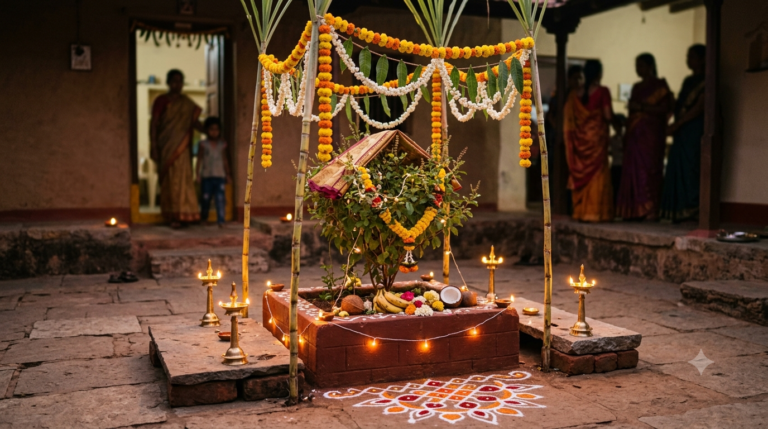
Kalamezhuthu is a ritual art form using coloured powders to form sacred floor designs. At Sabarimala, Kerala Tourism links it with the Manimandapam ceremonies during Makaravilakku. Songs and processional customs form part of the larger observance.
Why Does Sharamkuthi Matter?
The Makaravilakku processional tradition connects Malikappuram and Sharamkuthi. Kerala Tourism describes a ceremonial movement to Sharamkuthi near the conclusion of the festival sequence. Separate oral narratives associate that place with first-time devotees and the goddess’s story.
There is an important distinction here: the festival procession is a managed temple ceremony. It is not a self-guided ritual route for any pilgrim to follow after dark. Crowd-control rules and announcements determine what visitors can observe.
For the ceremonial background, read Kerala Tourism’s official Guruthi account and Kalamezhuthu account. Neither should be mistaken for a live booking calendar.
When to Plan Malikappuram Devi Worship
The main Sabarimala pilgrimage season covers Mandala and Makaravilakku observances, beginning around the Malayalam month of Vrishchikam. The hill shrine also follows other official opening periods. Check the current temple calendar instead of assuming that Sabarimala opens every day like a town temple.
For Malikappuram Devi worship, prioritise a confirmed pilgrimage opening and a valid darshan plan. Travelling solely to witness Guruthi requires extra caution, because festival ceremonies and public viewing arrangements are not guaranteed. Never infer a specific November or January date from last year’s social-media post.
The Kerala Tourism pilgrimage-season guide explains the seasonal pattern. However, the board’s current calendar and instructions should decide your actual travel dates.
Practical Details Many Pilgrims Overlook
Malikappuram Devi worship may feel brief after the long climb. That does not mean it deserves less planning. Yet the challenge is moving through Sannidhanam without disrupting queues or losing companions.
- Keep the two kinds of worship distinct. Ayyappa’s Neyyabhishekam is not a substitute for Malikappurathamma’s customary prayers. Our Sabarimala Neyyabhishekam guide explains that separate practice.
- Do not buy an assumed package. A seller’s list of Devi offerings does not prove temple approval or an official fee.
- Ask before taking photographs. The official visitor guidance restricts mobile-phone use inside temple premises. Follow signs and staff directions.
- Use the assigned return path. A route that looks shorter may cross an active queue or a restricted ritual space.
- Keep accommodation separate. If an overnight stay helps your pilgrimage, consult our Sabarimala rooms guide and verify availability through the board.
Make room for slower group members in your plan. The climb from Pamba, crowded paths and long waits can strain elderly pilgrims and people with medical conditions. Carry permitted water and essential medicines, use official rest points, and seek medical advice before a strenuous trip if you are at risk.
What If the Shrine or an Offering Is Unavailable?
Malikappuram darshan access and individual offerings cannot be guaranteed merely because a pilgrim reaches Sabarimala. A route may change, staff may pause movement, or an offering counter may not accept a particular item. A festival ceremony may also limit ordinary access.
- First, ask authorised temple staff. Confirm whether access has moved to another route or whether an offering remains available that day.
- Next, follow an official alternative. If staff direct pilgrims to another approved counter or prayer area, follow that instruction.
- If access remains closed, accept the restriction. Offer a respectful prayer from a permitted place, then return as directed.
- If the specific ritual matters, plan another date. Check the board’s next verified opening rather than trusting an agent’s promised entry.
Neither a Virtual-Q confirmation nor a general Sabarimala travel package guarantees a separate Devi pooja. Likewise, anyone claiming a fixed private booking link should raise concern. Use only current information from the temple authorities.
Before You Leave Sabarimala
Malikappurathamma’s shrine brings goddess devotion into the Ayyappa pilgrimage without erasing the differences between their rituals. The best visit respects that distinction. Offer prayers in the permitted space, ask before presenting materials, and let the temple’s current instructions guide your return.
The legends add meaning, though they cannot prove historical events. For practical details, favour the board’s notices over copied schedules or price lists. This keeps Malikappuram Devi worship sincere, informed and safe.
Frequently Asked Questions
Is Malikappuram Devi Temple inside Sabarimala?
Yes. The Malikappuram shrine stands within the Sabarimala Sannidhanam complex, close to the main Ayyappa pilgrimage area. Devotees generally visit after Lord Ayyappa darshan, subject to the current crowd-control route.
Who is worshipped at Malikappuram?
Devotees worship Malikappurathamma, whom the official Sabarimala account associates with Adiparasakthi. Kerala Tourism also describes her as Bhagavathi. Different legends explain her place near Lord Ayyappa.
Which Offerings Are Traditional in Malikappuram Devi Worship?
The official Sabarimala description also lists turmeric, kumkum, jaggery, honey, plantain and red silk. However, that list does not prove every item is accepted on every day. Confirm the current rules locally.
Can I book Malikappuram Devi pooja online?
No separate current Malikappuram-specific online booking service was confirmed from the official pages reviewed. Do not pay third parties who promise guaranteed pooja access. Ask the Travancore Devaswom Board about available official services.
What are the Malikappuram Devi temple timings?
A current, separate Malikappuram daily timetable could not be verified. The general Ayyappa shrine’s published timings should not be copied as a Malikappuram schedule. Check the day’s access instructions with temple staff.
How Does Malikappuram Devi Worship Differ from Ayyappa Worship?
Both belong to the Sabarimala pilgrimage, but they honour different deities and customs. Neyyabhishekam centres on Lord Ayyappa, while Malikappurathamma’s traditional offerings include items associated with Bhagavathi worship.
What is Guruthi at Malikappuram?
Guruthi is a traditional ritual associated with Bhadrakali and the closing ceremonies of Makaravilakku. Kerala Tourism locates it near the Manimandapam and records its hereditary ritual custodians. It is not an ordinary daily visitor activity.
Does a Virtual-Q slot guarantee Malikappuram darshan?
No. Virtual-Q manages pilgrim entry for Sabarimala, not a promised separate ritual at Malikappuram. Access still depends on the day’s shrine arrangements and crowd-control instructions.
Why is Malikappurathamma linked with Mahishi?
One devotional legend describes Mahishi’s transformation after Lord Ayyappa defeats her. Other traditions describe a woman associated with Ayyappa’s martial-arts teacher. They are parallel beliefs, not one verified historical account.