Anyone planning a trip to the Murugan temples in Tamil Nadu hits the same wall. There are hundreds of shrines, yet most online lists repeat the same six names with the same recycled details. This guide does the opposite. You get the six Arupadai Veedu abodes in brief, nine more temples worth your route, and a plan built around the city you start from.
We also flag the errors that keep resurfacing, because a wasted trip usually begins with one bad detail. Wrong step counts, invented booking links and decade-old timings are everywhere. So every number below is either sourced, labelled as indicative, or sent to the official portal for confirmation.
Sri Vyasa Pooja is an independent devotional guide. We are not affiliated with any temple, trust, or the Tamil Nadu Hindu Religious and Charitable Endowments (HR&CE) Department, and we accept no bookings, donations or payments. Use the official temple portals linked below for tickets and confirmations.
Murugan Temples in Tamil Nadu at a Glance
- The core circuit: the six Arupadai Veedu abodes, spread from Thiruthani in the north to Thiruchendur on the south coast.
- Beyond the six: Marudhamalai, Sikkal, Vayalur, Vadapalani, Thiruporur, Kundrathur, Siruvapuri, Viralimalai and several hill shrines.
- Entry cost: general darshan is free at HR&CE temples, so you pay only for special darshan, sevas or hill transport.
- Typical hours: roughly 5:30 AM to 8:30 PM, with a midday break at most shrines.
- Best months: October to February, when travel days are cooler and hill climbs are bearable.
- Official domain: genuine temple sites end in hrce.tn.gov.in — nothing else is the department.
Put simply, the Murugan temples in Tamil Nadu work best as clusters. Tamil tradition treats Murugan worship as a journey rather than a single destination, so group your shrines around Chennai, Coimbatore, Madurai or Kumbakonam.
The Six Arupadai Veedu Abodes in Short
The six Arupadai Veedu temples are Thiruparankundram, Thiruchendur, Palani, Swamimalai, Thiruthani and Pazhamudircholai. Named in the Sangam-era poem Thirumurugatruppadai, they mark stages of Murugan’s divine journey. Devotees treat the six as one continuous pilgrimage, not six separate trips.
| Abode | District | Why it stands out |
|---|---|---|
| Thiruparankundram | Madurai | Rock-cut shrine; abhishekam offered to the Vel |
| Thiruchendur | Thoothukudi | The only seaside abode; Soorasamharam |
| Palani | Dindigul | Hilltop shrine with rope car and winch |
| Swamimalai | Thanjavur | 60 steps; Murugan worshipped as guru |
| Thiruthani | Tiruvallur | 365 steps; closest abode to Chennai |
| Pazhamudircholai | Madurai | Forest hill shrine above Azhagar Kovil |
Because the circuit deserves its own planning, we keep it brief here. Our full Arupadai Veedu route map and timings guide covers distances, order and darshan hours for all six.
Famous Murugan Temples in Tamil Nadu Beyond the Six Abodes
Beyond the six abodes, the Murugan temples in Tamil Nadu number in the hundreds, and dozens carry their own festivals and legends. Marudhamalai near Coimbatore and Sikkal near Nagapattinam are the two most often called the “seventh abode” by devotees, while the Chennai belt alone holds four temples worth a half-day each.
Marudhamalai, Coimbatore
This 12th-century hill temple stands about 600 feet above the plains, some 12 to 15 km from Coimbatore city. Tradition ties it to Pambatti Siddhar, whose cave shrine still sits on the hill. Devotees widely treat Marudhamalai as the seventh abode, although that status is traditional rather than official.
Timings usually run from about 5:30 AM to 1 PM and again from 4 PM to 8:30 PM, though published hours differ by source. Temple buses climb the ghat road every few minutes for a nominal fare. Confirm current hours on marudhamalaimurugan.hrce.tn.gov.in before you travel.
Sikkal Singaravelan, Nagapattinam
At Sikkal, Murugan is worshipped as Singaravelar inside the Navaneetheswarar temple complex. Devotees believe he received the Vel from Parvati here, just before the battle at Thiruchendur. During Skanda Sashti the idol is said to sweat as the Vel is handed over. Devotees travel for that moment, though it remains a matter of faith.
Vayalur, Tiruchirappalli
Vayalur lies about 9 km from Trichy and dates to Chola patronage around the 9th century. Tamil tradition links the saint Arunagirinathar’s Thiruppugazh hymns to this shrine. Renovation work has been reported here in recent years, so check the temple’s status before making a special trip.
Vadapalani, Chennai
Vadapalani Andavar Temple is the busiest Murugan shrine inside Chennai city. Renovated in 1920 and roughly a century and a quarter old in its present form, it is also the state’s best-known temple wedding venue. Wedding and seva arrangements are handled at the temple office itself, never through agents online.
Thiruporur Kandaswamy, Chengalpattu
Thiruporur sits around 40 km south of Chennai near the Old Mahabalipuram Road, so it pairs naturally with a Mahabalipuram day trip. Legend places Murugan’s battle with Tharakasuran here. The temple is closely associated with the saint Chidambara Swamigal, whose shrine stands within the complex.
Kundrathur, Chennai
Kundrathur is a small hillock temple on Chennai’s south-western edge, built during the reign of Kulothunga Chola. Murugan is said to have worshipped a Shiva lingam here while travelling to Thiruthani. Sacred ash from the abhishekam is distributed as prasadam, which is unusual among Murugan shrines.
Siruvapuri, Thiruvallur
Siruvapuri Balasubramaniyar Temple lies about 45 km north of Chennai off the highway to Kolkata. Temple records place the structure at over five centuries old. Skanda Sashti in the Tamil month of Aippasi is its biggest festival, when crowds swell for the six-day Soorasamharam sequence.
Viralimalai, Pudukkottai
Viralimalai is a hill shrine on the Trichy–Madurai road, famous for the peacocks that live around the temple. Because it falls neatly between two big cities, it works well as a mid-route stop rather than a destination. The climb is short compared with Palani or Marudhamalai.
Three more worth the detour
- Kuzhanthai Velappar Temple, Poombarai: a Kodaikanal-hills shrine whose idol is traditionally attributed to the siddhar Bogar.
- Kalugumalai, Thoothukudi: an 8th-century Pandya rock-cut Murugan shrine, beside the unfinished Vettuvan Koil.
- Chennimalai, Erode: a hill temple reached by a long stepped path, with road access for those who cannot climb.
Best Pilgrimage Plan for Murugan Temples in Tamil Nadu
The best pilgrimage plan for Murugan temples in Tamil Nadu is cluster-based, not state-wide. Group shrines by base city, cover one cluster per trip, and keep hill temples for early morning. Trying to cover north and south in one rushed week is the single most common planning mistake.
Two days from Chennai
- Day 1: Thiruthani in the morning, since the 365 steps are easier before the sun climbs, then Siruvapuri on the way back.
- Day 2: Vadapalani early, Kundrathur by late morning, and Thiruporur in the afternoon before the evening closing.
Three days from Madurai
- Day 1: Thiruparankundram at dawn and Pazhamudircholai after lunch, as both sit within 25 km of the city.
- Day 2: Drive south to Thiruchendur for coastal darshan, then stay overnight or return.
- Day 3: Head north-west to Palani, and add Viralimalai if you are continuing towards Trichy.
Five days for the full circuit
A five-day loop from Madurai covers all six abodes with Swamimalai and Thiruthani on the closing legs. Add Vayalur near Trichy and Sikkal near Nagapattinam if the Cauvery delta is on your route. Because the total drive runs close to 900 km, four days is tight and three is unrealistic.
Darshan Timings and Costs at Murugan Temples in Tamil Nadu
Most Murugan temples in Tamil Nadu open between 5 AM and 6 AM, close for a midday break around noon, and reopen from about 4 PM until 8 or 9 PM. General darshan is free at every HR&CE shrine. You pay only for special darshan, specific sevas, or hill transport.
Special darshan stays modest where it exists. Thiruthani lists ₹100 for special darshan and ₹200 for VIP darshan. Marudhamalai’s special darshan is commonly quoted at ₹50 per person. Treat every figure as indicative, because the department revises rates without notice.
Sevas cost more and vary widely by temple. Abhishekam and archanai bookings often require a day’s notice, and long-term kattalai schemes run into thousands of rupees. Always confirm the current amount on the temple’s own hrce.tn.gov.in page or at its counter.
When to Visit Murugan Temples in Tamil Nadu: Festival Calendar
Murugan festivals follow the Tamil calendar, so their Gregorian dates shift each year. Thaipusam falls in Thai (January–February) and draws the biggest kavadi processions. Panguni Uthiram (March–April), Vaikasi Visakam (May–June), Aadi Krithigai (July–August), Skanda Sashti in Aippasi (October–November) and Karthigai Deepam (November–December) complete the main cycle.
Tuesdays and Krithigai star days are considered especially auspicious for Murugan, so expect heavier queues then. Check the exact date for your travel year on a reliable panchangam, because lunar dates shift and a leap month can move them by nearly a month.
Booking Traps at Murugan Temples in Tamil Nadu
This is where most pilgrims lose money. Genuine Tamil Nadu temple websites sit on the government domain hrce.tn.gov.in, and individual temples get their own subdomain — for example palanimurugan.hrce.tn.gov.in and tiruchendurmurugan.hrce.tn.gov.in. A polished .com or .in site is not the department, whatever its logo says.
Three rules protect you. No genuine temple booking adds a service or agent fee on top of the seva price. No genuine booking asks you to upload identity documents to a private site. And no legitimate intermediary sells “guaranteed” queue-free entry.
These warnings are not theoretical. The Indian Cyber Crime Coordination Centre issued a public alert in April 2025 about fake pilgrimage booking websites and sponsored ads, urging people to verify sites before paying and to report fraud on cybercrime.gov.in or the 1930 helpline. In 2026, HR&CE also moved to tighten online ticketing after special-darshan fraud allegations at Tiruchendur and Tiruvannamalai.
Equally important: online booking at Murugan temples in Tamil Nadu is far from universal. Several shrines, including Marudhamalai, still handle pooja tickets at the counter only. If a site offers online tickets for a temple that has none, that alone tells you it is not official.
What to Do When Your Darshan Plan Fails
Official pages describe the ideal day. They rarely tell you what happens when it goes wrong, so here are the real failure modes and the fallbacks that work.
- Special darshan sold out: join the free general queue early, since it moves faster at opening than at midday.
- Arriving at noon: most shrines shut for a midday break, so use the gap for the foothill temples and return by 4 PM.
- Vehicles barred on the hill: during Thaipusam peaks at Marudhamalai, private vehicles park at the foothills and everyone walks up.
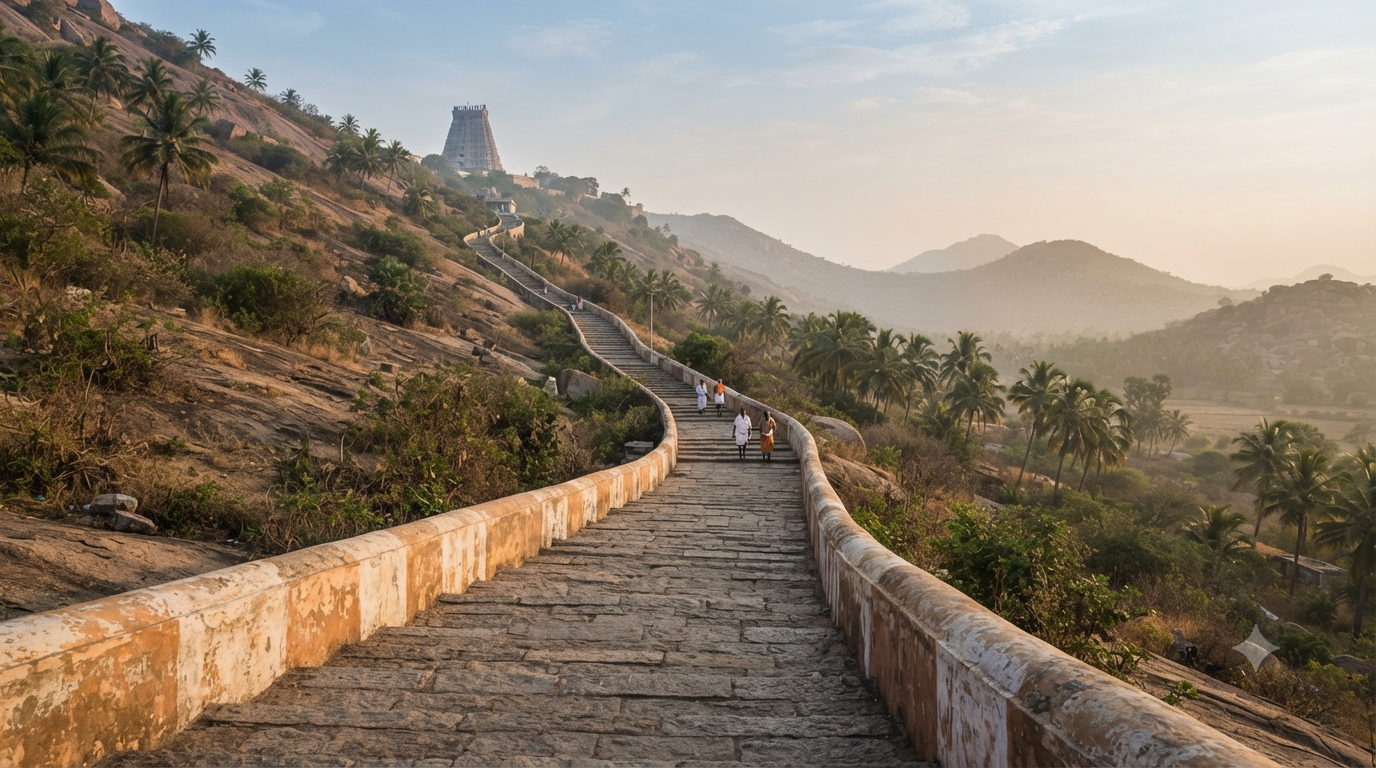
- Cannot climb: Palani has a rope car and winch, while Marudhamalai and Chennimalai have road or bus access to the top.
- Temple under renovation: Vayalur has seen extended work, so call the HR&CE listing or ask locally before a long detour.
- Festival crowds: if a Sashti or Thaipusam date is fixed for you, plan for hours in queue. Otherwise shift to a quieter shrine nearby.
Hill Climbs, Heat and Safety at Murugan Temples in Tamil Nadu
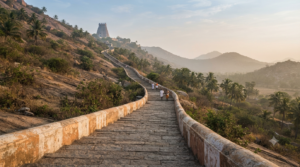
Several Murugan temples in Tamil Nadu involve real physical effort. Palani, Marudhamalai, Thiruthani and Chennimalai all sit on hills, and Tamil Nadu summers are punishing between March and June. Carry water, start before 7 AM, and keep any regular medication with you.
Elderly pilgrims, pregnant women and anyone with heart or knee problems should use the rope car, winch or bus wherever it exists. If you plan to fast before darshan, and you have a medical condition, speak to your doctor first. Ritual and prayer are matters of faith, and no temple offering replaces medical treatment.
Errors Most Murugan Temple Lists Repeat
Five mistakes travel from one list to the next, and each one can cost you a morning. Correct them before you plan.
- Palani step counts: published figures range from about 659 to 693, so no exact number is reliable. Plan for the climb, not the count.
- Marudhamalai “60 steps”: that figure belongs to Swamimalai. Marudhamalai’s stepped path is far longer, commonly described as around 700 steps.
- “Palani is near Chennai”: several travel blogs list Chennai as the nearest station. Palani is in Dindigul district, closer to Coimbatore and Madurai.
- Universal online booking: many pages claim every temple takes online tickets. Several do not, and counter-only booking remains the norm at smaller shrines.
- Fixed festival dates: Tamil festival dates move every year, so a date copied from an old post is usually wrong.
Before You Visit Murugan Temples in Tamil Nadu
Pick one cluster and keep mornings for the hills. Confirm timings the week you travel, rather than trusting any list, including this one. Book only on hrce.tn.gov.in subdomains or at the counter. For deeper detail on individual shrines, see our guides to Palani darshan timings and Thiruchendur darshan timings, and check Tamil Nadu Tourism for routes and stays.
Frequently Asked Questions
Which are the most famous Murugan temples in Tamil Nadu?
The six Arupadai Veedu abodes — Thiruparankundram, Thiruchendur, Palani, Swamimalai, Thiruthani and Pazhamudircholai — are the most famous. Marudhamalai, Sikkal Singaravelan, Vadapalani, Vayalur and Thiruporur follow closely. Together they cover almost every region of the state.
How many days do I need to cover the main Murugan temples?
Five days covers the six abodes comfortably from a Madurai base. Two days is enough for the Chennai cluster, and three days suits the Madurai and southern group. Splitting the state into clusters beats a single rushed trip.
Is there an entry fee at Murugan temples in Tamil Nadu?
General darshan is free at HR&CE-managed temples, so you pay only for special darshan, sevas or hill transport. Thiruthani lists ₹100 for special darshan and ₹200 for VIP darshan. Marudhamalai’s special darshan is commonly quoted at ₹50. Amounts change without notice.
Can I book darshan at Murugan temples in Tamil Nadu online?
Some temples accept online booking through their own hrce.tn.gov.in subdomain, while many smaller shrines remain counter-only. Never pay a third-party site that charges a service fee or asks for identity uploads. When in doubt, book at the counter on arrival.
Which Murugan temple is closest to Chennai?
Vadapalani sits inside Chennai city, so it is the easiest to reach. Kundrathur is about 20 km away, Thiruporur roughly 40 km, Siruvapuri around 45 km, and Thiruthani about 84 km. All five fit into a two-day plan.
What is the seventh abode of Murugan?
There is no official seventh abode. Devotees informally give that status to Marudhamalai near Coimbatore, and others give it to Sikkal Singaravelan near Nagapattinam. Both traditions are respected, though neither is part of the canonical six.
When is the best time to visit Murugan temples in Tamil Nadu?
October to February offers the coolest travel weather, so hill climbs and long drives feel easier. Early morning is best on any day, since queues are shortest just after opening. Avoid Thaipusam and Skanda Sashti peaks unless the festival itself is your reason for going.
What should I wear at Murugan temples?
Traditional dress is expected at most Murugan temples in Tamil Nadu. Men often remove shirts before entering the inner sanctum, while women are advised to wear a saree, half-saree or salwar. Because hill temples involve walking, carry a cloth bag for footwear and keep it simple.