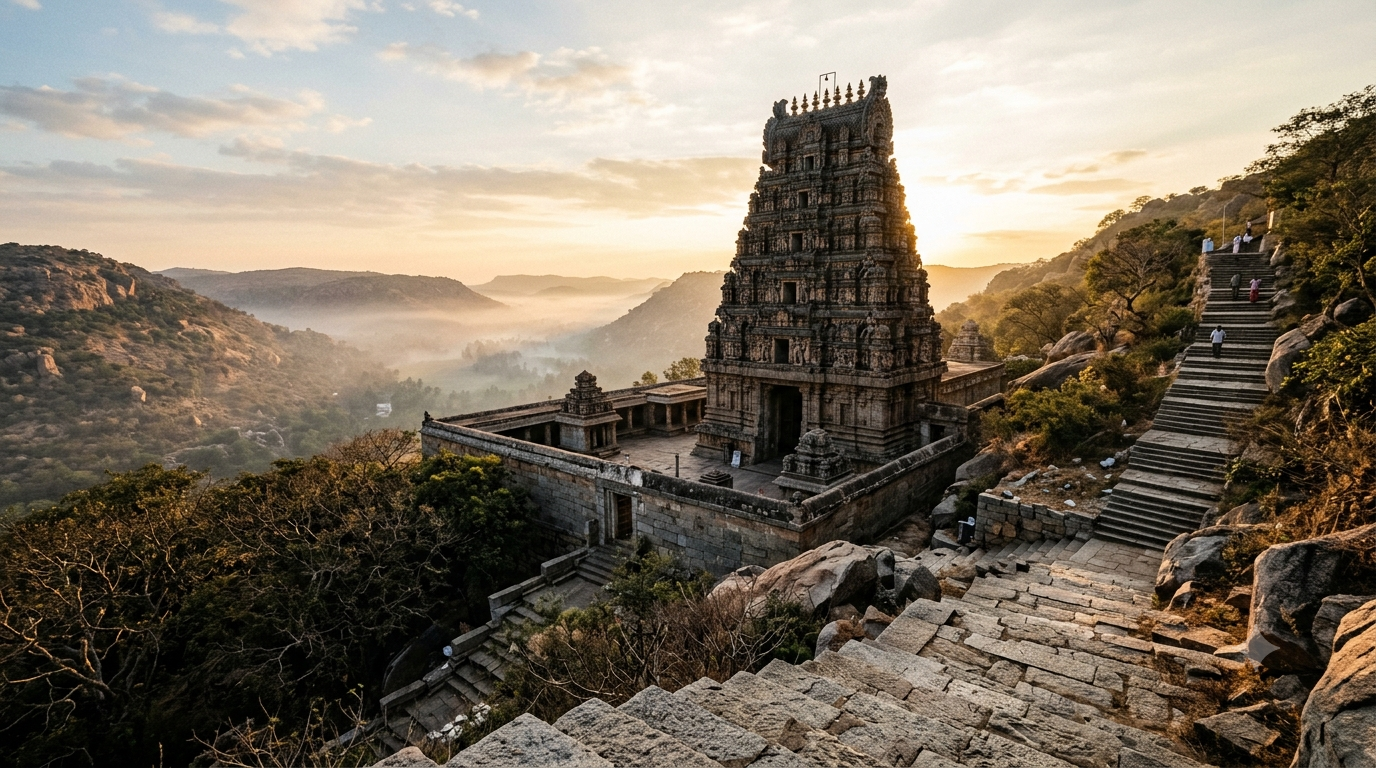
The Narasimha temples in South India share one habit that catches first-time pilgrims out. Because the Lord took a fierce form, his shrines usually sit on hilltops, inside caves, or deep in forest. So a Narasimha yatra is rarely a flat stroll to a town temple.
You came here for a list, and you will get one. You will also get the awkward details that most guides to the Narasimha temples in South India leave out. For instance, one famous deity stays hidden under sandalwood paste for all but a single day each year.
Sri Vyasa Pooja is an independent pilgrim guide. We are not affiliated with, endorsed by, or the official website of any Devasthanam, endowments department, or temple trust. We take no bookings, donations, or payments — use the official portals we link below.
Narasimha Temples in South India at a Glance
- Where the avatar happened: Ahobilam, Nandyal district, Andhra Pradesh — nine separate shrines across two hills.
- The once-a-year darshan: Simhachalam, Visakhapatnam, where the true form appears only on Akshaya Tritiya.
- The biggest crowds: Yadadri (Yadagirigutta), Telangana, open roughly 3:30 AM to 9:45 PM.
- The strangest offering: Mangalagiri, near Vijayawada, where devotees pour jaggery water into the Lord’s mouth.
- The hardest climb: Sholinghur, Tamil Nadu — about 1,300 steps, though a rope car now helps.
- The oldest carving: Namakkal, Tamil Nadu, a rock-cut cave shrine dating to roughly the 6th to 8th century.
Ahobilam: Where the Avatar Itself Took Place
Ahobilam ranks first among the Narasimha temples in South India, and it sits deep inside the Nallamala forest. It holds the Nava Narasimha Kshetram — nine shrines to nine forms of the Lord. Tradition places the avatar itself here, at the cave the name points to. The complex splits into Lower Ahobilam (Diguva) and Upper Ahobilam (Eguva), roughly 8 to 10 km apart.
Most aggregator pages tell you the nine shrines make an easy day trip. They do not. Several sit on rough forest paths above Upper Ahobilam, and the walk between them takes real effort.
Reported darshan hours differ between sources, so treat these as approximate. Lower Ahobilam generally runs about 6:30 AM to 1:00 PM and again from around 3:00 PM. Upper Ahobilam usually opens later, near 7:00 AM, and closes earlier in the evening. Confirm on the day with the Devasthanam office before you set out.
If you want the full seva picture, our guide to the Ahobilam Kalyanotsavam covers sponsorship and ticketing separately.
Simhachalam and the Deity You Cannot Normally See
Sri Varaha Lakshmi Narasimha Swamy at Simhachalam, near Visakhapatnam, holds the strangest rule among all the Narasimha temples in South India. Thick sandalwood paste covers the moola virat through the entire year. The paste gives the deity a smooth, almost linga-like shape.
Priests remove that covering on Akshaya Tritiya alone, during the festival called Chandanotsavam. Only then do devotees get Nijaroopa Darshanam — the true form. In 2026 that day fell on 20 April, and lakhs of pilgrims arrived for it.
Eastern Ganga king Narasingha Deva I built the present temple, and his son Bhanudeva I consecrated it in 1268 CE. The Kalinga-style architecture still marks it out from the Dravidian gopurams elsewhere in Andhra. Our separate Chandanotsavam travel guide goes deeper into that one day.
A word of caution about crowd days. During the April 2025 Chandanotsavam a rain-soaked wall collapsed at the temple and seven devotees died. Treat the crowd advisories on that festival as serious instructions, not suggestions.
The Andhra and Telangana Circuit
Yadadri, often written Yadagirigutta, draws the heaviest daily footfall in Telangana. The Telangana government rebuilt the complex between 2016 and 2022, so any guide written before that describes a temple that no longer exists. Doors open around 3:30 AM and shut near 9:45 PM, with free general darshan from about 7:00 AM.
Mangalagiri, roughly 12 km from Vijayawada, is the one nobody forgets. The swayambhu deity appears only as a wide-open mouth behind a metal face. Devotees pour panakam — jaggery water — straight into it through a conch.
Tradition holds that the Lord accepts about half, while the rest flows back as prasadam, and devotees say a gulping sound accompanies it. Pilgrims also note that ants and flies stay away despite the sweetness. These are matters of faith and long tradition rather than tested claims.
One practical warning matters more than any legend here. The Panakala Swamy shrine on the hill typically closes by around 3:00 PM, so an evening arrival means a locked gate. Kadiri and Penchalakona round out the circuit, and our Kadiri accommodation guide covers Devasthanam rooms there.
Narasimha Temples in South India Across Tamil Nadu and Karnataka
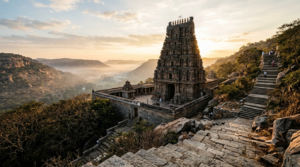
Tamil Nadu approaches Narasimha worship differently. Sholinghur, in Ranipet district, honours Yoga Narasimha in a seated, meditative posture rather than a fierce one. It counts among the 108 Divya Desams and sits on Periya Malai, the big hill.
The climb runs to roughly 1,300 steps. A rope car now serves devotees who cannot manage that, although ticket counters sit at the base and sell only in person. Hanuman occupies a separate shrine on the smaller hill nearby.
Namakkal offers something older still. Its Narasimha shrine is a rock-cut cave temple, and historians date the excavation to somewhere between the 6th and 8th century. The Ugra Narasimha panel there ranks among the rarest sculptures of its kind.
Karnataka contributes Melkote’s Yoga Narasimha above Mandya, the flooded cave shrine at Narasimha Jharni in Bidar, and the ruined monolith at Hampi. That Hampi figure is an Archaeological Survey monument today, not an active shrine, so plan it as heritage rather than darshan.
Comparing the Narasimha Temples in South India Before You Book
| Temple | State & district | Physical demand | Booking route |
|---|---|---|---|
| Ahobilam | AP, Nandyal | High — forest walks | Devasthanam counter / official portal |
| Simhachalam | AP, Visakhapatnam | Low — road to hilltop | Official Devasthanam site |
| Yadadri | Telangana, Yadadri Bhuvanagiri | Low to moderate | Official Telangana portal |
| Mangalagiri | AP, Guntur | Moderate — hill steps | Counter only |
| Sholinghur | TN, Ranipet | High — ~1,300 steps | Counter / rope car at base |
| Namakkal | TN, Namakkal | Low | Counter only |
The Narasimha temples in South India differ sharply in what they ask of you, so two figures deserve repeating outside that table. Sholinghur asks for about 1,300 steps, while Yadadri stays open roughly eighteen hours a day. Fees and hours shift, so confirm both before you travel.
Why Half the Guides Give You the Wrong District
Here is a correction you will not find on most pages listing the Narasimha temples in South India. Andhra Pradesh, Telangana and Tamil Nadu all redrew their district maps recently, yet older articles still print the old names.
Ahobilam now falls in Nandyal district, not Kurnool, after Andhra Pradesh reorganised on 4 April 2022. Kadiri moved into the new Sri Sathya Sai district on the same date, though countless pages still say Anantapur. Antarvedi now sits in Konaseema district rather than East Godavari.
Telangana made its change earlier, so Yadadri belongs to Yadadri Bhuvanagiri district and no longer to Nalgonda. Tamil Nadu carved Ranipet out of Vellore in 2019, which is why Sholinghur listings disagree with each other.
This is not pedantry. You book state buses by district, you search hospitals by district, and you file a police complaint by district. Getting it wrong costs you time exactly when you have none. Several Narasimha temples in South India still appear under two different district names online.
Planning a Narasimha Temples in South India Yatra
Group the shrines geographically instead of chasing a list. A Coastal Andhra loop links Simhachalam, Antarvedi and Mangalagiri comfortably over three days. A Rayalaseema loop pairs Ahobilam with Kadiri and Penchalakona, although the roads demand more patience.
Telangana works as its own short trip, since Yadadri sits about 60 km from Hyderabad. Tamil Nadu suits a Chennai base, because Sholinghur lies roughly 100 km away and Namakkal fits a Salem leg.
Winter serves every one of these routes best. Between roughly November and February the hill climbs stay bearable, whereas April to June turns the Rayalaseema and Namakkal stretches punishing. Swati nakshatra days and Narasimha Jayanti draw the largest crowds, so decide whether you want atmosphere or a short queue.
Pilgrims combining avatars often pair this route with the Rama temples in South India, since several sit on the same highways.
Booking Narasimha Temples in South India: Fees and Fake Portals
Most Narasimha temples in South India still sell darshan and seva tickets at the counter. Only a few run genuine online booking, and Yadadri is the clearest example through the official Telangana temple portal. Simhachalam publishes its own details on the Devasthanam website.
Fake booking sites are the real hazard. They copy temple photos, add an “official” badge, and charge a processing fee for tickets that cost little or nothing at the counter. Some collect Aadhaar numbers and phone numbers along the way.
Check three things before you pay anyone. The domain should belong to the Devasthanam or a government department such as the Andhra Pradesh Endowments Department or Tamil Nadu HR&CE. General darshan at most of these shrines is free. And no genuine temple asks for payment through a personal UPI handle.
Health and Safety on the Hill Shrines
Many Narasimha temples in South India sit on genuinely demanding terrain, and guides that gloss over it do pilgrims no favours. Upper Ahobilam involves forest paths with uneven footing and limited shade. Sholinghur’s step climb is steep in stretches, and monkeys along the route grab loose bags and food.
Carry water, carry your regular medication, and start climbs early while the stone stays cool. If you are elderly, pregnant, or managing a heart or joint condition, speak to your doctor before committing to Upper Ahobilam or the Sholinghur steps. Use the rope car where one exists.
Rituals and parihara poojas at these shrines belong to faith and tradition. They are not medical treatment, so never substitute them for care a qualified doctor has advised.
What Experienced Pilgrims Get Wrong
Even repeat visitors to the Narasimha temples in South India trip over the same things. The afternoon break is the biggest one, because nearly every shrine here closes for two to four hours after midday. Arriving at 2:00 PM usually means waiting outside.
Second, people underestimate Ahobilam’s internal distances and book a single night. Third, many travel to Simhachalam expecting to see the deity’s features, unaware of the sandalwood covering.
Fourth, footwear matters more than anything you will read elsewhere. Granite steps warmed by the sun punish thin soles, and you walk barefoot inside temple precincts anyway. Finally, carry small cash, since counters at the smaller shrines rarely take cards.
Before You Go
The Narasimha temples in South India reward depth over speed, so choose two or three shrines and do them properly. Confirm timings with the Devasthanam on the morning you travel, because published hours drift with festivals and rituals. Book only on official or government portals, and never through a site charging a “processing fee” for free darshan. If your yatra allows just one temple, Ahobilam carries the deepest association with the avatar itself, while Simhachalam on Akshaya Tritiya offers the rarest darshan of the year.
Frequently Asked Questions
Which are the most famous Narasimha temples in South India?
Ahobilam in Andhra Pradesh ranks first, since tradition places the Narasimha avatar there across nine shrines. Simhachalam near Visakhapatnam and Yadadri in Telangana follow closely. Mangalagiri, Kadiri, Sholinghur and Namakkal complete the list most pilgrims recognise.
Where did Lord Narasimha actually appear?
Tradition identifies Ahobilam, in the Nallamala hills of Nandyal district, Andhra Pradesh, as the site of the avatar. The name itself points to a cave. Nine shrines across Upper and Lower Ahobilam mark different forms of the Lord.
Why is the Simhachalam deity covered in sandalwood?
Sandalwood paste covers the deity through the year, and devotees understand it as a cooling offering to a fierce form. Priests remove the covering once a year on Akshaya Tritiya during Chandanotsavam. That single day gives devotees Nijaroopa Darshanam, the true form.
Can I visit all nine Ahobilam shrines in one day?
It is difficult and not advisable for most visitors. The shrines spread across two hill areas with forest paths between several of them. Plan at least a full day with an overnight stay, and start at sunrise.
How many steps are there at Sholinghur?
The main hill climb runs to roughly 1,300 steps, with sources quoting 1,300 to 1,305. A rope car serves devotees who cannot manage the climb. Hanuman’s shrine on the smaller hill needs a separate, shorter ascent.
Is darshan free at Narasimha temples in South India?
General darshan is free at most of these shrines. Paid options exist for faster entry and for sevas such as abhishekam and kalyanotsavam. Amounts vary by temple and change over time, so confirm at the counter or on the official portal.
What is the best time to visit?
November to February suits every route, because the hill climbs stay comfortable then. Avoid April to June in Rayalaseema and inland Tamil Nadu, where heat makes the climbs unsafe. Narasimha Jayanti and Swati nakshatra days bring the heaviest crowds.
Can I book Narasimha temples in South India darshan online?
Only some of them. Yadadri offers genuine online darshan and seva booking through the Telangana government portal. Most other shrines, including Mangalagiri and Namakkal, still work on counter sales, so treat any third-party site claiming otherwise with suspicion.