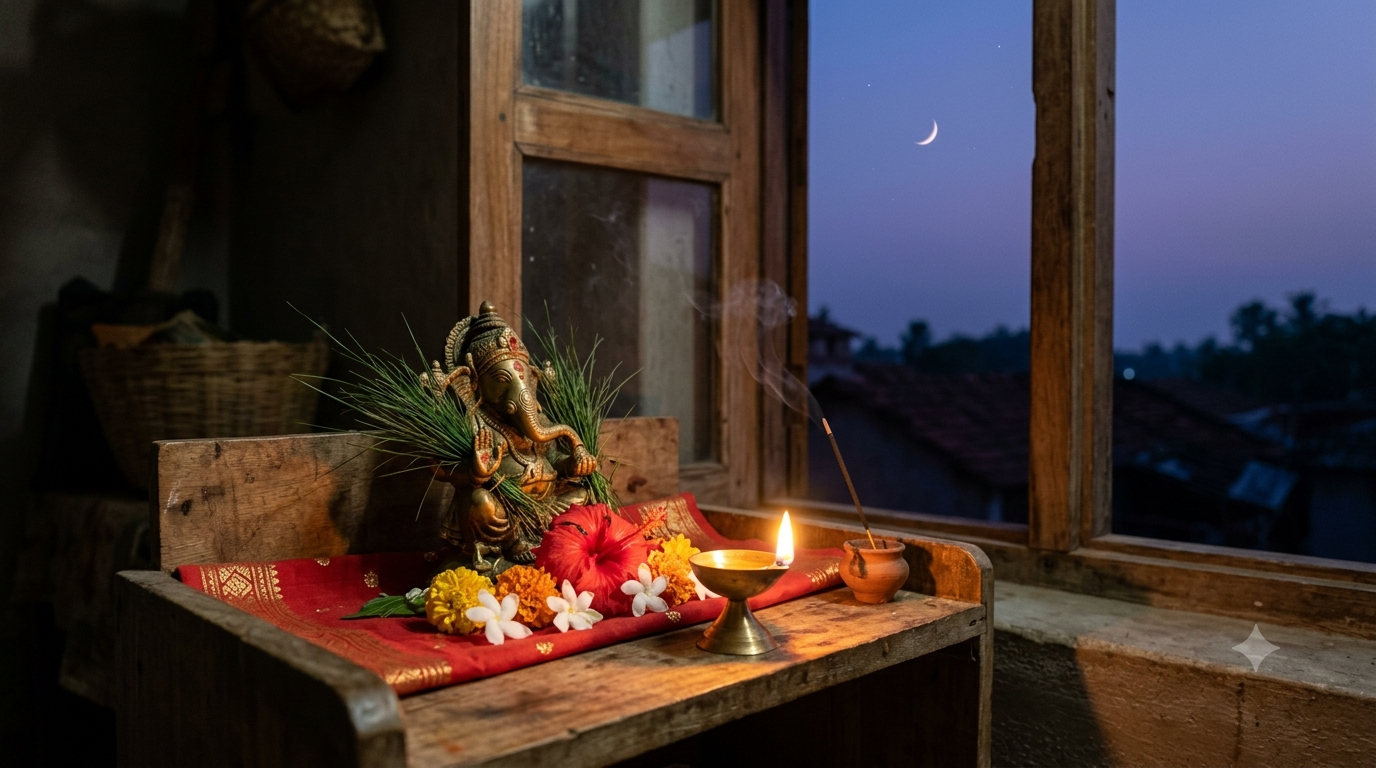
The Sankashti Chaturthi Vrat dates for 2026 and 2027 are all listed below. Each fast comes with the New Delhi moonrise time. This monthly Ganesha vrat depends on moonrise, so a plain date is only half the picture.
Here is what most calendars quietly skip. In 2026 an Adhik Maas, the Hindu leap month, falls during the year. So there are 13 Sankashti fasts this year, not the usual 12.
Get the date and the moon right, and the rest of the vrat is simple. Use the tables below as your plan. Then confirm the moon for your own city before you fast.
Sri Vyasa Pooja is an independent devotional guide. We are not a temple, a government body, or an official panchang authority.
Every date here follows published Hindu panchang calculations for New Delhi. Timings can shift by a day for your location. So please confirm your local date and moonrise with a trusted panchang or your family priest before you fast.
Sankashti Chaturthi Vrat Dates: Quick Facts
- What it is: a monthly fast for Lord Ganesha on Chaturthi of Krishna Paksha, the fourth day after the full moon.
- How many in 2026: 13 fasts, because an Adhik Maas (leap month) falls in the year.
- Fasting window: from sunrise until moonrise. The fast breaks only after you sight the moon.
- Most auspicious day: Angaraki Chaturthi, when the vrat lands on a Tuesday.
- 2026 Angaraki days: 6 January, 5 May, and 29 September.
- The catch: moonrise changes by city. So the same fast can fall at different clock times.
Sankashti Chaturthi Vrat Dates in 2026
Below are all 13 Sankashti Chaturthi Vrat dates in 2026. Each fast is tied to a different form of Lord Ganesha. Moonrise timings are for New Delhi, the standard panchang reference.
Treat these as your baseline. Then adjust for your city using the note below the table.
| Date & Day | Ganesha Form | Moonrise (Delhi) |
|---|---|---|
| 6 Jan 2026, Tue (Angaraki) | Lambodara | 9:23 PM |
| 5 Feb 2026, Thu | Dwijapriya | 9:50 PM |
| 6 Mar 2026, Fri | Bhalachandra | 9:21 PM |
| 5 Apr 2026, Sun | Vikata | 9:50 PM |
| 5 May 2026, Tue (Angaraki) | Ekadanta | 10:22 PM |
| 3 Jun 2026, Wed (Adhik Maas) | Vibhuvana | 9:54 PM |
| 3 Jul 2026, Fri | Krishnapingala | 9:54 PM |
| 2 Aug 2026, Sun | Gajanana | 9:39 PM |
| 31 Aug 2026, Mon | Heramba | 8:52 PM |
| 29 Sep 2026, Tue (Angaraki) | Vighnaraja | 8:15 PM |
| 29 Oct 2026, Thu | Vakratunda | 8:55 PM |
| 27 Nov 2026, Fri | Ganadhipa | 8:54 PM |
| 26 Dec 2026, Sat | Akhuratha | 8:48 PM |
The rare one to note is 3 June 2026. It falls inside Adhik Jyeshtha, the leap month. Devotees worship it as Vibhuvana Sankashti Chaturthi.
This extra fast is why the 2026 count reaches 13. It is also the single detail most old date lists get wrong. You can cross-check these Sankashti Chaturthi Vrat dates on Drik Panchang for your own city.
Sankashti Chaturthi Vrat Dates in 2027
Planning ahead helps, since the fast returns every month. These are the Sankashti Chaturthi Vrat dates in 2027, again with New Delhi moonrise. The year 2027 has no leap month. So it settles back to 12 fasts, with one Angaraki Chaturthi on 19 October.
| Date & Day | Ganesha Form | Moonrise (Delhi) |
|---|---|---|
| 25 Jan 2027, Mon | Lambodara (Sakat Chauth) | 9:09 PM |
| 24 Feb 2027, Wed | Dwijapriya | 9:59 PM |
| 26 Mar 2027, Fri | Bhalachandra | 10:49 PM |
| 24 Apr 2027, Sat | Vikata | 10:33 PM |
| 24 May 2027, Mon | Ekadanta | 10:46 PM |
| 23 Jun 2027, Wed | Krishnapingala | 10:27 PM |
| 22 Jul 2027, Thu | Gajanana | 9:25 PM |
| 21 Aug 2027, Sat | Heramba | 8:54 PM |
| 20 Sep 2027, Mon | Vighnaraja | 8:46 PM |
| 19 Oct 2027, Tue (Angaraki) | Vakratunda | 8:21 PM |
| 17 Nov 2027, Wed | Ganadhipa | 8:14 PM |
| 17 Dec 2027, Fri | Akhuratha | 9:26 PM |
The 2027 dates come from panchang calculation for Delhi. So treat them as provisional and reconfirm nearer the day. This matters most for southern and coastal cities, where moonrise runs later. A location panchang such as mPanchang can show your city’s exact time.
Notice the Ganesha Form column in each table. Every month’s Sankashti carries a distinct name and Vrat Katha, from Lambodara to Akhuratha. Many devotees track these forms to give each monthly fast its own focus and prayer.
How to Read These Sankashti Chaturthi Vrat Dates
Sankashti is fixed by the moon, not by the calendar date alone. The rule is simple. You fast on the day when moonrise happens while Chaturthi tithi is still running.
Moonrise shifts from east to west across India. So two cities can observe on slightly different evenings.
Delhi is the panchang default, so it works as a safe baseline. Mumbai, Pune, and Chennai usually see the moon 20 to 40 minutes later than Delhi. Eastern cities like Kolkata see it earlier.
Sometimes Chaturthi begins or ends close to moonrise. In that case the gap can even nudge the fast to the previous day in some regions.
This is why a single all-India timing misleads readers. Most quick lists still publish one time for the whole country. For your exact minute, check a location-based panchang for your own city on the day itself.
What Is Sankashti Chaturthi?
Sankashti Chaturthi is a monthly vrat for Lord Ganesha. Devotees observe it on the Chaturthi of Krishna Paksha, the waning-moon fortnight. The word “Sankashti” means release from difficulties. So people fast and pray to Ganesha, the remover of obstacles, then break the fast after sighting the moon.
Each lunar month actually holds two Chaturthi tithis. The one after the full moon is Sankashti Chaturthi. The one after the new moon is Vinayaka Chaturthi.
Both honour the same deity, yet the rituals and timing differ. So it helps to keep them separate in your calendar.
What Makes Angaraki Chaturthi So Special?
Angaraki Chaturthi is a Sankashti that falls on a Tuesday, the day ruled by Mangal (Mars). Tradition holds that Ganesha’s grace and Mars’s energy combine on this day. So devotees believe a single Angaraki fast carries the merit of a year of vrats. In 2026 you get three such Tuesdays, which is unusually generous.
Sankashti Chaturthi Puja Vidhi Step by Step
The vrat is easy to do at home. Anyone can observe it, whatever their age, gender, or background. Follow these steps in order for a complete Sankashti Ganapati puja.
- Wake before sunrise, bathe, and take a sankalp (a simple vow) to keep the fast.
- Clean the altar and place a Ganesha idol or picture on a fresh cloth.
- Offer durva grass, red flowers, sandalwood, and a lit lamp, because these please Ganesha.
- Chant “Om Gam Ganapataye Namah” or the Vakratunda Mahakaya shloka 108 times.
- Read the month’s Vrat Katha, since each of the 13 fasts has its own story.
- Fast through the day on fruit, milk, and vrat foods until the moon appears.
- After moonrise, offer arghya to the moon, complete the aarti, then break your fast.
Fasting Rules and a Quick Safety Note
Devotees usually avoid grains, rice, wheat, and pulses during the fast. Instead they take fruit, potato, sabudana, peanuts, and milk. This keeps energy steady through the long day.
Some keep a nirjala (waterless) fast, while others take water and light satvik food. Tradition accepts both approaches.
The fast runs from sunrise to a late moonrise, so it can be demanding. Are you pregnant, elderly, diabetic, or managing a health condition? If so, please talk to your doctor before you attempt a strict or waterless fast.
Keep water and simple fruit on hand. The vrat is a spiritual discipline, not a medical practice. So listen to your body and adapt as needed.
What If You Cannot See the Moon?
Cloud cover and monsoon skies are the most common problem. This affects the June to September fasts most of all. The tradition has a practical answer, so a hidden moon does not ruin your vrat.
Suppose the moon is not visible after its listed moonrise time. Wait a reasonable while and watch the sky.
When it still cannot be seen, most families offer arghya toward the moon’s direction. They do this once the panchang moonrise time has passed, then break the fast. When in doubt, follow your local priest, because regional customs vary.
Sankashti Chaturthi Vrat Dates: Common Mistakes to Avoid
After years of following this vrat, a few mistakes show up again and again. Avoiding them keeps your Sankashti Chaturthi Vrat dates accurate.
- Assuming 12 fasts every year. In an Adhik Maas year like 2026 there are 13, and the leap-month fast is easy to miss.
- Trusting one nationwide time. Moonrise is local, so a Delhi time can be off by half an hour for your city.
- Confusing it with Vinayaka Chaturthi. That fast follows the new moon and uses a midday puja instead.
- Eating before moonrise. Even a small snack traditionally breaks the intent of the vrat.
Before You Use These Sankashti Chaturthi Vrat Dates
Keep this page handy for the full Sankashti Chaturthi Vrat dates across 2026 and 2027. Two things matter most. First, fast on the correct Chaturthi. Second, break it only after the moon.
For the exact moonrise minute in your town, cross-check a location panchang on the day. Bookmark these Sankashti Chaturthi Vrat dates so the next fast never slips past you.
If you would like a qualified purohit to perform a Sankashti Ganapati puja for you, Sri Vyasa Pooja offers that as an optional service. The vrat itself, though, is simple to complete at home. You can also read our guide to the significance of Sankatahara Chaturthi for the deeper meaning behind each fast.
Frequently Asked Questions
How many Sankashti Chaturthi fasts are there in 2026?
There are 13 Sankashti Chaturthi fasts in 2026. The extra fast appears because an Adhik Maas (Hindu leap month) falls during the year. It adds Vibhuvana Sankashti Chaturthi on 3 June 2026. In a normal year, such as 2027, there are 12.
What are the Angaraki Chaturthi dates in 2026?
Angaraki Chaturthi falls on 6 January, 5 May, and 29 September in 2026. Each of these Sankashti fasts lands on a Tuesday. Observing the vrat on an Angaraki day is considered especially powerful for removing long-standing obstacles.
Are these Sankashti Chaturthi Vrat dates the same for every city?
For most cities the dates match, but they can shift by a day where moonrise falls close to the tithi change. Moonrise is a local event, so its time differs everywhere. The dates here use New Delhi as the reference; southern and western cities see the moon later, and eastern cities earlier. Always confirm your own city’s date and moonrise on the day.
Can I drink water during the Sankashti Chaturthi vrat?
Yes, unless you have chosen a strict nirjala fast. Many devotees take water, fruit, milk, and vrat foods like sabudana and potato through the day. They then break the fast fully after moonrise. Choose the level of fasting that suits your health.
What is the difference between Sankashti and Vinayaka Chaturthi?
Both honour Lord Ganesha, but they fall at opposite points of the lunar month. Sankashti Chaturthi comes after the full moon in Krishna Paksha and runs until moonrise. Vinayaka Chaturthi comes after the new moon in Shukla Paksha and centres on a midday puja.
What should I eat while fasting on Sankashti Chaturthi?
Devotees typically eat fruit, potato, sabudana khichadi, peanuts, and milk. They avoid grains, rice, wheat, and pulses. After the moon is sighted, they break the fast with modak or ladoo offered to Ganesha. Keep the meal simple and satvik.
What if the moon is hidden by clouds on the fast day?
If clouds block the moon after its listed moonrise time, wait briefly. Then offer arghya toward the moon’s direction and complete the puja. This is an accepted practice during the monsoon months. Follow your local priest’s guidance if your family has a specific custom.
Is Sankashti Chaturthi the same as Sakat Chauth?
The Magha-month Sankashti Chaturthi is known as Sakat Chauth in North India. Mothers observe it mainly for their children’s wellbeing. It is the same tithi and the same deity. So the underlying vrat is one and the same, just under a regional name.