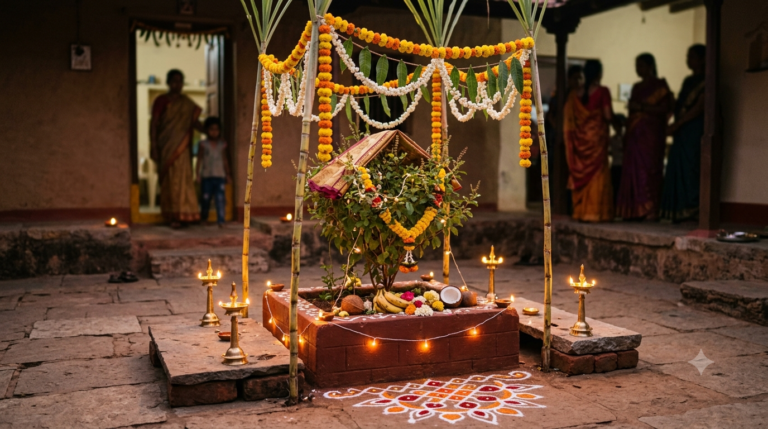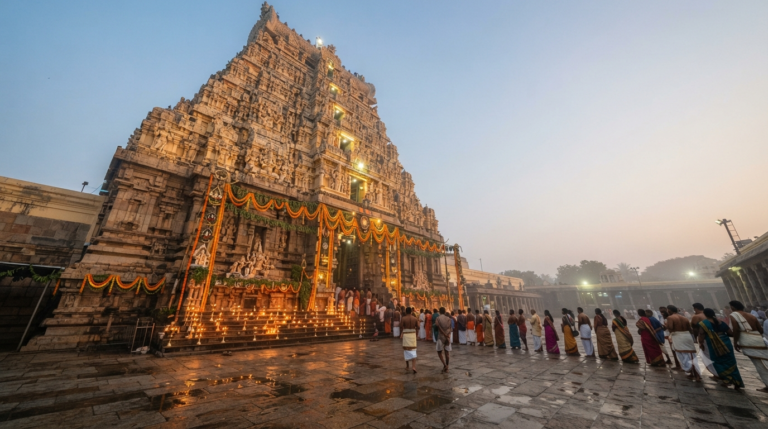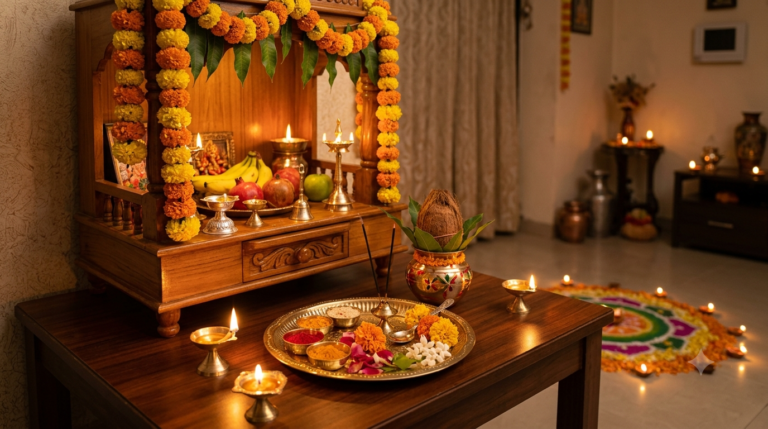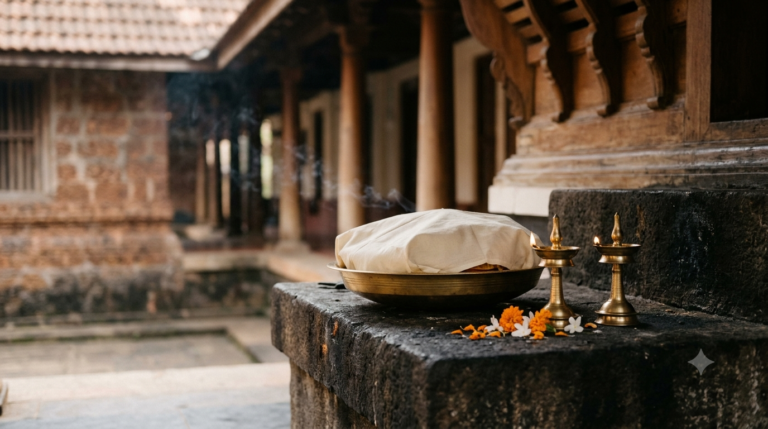
The Sri Ramanavami pooja procedure looks simple on paper, yet the two details that actually matter get skipped by almost every guide: the midday window when the puja should happen, and the naivedyam that makes this festival different from every other Vishnu vratam. Lord Rama was born at noon, not at dawn. So a puja rushed through at 6 AM misses the very moment the day exists to mark.
Sri Vyasa Pooja is an independent devotional guide. We are not affiliated with, endorsed by, or the official website of any temple or devasthanam. We take no bookings, donations, or payments. Use the official temple portals linked below for sevas and darshan.
Sri Ramanavami Pooja Procedure at a Glance
- Festival: Sri Rama Navami, the appearance day of Lord Rama, the seventh avatar of Lord Vishnu.
- Tithi: Chaitra Shukla Navami, the ninth day of the bright fortnight of Chaitra.
- Next date: Thursday, 15 April 2027.
- Best puja time: the Madhyahna window around solar midday, roughly two and a half hours centred on local noon.
- Core naivedyam: vadapappu, panakam and chalimidi.
- Fasting: optional, and broken after the midday puja or the next morning, depending on family custom.
- Cost: nothing. The home puja needs no priest, no ticket and no booking.
Because the festival closes Chaitra Navaratri, many families fold the ninth-day Navaratri puja into the Sri Ramanavami pooja procedure and sit through both together. That is traditional, and it is perfectly acceptable.
When to Perform the Sri Ramanavami Pooja Procedure in 2027
Sri Rama Navami falls on Thursday, 15 April 2027. Also, it is a gazetted holiday across India, so banks and government offices stay closed.
The tithi fixes the date, not the English calendar. Because Chaitra Shukla Navami drifts every year, the festival can land anywhere between late March and late April. Our note on the significance of the Ugadi festival explains how the Chaitra month itself begins.
| Year | Day | Date |
|---|---|---|
| 2026 | Thursday | 26 March |
| 2027 | Thursday | 15 April |
| 2028 | Monday | 3 April |
| 2029 | Sunday | 22 April |
| 2030 | Friday | 12 April |
The Madhyahna Window, Not Sunrise
Tradition places Rama’s birth at Madhyahna, the middle of the Hindu day. Madhyahna runs for six ghatis, which works out to about two hours and twenty-four minutes.
Its mid-point marks the birth moment itself. In most Indian cities the window opens near 11 AM and closes in the early afternoon, though the exact clock time shifts with your local sunrise and sunset.
Do not simply assume 12:00 noon. That would only hold if the sun rose at 6 AM and set at 6 PM, which it rarely does. So check your city’s Madhyahna window on a panchangam such as Drik Panchang a day before, then schedule the Sri Ramanavami pooja procedure inside it.
Why Some Calendars Show 14 April Instead
You will find a few 2027 listings showing 14 April, and this confuses readers every year. However, the reason is mechanical rather than doctrinal.
Navami tithi begins on the afternoon of 14 April 2027 and runs into the next day. Since the festival follows the sunrise rule, the day on which Navami is live at sunrise wins. That is 15 April.
In short, a tithi that starts in the afternoon does not claim the day it began on. So whenever two dates circulate, apply this test instead of trusting whichever calendar you saw first.
Smarta and Vaishnava Dates Sometimes Differ
In certain years, Smarta households and Vaishnava or Madhva households observe Rama Navami on consecutive days. This has happened before, notably in 2018.
The split comes from different rules for resolving a tithi that spans two sunrises. Clearly, neither is wrong. If your family follows a particular sampradaya, then take the date from your family panchangam or purohit rather than a generic calendar.
Samagri You Need Before You Start
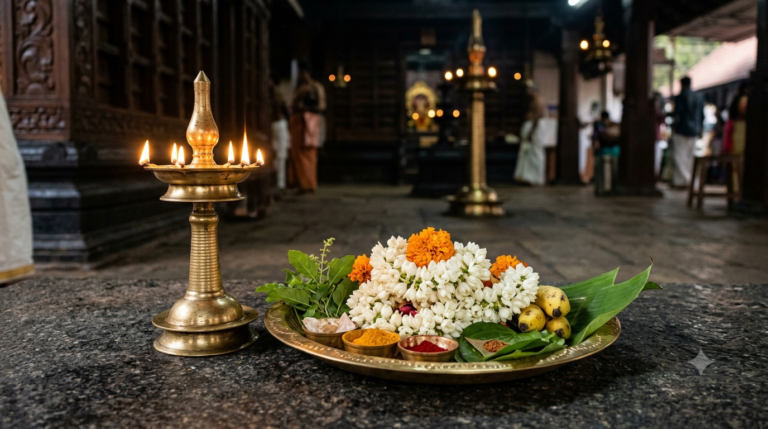
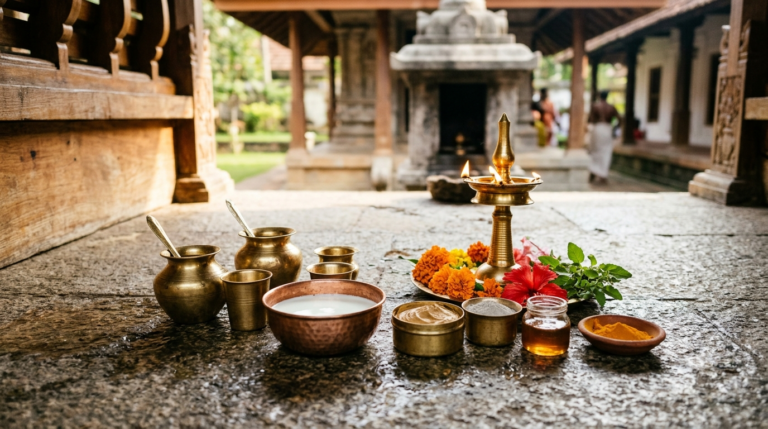
Gather everything for the Sri Ramanavami pooja procedure the previous evening. Hunting for turmeric mid-puja breaks concentration, and the midday window is short.
| Category | Items |
|---|---|
| Deity | Idol or framed picture of Sri Rama with Sita, Lakshmana and Hanuman |
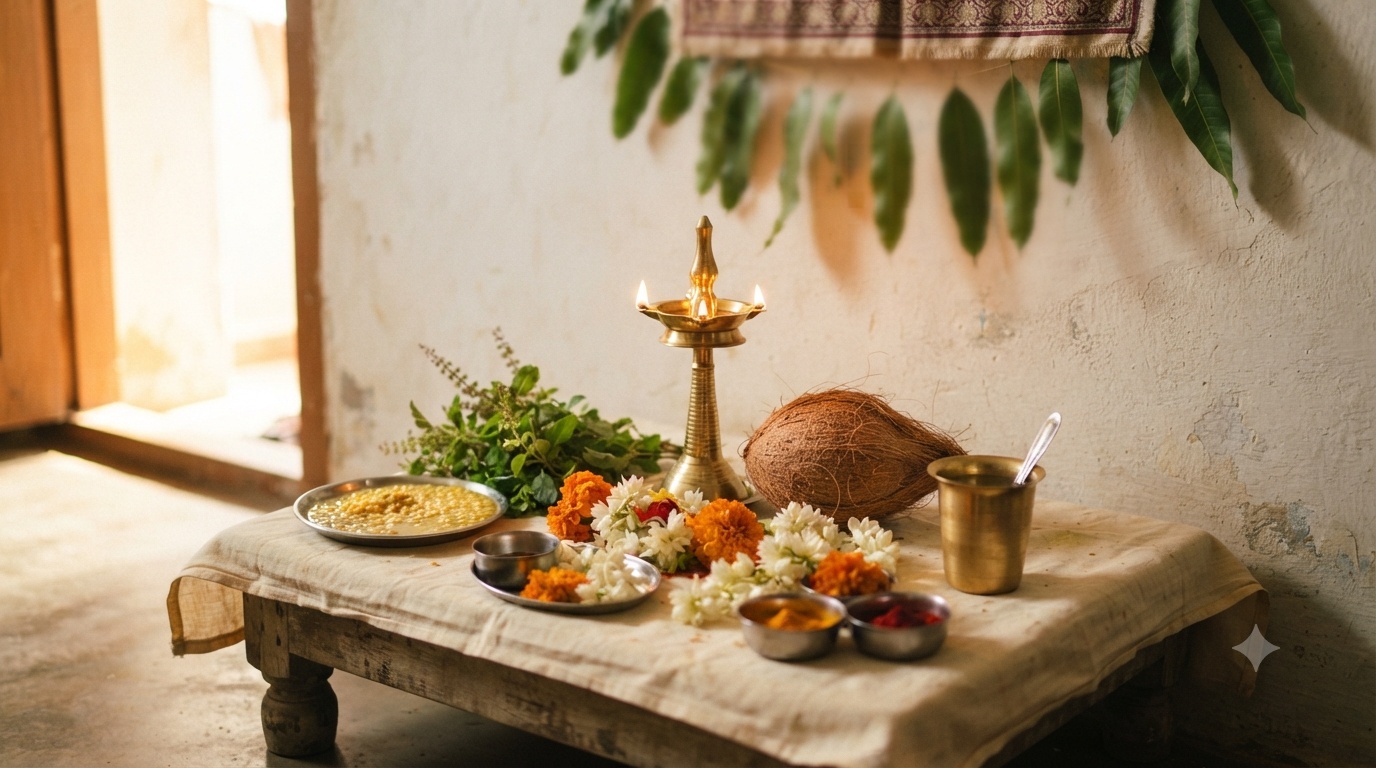
| Altar | Clean cloth, wooden plank or peetam, mango-leaf thoranam |
| Lamps | Brass deepam, ghee or sesame oil, cotton wicks, camphor, agarbatti |
| Offerings | Turmeric, kumkum, sandalwood paste, akshata (unbroken rice), betel leaves and nuts |
| Flowers | Tulasi leaves, jasmine, marigold, a garland if available |
| Naivedyam | Vadapappu, panakam, chalimidi, seasonal fruit, coconut |
| Vessels | Kalasham, small water tumbler, spoon, harathi plate |
Tulasi matters more than the rest of the flowers. Because Rama is an avatar of Vishnu, tulasi is the one offering the tradition treats as essential.
Sri Ramanavami Pooja Procedure Step by Step at Home
The Sri Ramanavami pooja procedure below is the shodasopachara sequence in its simple household form. A full priest-led version runs longer, although nothing here needs a purohit.
Setting Up and Invoking
- Bathe early and clean the puja space. Wash the altar area, draw a muggu at the doorway, and tie mango leaves above it if you keep that custom.
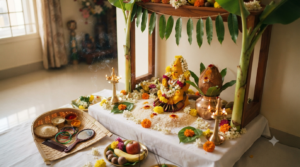
- Arrange the altar. Spread the fresh cloth, place the idol or picture facing east or west, and set the lamp to the right of the deity.
- Light the deepam and do achamanam. Sip water three times, then light the lamp before anything else. The lamp opens every household puja.
- Begin with Ganapati. Offer akshata and a flower to Lord Ganesha so the ritual proceeds without obstruction.
- Take the sankalpam. With folded hands, state your name, gotra, place, the tithi and your intention aloud. This is the moment the vratam formally starts.
- Do dhyanam and avahanam. Meditate on Rama with Sita, Lakshmana and Hanuman, then invite them into the idol with “Om Sri Sita Ramachandra Parabrahmane Namaha, avahayami”.
- Offer the upacharas in order. Water for the feet and hands, a cloth or thread, sandalwood, akshata, flowers and tulasi, dhupam and deepam, each with the mantra above and the matching ending.
Completing the Sri Ramanavami Pooja Procedure
The second half is where the day earns its name, since the chanting and the naivedyam should land inside the Madhyahna window.
- Chant the Rama nama. Repeat “Sri Rama Jaya Rama Jaya Jaya Rama” or the Rama Taraka mantra 108 times, ideally as the Madhyahna window opens.
- Recite the katha. Read the birth episode from the Bala Kanda, or the Sundara Kanda, or the Vishnu Sahasranama. Families with time do a full Ramayana parayanam.
- Offer naivedyam. Place the panakam, vadapappu and chalimidi before the deity, sprinkle water around the plate and offer it.
- Perform harathi. Light camphor, circle it before the deity, then close with the mangala harathi and pradakshina namaskaram.
- Distribute the prasadam. Share the panakam and vadapappu with everyone at home, and with neighbours if you have made enough.
Keep the whole sequence unhurried but compact. Forty-five minutes is plenty for the household version, so there is no need to rush the chanting.
Naivedyam: Why Panakam and Vadapappu, Specifically
Every festival has its signature offering, and the Sri Ramanavami pooja procedure has three. They are not interchangeable with generic sweets, because each one answers the season.
Panakam is jaggery dissolved in water with dry ginger, crushed pepper and cardamom. Vadapappu is moong dal soaked for a few hours and drained, sometimes mixed with grated coconut, raw mango and green chilli. Chalimidi is rice flour worked with jaggery and a splash of water.
Notice what they have in common. Nothing goes on the fire, while everything cools the body.
Chaitra falls at the start of the Indian summer. Ayurvedic tradition holds that jaggery, dry ginger and pepper together settle the digestive fire while the drink itself rehydrates. Whether or not you read it that way, the practical logic is hard to miss: a cooling drink handed out at midday in April is exactly what a crowd needs.
Fasting Rules and a Health Note
Fasting on Rama Navami is voluntary, and two levels are common. A nirjala vrat means no food and no water until the puja concludes. A phalahara vrat allows fruit, milk, sabudana, singhara or kuttu flour preparations and sendha namak.
Rice, wheat, lentils, onion and garlic are usually set aside for the day. Most households break the fast after the midday puja with prasadam, while stricter observers continue until the next morning. Either way, the vratam counts.
One practical caution, because April heat is real. If you have diabetes, low blood pressure, or you are pregnant, elderly or on regular medication, choose the phalahara fast over a waterless one. Better still, speak to your doctor first. Devotion does not require a medical risk, and no scripture asks you to harm your body to please Rama.
The Sri Ramanavami Pooja Procedure in Temples Versus at Home
Temple observance follows the same spirit as the home Sri Ramanavami pooja procedure, only on a far larger scale. Still, the headline event differs by place.
At Bhadrachalam in Telangana, priests conduct the Sri Sita Rama Kalyanam on Rama Navami day itself at the Sree Seetha Ramachandra Swamy Devasthanam. Sevas there are booked only through the official Telangana Endowments portal.
At Vontimitta in Andhra Pradesh, the pattern is different and it catches people out. Rama Navami opens the Brahmotsavams, while the state-sponsored Kalyanam usually lands a few days later. Our guide to the Vontimitta Brahmotsavam dates carries the day-by-day schedule.
In Ayodhya, the Surya Tilak has become the moment everyone waits for. A beam of sunlight falls on the forehead of Ram Lalla at noon for roughly four minutes, and Doordarshan telecasts it live.
Tirumala marks the day with the Sri Rama Navami Asthanam. For any TTD seva, use the official TTD portal and nothing else.
Mistakes to Avoid in the Sri Ramanavami Pooja Procedure
- Doing the puja at dawn out of habit. Midday is the tradition here, unlike most other vratams.
- Cooking the naivedyam. Panakam, vadapappu and chalimidi are all uncooked by design. Boiling the jaggery turns panakam into syrup.
- Skipping tulasi. Flowers alone are incomplete for a Vishnu avatar.
- Taking the date from last year. The tithi shifts annually, and leap-month years shift it further.
- Paying a private site for a “Rama Navami darshan ticket”. Bhadrachalam and Vontimitta darshan carry no online ticket for general entry.
- Fasting without water in April heat when your health does not allow it.
What Experience Teaches That Guides Leave Out
A few things only show up after you have actually run this puja at home once or twice.
Soak the moong dal by 8 AM at the latest, because two hours is the bare minimum. Dal soaked in a rush stays hard and unpleasant.
Make the panakam thin rather than syrupy. Since people drink it by the glass instead of spooning it, keep the consistency closer to juice.
Grind the dry ginger and pepper fresh if you can, although shop powder will do. The difference is obvious the moment you taste it.
Finally, make double what you think you need. Panakam disappears fast when neighbours drop in, so offering it onward is part of the day’s character.
Before You Begin
Fix the date from your family panchangam, then find your city’s Madhyahna window and work backwards from there. Prepare the samagri and soak the dal the night before, so the morning belongs to the Sri Ramanavami pooja procedure rather than to errands.
Above all, keep the ritual simple. A lamp, tulasi, the Rama nama chanted with attention, and panakam shared with whoever walks in will carry the day further than an elaborate sequence rushed through.
Frequently Asked Questions
What is the correct time for the Sri Ramanavami pooja procedure?
Perform it during the Madhyahna window, the roughly two-and-a-half-hour period centred on local solar midday. Tradition places Rama’s birth at its mid-point. Because the window depends on your city’s sunrise and sunset, confirm the exact clock time on a panchangam rather than assuming 12:00 noon.
When is Sri Rama Navami in 2027?
Thursday, 15 April 2027, on Chaitra Shukla Navami. It is a gazetted holiday in India. Navami tithi begins on the afternoon of 14 April, which is why a few calendars mistakenly print that earlier date.
Can I do the Sri Ramanavami pooja procedure without a priest?
Yes. The household version of the Sri Ramanavami pooja procedure needs no purohit at all. Lighting the lamp, taking a sankalpam, chanting the Rama nama and offering naivedyam covers everything the tradition asks of a family. A priest becomes relevant only for an elaborate homam or a formal Sita Rama Kalyanam at home.
What prasadam should I offer?
Panakam, vadapappu and chalimidi are the traditional three. Panakam is jaggery water with dry ginger and pepper, vadapappu is soaked moong dal, and chalimidi is rice flour with jaggery. Add seasonal fruit and a coconut if you wish, but keep the core three uncooked.
Is fasting compulsory on Rama Navami?
No, fasting is voluntary. Those who observe it choose either a nirjala fast without water or a phalahara fast with fruit and milk. Anyone with a medical condition, and anyone pregnant or elderly, should take the lighter option and consult a doctor beforehand.
Why do some families observe Rama Navami a day apart?
Smarta and Vaishnava traditions apply different rules when Navami tithi spans two sunrises, so the observed day can differ. This is a difference of method, not a mistake. Follow your family panchangam or your purohit.
Does Rama Navami end Chaitra Navaratri?
Yes. Rama Navami is the ninth and final day of Chaitra Navaratri, so many households conclude the Navaratri vratam on this day. Combining the closing Navaratri puja with the Rama puja in one sitting is a common and accepted practice.
Do I need to book a ticket for Rama Navami darshan?
General darshan at Bhadrachalam and Vontimitta carries no online ticket, and entry is free. Paid sevas at Bhadrachalam go through the official Telangana Endowments portal, while TTD sevas go through tirumala.org. Ignore any private site charging a darshan fee.
What should I chant if I do not know Sanskrit?
“Sri Rama Jaya Rama Jaya Jaya Rama” is enough, and the tradition treats it as complete in itself. Repeat it 108 times during the Madhyahna window. Reading the Ramayana birth episode in your own language works just as well as reciting it in Sanskrit.