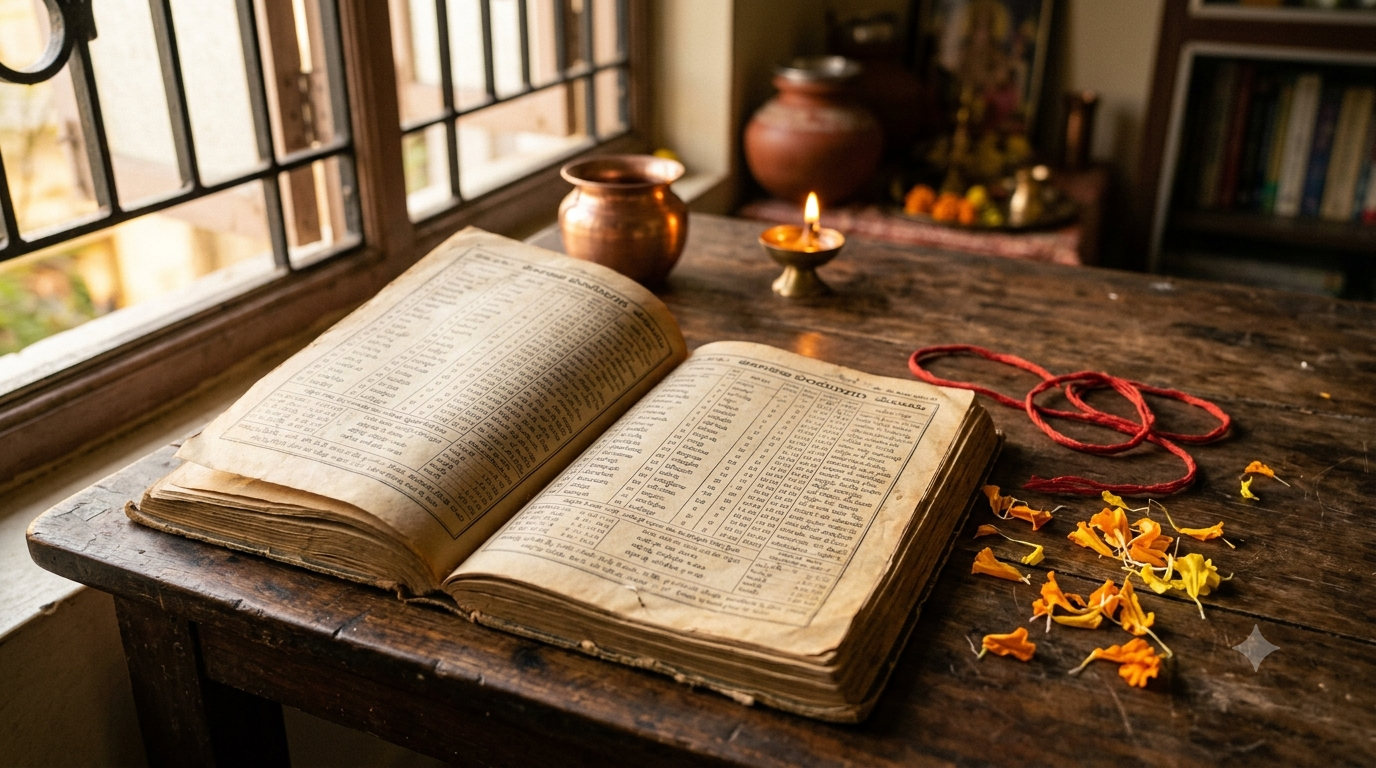
This Telugu Panchangam guide explains what the traditional almanac actually is, how to read it, and how to use it for choosing an auspicious time. A panchangam is not just a calendar. It is a daily astronomical almanac built on five parts of time, and Telugu families have leaned on it for generations to fix weddings, housewarmings, and vratams. So whether you are opening a printed gantala panchangam for the first time or checking a timing online, this page walks you through every element in plain language.
Srivyasapooja.in is an independent devotional guide. We are not an official panchangam publisher, and we are not affiliated with any mutt, temple, or almanac author. We do not sell panchangams or take pooja bookings. For an authentic almanac, use the official publishers and portals linked below.
Telugu Panchangam at a Glance
- What it is: a daily Hindu almanac made of five angams — Tithi, Vara, Nakshatra, Yoga, and Karana.
- Main use: finding muhurtham, the auspicious time for weddings, pujas, travel, and new ventures.
- Key daily timings: Rahukalam and Yamagandam to avoid, plus Abhijit muhurtham and Amritakalam to prefer.
- Current Telugu year: Sri Parabhava Nama Samvatsaram, the 2026–27 year, which began on Ugadi, 19 March 2026.
- When it is read aloud: on Ugadi day, through the ritual of Panchanga Sravanam.
Telugu Panchangam Guide: What the Almanac Actually Is
A Telugu Panchangam is a daily almanac that records the position of the sun, moon, and stars so people can pick auspicious times. The word itself means “five limbs” of time. These five limbs, or angams, are Tithi, Vara, Nakshatra, Yoga, and Karana. Together they describe any given day in the Hindu lunisolar calendar.
Because the Telugu calendar follows the moon as well as the sun, dates shift each year against the English calendar. A festival that falls in March one year can move into April the next. The panchangam tracks these shifts precisely, which is why priests and families still consult it before every important event.
Think of it as a decision tool, not just a date-keeper. When you know the tithi and nakshatra of a day, you can judge whether that day suits a wedding, a griha pravesam, or a long journey. That practical use is exactly why this Telugu Panchangam guide starts with the five angams.
Telugu Panchangam Guide to the Five Angams
The five angams are the backbone of every almanac, so learning them once helps you read any panchangam. Each angam answers a different question about the day. Here is a quick breakdown before the detail.
| Angam | What it measures | Why it matters |
|---|---|---|
| Tithi | The lunar day (moon phase) | Sets fasting days and festivals |
| Vara | The weekday | Links each day to a planet |
| Nakshatra | The birth star of the day | Central to muhurtham and horoscopes |
| Yoga | A sun-moon angular combination | Marks favourable or difficult spells |
| Karana | Half of a tithi | Fine-tunes the timing of tasks |
Tithi and Vara
Tithi is the lunar day, and there are thirty of them across the waxing and waning halves of the month. Ekadasi, Amavasya, and Pournami are all tithis you will recognise. Vara is simply the weekday, yet each weekday connects to a planet, so Sunday belongs to the Sun and Monday to the Moon.
Nakshatra, Yoga, and Karana
Nakshatra is the star the moon sits in on a given day, and there are twenty-seven of them. Because a person’s birth star comes from this, nakshatra drives most muhurtham decisions. Yoga is an angle between the sun and moon, while Karana is half a tithi, and both refine whether a moment is truly auspicious.
Daily Timings and Muhurtham in the Almanac
Beyond the five angams, a panchangam lists several daily time windows. Some are best avoided, while others are actively favourable. Knowing these windows is the most practical skill this Telugu Panchangam guide can give you.
| Timing | Meaning | Use it to |
|---|---|---|
| Rahukalam | An inauspicious window ruled by Rahu | Avoid starting new work |
| Yamagandam | Another period to avoid | Skip important beginnings |
| Durmuhurtham | A short unfavourable spell | Postpone key tasks |
| Varjyam | A star-based window to avoid | Delay travel or signings |
| Amritakalam | A highly auspicious window | Begin good work |
| Abhijit Muhurtham | The auspicious midday window | Start ventures safely |
What is Rahukalam and how do you avoid it?
Rahukalam is a roughly ninety-minute window each day that tradition treats as unfavourable for beginnings. It changes by weekday and by your city’s sunrise, so the printed time in a panchangam is only a guide. Many families simply avoid starting travel or signing papers during this window. Because it depends on sunrise, always check the timing for your own location.
How do you find a muhurtham?
A muhurtham is an auspicious time fixed by combining tithi, nakshatra, and the daily windows above. To find one, you match the person’s birth star with a suitable day, then avoid Rahukalam and Varjyam on that day. Priests weigh several factors together, so a printed almanac gives the raw data while an expert reads the full picture. For a wedding or housewarming, most families still consult a purohit rather than deciding alone.
Telugu Panchangam Guide to the 60-Year Samvatsara Cycle
Telugu years are not numbered like 2025 or 2026. Instead they run through a repeating cycle of sixty named years called samvatsaras. Each year carries its own name and, in tradition, its own general character. When one cycle of sixty ends, the same names begin again.
The 2026–27 Telugu year is Sri Parabhava Nama Samvatsaram, the fortieth year in this cycle, and it began on Ugadi, 19 March 2026. Vedic scholars read the name not as literal defeat but as overcoming ego and inner flaws. Since the year rolls over every Ugadi, always check which samvatsara is current before you rely on an older almanac.
| Ugadi year | Samvatsara name | Ugadi date |
|---|---|---|
| 2022–23 | Shubhakruth | 2 April 2022 |
| 2023–24 | Shobhakruth | 22 March 2023 |
| 2024–25 | Krodhi | 9 April 2024 |
| 2025–26 | Vishwavasu | 30 March 2025 |
| 2026–27 | Parabhava | 19 March 2026 |
This page originally covered the Shubhakruth (2022–23) panchangam. That year now sits in the table above as a reference point. If you landed here looking for a specific past year, use the current samvatsara for anything you plan today.
Ugadi and Panchanga Sravanam
Ugadi is the Telugu New Year, and it is the day the fresh panchangam is read aloud. This reading is called Panchanga Sravanam, or Panchanga Pathanam in some regions. A learned person recites the year’s predictions for rain, harvest, health, and general fortune while the family listens.
The custom carries real meaning because it sets the tone for the year ahead. People also share Ugadi Pachadi, the six-taste dish that reminds everyone life mixes sweet and bitter. So the panchangam and the festival are tied together, one marking time and the other welcoming it.
Types of Telugu Panchangam
Not every almanac is identical, though most agree on the core data. Different authors and mutts publish their own editions, and readers usually stick with the one their family trusts. This part of the Telugu Panchangam guide compares the main kinds you will meet.
Gantala Panchangam
Gantala Panchangam is the most popular printed edition across Andhra Pradesh and Telangana. Many respected authors publish their own versions each year before Ugadi. You can compare a few in our overview of the Telugu Gantala Panchangam editions, which lists several trusted publishers side by side.
Mutt and Temple Panchangams
Several mutts and temples release official almanacs that devotees follow closely. The TTD edition is widely used, and you can read about the TTD Relangi Tangirala Gantala Panchangam for its structure. The Sringeri Sharada Peetham also publishes an official version, and we have covered the Sringeri Sharada Peetha Panchangam in a separate post.
How to Choose a Panchangam: Telugu Panchangam Guide Tips
With so many editions, choosing one can feel confusing, so a few simple rules help. First, prefer an almanac your family or purohit already follows, because consistency avoids conflicting dates. Second, match the panchangam to your region, since sunrise-based timings differ across cities.
For authoritative data, the Drik Panchang website is a trusted digital reference. For official printed editions, the Sringeri Sharada Peetham and the Tirumala Tirupati Devasthanams both publish yearly almanacs. When two sources differ on a minor timing, treat the difference as normal, because siddhanta methods vary slightly between authors.
What Most Panchangam Readers Get Wrong
A common mistake is using last year’s almanac for this year’s dates. Tithis shift annually, so an old panchangam quickly goes out of step. Another error is reading a printed timing without adjusting for your own city’s sunrise, which changes Rahukalam and muhurtham windows.
People also treat every prediction as a fixed outcome. In tradition, samvatsara phala and daily timings are guidance rooted in faith, not guaranteed results. So use the almanac to plan sensibly, and for major legal, medical, or financial decisions, rely on qualified professionals rather than timing alone.
Reading the Almanac as a First-Time User
If this is your first almanac, do not try to absorb everything at once. Begin with today’s page and find just three things: the tithi, the nakshatra, and the Rahukalam window. Once those feel familiar, add the weekday planet and the muhurtham timings. This Telugu Panchangam guide is meant to be revisited, not memorised in a single day.
A simple habit helps the most. Check the almanac every morning for a week, and you will quickly notice how the tithi changes and how Rahukalam shifts by weekday. Because the timings depend on your city, keep your location fixed while you learn. Within a few days, reading the daily page becomes second nature, and the almanac stops feeling like a puzzle.
Before You Consult a Panchangam
A Telugu Panchangam guide is only useful if you apply it with care. Start with the five angams, learn the daily windows, and always confirm the current samvatsara and your local timings. For a wedding or housewarming, take the raw dates to a trusted purohit who can finalise the muhurtham. Used this way, a Telugu Panchangam guide keeps the almanac a practical companion rather than a source of worry.
Frequently Asked Questions
What are the five angams of a Telugu Panchangam?
The five angams are Tithi, Vara, Nakshatra, Yoga, and Karana. Tithi is the lunar day, Vara is the weekday, and Nakshatra is the star of the day. Yoga and Karana are finer combinations that refine the timing. Together they define every day in the almanac.
What is the Telugu year in 2026?
The 2026–27 Telugu year is Sri Parabhava Nama Samvatsaram. It began on Ugadi, which fell on 19 March 2026. Parabhava is the fortieth year in the sixty-year cycle. The previous year was Vishwavasu.
What is Rahukalam in the panchangam?
Rahukalam is a daily window of about ninety minutes that tradition treats as inauspicious for new beginnings. It changes with the weekday and your city’s sunrise. Many families avoid starting travel or important work during it. Always check the timing for your own location.
What is Gantala Panchangam?
Gantala Panchangam is the most popular printed Telugu almanac across Andhra Pradesh and Telangana. Several trusted authors publish their own editions before Ugadi each year. Most editions share the same core data. Families usually follow the one they trust.
How do I read a panchangam for a muhurtham?
Match the person’s birth star with a suitable tithi and nakshatra, then avoid Rahukalam and Varjyam on that day. The almanac gives the raw data, while a purohit reads the full combination. For weddings and housewarmings, most families still consult an expert. This keeps the timing accurate for your region.
Is a Telugu Panchangam the same as a Hindu calendar?
A Hindu calendar shows dates and festivals, while a panchangam adds the five angams and daily timings. So every panchangam is a calendar, but not every calendar is a full panchangam. The extra detail is what makes it useful for muhurtham. That is the key difference.
Where can I get an authentic Telugu Panchangam?
You can consult trusted digital sources like Drik Panchang, or official printed editions from mutts such as Sringeri and temples like Tirumala Tirupati Devasthanams. Choose the one your family or purohit already follows. Always confirm it matches the current samvatsara. That way your dates and timings stay reliable.