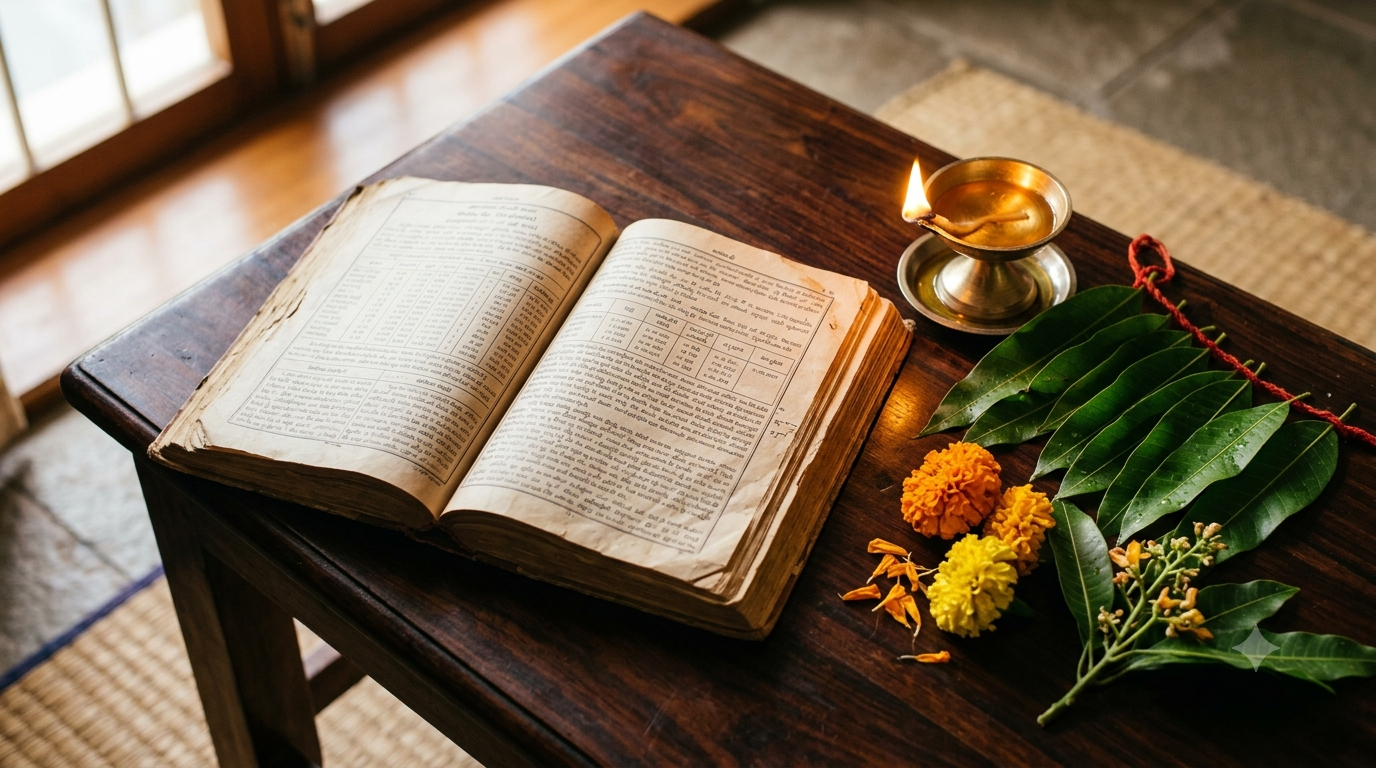
The Plavanama Samvatsara Sringeri Panchangam is the official Hindu almanac published by the Dakshinamnaya Sri Sharada Peetham for the Plava year. That year ran from Ugadi on 13 April 2021 to early April 2022.
Devotees still look for it because Sringeri’s calculations are trusted right across South India. The archived edition also stays a clean reference for that year’s tithis, festivals, and muhurtas. This guide explains what the almanac covers, which year “Plava” points to, and how to download the genuine copy in Kannada, Tamil, or Telugu.
Sri Vyasa Pooja is an independent devotional guide. We are not affiliated with, endorsed by, or the official website of the Sringeri Sharada Peetham. We do not sell, print, or take orders for any panchangam. Every download link here points to the Peetham’s official portal.
Plavanama Panchangam at a Glance
- Samvatsara: Plava, the 35th year in the 60-year Hindu cycle.
- English year: 2021–2022, beginning on Ugadi, Tuesday 13 April 2021.
- Publisher: Dakshinamnaya Sri Sharada Peetham, Sringeri, Karnataka.
- Languages available: Kannada, Tamil, and Telugu.
- Where to get it: the official Sringeri downloads page, as a free PDF.
- Current year for comparison: Parabhava, 2026–2027.
What Is the Plavanama Samvatsara Sringeri Panchangam?
The Plavanama Samvatsara Sringeri Panchangam is a year-long Hindu almanac. It lists every tithi, nakshatra, festival, and auspicious timing for the Plava year. The word panchangam comes from pancha, meaning five, and anga, meaning limb. It gets that name because it records five elements of each day: tithi, nakshatra, yoga, karana, and vara, the weekday.
Sringeri’s edition carries extra weight for a clear reason. The Sri Sharada Peetham is one of the four Amnaya Peethams established by Jagadguru Adi Shankaracharya. The math sits on the banks of the Tunga River, and its scholars have prepared panchangas for centuries. So many families and temple priests treat the Sringeri almanac as their first reference for ritual timing.
Which Year Is Plava Nama Samvatsara?
Plava is the 35th samvatsara in the Hindu 60-year cycle that runs from Prabhava to Akshaya. It corresponds to the English year 2021–2022, and the Plava year began on Ugadi, Tuesday 13 April 2021. The year then closed just before the next Ugadi in early April 2022, when Shubhakrit took over.
Aggregator pages often blur these dates or pin the Plava label on the wrong year, so the exact anchors matter. In the Shaka reckoning, Plava is Shaka 1943. Because the cycle splits into three groups of twenty samvatsaras, Plava falls in the middle group traditionally assigned to Lord Vishnu.
The name itself carries meaning in tradition. “Plava” suggests a boat, or that which floats across. Elders read it as a year of crossing over difficulty.
These readings belong to custom and to the Ugadi Panchanga Sravanam, not to proven prediction. So treat them as faith rather than forecast.
Where Plava Sits in the 60-Year Cycle
The Hindu luni-solar calendar names sixty years in a fixed order. The cycle starts with Prabhava and closes with Akshaya. After sixty years, the same names return.
Tradition divides these sixty years into three groups of twenty. The first twenty, from Prabhava to Vyaya, belong to Lord Brahma. The next twenty, from Sarvajit to Parabhava, belong to Lord Vishnu. The last twenty, from Plavanga to Akshaya, belong to Lord Shiva.
Plava is the 35th name, so it sits inside Vishnu’s group. Each year also links to the slow movement of Jupiter and Saturn, the two planets that shape the cycle in tradition. Devotees sometimes note the ruling planets of a samvatsara during the Ugadi reading. This background helps explain why one year feels different from the next in the traditional view.
What the Plavanama Samvatsara Sringeri Panchangam Includes
The Plavanama Samvatsara Sringeri Panchangam includes daily tithi and nakshatra tables, sunrise and sunset times, and the full festival calendar. It also lists muhurtas for weddings, housewarmings, and naming ceremonies. Alongside these, it carries the year’s Panchanga Sravanam, the traditional reading of what the samvatsara may bring.
Every day in the almanac is described through the five angas. Because those five limbs decide whether a moment is auspicious, it helps to know what each one measures.
| Anga (Limb) | What It Measures | Why It Matters |
|---|---|---|
| Tithi | The lunar day | Fixes festival and vratam dates |
| Nakshatra | The Moon’s star position | Guides naming and marriage muhurtas |
| Yoga | Sun–Moon angular relation | Marks favourable and avoidable spells |
| Karana | Half of a tithi | Refines the timing of a task |
| Vara | The weekday | Anchors daily routines and fasts |
Festivals such as Ugadi, Sri Rama Navami, Navaratri, Deepavali, and the Sankrantis appear with their dates and start times. Where a family follows a specific vratam, the almanac shows the tithi window. So the observance lands on the correct day.
How the Sringeri Scholars Prepare the Almanac
Sringeri does not print a generic calendar. Its scholars compute each day from the Surya Siddhanta, an old text of Indian astronomy. They fix the tithi, nakshatra, and other angas from the positions of the Sun and Moon.
The Peetham then releases the almanac before Ugadi each year. On Ugadi day, priests read the Panchanga Sravanam aloud. This reading sets out the year’s festival dates and the traditional forecast for each rashi.
For the Plava year, that reading took place at Ugadi in April 2021. Because the method stays consistent, devotees trust the timings year after year. That care is why the Plavanama Samvatsara Sringeri Panchangam stays a respected record.
How to Download the Plavanama Samvatsara Sringeri Panchangam
You can download the Plavanama Samvatsara Sringeri Panchangam free from the Peetham’s official downloads page, where every published year is listed by its samvatsara name. The Plava row links to Kannada, Tamil, and Telugu PDFs. Always take the file from the official portal, so you avoid altered or mislabelled copies.
- Open the official Sringeri panchangam page at sringeri.net.
- Find the 2021 row marked “plava”.
- Pick your language column — Kannada, Tamil, or Telugu.
- Tap the PDF icon to open or save the almanac.
- Check that the front page confirms the Plava samvatsara before you rely on it.
The same page keeps a long archive, so you can also compare Plava with earlier and later years. Since the files are shared in public interest, download only what you actually need.
Languages of the Plavanama Samvatsara Sringeri Panchangam
The Sringeri math released the Plava panchangam in three languages: Kannada, Tamil, and Telugu. Not every year in the archive carries all three, so the Plava year is comparatively well served.
Choose the language you read most comfortably, because a misread tithi can push a ritual to the wrong day. If you live outside South India, the Kannada or Telugu edition still works fine. The astronomical data stays identical across languages, and only the script and the festival names change.
Who Uses the Plavanama Samvatsara Sringeri Panchangam?
A panchangam is not only for astrologers. Several groups reach for it through the year.
- Families: they set wedding, housewarming, and naming dates by the muhurtas.
- Temple priests: they schedule daily pujas and festival rituals by the tithi.
- Farmers: in villages, elders still read the almanac for sowing and harvest cues.
- Astrologers: they use the planetary tables for horoscopes and remedies.
You may wonder why anyone downloads the old Plavanama Samvatsara Sringeri Panchangam today. The reason is simple and practical. People often need to check a past date, confirm a muhurta used for a wedding, or match a horoscope cast in 2021.
An archived almanac answers those questions exactly. It also helps students of jyotisha study how a full year was mapped out. For that purpose, a trusted edition like Sringeri’s is the natural choice.
Sringeri Panchangam vs Other Panchangams
Sringeri computes its almanac in the Surya Siddhanta tradition, while other maths follow their own siddhanta and can reach slightly different timings. So a date in the Sringeri edition may differ by a tithi from a Kanchi or a Madhwa almanac.
Advaita followers of Sringeri usually stay with the Peetham’s calculation for consistency. Devotees of the Madhwa tradition often prefer the Mantralayam Raghavendra Mutt Plava panchangam. That mutt released it the same year in Kannada, Sanskrit, Tamil, and Telugu. In Karnataka, many households also keep the Ontikoppal Mysore Plava panchangam, a long-running regional favourite.
One practical caution applies to every edition. Sunrise, sunset, and muhurta times shift with your longitude, so correct them for your own city before you fix a ceremony. For Sringeri’s later format, the Sringeri Kannada panchanga for 2023–2024 shows how the layout carries forward.
The Plavanama Samvatsara Sringeri Panchangam Today
Plava, the 2021–2022 year, has since given way to several samvatsaras. Shubhakrit, Shobhakrit, Krodhi, and Vishvavasu followed in turn. Parabhava now runs for 2026–2027. So anyone opening the Plava edition today is using it as an archive, not as a live calendar.
Sringeri has also moved its almanac into a digital format. The Peetham now runs an online panchangam for the current year. It gives tithi and nakshatra data, carries no advertisements, and supports several regional calendars. So for daily use today, that live tool beats the archived Plava PDF.
If you mark festivals afresh each Ugadi, the Ugadi celebration procedure explains how Panchanga Sravanam fits into the new-year ritual.
What Most Panchangam Guides Get Wrong
Plenty of pages repeat the same mistakes about the Sringeri almanac. A few quick checks save you real trouble.
- Wrong year tags: some sites file Plava under 2020 or 2022, yet it is squarely the 2021–2022 samvatsara.
- Fake “official” portals: only the Sringeri site hosts the genuine PDF, so a page that asks for payment or personal details is not the Peetham.
- Uncorrected timings: the printed muhurtas suit Sringeri’s coordinates, so adjust them for your city.
- Prediction as fact: the samvatsara phala is tradition and belief, never a guarantee about your year.
Before You Download the Plavanama Samvatsara Sringeri Panchangam
The Plavanama Samvatsara Sringeri Panchangam stays a dependable record of the 2021–2022 Hindu year, and the safest copy is always the free PDF on the Peetham’s own site. Confirm the samvatsara name on the cover, pick your language, and correct the timings for your location. For anything in the current year, reach for Sringeri’s live digital panchangam instead. Used that way, the almanac does exactly what the tradition intends, because it keeps your rituals aligned with the sky.
Frequently Asked Questions
Which year does the Plavanama Samvatsara Sringeri Panchangam cover?
It covers the Plava year, 2021–2022. The year began on Ugadi, Tuesday 13 April 2021, and it ended just before Ugadi in early April 2022.
Is the Sringeri Plava panchangam free to download?
Yes, it is free. The Sringeri Sharada Peetham shares it as a PDF on its official downloads page, so you do not need to pay or register to open it.
In which languages is the Plava edition available?
The Sringeri math released the Plava panchangam in Kannada, Tamil, and Telugu. Choose the language you read most easily, because that avoids misreading a tithi.
What does the name “Plava” mean?
In tradition, “Plava” suggests a boat or that which floats across. Elders read it as a year of crossing over obstacles, although this is faith-based custom rather than proven prediction.
Is Plava the current samvatsara?
No, Plava was 2021–2022. The current samvatsara for 2026–2027 is Parabhava, which sits several years further along the 60-year cycle.
How is the Sringeri panchangam different from the Mantralayam one?
Sringeri follows the Surya Siddhanta computation of the Advaita tradition, while the Mantralayam Raghavendra Mutt follows the Madhwa tradition. Timings can differ by a tithi, so devotees usually keep to their own lineage’s edition.
Can I use the Plava panchangam for daily planning today?
Not for live dates, since the Plava edition is now an archive for 2021–2022. For current timings, use Sringeri’s digital panchangam or the latest year’s PDF instead.
Do I need to adjust the panchangam for my city?
Yes, you should. Sunrise, sunset, and muhurta times depend on longitude, so correct the printed times for your location before you fix an important ceremony.