Who built Mangalagiri temple? The most accurate answer is that no single ruler built the entire sacred complex. The shrine developed over centuries, while Raja Vasireddy Venkatadri Naidu built the famous 11-storey Raja Gopuram in 1809. Sri Krishnadevaraya also added the Mukha Mandapa in 1520, and older Vijayanagara inscriptions record royal patronage at the site.
Sri Vyasa Pooja is an independent temple guide. We are not affiliated with the Mangalagiri temple administration or the Andhra Pradesh Endowments Department, and we do not accept bookings, donations, or payments.
This distinction matters because many short answers online reduce the story to one name. However, Mangalagiri has an ancient hill shrine, a major temple at the foot of the hill, later mandapas, inscriptions, and a monumental gopuram. Each belongs to a different layer of history.
Who Built Mangalagiri Temple? The Short Answer
If you mean the entire Mangalagiri temple complex, historians cannot name one founder. The present complex grew in stages under different patrons. The current temple history credits Raja Vasireddy Venkatadri Naidu with the 11-storey Raja Gopuram in 1809 and Sri Krishnadevaraya with the Mukha Mandapa in 1520.
If you mean the ancient sacred origin, tradition gives a different answer. Devotees regard the hill shrine of Panakala Narasimha as a swayambhu, or self-manifested, kshetra. Meanwhile, a separate tradition links Yudhishthira, the eldest Pandava, with the lower Lakshmi Narasimha shrine.
- Entire sacred complex: developed over centuries, so there is no single historically proven builder.
- Raja Gopuram: credited to Raja Vasireddy Venkatadri Naidu, completed in 1809.
- Mukha Mandapa: credited by the temple history to Sri Krishnadevaraya in 1520.
- Ancient sacred origin: explained through temple tradition rather than one dated construction record.
Why “Who Built Mangalagiri Temple?” Has More Than One Answer
The phrase “Mangalagiri temple” can describe more than one sacred structure around the hill. That is why the builder question often produces conflicting answers. The Panakala Lakshmi Narasimha Swamy shrine stands on the hill, while the huge Raja Gopuram marks the Lakshmi Narasimha Swamy temple at the foot.
The Guntur District administration identifies Mangalagiri as an ancient pilgrimage centre dedicated to Panakala Lakshmi Narasimha Swamy. It treats the sacred site as far older than its best-known architectural additions. So the age of the kshetra and the age of one visible tower are not the same thing.
This is the key point to keep in mind when asking who built Mangalagiri temple. A ruler may have built a mandapa or tower without founding the entire shrine. In South Indian temple history, centuries of rebuilding and royal patronage are common.
Mangalagiri Temple History in a Simple Timeline
The safest way to understand Mangalagiri temple history is to separate sacred tradition from dated evidence. The table below follows that method, so a devotional story is not presented as if it were an inscriptional fact.
| Period | Person or tradition | What it represents |
|---|---|---|
| Ancient sacred tradition | Panakala Narasimha | Devotees revere the hill shrine as a swayambhu kshetra. |
| Epic tradition | Yudhishthira | Tradition associates him with the lower Lakshmi Narasimha shrine. |
| 16th century | Vijayanagara rulers | Inscriptions and royal patronage show active development of the temple. |
| 1520 | Sri Krishnadevaraya | The temple history credits him with the Mukha Mandapa. |
| 1809 | Raja Vasireddy Venkatadri Naidu | The temple history credits him with the 11-storey Raja Gopuram. |
The Sri Panakala Lakshmi Narasimha Swamy temple website states that the Raja Gopuram rises 153 feet and has 11 storeys. It also credits Raja Vasireddy Venkatadri Naidu with its construction in 1809. That is the clearest documented answer for the landmark most visitors notice first.
Who Built Mangalagiri Temple’s Famous Raja Gopuram?
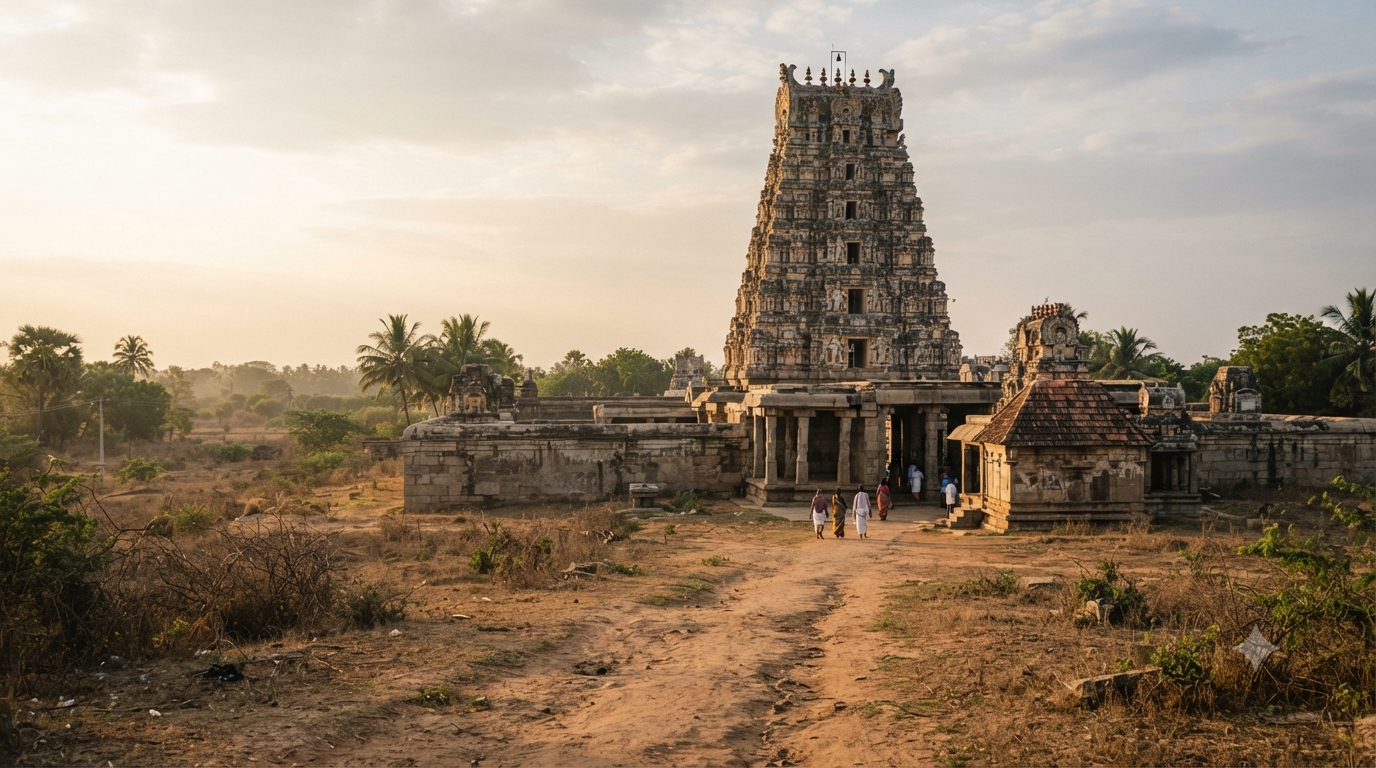
Raja Vasireddy Venkatadri Naidu built the famous Raja Gopuram associated with the lower Lakshmi Narasimha temple. The current temple history dates the work to 1809. Because the tower dominates the skyline, many modern summaries incorrectly turn “builder of the gopuram” into “builder of the whole temple.”
Venkatadri Naidu ruled from Amaravati and became known for supporting temples across the region. At Mangalagiri, his contribution created the structure that became the complex’s strongest architectural symbol. Therefore, his name appears in almost every account of the site.
An archival Census of India publication on Guntur fairs and festivals records older competing stories about the tower’s origin. It also notes the attribution of the gopuram’s present form to Vasireddy Venkatadri Naidu. That is useful because it shows how oral memory and later documentation can overlap.
What Did Sri Krishnadevaraya Add at Mangalagiri?
Sri Krishnadevaraya belongs to an earlier layer of Mangalagiri’s documented history. The present temple account says he constructed the Mukha Mandapa in 1520. Stone inscriptions from the Vijayanagara period also survive on the approach to the hill shrine.
The 1961 Census publication records an inscription dated 1520 near the steps. It mentions the capture of Kondavidu by Timmarusu, Krishnadevaraya’s general, in 1515. Another inscription records grants during the Vijayanagara period, showing that the temple remained a supported religious centre rather than an isolated local shrine.
This evidence helps answer who built Mangalagiri temple without forcing one name onto every structure. Krishnadevaraya contributed to the complex, yet he did not build the later 11-storey Raja Gopuram. Likewise, Venkatadri Naidu built the landmark tower but did not originate the ancient hill shrine.
Did Yudhishthira Build the Mangalagiri Temple?
Temple tradition associates Yudhishthira with the lower Lakshmi Narasimha shrine, but this belongs to sacred tradition rather than securely dated architectural history. Devotional accounts often say the eldest Pandava established or discovered the chief image. Historians therefore treat the story differently from an inscription carrying a ruler’s name and date.
That does not make the tradition unimportant. For devotees, it explains the shrine’s place within the larger sacred geography of the epics. For a history article, though, the careful wording is “tradition attributes” rather than “historical records prove.”
This distinction also keeps the answer evergreen. Readers can assess archaeological or inscriptional evidence separately while also respecting the temple’s living tradition on its own terms.
Who Built Mangalagiri Temple Features We See Today?
The visible Mangalagiri complex is the result of layered construction. Some features belong to Vijayanagara patronage, while the best-known tower belongs to the early nineteenth century. Therefore, the answer depends on which part of the temple a visitor is actually looking at.
- Hill shrine: treated in temple tradition as an ancient swayambhu kshetra.
- Mukha Mandapa: credited to Sri Krishnadevaraya in 1520.
- Vijayanagara inscriptions: record grants, conquest references, and continued patronage.
- Raja Gopuram: credited to Raja Vasireddy Venkatadri Naidu in 1809.
- Later temple life: continued through repairs, worship, festivals, and administration after these royal periods.
So, when someone asks who built Mangalagiri temple, the strongest answer has several historical layers rather than one simplistic name. Raja Vasireddy Venkatadri Naidu built the famous gopuram. Krishnadevaraya contributed an important mandapa, while the sacred site itself is older than both rulers.
Why the Builder Is Often Reported Incorrectly
Most errors come from collapsing several places into one. A travel page sees the 153-foot gopuram, finds Venkatadri Naidu’s name, and then labels him the founder of Mangalagiri temple. That skips the older shrine, the Vijayanagara inscriptions, and the distinction between sacred origin and later architecture.
A second source of confusion is the word “temple.” Visitors may mean the Panakala Narasimha hill shrine, the lower Lakshmi Narasimha temple, or the whole sacred hill complex. Since each has a different historical layer, one sentence cannot describe them accurately without qualification.
The better editorial rule is simple: name the structure before naming the builder. Say “Raja Gopuram built by Vasireddy Venkatadri Naidu” or “Mukha Mandapa credited to Krishnadevaraya.” That wording remains accurate even when legends and architectural phases differ.
Mangalagiri’s Vijayanagara Inscriptions and What They Prove
Inscriptions are the strongest bridge between temple tradition and dated history because they anchor people and events to specific periods. Mangalagiri preserves records from the Vijayanagara era. These inscriptions show that the site received royal attention and grants during the sixteenth century.
The 1520 inscription is especially useful because it connects Mangalagiri to the political world of Krishnadevaraya. It refers to the earlier capture of Kondavidu by Timmarusu. Another inscription records grants in the reign of Sadasiva Raya, reinforcing the temple’s continued importance.
These records do not prove that one Vijayanagara king founded the whole temple. Instead, they show an already important sacred site receiving patronage and development. That is a more defensible historical picture.
What Is Special About the Panakala Narasimha Hill Shrine?
The hill shrine is famous for the offering of panakam, a jaggery-water drink presented to Lord Narasimha. The Guntur District administration describes the tradition that the deity accepts part of the offering and the remainder becomes prasada. Devotees regard this as one of Mangalagiri’s defining sacred customs.
The temple tradition also identifies the deity as swayambhu. In devotional language, devotees regard the divine presence as self-manifested rather than the result of an ordinary founding act. That is another reason why one builder’s name cannot fully answer who built Mangalagiri temple.
If you are exploring Narasimha pilgrimage sites, the site also fits into a wider Andhra tradition. Our guide to Narasimha temples in South India places Mangalagiri alongside Ahobilam, Simhachalam, Penchalakona, and other major shrines.
How Mangalagiri Compares With Other Narasimha Temples
Mangalagiri stands apart because its identity combines a sacred hill, the panakam offering, Vijayanagara inscriptions, and a huge later gopuram. By comparison, pilgrims know Ahobilam for nine Narasimha shrines across the Nallamala hills, while Simhachalam centres on the Varaha-Narasimha form.
For deeper historical context, read our Nava Narasimha temples at Ahobilam guide. You can also compare Mangalagiri with the documented royal history in our Simhachalam Varaha Narasimha temple history.
These comparisons show why temple history rarely follows one construction date. Major pilgrimage centres usually accumulate shrines, towers, halls, inscriptions, and repairs under different patrons. Mangalagiri follows that same pattern.
How to Read Mangalagiri Temple History Without Mixing Legend and Evidence
Start by asking what type of claim you are reading. A dated inscription is historical evidence. A temple website’s record of who built a mandapa or gopuram is an institutional historical claim, while a story about Yudhishthira belongs to sacred tradition.
- Identify the exact structure the source discusses: hill shrine, lower temple, mandapa, or gopuram.
- Check whether the claim has a date, inscription, or named historical patron.
- Label epic and sthala-purana accounts as tradition rather than proven construction history.
- Prefer official temple, government, and archival sources over copied travel-blog summaries.
This method gives a clearer answer to who built Mangalagiri temple and protects readers from repeated errors. It also respects belief without turning a devotional narrative into a modern archaeological claim.
The Bottom Line on Who Built Mangalagiri Temple
Historical evidence does not support crediting one ruler with the whole Mangalagiri sacred complex. The site is ancient and layered, with devotional traditions that reach far beyond the surviving dated structures. Historically, the clearest builder attribution belongs to Raja Vasireddy Venkatadri Naidu for the 11-storey Raja Gopuram in 1809.
Sri Krishnadevaraya also left a major mark through the Mukha Mandapa in 1520 and Vijayanagara-era patronage. Meanwhile, tradition associates Yudhishthira with the lower shrine and regards Panakala Narasimha as self-manifested. Keeping those layers separate gives the most accurate answer.
Frequently Asked Questions
Who built Mangalagiri temple?
No single ruler built the entire Mangalagiri temple complex. The current temple history credits Raja Vasireddy Venkatadri Naidu with the famous 11-storey Raja Gopuram in 1809. The current temple history credits Sri Krishnadevaraya with the Mukha Mandapa in 1520, while the sacred site itself is much older.
Who built the Mangalagiri Raja Gopuram?
Raja Vasireddy Venkatadri Naidu built the famous Raja Gopuram at Mangalagiri. The current temple history dates it to 1809 and describes it as an 11-storey tower rising about 153 feet.
Did Krishnadevaraya build Mangalagiri temple?
Krishnadevaraya contributed to Mangalagiri, but he did not build the whole temple complex. The temple history credits him with the Mukha Mandapa in 1520. Vijayanagara inscriptions also record the site’s importance during his era and afterward.
Did Yudhishthira build Mangalagiri temple?
Tradition links Yudhishthira with the lower Lakshmi Narasimha shrine. However, this is a sacred tradition rather than a dated construction record. Writers should therefore describe it as a traditional attribution, not as a proven historical builder claim.
How old is Mangalagiri temple?
Temple tradition treats the sacred site as ancient, but its surviving features belong to different periods. Vijayanagara inscriptions document activity in the sixteenth century, while the famous Raja Gopuram dates to 1809. The hill shrine’s sacred tradition reaches much further back.
What is the difference between Panakala Narasimha and Lakshmi Narasimha temples at Mangalagiri?
Panakala Narasimha is the famous hill shrine associated with the panakam offering. The lower Lakshmi Narasimha temple stands at the foot of the hill, where the towering Raja Gopuram dominates the entrance. Both belong to the wider Mangalagiri sacred complex.
What did Raja Vasireddy Venkatadri Naidu build at Mangalagiri?
Raja Vasireddy Venkatadri Naidu is best known at Mangalagiri for the 11-storey Raja Gopuram. The temple’s current historical account dates that contribution to 1809. Do not confuse his role with founding the much older sacred site.
What historical evidence survives at Mangalagiri temple?
Stone inscriptions from the Vijayanagara period survive around the temple approach. A 1520 inscription records events connected with Krishnadevaraya’s reign, while later inscriptions record grants under other Vijayanagara rulers. These records help separate dated history from sacred tradition.