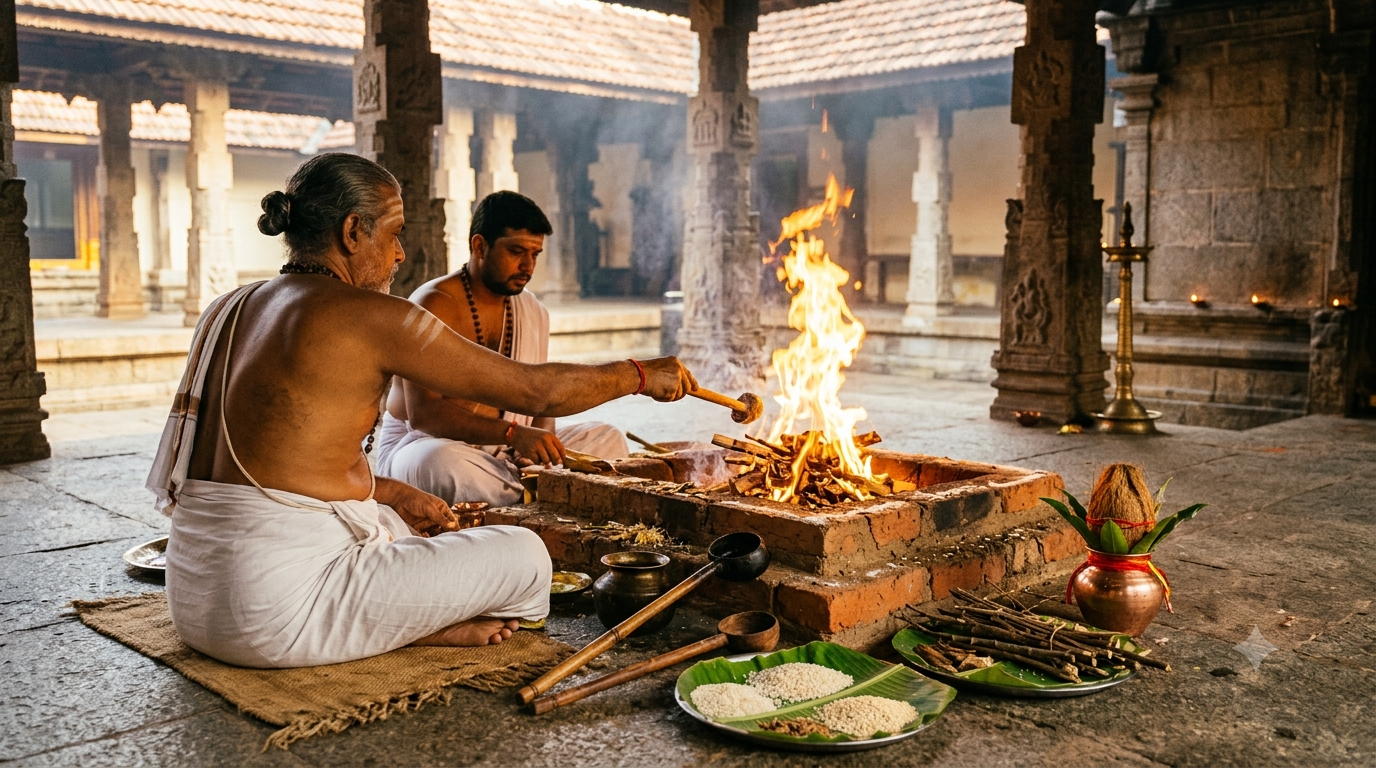
Ayushya homam is the Vedic fire ritual families choose on a birthday, after an illness, or at a 60th-year milestone. One detail surprises almost everyone who starts searching. A devasthanam may conduct the same ritual for a four-figure ticket, while private agencies advertise five-figure packages online.
That gap is not a difference in the mantras. It is a difference in who takes your money.
So this guide covers the correct day to fix and what the priest actually does at the kunda. It also lists the samagri your family has to arrange. Then it sets out the official booking routes we could verify, along with the safety points nobody mentions when an elderly parent is the sankalpa karta.
Sri Vyasa Pooja is an independent temple guide. We are not affiliated with any devasthanam, trust or endowments department, and we accept no bookings, donations or payments of any kind. Every booking link below goes to the temple’s own official portal.
Ayushya Homam at a Glance
- Purpose: invoking Ayur Devata, the presiding deity of life span, for health and longevity.
- Core recitation: the Ayushya Suktam, usually supported by the Mrityunjaya mantra.
- Best day: your janma nakshatra (birth star), ideally in your birth month.
- Most common occasions: a child’s first birthday, recovery from long illness, and the 60th, 70th or 80th year.
- Duration: roughly one and a half to three hours, depending on the number of ritviks.
- Verified temple rate: Annavaram Devasthanam lists Ayushya Homam at Rs 2,116 as a paroksha seva.
- Never a substitute for medical treatment — it sits alongside a doctor’s care, not in place of it.
What Is Ayushya Homam and Who Is It For?
Ayushya homam is a homa that invokes Ayur Devata, the deity of life span. Offerings go into a consecrated fire while priests recite the Ayushya Suktam. Families perform it for a long, healthy life, most often on the birth star day. Priests commonly add the Mahamrityunjaya mantra when the person is unwell.
The ritual is not restricted by age, and that is where most articles go wrong. Infants are the best-known beneficiaries because tradition prescribes it on the first birthday, when Balarishta dosha is believed to affect a child’s early years.
Older devotees form the second large group. Ayushya homam is folded into Shashtiabdapoorthi at 60, Bhimaratha Shanti at 70 and Sathabhishekam at 80, alongside the couple’s ceremonial re-wedding. Adults recovering from surgery or chronic illness form the third group, usually on the advice of a family purohit or astrologer.
The Right Day: Janma Nakshatra, Not the English Date
Fix the date by star, not by calendar. The traditional rule is to perform ayushya homam on the janma nakshatra. That is the lunar star under which the person was born, and the birth month is preferred. Because a nakshatra repeats roughly every 27 days, you get about twelve suitable days a year.
If the same star falls twice inside one month, priests generally take the second occurrence. Morning hours are preferred, since brahma muhurta and the early forenoon are considered the strongest slots for a homa of this kind.
When a child is unwell, some manuals allow the homa monthly on the birth star until health improves. That is a traditional prescription, not a medical one, and it does not replace paediatric care. Carry the exact birth date, time and place when you approach the purohit, because the sankalpa needs your nakshatra, rasi and gotra.
What Actually Happens at the Kunda
The sequence below is the shape most South Indian priests follow. Timings shift a little between sampradayas, so treat it as a map rather than a script.
- Punyahavachanam and achamana to purify the space, the vessels and the participants.
- Sankalpa, where the priest states your name, gotra, nakshatra and the exact purpose aloud.
- Ganapati puja and kalasa sthapana, so the ritual begins without obstruction.
- Agni pratishtha, the formal establishment of fire in the homa kunda.
- Ahutis with ghee, samidha and havis while the Ayushya Suktam and allied mantras are chanted.
- Purnahuti, the concluding full offering, followed by the mangala arati.
- Ashirvadam, when elders and priests bless the person and tie the raksha.
Families often ask why the ritual feels long. The ahuti count is the reason, since a full recitation covers several rounds of the Suktam. If a Navagraha homa or Mrityunjaya homa is added, the sitting stretches well past two hours.
Ayushya Homam Cost: Temple Rates Against Private Packages
Here is the single most useful number in this guide. Sri Veera Venkata Satyanarayana Swamy Vari Devasthanam at Annavaram lists Ayushya Homam among its paroksha sevas. The published rate is Rs 2,116, scheduled at 9:00 AM, and you book it on the devasthanam’s own website. That is a government-run temple rate, published by the temple itself.
Now compare it with what the commercial market quotes. Private ritual agencies and online pooja portals routinely advertise ayushya homam packages between roughly Rs 12,000 and Rs 25,000. The figure climbs as they add priests, japa counts and livestreaming.
| Route | Indicative cost | Where you book |
|---|---|---|
| Temple paroksha seva (Annavaram) | Rs 2,116 | Devasthanam’s official website |
| Temple-conducted homa elsewhere | Varies; confirm on the temple portal | State endowments or temple portal |
| Purohit at home | Samagri plus dakshina, settled directly | Your family purohit |
| Private agency package | Roughly Rs 12,000 to Rs 25,000 advertised | Commercial websites |
Temple rates change without notice, so confirm the current amount on the official portal before you transfer anything. A higher price buys convenience and logistics, not extra punya.
Where to Book Ayushya Homam Officially
Start with the state endowments portal for the temple you have in mind. Andhra Pradesh temples publish their seva and paroksha seva lists through the AP Endowments system at tms.ap.gov.in, and Annavaram runs its own booking pages at annavaramdevasthanam.nic.in.
Karnataka temples list sevas through the Muzrai department’s ITMS portal, while Tamil Nadu temples publish theirs through the Hindu Religious and Charitable Endowments department. Thirukadaiyur remains the best-known destination for a temple ayushya homam. The Markandeya legend gives that shrine its longevity association, so 60th and 80th year celebrations cluster there.
One warning deserves your attention before you pay anyone. The AP Endowments portal states plainly that it does not authorise any agents, persons or third-party agencies to book the services offered on it. Karnataka’s temple administration has issued similar warnings about private websites collecting seva money into personal accounts.
So apply three quick tests. Check that the domain belongs to the temple or the government. Check that payment goes to a devasthanam account, never a personal UPI number. Finally, check that the receipt carries the temple’s seal.
Is Ayushya Homam a TTD Seva at Tirumala?
No. Tirumala Tirupati Devasthanams does not list ayushya homam among its arjitha sevas. Its one sponsored homam is the Sri Srinivasa Divya Anugraha Homam.
The published TTD seva list runs to Suprabhatam, Thomala, Archana, Ashtadala Pada Padmaradhana and Kalyanotsavam. It also covers Unjal Seva, Vasantotsavam, Sahasra Deepalankarana Seva and Arjitha Brahmotsavam.
This matters because several pages advertise an ayushya homam “at Tirumala” for a package price. What they sell is usually a private purohit arrangement in a rented mandapam near the hill. That is a legitimate service, though it is not a TTD seva and carries no TTD ticket.
If you want a genuine Tirumala booking, TTD asks devotees to use only ttdevasthanams.ap.gov.in. For a birthday remembrance at Tirumala, many families instead send photographs to the SVBC Shatamanam Bhavati programme, which is free.
Samagri Checklist Families Forget
Most temples supply everything when you buy a seva ticket. At home, the list falls to you, so confirm it with your purohit a week ahead.
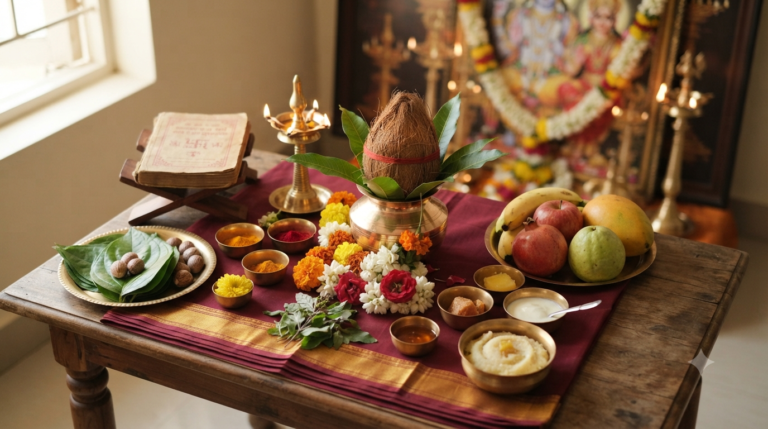
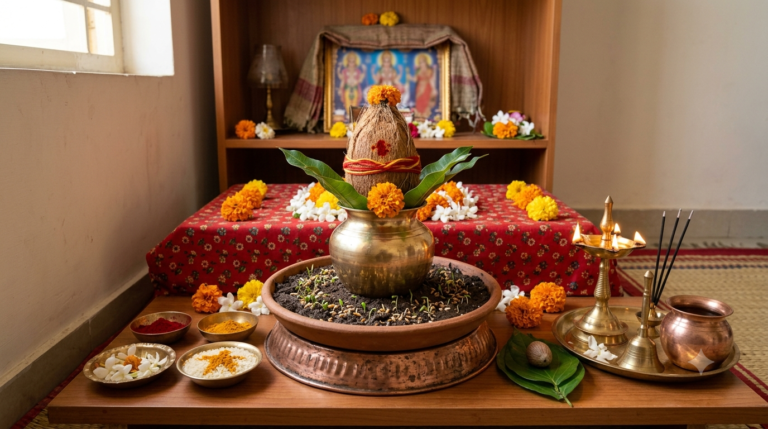
- Homa kunda or a sturdy brick platform, plus dry mango or palasa samidha.
- Cow ghee in generous quantity, since the ahutis consume more than families expect.
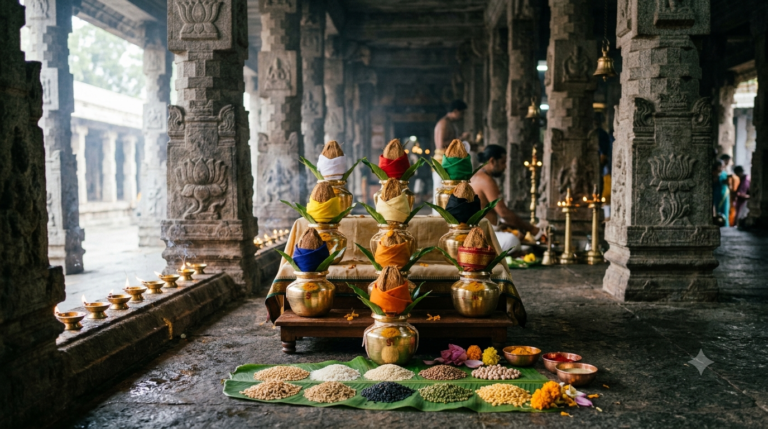
- Rice, black and white sesame, barley, durva grass and navadhanya.
- Kalasa with a coconut, mango leaves, new cloth and turmeric-smeared thread.
- Fruits, betel leaves, flowers, camphor and a clean lamp with oil.
- New clothes for the person receiving the blessing, and the raksha thread.
Ask two practical questions while you are at it. Ask how many ritviks will attend, because dakshina scales with that number. Also ask whether the priest brings the samagri, since a bundled quote and an unbundled quote look very different on the day.
Health, Fasting and Safety Before You Book
An ayushya homam is often performed for someone who is already frail, so plan the practical side with care. The sitting is long, the room fills with smoke, and the person at the centre usually fasts until purnahuti.
Elderly participants, diabetics, pregnant women and anyone with asthma or a cardiac condition should speak to their doctor first. That applies to fasting as well as to sitting near a homa fire for two hours. Ask the priest to allow water, a chair and a short break, because no sampradaya requires a devotee to collapse.
Keep infants at a safe distance from the kunda, and keep the hall ventilated. Most importantly, treat the homa as a matter of faith and tradition. It is not a medical treatment, and prescribed medication or therapy should never be stopped or delayed for a ritual.
What Families Get Wrong About Ayushya Homam
Booking too late is the most common mistake. Because the janma nakshatra falls only once a month, a temple slot or a good purohit may already be committed, so start ten to fifteen days ahead.
The second mistake is treating an ayushya homam as a one-time insurance policy. Tradition recommends repeating it yearly on the birth star, which is why the modest temple rate matters more than a lavish single event.
The third is confusing it with neighbouring rituals. Mrityunjaya homam addresses danger to life, Dhanvantari homam addresses disease, and Navagraha homam addresses planetary afflictions. Priests often combine them, though each has its own sankalpa and its own cost.
Finally, families forget the paperwork of tradition. Bring the birth details in writing, since a mispronounced nakshatra in the sankalpa is the one error you cannot fix afterwards. Planning a 60th year function takes separate homework. Our guides on Shashtiabdapoorthi at the TTD Kalyana Vedika and on 60th wedding temples around Coimbatore cover the venue side.
The Bottom Line
Fix the date by your birth star. Book through a temple or a purohit you can verify, and refuse to pay a premium for the same mantras. A published devasthanam rate such as Annavaram’s Rs 2,116 gives you a fair benchmark before you consider any package.
If the ritual is for an elderly parent or a small child, plan the fasting, the seating and the ventilation as carefully as you plan the muhurta. Similar homa bookings are covered in our guides to the Alampur Jogulamba Chandi Homam and the Mysore Chamundeshwari Chandika Homam.
Ayushya Homam FAQs
What is the right age to start ayushya homam for a child?
Tradition starts it on the first birthday, counted by the janma nakshatra rather than the English date. Families then repeat it yearly on the same star. If a child is repeatedly unwell, some priests advise a monthly homa until health steadies.
How long does an ayushya homam take?
Plan for one and a half to three hours from punyahavachanam to ashirvadam. The number of priests and the ahuti count decide the length. Adding a Navagraha or Mrityunjaya homa pushes the sitting past two hours, so keep the day free.
Can ayushya homam be done on any day if the star is missed?
Yes, though priests treat it as the second-best option. When the janma nakshatra is unavailable, an auspicious muhurta chosen by the purohit is acceptable. Avoid days the family panchangam marks as unsuitable, and confirm the choice before you book.
Is ayushya homam available as an online or paroksha seva?
Yes, at temples that offer paroksha sevas. Annavaram Devasthanam lists Ayushya Homam at Rs 2,116 on its official paroksha seva page. You book on the temple’s own site, the priests perform it in your absence, and prasadam follows by post.
Who should be the sankalpa karta?
The person seeking longevity sits as the karta whenever age allows. For infants, a parent performs the sankalpa on the child’s behalf. For an elderly couple, both usually sit together, especially during Shashtiabdapoorthi and Sathabhishekam.
Do I need to fast before the homam?
A light fast until purnahuti is customary, and many families avoid non-vegetarian food for three days beforehand. Anyone with a medical condition should ask their doctor first. Water and short breaks are acceptable, since health comes before custom.
Is ayushya homam the same as Mrityunjaya homam?
No. Ayushya homam invokes Ayur Devata for life span and vitality, while Mrityunjaya homam invokes Shiva for protection from grave danger. Priests often perform both together when someone is seriously ill, but the sankalpa and the mantras differ.
How do I avoid fake ayushya homam booking websites?
Book only on the temple’s own domain or the state endowments portal. AP Endowments states that it authorises no agents or third-party agencies for online booking. Refuse any request to pay a personal UPI number, and keep the official receipt.