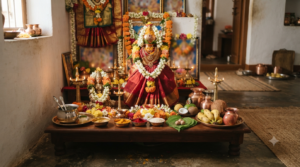
Mangala Gowri Vratam is the Shravana Tuesday worship of Goddess Gowri, observed especially in Telugu and Kannada households for marital wellbeing and family auspiciousness. The ritual repeats on each Tuesday that falls within Shravana, so the calendar dates change every year and can differ between South and North Indian traditions.
Sri Vyasa Pooja is an independent devotional guide. We are not affiliated with any temple, mutt, trust, or government body, and we do not accept pooja bookings, donations, or payments. Follow your family sampradaya or a trusted purohit when household practice differs.
Mangala Gowri Vratam at a Glance
- Deity: Goddess Gowri, a form of Parvati associated with auspicious married life.
- Day: Tuesdays that fall within Shravana masam.
- Regional name: Mangala Gauri Vrat in many North Indian calendars; Mangala Gowri Vratham or Nomu in South India.
- Who traditionally observes it: especially newly married women, though family custom varies.
- Common duration: many Telugu and Kannada families continue the observance for the first five years of marriage.
- Main elements: Gowri pooja, Shodashopachara offerings, vratam katha, thoram, naivedyam, and vayanam where customary.
The most important evergreen rule is simple: do not carry last year’s dates forward. Use the Tuesdays that fall inside Shravana according to the lunar calendar your family follows.
When Are the Mangala Gowri Vratam Dates?
Mangala Gowri Vratam does not have one fixed Gregorian date. It falls on every Tuesday within Shravana, so there are usually four or five observance days in the month. Check the Shravana start and end dates for your city before marking the Tuesdays.
This is also why two correct calendars can show different date lists. Drik Panchang separates the North Indian Purnimanta schedule from the Amanta schedule followed across Andhra Pradesh, Telangana, Karnataka, Maharashtra, Goa, Gujarat, and much of South India. The two systems can differ by roughly a fortnight at the beginning of the month.
| Calendar tradition | Where commonly followed | How to find the vratam days |
|---|---|---|
| Amanta | Andhra Pradesh, Telangana, Karnataka, Maharashtra and several western/southern regions | Mark every Tuesday that falls within the local Shravana month |
| Purnimanta | Many North Indian states | Mark every Tuesday within the Purnimanta Shravana month |
Why old Mangala Gowri date lists become wrong
Hindu lunar months move against the Gregorian calendar, so a Tuesday date from one year cannot be reused automatically in the next. Adhika masa, or an extra lunar month, can shift festival sequences even more. Therefore, an undated rule is safer than a copied annual list.
For current planning, choose your city on a reliable panchang and confirm which month system your household follows. HinduCalendar.in also describes the observance as the Tuesdays of Shravana and notes that Amanta, Purnimanta, and solar month systems can produce different results.
Why Shravana Tuesday Worship Matters
The vratam honours Goddess Gowri as the auspicious form of Parvati. In household tradition, newly married women worship her while praying for the wellbeing of their spouse, harmony at home, and a stable married life. These are devotional beliefs, not guaranteed outcomes.
The Ottawa Hindu Temple’s Sanatan Cultural Library describes the observance as a South Indian Shravana Tuesday vrata centred on Gowri, the katha, sixteen-fold worship, vayanam, and haldi-kumkum. The same source also records the common first-five-years-of-marriage custom.
Is the five-year rule compulsory?
No single household rule applies everywhere. Many Telugu and Kannada families begin the vratam after marriage and continue it for five Shravana seasons. However, some families follow a different count or continue beyond five years.
If your mother, mother-in-law, or family purohit follows a specific sampradaya, keep that practice rather than replacing it with an internet checklist. The family tradition is often part of the vratam itself.
Samagri Checklist for the Pooja
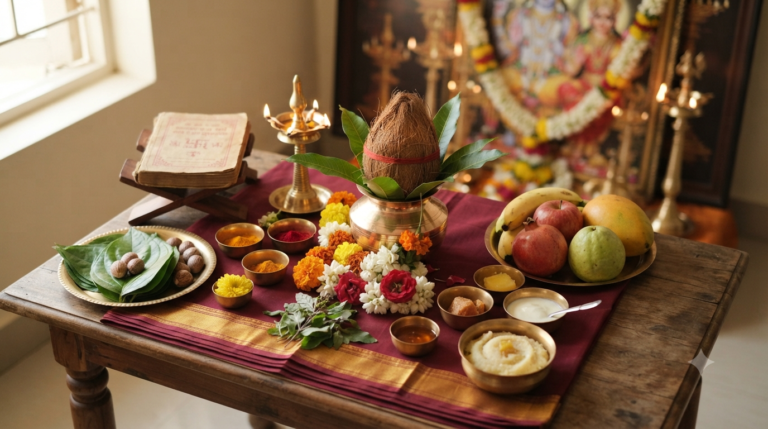
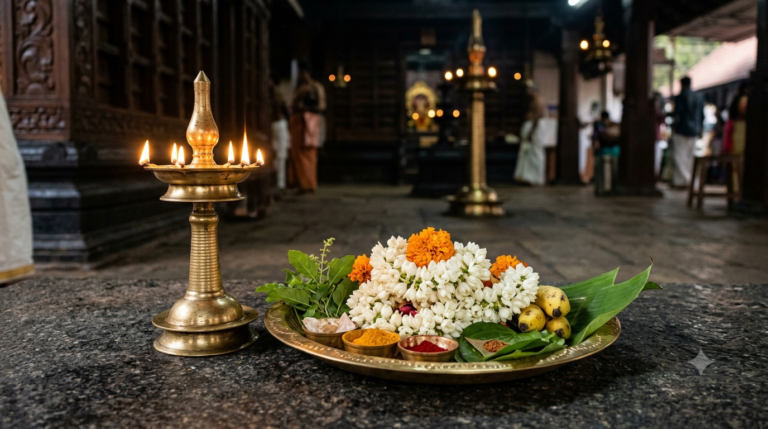
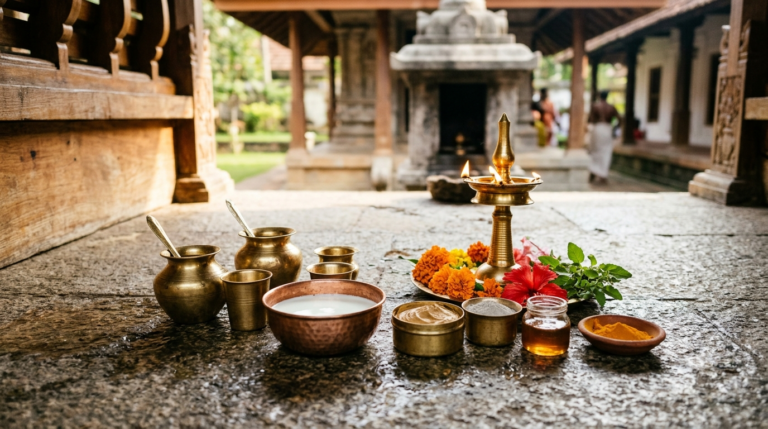
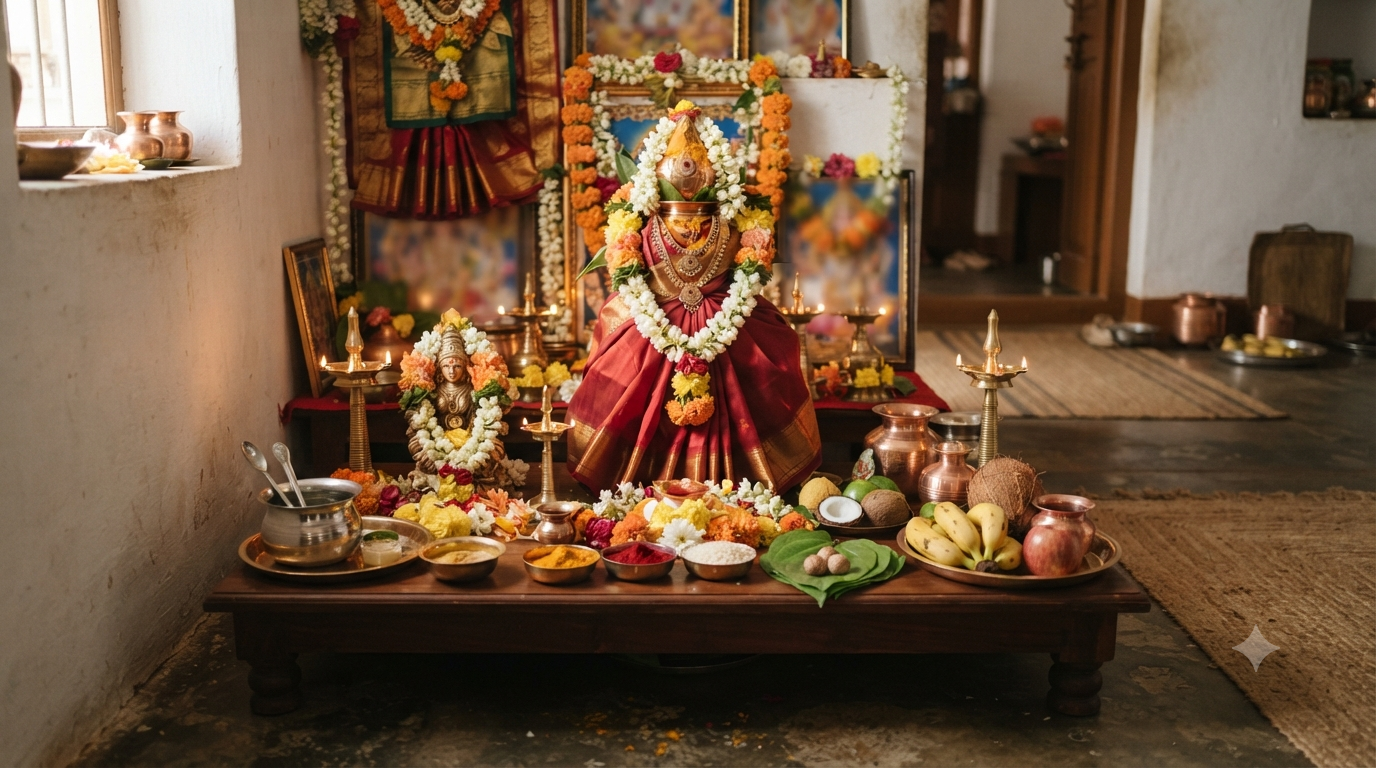
The exact samagri varies, yet the basic set is modest. Prepare it on Monday evening so the Tuesday pooja stays calm. Avoid buying elaborate items merely because a website presents them as compulsory.
| Category | Common items | Purpose |
|---|---|---|
| Gowri setup | Gowri image or idol, wooden plank, clean cloth | Creates the pooja seat |
| Basic pooja | Turmeric, kumum, sandal paste, akshata, flowers | Daily worship offerings |
| Lamp and fragrance | Deepam, oil or ghee, wicks, incense, camphor | Deepa and dhupa offerings |
| Naivedyam | Fruit, coconut, cooked sweet or family-special prasadam | Food offering |
| Traditional extras | Thoram, betel leaves, betel nut, bangles, blouse piece, soaked chickpeas where customary | Used for tying, tambulam, or vayanam |
Some Telugu homes also prepare pindi jyothulu, small flour-based lamps or offerings, as part of their inherited Mangala Gowri practice. Other families do not use them at all. Treat such details as regional customs rather than universal requirements.
Mangala Gowri Vratam Pooja Vidhanam
Mangala Gowri Vratam usually follows a familiar Hindu home-pooja sequence: purification, sankalpam, Ganapati worship, Gowri avahanam, Shodashopachara offerings, katha, naivedyam, harati, and the family-specific thoram or vayanam customs. The order matters more than expensive decoration.
- Clean the pooja space. Bathe, wear clean clothes, and prepare a quiet place for worship.
- Install Gowri. Place the Goddess image or idol on a clean plank with flowers and a lamp.
- Begin with Ganapati. Offer a short prayer to Lord Ganesha before the main worship.
- Take sankalpam. State your intention to observe the Shravana Tuesday vratam according to your family custom.
- Invoke Goddess Gowri. Offer a seat, water, flowers, turmeric, kumkum, sandal, incense, and lamp.
- Perform Shodashopachara. Complete the sixteen honours if your family follows the full format.
- Recite names or stotras. Use the Gowri, Parvati, or Lalita prayers traditionally used in your home.
- Read the vratam katha. Listen to or read the Mangala Gowri story with attention.
- Offer naivedyam and harati. Present food, tambulam, and aarti to conclude the main worship.
- Complete thoram and vayanam customs. Tie the sacred thread and offer vayanam only as your family tradition directs.
Do you need a priest to perform the vratam?
Usually, no. Mangala Gowri is widely observed as a household vratam, so many families perform it themselves using the procedure taught by elders. A priest can help with mantras or a first-time sankalpam, but there is no need to use a private online booking service.
If you want formal guidance, contact a trusted local temple or your own family purohit directly. Do not share personal details or make payments to unofficial pages claiming to be the only authorised channel for this home worship.
Thoram, Vayanam and the Family Customs That Vary
Three details cause more confusion than the basic pooja: the thoram, vayanam, and the number of items offered. Their form changes from family to family, which is why rigid online instructions often conflict.
The thoram is the sacred thread tied after worship in many households. Vayanam usually means an auspicious offering shared with married women and may include turmeric, kumkum, betel leaves, fruit, blouse cloth, or food. Some Telugu customs also include soaked chickpeas or a special lamp offering.
What about the number sixteen?
Some traditions strongly associate Mangala Gowri worship with sets of sixteen, including flowers, leaves, lamps, or other offerings. Other households keep a simpler version. Shodashopachara itself means sixteen forms of respectful worship, so the number has a clear ritual connection.
Do not discard a valid family practice because an online article lists a different quantity. When numbers differ, follow the custom you inherited or ask a knowledgeable purohit who understands your regional tradition.
Mangala Gowri vs Varalakshmi: What Changes?
These two Shravana observances are often mixed up, yet they are different. Mangala Gowri Vratam belongs to Tuesdays and honours Gowri or Parvati. Varalakshmi Vratam belongs to a Friday and centres on Goddess Lakshmi.
| Point | Mangala Gowri | Varalakshmi |
|---|---|---|
| Weekday | Tuesday | Friday |
| Deity | Gowri / Parvati | Varalakshmi / Mahalakshmi |
| Frequency in Shravana | Every qualifying Tuesday | One principal Friday observance |
| Common household focus | Marital auspiciousness and family wellbeing | Prosperity, wellbeing, and Lakshmi worship |
If you are planning both, keep separate checklists. Our Varalakshmi Vratam at home guide covers the Friday procedure, while the Vara Mahalakshmi Kalasam setup explains the decorated kalasam used for that Lakshmi worship.
Fasting Rules and a Practical Health Note
Fasting practice varies widely. Some women keep a light fast until the pooja ends, while others take fruit, milk, or a simple sattvic meal. Mangala Gowri Vratam should never require a person to ignore medical needs.
If you are pregnant, elderly, diabetic, unwell, or taking regular medication, do not attempt a strict fast without medical advice. Eat and hydrate as your doctor recommends, then keep the devotional parts of the vratam in a safe way.
Can you perform the pooja if you cannot fast?
Yes, in many family traditions the pooja and the fast are related but not identical. Health can change how you fast without cancelling your devotion. A simple meal, fruit, or regular food may be the safer choice.
Because practice differs by household, speak with an elder or purohit if you want to adapt the fast while preserving your family’s custom. Faith should not become a reason to skip essential food, water, or medicine.
Common Mistakes to Avoid
- Copying last year’s dates. Shravana shifts each year, so recalculate the Tuesdays.
- Ignoring regional calendar differences. Amanta and Purnimanta systems can produce different valid date lists.
- Treating every online samagri list as compulsory. Family practice may use fewer or different items.
- Confusing Mangala Gowri with Varalakshmi. One is a Tuesday Gowri vratam; the other is a Friday Lakshmi vratam.
- Forcing a strict fast despite health concerns. Safety comes first.
- Paying unofficial sites to “book” a home vratam. This worship does not require an online booking portal.
Another mistake is worrying that a small substitution makes the pooja invalid. Devotional home worship has always adapted to place, availability, and family practice. Keep the core worship sincere and avoid turning optional details into fear.
How to Keep This Guide Evergreen Every Shravana
You only need to update one thing each year: the date box. The ritual, deity, weekday rule, regional calendar explanation, samagri logic, and health guidance remain useful without a year in the title or URL.
- Check the Shravana start and end dates for your city.
- Confirm whether your family uses Amanta or Purnimanta reckoning.
- List every Tuesday inside that Shravana period.
- Cross-check the dates against a second established panchang.
- Update only the dated table and modified date, not the permalink.
This approach avoids the biggest weakness of old festival posts: a page can keep ranking for years without carrying a stale year in its slug. It also makes corrections simple if a regional panchang follows a different month boundary.
Before You Begin
Mangala Gowri Vratam is best understood as a Shravana Tuesday family observance, not as one fixed annual date. Confirm the right Tuesdays for your calendar, prepare the basic samagri, and follow the pooja order your household recognises.
For most families, Mangala Gowri Vratam stays meaningful because the ritual is repeated with the same core intention each Shravana, while the calendar dates change around it.
If you also observe Lakshmi worship during Shravana, our Vaibhava Lakshmi Vratha Vidhanam explains the Friday tradition. Keep both practices separate, since their deities, weekday rules, and household customs are different.
Frequently Asked Questions
On which day is Mangala Gowri Vratam observed?
It is observed on Tuesdays during Shravana masam. The exact Gregorian dates change every year, so mark the Tuesdays that fall within Shravana according to your regional lunar calendar.
Why do Mangala Gowri dates differ between websites?
The main reason is calendar tradition. South Indian Amanta and North Indian Purnimanta calendars begin Shravana at different points, so both can produce valid but different Tuesday lists.
Who traditionally observes this vratam?
Newly married women commonly observe it in Telugu, Kannada, Marathi, and related household traditions. However, details vary by family, so treat this as a custom rather than a universal restriction.
How many years should it be observed?
Many families observe it during the first five years of marriage and then complete an udyapana or concluding observance. Other families follow a different pattern, so confirm the rule used in your own household.
Is fasting compulsory?
Fasting is traditional in many homes, but its strictness varies. If you are pregnant, diabetic, elderly, unwell, or taking medication, follow medical advice and adapt the fast safely.
What is offered as vayanam?
Vayanam is an auspicious gift or food offering shared with married women in many traditions. The contents can include turmeric, kumkum, fruit, betel leaves, blouse cloth, chickpeas, or another family-specific item.
Is this the same as Varalakshmi Vratam?
No. Mangala Gowri honours Goddess Gowri on Shravana Tuesdays, while Varalakshmi Vratam honours Goddess Lakshmi on a Friday. Their samagri and family rituals also differ.
Can the pooja be done at home without a priest?
Yes. Many families perform it at home using the procedure taught by elders. A priest is helpful when you want formal mantra guidance, but the vratam does not require an online booking service.
Can I use an old Mangala Gowri date list next year?
No. The Gregorian dates shift with the lunar calendar, and an adhika masa can move the sequence further. Recheck the Shravana month and Tuesdays every year instead of copying an old list.