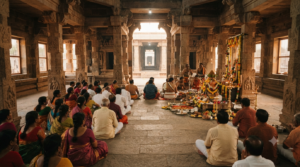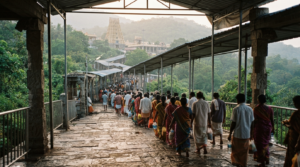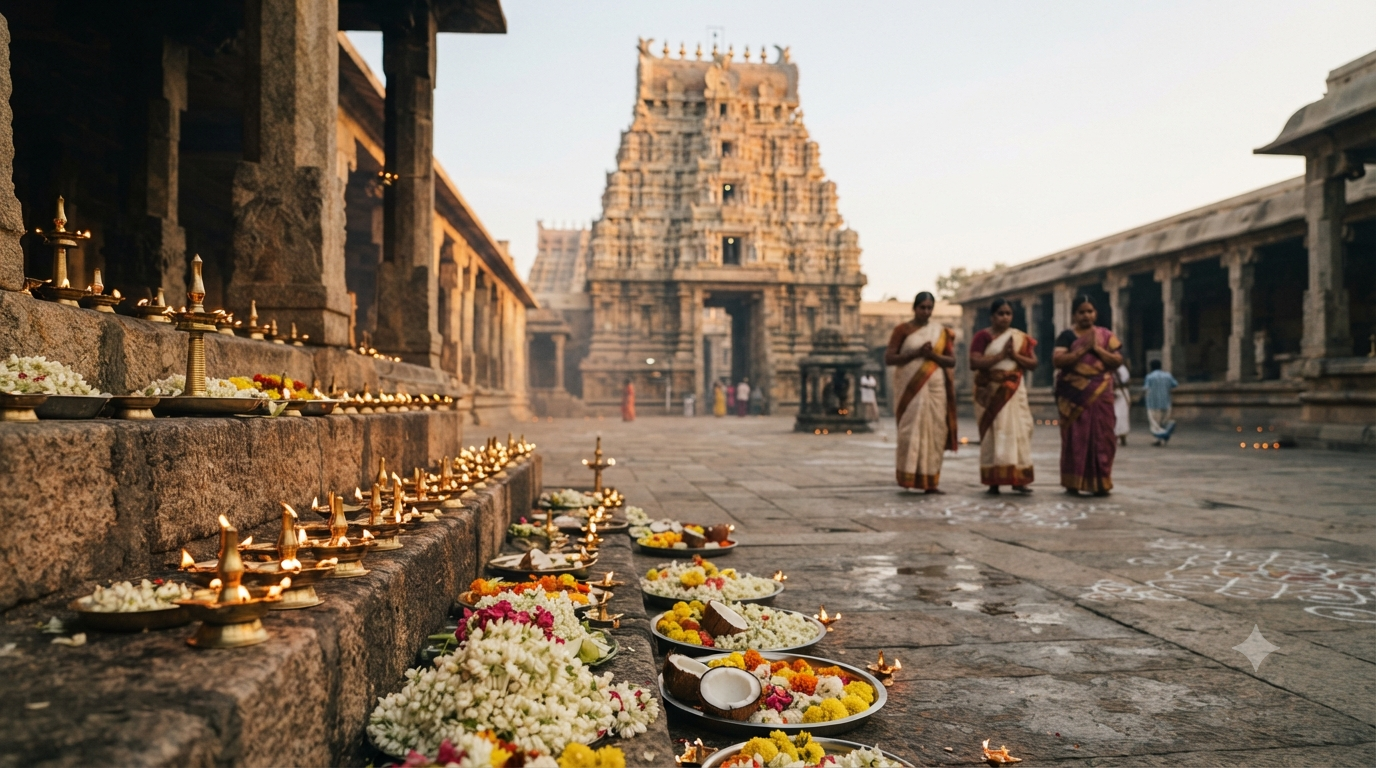
Shakti temples in Tamil Nadu include grand city shrines such as Madurai Meenakshi and Kanchi Kamakshi. They also include deeply local Mariamman and Angalamman temples. The most useful pilgrimage plan is not to chase a single “top” list.
Instead, choose a region and understand each temple’s tradition. Check the official temple page before travelling because darshan hours can change on festival days.
Sri Vyasa Pooja is an independent pilgrim guide. We are not affiliated with any temple, Devasthanam, or the Tamil Nadu Hindu Religious and Charitable Endowments Department. We do not accept bookings, donations, tickets, or payments; use only the official temple channels linked below for current services.
Shakti temples in Tamil Nadu at a glance
Tamil Nadu has many living goddess traditions, so one list can never represent every important shrine. This guide focuses on ten widely known temples across the state. Together, they cover Kamakshi, Meenakshi, Mariamman, Bhagavathi, Masaniamman, and Angalamman worship.
| Temple | Location | Current published opening hours |
|---|---|---|
| Kanchi Kamakshi Amman | Kanchipuram | Opens 5:30 AM; daily pooja schedule continues into the evening |
| Meenakshi Sundareswarar | Madurai | 5:00 AM–12:30 PM; 4:00 PM–10:00 PM |
| Samayapuram Mariamman | Near Tiruchirappalli | 5:30 AM–9:00 PM |
| Bannari Mariamman | Bannari, Erode district | 5:00 AM–9:00 PM |
| Masaniamman | Anaimalai, Coimbatore district | 6:00 AM–8:00 PM |
| Bhagavathi Amman | Kanyakumari | Government pages currently differ; confirm before travel |
| Punnainallur Mariamman | Thanjavur district | 6:00 AM–9:00 PM |
| Irukkangudi Mariamman | Virudhunagar district | 5:00 AM–1:30 PM; 4:00 PM–8:00 PM on regular days; Tue/Fri/Sun continuous to 8:15 PM |
| Melmalayanur Angalamman | Viluppuram district | 6:00 AM–9:00 PM |
| Mangadu Kamakshi Amman | Near Chennai | 6:00 AM–1:30 PM; 3:00 PM–8:45 PM on regular days |
The published hours for these Shakti temples in Tamil Nadu come from official temple pages or Tamil Nadu HR&CE records. However, special days can extend or alter access. Therefore, treat the table as a planning aid and recheck the official source before a long journey.
Are Shakti temples in Tamil Nadu and Shakti Peethas the same?
No. “Shakti temple” is a broad description for a shrine centred on the Divine Mother in forms such as Kamakshi, Meenakshi, Mariamman, Kali, Bhagavathi, or Angalamman. A “Shakti Peetha” belongs to a more specific sacred classification connected with traditions about Sati, and lists vary across texts and regional traditions.
This distinction matters because many travel pages label every famous Amman temple a Shakti Peetha. That is too broad. Some temples have a strong Peetha tradition, while others are renowned regional goddess shrines with different histories. The safest approach is to respect each temple’s own tradition rather than force every shrine into one list.
Shakti temples in Tamil Nadu: 10 famous shrines
1. Kanchi Kamakshi Amman Temple, Kanchipuram
Kanchi Kamakshi is one of the most important goddess shrines in Kanchipuram. The official Sri Kamakshi Ambal Devasthanam places the Goddess at the spiritual centre of the city’s Shakti tradition. Its daily schedule begins with Goh Pooja and Viswarupa Darshanam at 5:30 AM, followed by three abhishekam periods through the day.
The temple is especially meaningful for devotees interested in Sri Vidya and Sri Chakra traditions. For deeper context, read our Kanchi Kamakshi Temple significance guide. Before travelling, check the official Sri Kamakshi Ambal Devasthanam website because festival schedules can change normal access.
2. Meenakshi Sundareswarar Temple, Madurai
Madurai’s Meenakshi Sundareswarar Temple centres on Goddess Meenakshi and Lord Sundareswarar. The Tamil Nadu HR&CE page lists morning darshan from 5:00 AM to 12:30 PM. Evening darshan runs from 4:00 PM to 10:00 PM, and the portal also publishes six daily pooja periods.
This temple suits pilgrims who want both a major Shakti shrine and a large living temple complex. Its Chithirai celebrations are closely associated with the divine marriage of Meenakshi and Sundareswarar. See our Meenakshi Temple pooja timings, then confirm any special-day changes on the official HR&CE temple site.
3. Samayapuram Mariamman Temple, Tiruchirappalli district
Among Shakti temples in Tamil Nadu, Samayapuram is one of the best-known Mariamman pilgrimage centres. The official temple portal lists opening from 5:30 AM until 9:00 PM. It also notes that festival periods can change the schedule. This long daily window makes it easier to combine Samayapuram with other Tiruchirappalli-area temples.
Mariamman worship here carries a strong local devotional identity, so avoid reducing the temple to generic “Shakti Peetha” language. If you are visiting on a Tuesday, Friday, or during a major festival, allow extra queue time. Use the official Samayapuram Mariamman HR&CE portal for current notices and services.
4. Bannari Mariamman Temple, Erode district
Bannari Mariamman Temple stands near Sathyamangalam at the foot of the Western Ghats. Tamil Nadu government tourism information describes it as a major Amman shrine of the Kongu region. The temple’s official HR&CE page currently lists continuous opening from 5:00 AM to 9:00 PM.
The annual Kundam tradition is one of the temple’s best-known observances, while ordinary days offer a simpler darshan experience. Because the temple lies on a major road toward Mysuru, it also fits naturally into a western Tamil Nadu pilgrimage. Check the official Bannari Mariamman portal before festival travel.
5. Masaniamman Temple, Anaimalai
Among Shakti temples in Tamil Nadu, Arulmigu Masaniamman Temple stands out for its Anaimalai setting and local traditions. It is in Coimbatore district. The official HR&CE portal lists continuous darshan from 6:00 AM to 8:00 PM. Temple records also highlight the Neethi Kal, which devotees associate with petitions for justice.
This is a strong choice for travellers building a Coimbatore–Pollachi–Anaimalai route. The temple complex also lists pilgrim facilities such as a first-aid centre and a room for nursing mothers. For current timings and facilities, use the official Masaniamman HR&CE portal.
6. Bhagavathi Amman Temple, Kanyakumari
Kanyakumari Bhagavathi Amman Temple stands at India’s southern tip. Its tradition centres on the virgin goddess who gives the town its name. The coastal setting makes this shrine distinct from the others here.
Official Tamil Nadu government pages currently publish slightly different closing times for this temple. Because those primary sources conflict, confirm the day’s schedule before travel instead of relying on one copied timetable.
The Government of Tamil Nadu’s Kanyakumari district page also presents the temple as one of the area’s major pilgrimage landmarks. Devotees often combine darshan with other sacred sites around Kanyakumari and Suchindram. Before visiting, check the official Bhagavathi Amman HR&CE page.
7. Punnainallur Mariamman Temple, Thanjavur
Punnainallur Mariamman Temple near Thanjavur is an important mother-goddess shrine of the Kaveri delta. The official HR&CE page says the temple remains open from 6:00 AM to 9:00 PM without the usual daytime closure. On Sundays in the Tamil month of Avani, the published hours extend further.
A distinctive feature is the material of the main deity. The HR&CE page states that the moolavar is formed from a special earth material, so regular liquid abhishekam is not performed directly on the main deity. That makes the shrine’s ritual practice notably different from many other Shakti temples in Tamil Nadu. Check the official Punnainallur Mariamman page.
8. Irukkangudi Mariamman Temple, Virudhunagar district
Irukkangudi Mariamman is a major southern Tamil Nadu prayer centre near Sattur. The official HR&CE page lists 5:00 AM to 1:30 PM and 4:00 PM to 8:00 PM on regular days. On Tuesdays, Fridays, and Sundays, the shrine stays open continuously until 8:15 PM.
That special-day schedule is useful because many devotees deliberately choose those days. However, the same pattern can mean heavier crowds. Plan food, water, and return transport before entering a long queue. Current services and notices are available through the official Irukkangudi Mariamman portal.
9. Melmalayanur Angalamman Temple, Viluppuram district
Melmalayanur Angalamman Temple is a major Angalamman shrine in northern Tamil Nadu. The official HR&CE page lists normal daily opening from 6:00 AM to 9:00 PM. It also notes special overnight access connected with Amavasya observance, when pilgrim numbers can rise sharply.
Melmalayanur therefore needs more planning than a normal daytime stop. If you visit around Amavasya, confirm crowd-control arrangements and transport before leaving home. The temple’s official facilities page lists parking and accommodation facilities near the shrine. Use the official Melmalayanur Angalamman portal for current arrangements.
10. Mangadu Kamakshi Amman Temple, near Chennai
Among Shakti temples in Tamil Nadu, Mangadu Kamakshi Amman Temple is especially convenient for Chennai-based visitors. It should not be confused with Sri Kamakshi Ambal Devasthanam in Kanchipuram. The HR&CE page lists two sessions on Monday, Wednesday, Thursday, and Saturday: 6:00 AM to 1:30 PM, then 3:00 PM to 8:45 PM.
On Sunday, Tuesday, and Friday, the official page lists longer opening from 5:00 AM to 9:00 PM. Those are also popular devotional days, so an early start can reduce waiting. For the latest schedule, use the official Mangadu Kamakshi HR&CE portal.
How to plan Shakti temples in Tamil Nadu by region
The easiest way to visit several Shakti temples in Tamil Nadu is to build regional clusters. This avoids one exhausting statewide circuit. A northern route can combine Chennai, Mangadu, Kanchipuram, and Melmalayanur. A central route works well around Tiruchirappalli, Thanjavur, and the Kaveri delta.
For western Tamil Nadu, base yourself around Coimbatore or Erode for Masaniamman and Bannari Mariamman. A southern route can connect Madurai, Irukkangudi, and Kanyakumari. If you continue through Tirunelveli, use our Nava Tirupati temples guide for a separate Vishnu circuit. Keeping the circuits separate avoids too many long drives in one day.
Which Shakti temples in Tamil Nadu should you choose first?
Choose by geography and devotional interest rather than by a “best temple” ranking. Kanchi Kamakshi suits pilgrims drawn to Sri Vidya traditions, while Madurai Meenakshi combines goddess worship with one of Tamil Nadu’s great temple-city experiences. Samayapuram, Bannari, Punnainallur, and Irukkangudi are strong choices for Mariamman traditions.
Kanyakumari Bhagavathi gives a distinct coastal pilgrimage, while Masaniamman and Melmalayanur Angalamman reflect powerful regional goddess traditions. Mangadu is convenient for Chennai-based travellers. This approach respects the fact that Shakti worship is diverse, so different temples carry different ritual identities and local histories.
Practical rules for visiting Shakti temples in Tamil Nadu
Temple rules vary, but modest clothing is the safest choice across the state. Carry only what you need because security restrictions may limit bags, phones, or photography near inner sanctums. When paid sevas or donations are available, use the temple’s official counter or verified official portal.
- Recheck darshan timings on the official website before travel, especially on festival days.
- Do not pay agents who promise guaranteed darshan, special access, or unofficial bookings.
- Carry drinking water for travel, while following each temple’s rules about items allowed inside.
- Allow extra time on Fridays, Tuesdays, Amavasya, Pournima, Aadi observances, and Navaratri periods.
- For elderly pilgrims, children, pregnant visitors, or anyone with a medical condition, avoid long heat exposure and plan regular rest breaks.
Tamil Nadu’s hot afternoons can make long multi-temple days tiring, so fewer shrines per day often produces a better pilgrimage. During crowded festivals, follow local police and temple instructions. Also remember that devotional practices are matters of faith and tradition, not medical treatment or guaranteed outcomes.
Common mistakes in guides to Shakti temples in Tamil Nadu
The most common mistake is treating every Amman shrine as a Shakti Peetha. Another is copying old timings without checking the current temple page. Kanyakumari is a good example because current government pages themselves show slightly different closing times, so same-day confirmation is safer. A third is mixing similarly named temples, especially Kanchi Kamakshi and Mangadu Kamakshi, which are separate shrines in different places.
Some pages also publish private phone numbers or promise third-party booking help. Avoid those routes. Official HR&CE portals and the temples’ own Devasthanam pages are the safest sources for changing details. An evergreen guide should explain the tradition and route clearly, while leaving volatile bookings, fees, and festival-day changes to the official channel.
Before you plan your pilgrimage
The strongest way to explore Shakti temples in Tamil Nadu is region by region. Start with one temple that matches your route and devotional interest, then add nearby shrines without rushing. Keep the distinction between a general Shakti temple and a specifically recognised Shakti Peetha in mind.
Most importantly, verify timings again close to travel. Temple schedules can shift during major observances, and official pages are the right place for current notices. That simple habit prevents the most common planning mistake: arriving with an old timetable copied from an aggregator.
Frequently asked questions
Which are the most famous Shakti temples in Tamil Nadu?
Major choices include Kanchi Kamakshi, Madurai Meenakshi, Samayapuram Mariamman, Bannari Mariamman, Kanyakumari Bhagavathi, Punnainallur Mariamman, Masaniamman, Irukkangudi Mariamman, Melmalayanur Angalamman, and Mangadu Kamakshi. “Most famous” is subjective, so this list balances pilgrimage prominence with geographic coverage.
Are all Shakti temples in Tamil Nadu Shakti Peethas?
No. Shakti temple is a broad term for a goddess shrine, while Shakti Peetha refers to a specific sacred classification found in particular traditions. Lists of Peethas also vary, so it is inaccurate to label every well-known Amman temple a Shakti Peetha.
Which goddess temple is best to visit from Chennai?
Mangadu Kamakshi is convenient from Chennai, while Kanchi Kamakshi in Kanchipuram makes a strong day-trip pilgrimage. If you have more time, Melmalayanur can form part of a wider northern Tamil Nadu route. Check road conditions and temple timings before leaving.
Which Shakti temple is best for a Madurai trip?
Meenakshi Sundareswarar Temple is the central goddess shrine for a Madurai visit. Its official schedule has a midday closure, so plan darshan in the morning or after 4:00 PM. A southern itinerary can then continue toward Irukkangudi or Kanyakumari on separate travel days.
What is the difference between Kanchi Kamakshi and Mangadu Kamakshi?
They are separate temples. Sri Kamakshi Ambal Devasthanam is in Kanchipuram, while Arulmigu Kamakshi Amman Temple at Mangadu is near Chennai and falls under Tamil Nadu HR&CE. Their histories, schedules, and administration differ, so always check the correct official website.
When are Tamil Nadu Amman temples most crowded?
Crowds often rise on Tuesdays, Fridays, Amavasya, Pournima, Aadi observances, Navaratri, and each temple’s annual festival. The exact pattern varies by shrine. If you prefer shorter queues, choose an ordinary weekday and arrive early after checking the official schedule.
Can I book darshan or sevas through Sri Vyasa Pooja?
No. Sri Vyasa Pooja is an independent information guide and does not accept bookings, tickets, donations, or payments. Use the official temple or Tamil Nadu HR&CE channel for any paid service, and avoid private agents who promise guaranteed access.
How many days do I need for a Shakti temple trip in Tamil Nadu?
There is no useful single number because the temples span the state. A regional cluster can fit into one to three days, while a statewide journey needs much longer. Plan by geography, keep road travel realistic, and avoid squeezing distant temples into one day.