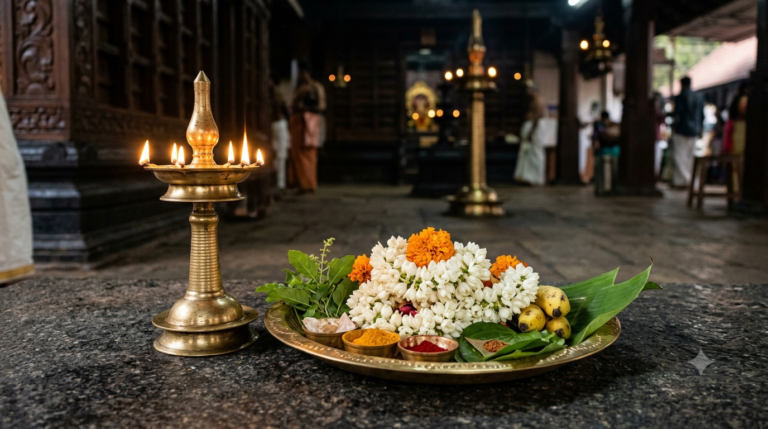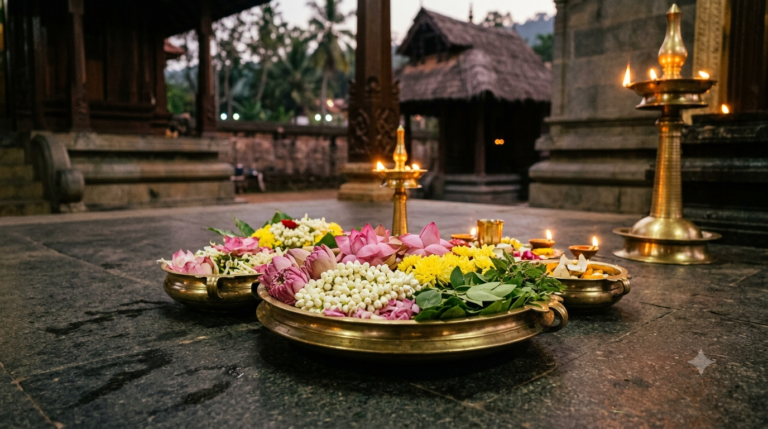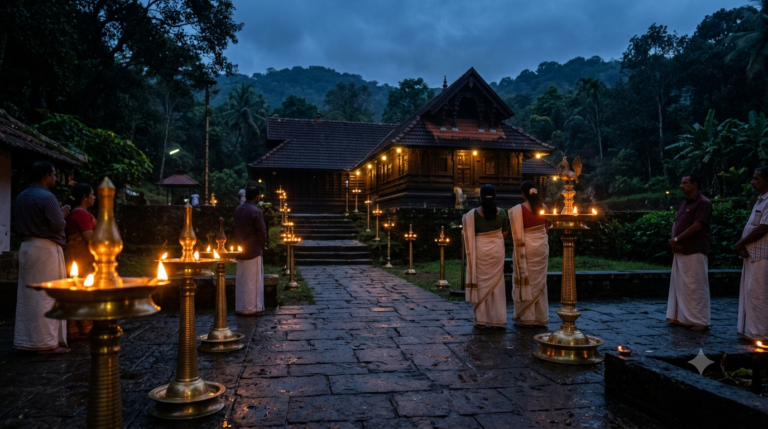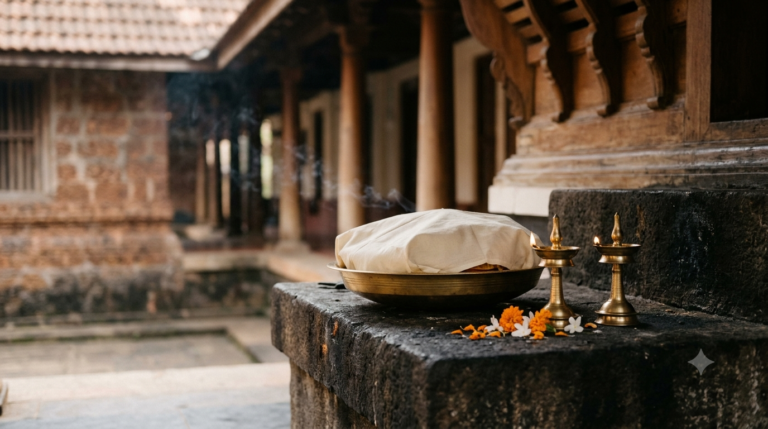
Kanchi Kamakshi Temple significance comes from four connected ideas. They include Kamakshi’s city-wide role as well as the Sri Chakra tradition, Shakti Peetha identity, and the temple’s layered history. Together, these themes explain why the shrine means far more than one stop on a Kanchipuram temple tour.
Sri Vyasa Pooja is an independent temple guide. It is not affiliated with Sri Kamakshi Ambal Devasthanam or Shri Kanchi Kamakoti Peetham. We do not accept bookings, donations, or payments, so use the official temple authorities for current services and announcements.
Kanchi Kamakshi Temple significance at a glance
The core Kanchi Kamakshi Temple significance is Kamakshi’s role as the spiritual centre of sacred Kanchipuram. The Devasthanam describes the city as one of the seven Mokshapuris, while its tradition places the shrine among 51 Shakti Peethas. The same temple tradition places the Goddess in Padmasana inside the Gayatri Mandapam and gives Sri Chakra worship a central place.
- Presiding deity: Goddess Kamakshi, seated in Padmasana inside the Gayatri Mandapam.
- Sacred status: the Devasthanam identifies Kanchipuram as a Mokshapuri and the shrine as a Shakti Peetha.
- City-wide role: Kanchi tradition treats Kamakshi as the shared Ambal, or Goddess, of the city’s major Shiva temples.
- Sri Chakra tradition: Shri Kanchi Kamakoti Peetham associates Adi Shankara with the consecration of the Sri Chakra before Kamakshi.
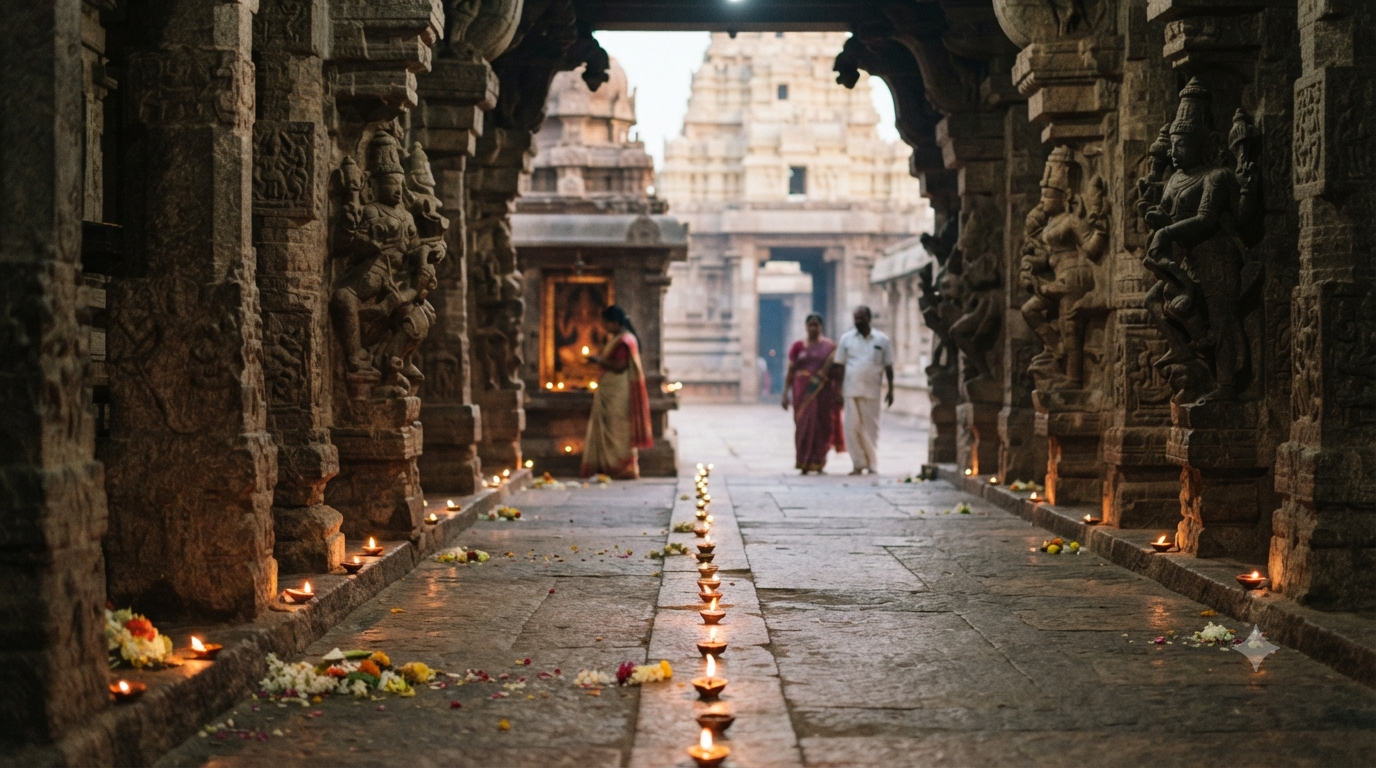
- Layered sacred space: the precinct includes Varahi, Arupa Lakshmi, Ganapati, Adi Shankara, and Kalvar Perumal among its important sannidhis.
Why Kanchi Kamakshi Temple significance is unusual in Kanchipuram
Kamakshi is not simply one Goddess among many in Kanchipuram. Temple tradition gives her a city-wide role because her meaning extends beyond the temple enclosure. This is why the shrine becomes a key to understanding the religious geography of Kanchi rather than an isolated place of worship.
The Devasthanam’s account of Kamakotipuri says major temple towers face Kamakshi, while festival processions use the Raja Veedhis around her temple. It also highlights the absence of separate Devi sanctums in Kanchi’s Shiva temples. That pattern is one of the strongest explanations for the Goddess’s central status.
Kamakshi as Kanchi’s shared Goddess
In Kanchi tradition, Kamakshi serves as the Ambal shrine for the city’s Shiva temples. Therefore, a pilgrim does not need to imagine each Shiva temple as having an entirely separate Goddess tradition. The sacred map instead points back to Kamakshi as the feminine centre of the city.
Kanchipuram as Mokshapuri and Shakti Peetha
The Devasthanam includes Kanchipuram among the seven sacred cities linked with moksha, or liberation. It also identifies the Kamakshi shrine as one of 51 Shakti Peethas. These are religious classifications followed within living Hindu traditions, so they should not be confused with archaeological labels.
Kanchi Kamakshi Temple significance and the Sri Chakra
The Sri Chakra also gives Kanchi Kamakshi a strong connection with Sri Vidya, a Shakta tradition centred on the Goddess as supreme reality. Shri Kanchi Kamakoti Peetham tradition says Adi Shankara consecrated the Sri Chakra before Kamakshi. The temple’s current puja page also records Kumkuma Archana at the Sri Chakram, so the symbol remains part of living worship.
For devotees, the Sri Chakra matters because it is not merely a decorative diagram. It is a sacred geometric form used in worship and contemplation. Its layers are traditionally read as a movement from the outer world toward the divine centre, linking ritual, mantra, geometry, and inward attention.
What the Sri Chakra means at Kamakshi Temple
Kamakshi appears in visible deity form while the Sri Chakra expresses the Goddess through sacred geometry. Together, they create two complementary modes of worship. One is personal and iconic, while the other gives devotees a structured symbolic path toward the same divine reality.
Adi Shankara: tradition and history should remain distinct
The Kanchi Kamakoti tradition strongly associates Adi Shankara with the Sri Chakra and with Kamakshi worship. The temple also contains a shrine for Adi Shankaracharya. However, this devotional lineage should not be used as a shortcut for dating every part of the present temple structure.
Kamakshi’s Padmasana form and sacred iconography
The official Devasthanam describes Goddess Kamakshi seated in Padmasana, a lotus-like posture. It also describes the sugarcane bow, pasha, ankusha, lotus, parrot, and crescent form on her forehead. These features distinguish her iconography and shape how devotees read the deity during darshan.
| Feature. | What devotees see. | Traditional reading. |
|---|---|---|
| Padmasana. | Seated lotus posture. | Composure, inward focus, and sovereign stillness. |
| Sugarcane bow. | Bow held by the Goddess. | The mind and the direction of desire. |
| Pasha. | Noose. | Attachment and the bonds of worldly life. |
| Ankusha. | Goad. | Guidance, restraint, and redirection. |
| Chandra Prabhai. | Crescent form on the forehead. | A distinctive mark in Kamakshi’s temple iconography. |
What does the name Kamakshi mean?
More than one devotional explanation of the name circulates, so no single reading should be treated as exclusive. One reading connects the name with compassion or love and the eye, stressing the grace of the Goddess’s gaze. A Kancheepuram district tourism page gives another popular explanation linking “Ka” with Saraswati, “Ma” with Lakshmi, and “Akshi” with eye.
These are devotional etymologies, not a single settled linguistic formula. Therefore, it is better to present them as traditional interpretations. What remains consistent is the importance of the Goddess’s gaze, knowledge, prosperity, compassion, and grace in popular worship.
Kanchi Kamakshi Temple significance as a Shakti Peetha
The Devasthanam explicitly places Kanchi Kamakshi within a 51-Shakti-Peetha tradition. That gives the shrine a sacred geography that also extends far beyond Tamil Nadu. Pilgrims come not only because Kamakshi is Kanchipuram’s presiding Goddess, but also because the temple belongs to a wider network of Shakta sacred places.
Online articles often create confusion by treating one numbered Shakti Peetha list as the only valid list. In practice, lists vary across texts and regional traditions. The safest evergreen wording is simple: the Sri Kamakshi Ambal Devasthanam identifies Kanchi as one of 51 Shakti Peethas in its tradition.
Why do “51” and “18” both appear online?
Different Shakta traditions preserve different groupings, while each list reflects its own textual or regional setting. Some sources speak of 51 Peethas, while South Indian devotional traditions also celebrate a smaller group of major or Maha Shakti Peethas. The numbers describe different traditional lists rather than a single universal ranking system.
Therefore, claims such as “Kanchi is exactly number two of exactly 18” need a named textual or regional tradition behind them. Without that context, the statement looks more precise than the evidence allows. The temple’s spiritual importance does not depend on forcing every tradition into one count.
Kanchi’s sacred geography: Kamakshi, Ekambareswarar and Kumarakottam
Kanchipuram’s temple map also adds another layer to the shrine’s meaning. Kanchi traditions connect Kamakshi with Ekambareswarar and Kumarakottam Murugan through a Somaskanda pattern: Shiva, Uma, and Skanda. This lets devotees read three major temples as a sacred family relationship across the city.
The Devasthanam’s Kamakotipuri account goes further by describing Kamakshi as the central nucleus of Shakti in Kanchi. It also notes that important festival processions move around the streets surrounding her temple.
Why Kanchi’s Shiva temples traditionally lack separate Ambal shrines
This is one of the most distinctive points about Kanchipuram. Temple tradition says Kamakshi fulfils the role of the common Goddess for the city’s Shiva shrines. Therefore, the absence of separate Ambal sanctums is not treated as an omission but as a sign of Kamakshi’s centrality.
For a visitor, this matters because it changes the way a multi-temple circuit feels. Ekambareswarar, Kamakshi, and other shrines stop looking like unrelated monuments. Instead, the city presents a network of sacred relationships built through theology, procession routes, and long devotional memory.
Why Kalvar Perumal matters inside Kamakshi Temple
The Devasthanam lists Kalvar Perumal, or Adivaraha, among the important sannidhis within the Gayatri Mandapam area and connects the shrine with the Divya Desam tradition. That Vaishnava presence inside a major Shakta temple is significant because Kanchipuram has long served Shaiva, Vaishnava, and Shakta communities.
Kanchi Kamakshi Temple significance in history
Kanchi Kamakshi Temple significance also depends on avoiding one misleading founding date. Even official and institutional pages simplify the chronology differently. The Kancheepuram district tourism page calls it a 12th-century temple, while the Devasthanam’s restoration material cites evidence for a much older sacred site and later additions across several dynasties.
The restoration account discusses evidence connected with Pallava remains, Chola inscriptions, Pandya work, and later Vijayanagara or Telugu-period contributions. It also reports inscriptions associated with several Chola rulers. Therefore, “ancient site with multiple building phases” is safer than saying one ruler built the entire visible temple at one moment.
Why a single-century origin story is too simple
A temple can preserve an early sacred tradition while its present walls, halls, towers, and inscriptions belong to several periods. That is common in long-lived South Indian temple complexes. Renovation and patronage do not erase earlier history; they create layers that scholars must separate carefully.
Kanchi Kamakshi Temple significance in living worship
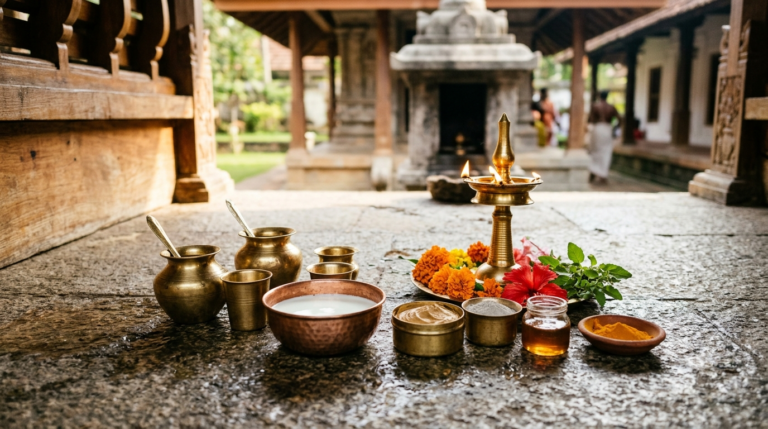
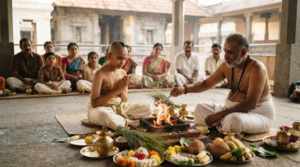
The temple’s meaning is not frozen in history, since its ritual life continues every day. Its official puja page records daily worship beginning with Goh Pooja and Viswarupa Darshanam, as well as three daily abhishekams. It also lists Sri Chakra Kumkuma Archana and Navavarna Pooja, showing that Sri Vidya-linked worship continues within the temple’s regular ritual life.
The official puja page also says Navavarna Pooja takes place on Pournami nights and that Sharada Navaratri and Vasantha Navaratri receive special observance. These practices help devotees experience the theology described earlier rather than merely reading about it.
Why an evergreen significance guide should not duplicate live timings
Timings, seva charges, festival access, and counter procedures can change, so they do not belong at the centre of an evergreen significance page. Keeping them in a separate operational guide also prevents this article from going stale. It also protects readers from treating an old fee or opening hour as permanent.
Before a visit, check our Kamakshi Temple darshan timings guide. If you plan a paid ritual, use the separate Kamakshi Temple seva guide and confirm the current process with the Devasthanam.
How to notice the temple’s significance during a visit
You do not need advanced knowledge of Sri Vidya, because the main ideas are visible in the temple’s form and ritual life. However, a few points can turn a quick darshan into a more meaningful visit. The aim is not to analyse every symbol, but to recognise how the temple’s theology, city role, and ritual life connect.
- Start with the Gayatri Mandapam. Remember that Kamakshi’s main sannidhi stands within the temple’s central ritual setting.
- Notice the Padmasana form. The seated posture is one of the clearest visual features of the Goddess here.
- Remember the Sri Chakra. Its continuing ritual use explains why Sri Vidya is central to the temple’s identity.
- Look beyond one sanctum. Varahi, Arupa Lakshmi, Ganapati, Adi Shankara, and Kalvar Perumal show the layered nature of the precinct.
- Place the shrine within Kanchi. Connect Kamakshi with Ekambareswarar, Kumarakottam, and the city’s wider sacred geography.
If you are building a broader Kanchipuram circuit, our Varadaraja Perumal Temple timings guide helps with the Vaishnava side of the city. Keep operational planning separate from the theological meaning discussed here.
Common misconceptions about Kanchi Kamakshi
Understanding Kanchi Kamakshi Temple significance also means separating legend, history, theology, and modern travel information. The result is often a page full of confident statements that cannot all be equally verified. A stronger reading instead separates devotional tradition from material history without dismissing either.
| Common claim. | Better interpretation. | Why it matters. |
|---|---|---|
| The whole temple was built in one century. | The site and complex have multiple historical layers. | Inscriptions and restoration evidence point to long development. |
| There is one universal Shakti Peetha count. | Lists vary by text and tradition. | The Devasthanam itself uses a 51-Peetha tradition. |
| Adi Shankara’s role is an archaeological fact. | It is a central and longstanding Kanchi Kamakoti tradition. | Tradition and material dating answer different questions. |
| Kamakshi is only one local Amman shrine. | She is treated as Kanchi’s central Goddess. | Her role extends across the city’s Shiva sacred geography. |
| The temple matters only for miracle beliefs. | Its importance includes theology, ritual, iconography, history, and urban sacred space. | This gives a fuller and more durable understanding of the shrine. |
Before you go
Kanchi Kamakshi Temple significance becomes clearest when the shrine is not reduced to one label. It is a Shakti Peetha in the Devasthanam’s tradition, a major Sri Vidya centre, Kanchi’s shared Goddess shrine, and a temple complex with many historical layers.
That combination is also what gives Kamakshi her enduring place in Kanchipuram. Read legends as living religious tradition and inscriptions as material history. When those categories remain clear, they deepen rather than contradict each other.
Frequently asked questions
What is the main Kanchi Kamakshi Temple significance?
The main Kanchi Kamakshi Temple significance is Kamakshi’s role as the central Goddess of sacred Kanchipuram. Her Shakti Peetha identity and Sri Chakra tradition deepen that role. Her importance therefore extends beyond one temple and shapes how devotees understand Kanchi’s wider network of Shiva, Shakti, and Vishnu shrines.
Is Kanchi Kamakshi Temple a Shakti Peetha?
Yes. Sri Kamakshi Ambal Devasthanam identifies Kanchipuram as one of 51 Shakti Peethas in its tradition. However, Shakti Peetha lists vary across texts and regions, so it is better to name the tradition than to claim one universal count.
What is the significance of the Sri Chakra at Kanchi Kamakshi Temple?
The Sri Chakra is central to the temple’s Sri Vidya identity and provides a sacred geometric focus for Goddess worship. Kanchi Kamakoti tradition associates its consecration with Adi Shankara. The temple’s current puja page also confirms continuing Kumkuma Archana at the Sri Chakram.
Did Adi Shankara install the Sri Chakra at Kanchi Kamakshi Temple?
According to Shri Kanchi Kamakoti Peetham tradition, yes. The Peetham consistently associates Adi Shankara with the Sri Chakra at Kamakshi, and the temple contains a shrine for him. This is best presented as a longstanding religious tradition rather than as a modern archaeological conclusion.
Why is Goddess Kamakshi seated in Padmasana?
The Devasthanam describes Kamakshi in a lotus-like Padmasana posture. Devotional interpretation connects that seated form with centred power, meditative stillness, and composure. It also fits the temple’s strong Sri Vidya and Sri Chakra context.
Why do Kanchipuram Shiva temples traditionally lack separate Ambal shrines?
Kanchi temple tradition treats Kamakshi as the common Ambal, or Goddess, for the city’s Shiva temples. The Devasthanam’s Kamakotipuri account highlights this unusual arrangement. It is one of the clearest reasons Kamakshi holds a city-wide role.
What is the relationship between Kamakshi and Ekambareswarar?
Kanchi sacred geography links Kamakshi with Ekambareswarar, while Kumarakottam Murugan forms another part of the same devotional landscape. Traditional readings use a Somaskanda relationship to connect Shiva, Uma, and Skanda across the city.
Is there a Divya Desam inside Kanchi Kamakshi Temple?
The Devasthanam identifies Kalvar Perumal, or Adivaraha, within the temple precinct with the Divya Desam tradition. Its presence matters because it shows a Vaishnava layer inside a shrine whose primary identity is strongly Shakta.
How old is Kanchi Kamakshi Temple?
There is no single date that explains the whole present complex. Official sources themselves simplify the chronology differently, while restoration material points to an ancient sacred site with Pallava traces, Chola inscriptions, and later contributions. “Multiple historical phases” is therefore safer than assigning the entire temple to one century.