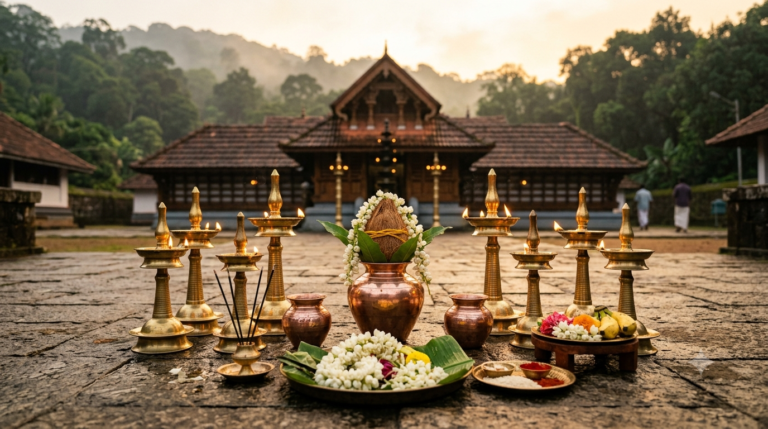
The Sri Satyanarayana Vratam dates for 2026 fall on the twelve Pournami (full moon) days of the year, plus one rare extra full moon in the Adhika month. That makes thirteen Pournami days in all. Most aggregator calendars still copy only twelve, so many devotees miss the extra Jyeshtha Purnima on 31 May 2026. Below you get the full verified calendar, the reason the puja day sometimes moves by a day, and a clear plan for the vratam at home or at Annavaram.
Sri Vyasa Pooja is an independent devotional guide. We are not affiliated with the Annavaram Devasthanam or any temple trust, and we do not take bookings, poojas, or payments. For temple tickets and sevas, always use the official temple portal linked below.
Sri Satyanarayana Vratam 2026 at a Glance
Here are the essentials before the full calendar. Keep these handy while you plan the day.
- 13 Pournami days in 2026 — one more than usual, because 2026 is an Adhika Maas (leap-month) year.
- Extra full moon: Adhika Jyeshtha Purnima on 31 May 2026, a highly auspicious day for Vishnu worship.
- Duration: the puja usually runs about 1.5 to 2 hours, from setup to aarti.
- Who can do it: anyone may perform the vratam. It is not restricted to married couples.
- Best time of day: evening suits most families, since they break the fast with prasadam after moonrise.
- Where: at home, or at a temple such as Annavaram, where priests perform it daily.
Sri Satyanarayana Vratam Dates in 2026 (Full Pournami Calendar)
The Sri Satyanarayana Vratam dates below are the full-moon (Pournami) days for 2026 in Indian Standard Time. Devotees choose these days because the full moon carries the most merit for worshipping Lord Satyanarayana. Verify the exact tithi window for your own city before you begin.
| Date | Day | Pournami (Masam) |
|---|---|---|
| 3 January 2026 | Saturday | Pausha Purnima |
| 1 February 2026 | Sunday | Magha Purnima |
| 3 March 2026 | Tuesday | Phalguna Purnima |
| 2 April 2026 | Thursday | Chaitra Purnima |
| 1 May 2026 | Friday | Vaishakha Purnima |
| 31 May 2026 | Sunday | Adhika Jyeshtha Purnima (extra) |
| 29 June 2026 | Monday | Jyeshtha Purnima |
| 29 July 2026 | Wednesday | Ashadha Purnima (Guru Purnima) |
| 28 August 2026 | Friday | Shravana Purnima |
| 26 September 2026 | Saturday | Bhadrapada Purnima |
| 26 October 2026 | Monday | Ashwina (Sharad) Purnima |
| 24 November 2026 | Tuesday | Kartika Purnima |
| 23 December 2026 | Wednesday | Margashirsha Purnima |
To put the key facts plainly: the first full moon of 2026 arrives on 3 January, and the last on 23 December. Many people miss the extra Adhika Purnima on 31 May, since it only appears in a leap-month year.
Why 2026 Has Thirteen Sri Satyanarayana Vratam Dates
A normal Hindu year runs twelve lunar months and twelve full moons. Roughly once every three years, though, the calendar inserts an extra month called Adhika Maas. Some also call it Mala Masa or Purushottama Maas. Because 2026 is such a year, it carries thirteen Pournami days instead of twelve.
That extra full moon, Adhika Jyeshtha Purnima, lands on 31 May 2026. Tradition treats the Adhika month as especially dear to Lord Vishnu. So a vratam performed then earns great merit.
Many aggregator sites simply copy last year’s twelve-date list forward, and that is exactly how the 31 May date drops off their Sri Satyanarayana Vratam dates. We have kept it in.
Why the Sri Satyanarayana Vratam Dates Can Shift by a Day
Here is a nuance most date lists skip. The Sri Satyanarayana Vratam dates depend on the Purnima tithi, and a tithi does not line up neatly with a calendar day. It starts and ends at a precise moment, which changes with your location.
So the puja day can land on the marked full-moon date, or one day earlier on Chaturdashi. It depends on when the tithi begins, and on whether you worship in the morning or the evening.
Drik Panchang lists Satyanarayana Puja dates for evening worship, since most families break the fast with prasadam in the evening. If you plan a morning puja instead, confirm that the Purnima tithi still runs at that hour. When in doubt, check the panchang for your own town rather than trusting a flat printed list.
What Is the Sri Satyanarayana Vratam?
The Sri Satyanarayana Vratam honours Lord Satyanarayana, a benevolent form of Lord Vishnu. His name means “the Lord who embodies truth.” Devotees perform it to give thanks and to seek prosperity, health, peace, and the fulfilment of sincere wishes. It ranks among the most widely observed household vratams across South and East India.
The vratam suits almost every happy occasion. Families often perform it after a wedding, after an upanayanam, at a griha pravesham, or when opening a new shop. Many also observe it simply for the wellbeing of the home. Because the ritual is gentle and needs no special initiation, it fits both first-timers and lifelong devotees.
Who Can Perform the Vratam?
Anyone may perform the Sri Satyanarayana Vratam. You do not have to be married, and you need no particular caste or qualification. A couple often sits together as the main hosts.
Yet a single devotee, a widow, or a whole family can observe it with equal right. Even listening to the katha with devotion carries the blessing when you cannot host the full puja yourself.
When Should You Perform the Vratam?
Full-moon days are the classic choice, but they are not the only ones. Ekadashi, Kartika Masam, Sravana Masam, and Sankranti all suit the vratam well. So does any day of personal meaning, such as a birthday or the anniversary of a vow. In truth, no day is forbidden for this puja, which is part of why so many families love it.
Even so, the Sri Satyanarayana Vratam dates above remain the most auspicious and the most commonly chosen. If you want the merit of a full-moon observance, pick the nearest Purnima from the table and plan around it.
How the Sri Satyanarayana Vratam Dates Are Fixed Each Month
Panchang makers set each month’s date by the Purnima tithi of that lunar month, not by the Gregorian calendar. They calculate the exact moment the full moon peaks. Then they mark the day on which that tithi stays active during worship hours.
Since the lunar month spans about 29.5 days, the dates drift earlier through the solar year. That is why the Sri Satyanarayana Vratam dates never repeat on the same calendar date.
This is also why you should not carry a previous year’s list into a new one. A single Adhika month, like the one in 2026, pushes every later date by roughly a lunar cycle. Always use a calendar computed for the specific year you are planning.
Sri Satyanarayana Puja Vidhi in Brief
The vratam follows a clear sequence. You can complete it at home with a priest, or on your own with a katha book. Here is the shape of the ritual, so you know what to expect.
- Bathe early, wear clean traditional clothes, and tidy the pooja space.
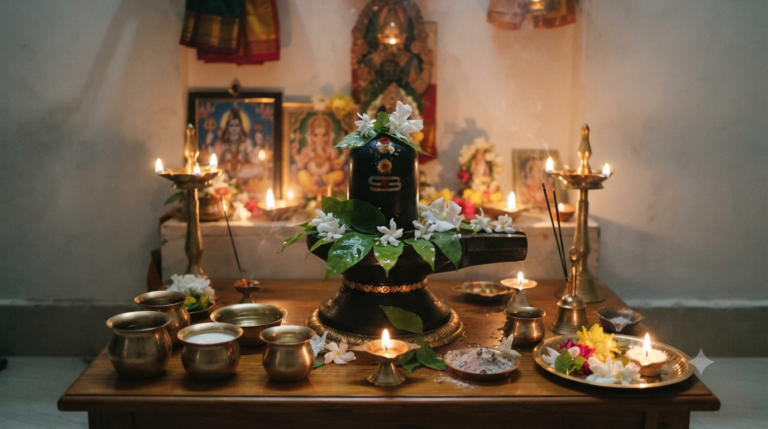
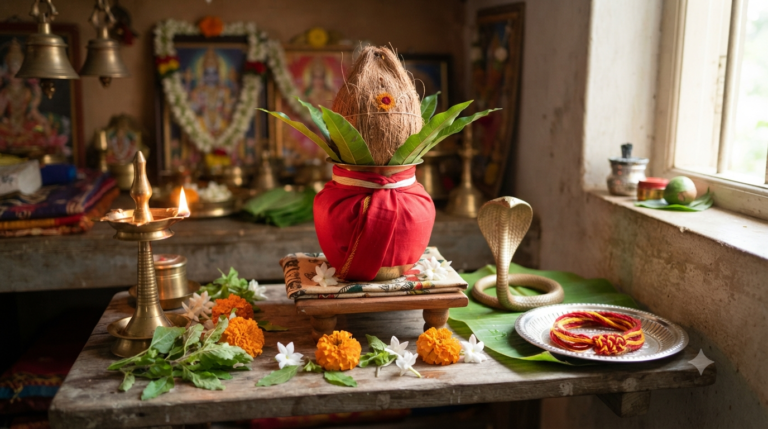
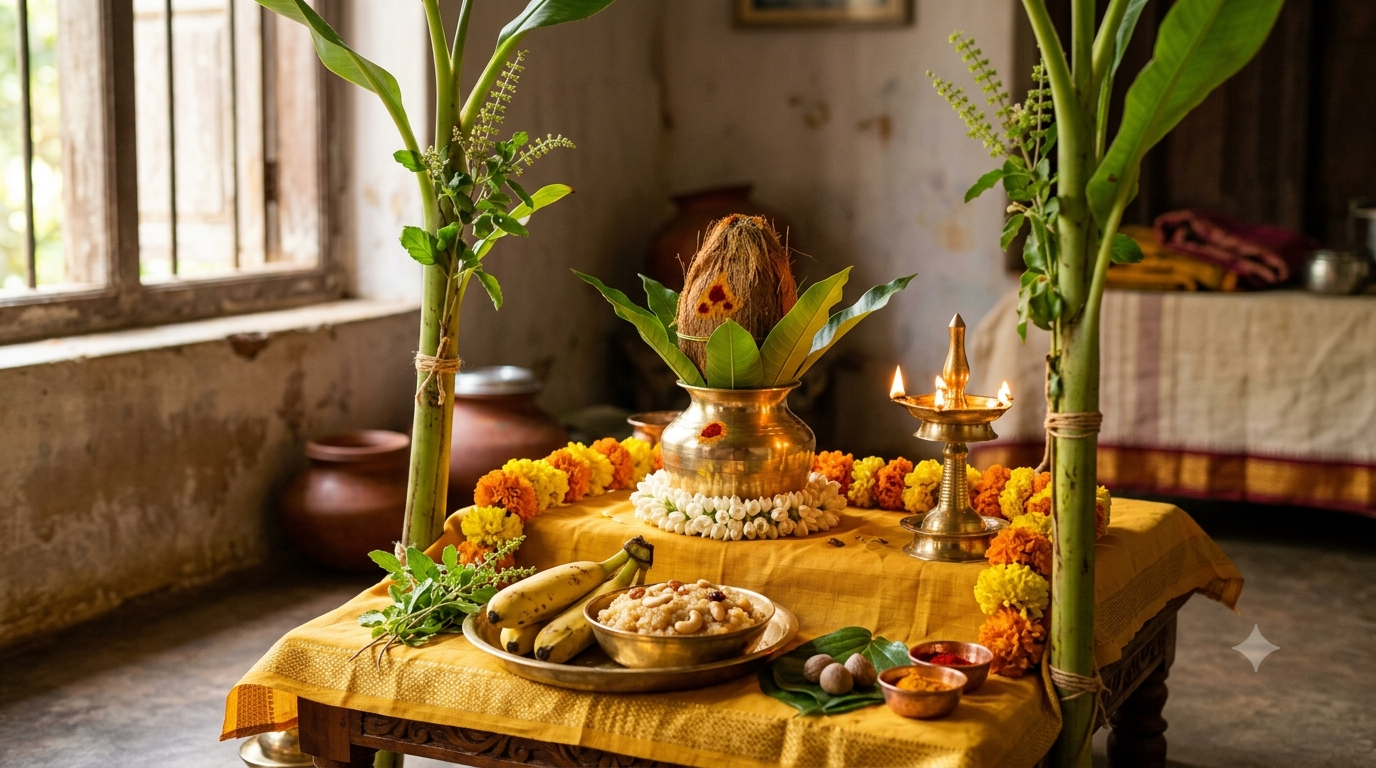
- Set a low platform with a fresh cloth, rice, and a kalasham. Place a picture or idol of Lord Satyanarayana, framed by banana stems and leaves.
- Begin with Ganesha puja. Then worship the Navagraha and the kalasham.
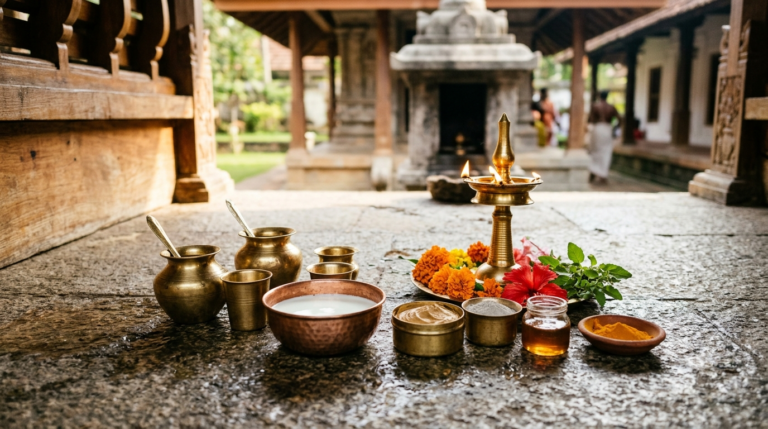
- Invoke Lord Satyanarayana, and offer the abhishekam with panchamritam — milk, curd, ghee, honey, and sugar.
- Recite the Satyanarayana Ashtottara, the 108 names, and offer flowers, fruit, and tulsi.
- Read or listen to the five chapters of the Satyanarayana Vrata Katha.
- Perform the aarti, offer the sapaad-bhakshyam prasadam, and give dakshina to the priest.
For the full samagri list and the step-by-step method, see our detailed guide to the Sri Satya Narayana Vratam pooja list and procedure. A Telugu katha and pooja vidhanam PDF also helps if you prefer to read along in Telugu.
The Satyanarayana Vrata Katha
The katha sits at the heart of the vratam, and listening to it matters as much as the offerings. The story comes from the Reva Khanda of the Skanda Purana. There, Suta Maharshi first narrates it to the sages. It unfolds in five short chapters that show, through simple characters, how honouring the vow brings grace and how forgetting it invites trouble.
One chapter follows a poor woodcutter who performs the vratam after merely witnessing it, and then prospers. Another warns of a merchant who prospers, slights the puja, and suffers until he restores his devotion. The moral thread stays steady: keep your word, stay grateful, and finish what you vow.
Sri Satyanarayana Vratam Prasadam and Offerings
The signature prasadam is a sweet of rava (semolina) or wheat flour, banana, milk, sugar or jaggery, and ghee. Many call it sapaad-bhakshyam or sheera. You also add bananas and tulsi leaves as offerings, and everyone shares panchamritam after the aarti. Devotees distribute the prasadam to family and guests, since sharing it forms part of the vratam’s merit.
Performing the Vratam at Annavaram Temple
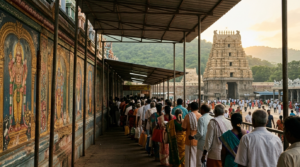
If you prefer a temple setting, the most famous venue is the Sri Veera Venkata Satyanarayana Swamy Temple at Annavaram, on Ratnagiri hill in Andhra Pradesh. Priests conduct vrathams there almost every day, roughly from early morning to evening. Large halls seat many families at once. You buy a vratham ticket at the temple, collect the provided samagri, and a priest guides the ritual.
The temple alone handles booking and fees. To confirm current ticket tiers, timings, and any online option, use the official Annavaram Devasthanam website. Read our practical walkthrough of Annavaram Satyanarayana Swamy vratham booking before you travel.
Beware of lookalike “booking” sites that charge inflated fees. A genuine temple portal sits on the official government domain and never asks for odd advance payments to a private account.
Satyanarayana Vratam Fasting and Health Tips
Most devotees keep a fast on the puja day and break it with prasadam after the aarti. Usually the fast stays light — fruit, milk, and simple sattvic food — rather than total abstention. If you are elderly, pregnant, diabetic, or unwell, keep a partial fast and eat as your body needs. Faith does not ask you to risk your health, so consult your doctor before any strict fast.
Common Sri Satyanarayana Vratam Mistakes
A few avoidable errors trip up first-timers. Clearing them up saves a lot of worry.
- Assuming only married couples may do it. Not so — any devotee can perform the vratam.
- Copying an old date list. Because of the 2026 Adhika month, last year’s dates are wrong this year.
- Treating the printed date as universal. The puja day can shift by one day by city and by morning-versus-evening worship, so check your local panchang.
- Trusting unofficial temple “booking” portals. Confirm every temple ticket only on the official devasthanam site.
Before You Begin
Pick your Purnima from the 2026 table, and confirm the tithi timing for your city. Decide whether you will host at home or at a temple. Keep the katha central, share the prasadam freely, and treat the fast sensibly. Done with sincerity, the Sri Satyanarayana Vratam ranks among the simplest and most rewarding household observances in the Hindu year.
Frequently Asked Questions
What are the Sri Satyanarayana Vratam dates for 2026?
The Sri Satyanarayana Vratam dates for 2026 are the thirteen Pournami days: 3 Jan, 1 Feb, 3 Mar, 2 Apr, 1 May, 31 May (Adhika), 29 Jun, 29 Jul, 28 Aug, 26 Sep, 26 Oct, 24 Nov, and 23 Dec. Confirm the tithi window for your city before you begin.
Why does 2026 have an extra Satyanarayana Vratam date?
2026 is an Adhika Maas (leap-month) year, so it has thirteen full moons instead of twelve. The extra one, Adhika Jyeshtha Purnima on 31 May 2026, counts as especially auspicious for worshipping Lord Vishnu.
Can I perform the Satyanarayana Vratam on a day other than Purnima?
Yes. Full-moon days are the most auspicious, but you can perform the vratam on Ekadashi, Sankranti, during Kartika or Sravana Masam, or on any personally significant day. No day is forbidden for it.
Do I need to be married to perform the vratam?
No. Anyone can perform the Sri Satyanarayana Vratam, married or not. A single devotee, a widow, or a whole family may host it, and even attentively listening to the katha brings the blessing.
How long does the puja take?
The full vratam usually takes about 1.5 to 2 hours. That covers the setup, the puja, the five-chapter katha, the aarti, and the prasadam. Temple vrathams at places like Annavaram often finish in roughly an hour, because the halls run continuously.
Where can I perform the vratam at a temple?
The best-known temple is the Sri Veera Venkata Satyanarayana Swamy Temple at Annavaram in Andhra Pradesh, where priests conduct vrathams daily. Buy the ticket at the temple, and confirm current fees and timings on the official Annavaram Devasthanam website.
What prasadam is offered during the vratam?
The main prasadam is a sweet of rava or wheat flour, banana, milk, ghee, and sugar or jaggery, along with panchamritam. Devotees also offer bananas and tulsi, and then share the prasadam with everyone present.
Which is the best time of day for the puja?
Evening generally suits best, because devotees break the fast with prasadam after moonrise. Morning worship also works, as long as the Purnima tithi still runs during the puja hours.