Vat Savitri Vrat 2026 falls on Saturday, May 16. Discover the exact Amavasya tithi, puja muhurat, vidhi, regional differences and the Shani Jayanti link.
Vat Savitri Vrat 2026 falls on Saturday, May 16, with the Jyeshtha Amavasya tithi running from 5:11 AM on May 16 to 1:30 AM on May 17 (IST). Married women across Uttar Pradesh, Bihar, Jharkhand, Odisha, Delhi and Madhya Pradesh will fast under the banyan tree this day, praying for the longevity and protection of their husbands. What makes this year truly unusual is the rare alignment of three sacred occasions on a single day — and Maharashtra observes it 44 days later because of the Adhik Maas.
Vat Savitri Vrat 2026: Quick Summary
Before we dig into the details, here are the essentials every devotee needs at a glance.
- Amavasya Date (North India): Saturday, May 16, 2026
- Amavasya Tithi Begins: 5:11 AM on May 16, 2026
- Amavasya Tithi Ends: 1:30 AM on May 17, 2026
- Vat Purnima Date (Maharashtra/Gujarat): Monday, June 29, 2026
- Best Puja Time: Pratahkal — morning after sunrise until 11 AM
- Coinciding Festivals: Shani Jayanti, Shani Amavasya
- Type of Day: Triple-auspicious — extremely rare alignment
When Is Vat Savitri Vrat 2026?
The Vat Savitri Vrat 2026 falls on Saturday, May 16, on Jyeshtha Krishna Amavasya. However, this single date hides a layered story rooted in two parallel calendar systems used across India. Notably, the same vrat is observed on two different days depending on which region you belong to.
The Amavasya Date — Followed in North India
States that follow the Purnimanta calendar observe the vrat on Jyeshtha Amavasya. Therefore, women in Uttar Pradesh, Bihar, Jharkhand, Madhya Pradesh, Punjab, Haryana, Delhi and Odisha will fast on May 16, 2026. In Odisha, the same observance is locally called Sabitri Brata.
The Purnima Date — Followed in Western India
Maharashtra, Gujarat and parts of southern India follow the Amanta calendar. Consequently, married women in these regions observe Vat Purnima Vrat on Jyeshtha Purnima, which falls on Monday, June 29, 2026. The Purnima tithi begins at 3:06 AM on June 29 and ends at 5:26 PM on June 30.
Why Two Different Dates?
The legend, the rituals and the spiritual purpose are identical in both traditions. Moreover, scriptures themselves differ — the Skanda Purana names Jyeshtha Purnima as the correct tithi, while the Nirnayamrit cites Jyeshtha Amavasya. The Narad Purana resolves the debate by allowing both. As a result, regional traditions diverged centuries ago and have stayed that way.
Exact Tithi Timings for Vat Savitri Vrat 2026
For ritual accuracy, the exact tithi window matters far more than the calendar date. Below are the precise timings as per Drik Panchang for New Delhi (IST). Devotees in other cities should adjust by a few minutes based on local sunrise.
| Event | Date | Time (IST) |
|---|---|---|
| Amavasya Tithi Begins | May 16, 2026 (Saturday) | 5:11 AM |
| Amavasya Tithi Ends | May 17, 2026 (Sunday) | 1:30 AM |
| Sunrise on Vrat Day | May 16, 2026 | ~5:30 AM |
| Best Puja Window | May 16, 2026 | 5:30 AM – 11:00 AM |
| Total Tithi Duration | — | 20 hours 19 minutes |
The Most Auspicious Puja Muhurat
Pratahkal — the early morning hours after sunrise — is considered the most powerful window for Vat Savitri puja. Specifically, the period between 5:30 AM and 11:00 AM on May 16 carries the strongest spiritual potency. Many priests also recommend the Abhijit Muhurat around 11:50 AM to 12:45 PM if morning rituals run late.
Why Vat Savitri Vrat 2026 Is Especially Rare
This year’s observance is not an ordinary one. In fact, three powerful spiritual events fall on the very same day — a combination that occurs only once in several decades.
The Triple Alignment
On May 16, 2026, three sacred days converge: Vat Savitri Vrat, Shani Jayanti, and Shani Amavasya. Furthermore, the Saturday occurrence (Shanivar) intensifies the Saturn connection, since Saturn rules Saturdays in Vedic astrology. Devotees believe rituals performed on this day yield multiplied benefits.
What Makes Shani Amavasya Special
Shani Amavasya occurs whenever Amavasya tithi falls on a Saturday. Additionally, Shani Jayanti — the birth anniversary of Lord Shani — also falls on this date. As a result, devotees observing Vat Savitri Vrat can simultaneously seek relief from Saturn’s malefic effects, ancestral blessings through tarpan, and spousal longevity in one unified observance.
Adhik Jyeshtha Maas in 2026
An additional layer makes 2026 particularly significant. The Hindu calendar introduces an Adhik Maas (extra month) in Jyeshtha this year, stretching the month to 60 days instead of the usual 30. Therefore, Jyeshtha begins earlier and includes both a regular Jyeshtha Amavasya on May 16 and an Adhik Jyeshtha Amavasya on June 14, 2026.
The Story Behind Vat Savitri Vrat
The vrat draws its power from one of the most stirring legends in the Mahabharata. Savitri, the radiant daughter of King Ashwapati of Madra, chose Satyavan as her husband — fully aware of sage Narada’s prophecy that he would die within a year of marriage.
Savitri’s Defiance of Death
On the predicted day, Satyavan collapsed under a banyan tree while cutting wood. Then Yama, the Lord of Death, arrived to claim his soul. Savitri followed Yama with such steadfast devotion that he offered her three boons — but forbade asking for Satyavan’s life directly.
The Boons That Won Her Husband Back
Savitri asked for sight for her blind father-in-law, the restoration of his lost kingdom, and a hundred sons born to her. Yama, bound by his word, had no choice but to release Satyavan — for Savitri could not bear sons without a living husband. Hence, the banyan tree under which Satyavan died became sacred forever, and married women have honored that day ever since.
Vat Savitri Vrat Puja Vidhi: Step-by-Step
The complete ritual sequence has been preserved unchanged for centuries. Below is a clear, ordered breakdown for women observing Vat Savitri Vrat 2026.
- Pre-Dawn Bath: Wake before sunrise and bathe with water mixed with sesame seeds (til) and amla. Wear new or clean clothes — preferably red, yellow or green.
- Solah Shringar: Apply sindoor, wear bangles, mehendi, mangalsutra, bindi and complete the sixteen traditional adornments of a married woman.
- Prepare the Puja Thali: Arrange a yellow or red sacred thread (kalava), kumkum, haldi, akshat, flowers, fruits, sweets, water, milk, gangajal, and a small idol or photo of Savitri-Satyavan.
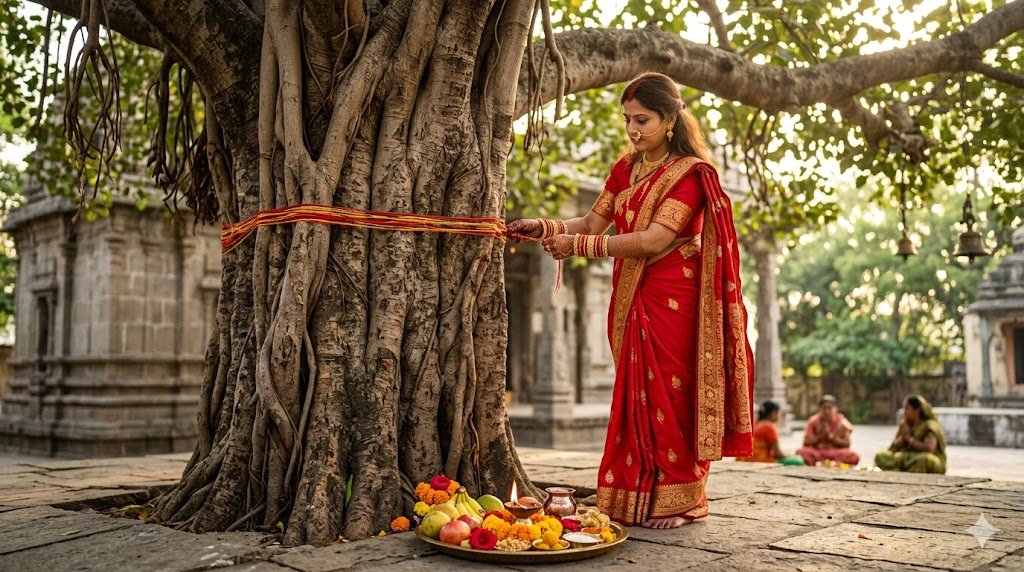
- Visit the Banyan Tree: Reach a banyan (Vat Vriksha) tree before mid-morning. If unavailable, place a banyan branch in a clay pot at home, or draw the tree on a wooden plank with turmeric paste.
- Sprinkle Water at Roots: Offer water at the base of the tree, then apply kumkum and haldi to the trunk.
- Tie the Sacred Thread: Wrap the kalava (red/yellow thread) around the trunk while circumambulating the tree. Most traditions prescribe 7, 21 or 108 parikrama.
- Offer Bhog: Place fruits, sweets (especially gud-channa), bhigi-chana (soaked black gram) and seasonal flowers near the tree.
- Read the Vrat Katha: Recite the Savitri-Satyavan story aloud or listen to it with full attention.
- Final Prayer: Pray for your husband’s longevity, family well-being and a harmonious married life.
- Break the Fast: Most women break the fast after sighting the moon or by completing all rituals before sundown. Consume the bhog as prasad.
Fasting Rules: What You Can and Cannot Do
The fast carries specific guidelines that vary slightly by region and personal capacity. Generally, devotees follow one of three formats based on health and tradition.
Three Types of Fast
- Nirjala Vrat: The strictest form — no food or water for the full day. Mostly observed by experienced devotees in good health.
- Phalahar Vrat: Only fruits, milk, and water are permitted. Most common format among working women and first-time observers.
- Three-Day Vrat: Begins on Trayodashi and continues through Chaturdashi and Amavasya. Reserved for those with deep traditional commitment.
What to Avoid on Vrat Day
Certain restrictions apply across all three formats. Specifically, avoid grains (rice, wheat, dal), salt, onion, garlic, alcohol and non-vegetarian food. Likewise, refrain from cutting hair or nails, harsh speech, and major arguments. Pregnant women, nursing mothers and those with diabetes should consult an elder or family priest before attempting Nirjala Vrat.
Regional Differences in Vat Savitri Vrat 2026
While the heart of the vrat remains identical, regional practices add fascinating local color. The table below maps how different states observe the day.
| State / Region | Date in 2026 | Local Name |
|---|---|---|
| Uttar Pradesh, Bihar, Jharkhand | May 16, 2026 | Vat Savitri / Bar Puja |
| Delhi, Punjab, Haryana | May 16, 2026 | Vat Savitri Vrat |
| Madhya Pradesh, Rajasthan | May 16, 2026 | Vat Savitri Amavasya |
| Odisha | May 16, 2026 | Sabitri Brata |
| Maharashtra, Goa | June 29, 2026 | Vat Purnima |
| Gujarat | June 29, 2026 | Vad Savitri |
| Tamil Nadu, Karnataka | March 14, 2026 (Karadaiyan Nombu) | Karadaiyan Nonbu |
Bihar and Jharkhand: Bar Puja
In Bihar and Jharkhand, the vrat is locally called Bar Puja or Bargad Puja. Women gather in groups around large banyan trees in villages and towns. Subsequently, they share bhog and exchange the sacred kalava as a sisterhood gesture.
Maharashtra: Vat Purnima
Maharashtrian women perform Vat Purnima with elaborate solah shringar and exchange the haldi-kumkum greeting. Furthermore, the celebration includes traditional songs (ovi) sung in praise of Savitri, often passed down across generations within families.
Odisha: Sabitri Brata
Odia women prepare a special bhog of khai (puffed rice), sugarcane, and seasonal mangoes. Additionally, the puja includes offering pidha (sweet rice cake) to the banyan tree, with the entire family gathering for the evening prasad.
What to Offer on Vat Savitri Vrat
The puja samagri (offering items) carries deep symbolic meaning. Each item links to a specific aspect of marital well-being.
- Red/yellow kalava thread: Symbolizes the unbreakable bond of marriage
- Sindoor and bangles: Represent saubhagya (good fortune as a married woman)
- Bhigi chana (soaked black gram): Offered for prosperity and ancestral blessings
- Seasonal mangoes: Symbol of fertility and abundance
- Banana, jamun, lychee: Seasonal fruits offered as bhog
- Sweet pakwan (gud, batasha): For sweetness in married life
- Hand fan made of bamboo: Gifted to elders as a mark of respect
Common Mistakes to Avoid
Many first-time observers stumble on small but important details. Below are mistakes seasoned women warn against — drawn from common questions asked every year.
- Wearing dark or black clothes: Considered inauspicious for married women on this day. Choose red, yellow, green or pink instead.
- Skipping the parikrama count: The number of circumambulations matters — most traditions prescribe a multiple of 7.
- Performing puja after midday: Pratahkal is strongly preferred. Doing puja after 12 PM is acceptable but considered less potent.
- Eating salt during fast: Even Phalahar Vrat strictly excludes regular salt. Sendha namak (rock salt) is permissible only in some traditions.
- Forgetting the Vrat Katha: The fast remains incomplete without listening to or reciting the Savitri-Satyavan story.
Vat Savitri Vrat 2026 vs Past Years
Comparing this year to recent observances reveals why 2026 stands out. The table below tracks the date pattern across recent years.
| Year | Vat Savitri Date | Day | Special Alignment |
|---|---|---|---|
| 2024 | June 6 | Thursday | Standard observance |
| 2025 | May 26 | Monday | Standard observance |
| 2026 | May 16 | Saturday | Shani Jayanti + Shani Amavasya |
| 2027 | June 4 | Friday | Standard observance |
Forecast: How 2026’s Triple Alignment Affects Worship
The convergence of Vat Savitri, Shani Jayanti and Shani Amavasya on a Saturday is statistically rare — astrologers estimate it occurs roughly once every 20-30 years. Consequently, temple footfall in 2026 is expected to be 30-40% higher than in standard years, particularly at Shani Shingnapur in Maharashtra and major banyan-tree pilgrimage sites in Bihar.
Furthermore, devotees seeking relief from Sade Sati or Shani Dasha will find this day uniquely powerful. Many priests recommend combining the standard Vat Savitri puja with a brief Shani Tarpan ritual — offering mustard oil, black sesame and til at a Peepal tree in the evening hours.
Final Thoughts
Vat Savitri Vrat 2026 is not just another date on the calendar — it is a once-in-a-generation alignment of three powerful sacred days. Mark Saturday, May 16 if you live in North or East India, and June 29 if you observe Vat Purnima in Maharashtra or Gujarat. Plan your puja for the morning hours, gather your samagri the evening before, and remember that devotion matters more than perfection. The story of Savitri reminds us that love, when paired with conviction, can rewrite even the script of fate.
Frequently Asked Questions
What is the exact date of Vat Savitri Vrat 2026?
Vat Savitri Vrat 2026 falls on Saturday, May 16, 2026, in North Indian states. The Amavasya tithi begins at 5:11 AM on May 16 and ends at 1:30 AM on May 17. Maharashtra and Gujarat observe Vat Purnima 44 days later on June 29, 2026.
What is the best time to perform Vat Savitri puja?
The Pratahkal period — between sunrise (around 5:30 AM) and 11:00 AM — is considered the most auspicious window. If morning rituals are missed, Abhijit Muhurat from approximately 11:50 AM to 12:45 PM serves as a backup. Avoid performing puja after sunset.
Why is Vat Savitri Vrat 2026 considered special?
The 2026 observance coincides with Shani Jayanti, Shani Amavasya, and falls on a Saturday — a triple alignment that occurs once in 20-30 years. As a result, the spiritual potency of all rituals performed on this day is believed to be greatly amplified.
Can unmarried women observe Vat Savitri Vrat?
Yes, unmarried girls can observe the vrat to pray for a desired life partner and a harmonious future marriage. However, the rituals focus on praying to Goddess Savitri rather than performing the full banyan-tree parikrama traditionally meant for married women.
What if there is no banyan tree near my home?
Place a small banyan branch in a clay pot at home or draw the tree on a wooden plank using turmeric or sandalwood paste. The puja can then be performed exactly as it would be at an actual tree, with full devotion intact. Spiritual intent is what completes the ritual.
Is Nirjala fasting mandatory for Vat Savitri Vrat?
Nirjala Vrat (no food or water) is the strictest form but not mandatory. Phalahar Vrat — fruits, milk and water only — is widely accepted and recommended for first-time observers, working women, and those with health conditions like diabetes or hypertension.
How is Vat Savitri different from Vat Purnima?
Both observances honor the same Savitri-Satyavan legend with identical rituals. The only difference is the tithi — Vat Savitri falls on Jyeshtha Amavasya (new moon), while Vat Purnima falls on Jyeshtha Purnima (full moon), exactly 15 days apart due to regional calendar systems.
You May Also Like
- Shani Jayanti 2026: Date, Significance and Powerful Remedies for Saturn
- Jyeshtha Amavasya 2026: Pitru Tarpan Vidhi and Shani Amavasya Rituals
- Karadaiyan Nombu 2026: The Tamil Version of Vat Savitri Vrat
- Top 10 Most Sacred Banyan Trees in India for Vat Savitri Puja