Seeing Hanuman Jayanthi celebrated twice in one year confuses almost every devotee who compares two panchangams. One calendar marks a full-moon morning in April. Another points to a Tuesday in late May, or a new-moon night in December. Neither printer made a mistake.
The real answer is simpler than the internet suggests, and also bigger. India does not keep two Hanuman birthdays. It keeps as many as five, because different regions inherited different scriptural readings of when Anjaneya was born. This guide sorts them out region by region, with every date checked against panchangam sources instead of copied from older posts.
Sri Vyasa Pooja is an independent devotional guide. We are not affiliated with, endorsed by, or the official website of any temple, mutt, or endowments department, and we do not accept bookings, sevas, donations, or payments. Use the official temple or endowments portal for any reservation or official announcement.
Hanuman Jayanthi at a Glance
- North India, Maharashtra and much of the Deccan observe Chaitra Purnima, the spring full moon.
- Andhra Pradesh and Telangana close a 41-day deeksha on Vaishakha Krishna Dashami, about six weeks later.
- Karnataka keeps Hanuman Vratam on Margashirsha Shukla Trayodashi in December.
- Tamil Nadu and Kerala observe Hanumath Jayanthi on the Margazhi new moon, in December or January.
- Gujarat and Ayodhya’s Hanumangarhi hold a separate Hanuman Puja on the night before Diwali.
- Odisha folds the day into Pana Sankranti, its solar new year in mid-April.
Those six lines already show why devotees find Hanuman Jayanthi celebrated twice, or even more often, inside one calendar year.
Why Is Hanuman Jayanthi Celebrated Twice a Year?
Hanuman Jayanthi is celebrated twice because Hindu tradition preserves two separate accounts of Anjaneya’s birth tithi. One stream places that birth on Chaitra Purnima, the spring full moon. Another places it on Vaishakha Krishna Dashami, six weeks afterwards. Regional panchangams then layer their own local reckonings on top of both.
So the duplication is not a calendar error that crept in over time. Instead, two scriptural traditions have run side by side for centuries, since both carry long temple practice behind them. Neither one cancels the other out. Seeing Hanuman Jayanthi celebrated twice is therefore evidence of two living traditions.
Chaitra Purnima: birth day, or victory day?
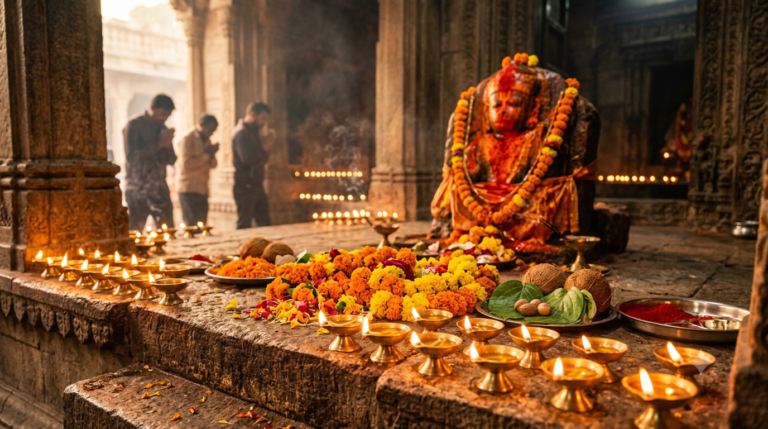
The Chaitra full moon is the date most Indians recognise. Temples across Delhi, Uttar Pradesh, Rajasthan, Bihar and Maharashtra fill before sunrise, while the Hanuman Chalisa runs from dawn until well after dark. Devotees here treat the day plainly as Hanuman Janmotsava.
A second reading exists, though. Several Vaishnava and Telugu traditions hold that Chaitra Purnima actually marks Hanumad Vijayotsavam, the day Hanuman found Sita Devi in Lanka and carried her news back to Rama. Because that reading treats the day as a victory rather than a birth, those households look elsewhere for the Jayanthi itself. That single disagreement is the root of Hanuman Jayanthi celebrated twice.
Vaishakha Krishna Dashami: the Parasara Samhita reckoning
The Parasara Samhita, a text devoted entirely to Hanuman, records his birth on the tenth day of the waning moon in Vaishakha, under Poorvabhadra nakshatram. Telugu households follow this reading closely. Consequently, Andhra Pradesh and Telangana celebrate roughly six weeks after North India does.
That gap catches travellers out constantly. A Telugu devotee who lands in Delhi during April often finds the festival already finished, while a North Indian visiting Vijayawada in late May walks into celebrations they did not expect.
Hanuman Jayanthi Celebrated Twice, or Actually Five Times?
Once you map the whole country, the word “twice” undersells it. Five distinct observances run every year, so a devotee who travels can attend Hanuman Jayanthi celebrated twice, thrice or more without ever repeating a tithi. The table below sets them side by side.
| Region | Tithi followed | 2027 date | What the day marks |
|---|---|---|---|
| North India, Maharashtra | Chaitra Shukla Purnima | Tue, 20 April 2027 | Hanuman Janmotsava |
| Andhra Pradesh, Telangana | Vaishakha Krishna Dashami | Sun, 30 May 2027 | Birth per Parasara Samhita; 41-day deeksha ends |
| Tamil Nadu, Kerala | Margazhi (Margashirsha) Amavasya | Thu, 7 Jan 2027 and Mon, 27 Dec 2027 | Hanumath Jayanthi |
| Karnataka | Margashirsha Shukla Trayodashi | Sat, 11 December 2027 | Hanuman Vratam |
| Gujarat, Ayodhya Hanumangarhi | Kartika Krishna Chaturdashi | Night before Diwali; confirm on the Diwali panchangam | Hanuman Puja on Kali Chaudas |
| Odisha | Mesha (Vishubha) Sankranti | Around 14 April 2027 | Hanuman Jayanti with Pana Sankranti |
For the current cycle, the two nearest observances are Karnataka’s Hanuman Vratam on Tuesday, 22 December 2026 and the Tamil Hanumath Jayanthi on Thursday, 7 January 2027. North India’s next Chaitra Purnima observance falls on Tuesday, 20 April 2027.
Region by Region: Who Observes Which Date
Andhra Pradesh and Telangana: the 41-day deeksha
This is the observance Telugu devotees care about most, and the one outside blogs get wrong most often. Deeksha begins on Chaitra Purnima, the very day North India celebrates, then runs for 41 days. It concludes on Vaishakha Krishna Dashami, which is the actual Hanuman Jayanthi here.
Deeksha-holders wear ochre or black, carry a mala, walk barefoot and keep a restricted satvik diet while reciting the Chalisa daily. Some observe a shorter 21-day version instead. Kondagattu, Paritala and hundreds of village Anjaneya shrines stay crowded through the closing week. Our Kondagattu Anjaneya Swamy Temple guide covers darshan timings there in detail.
A word on health. Forty-one days of fasting, barefoot walking through May heat and long queues put genuine strain on the body. Elderly devotees, pregnant women and anyone managing diabetes, blood pressure or a heart condition should talk to a doctor before starting. Carry water and rest in shade when needed.
Tamil Nadu and Kerala: the Margazhi new moon
Tamil Nadu keeps Hanumath Jayanthi on Margashirsha Amavasya, the new-moon day of Margazhi, usually when Moolam nakshatram prevails. Kerala follows the matching Dhanu month reckoning. On the Gregorian calendar this lands in either late December or early January, which is exactly why the date seems to skip years.
2027 is one of those unusual years carrying two Tamil observances, on 7 January and again on 27 December. That is not a duplication error either. Two Margazhi new moons simply happen to fall inside one Gregorian year, so Tamil families will see Hanuman Jayanthi celebrated twice on their own calendar.
Karnataka: Hanuman Vratam in Margashirsha
Karnataka observes Shukla Paksha Trayodashi in Margashirsha, known locally as Hanuman Vratam. It falls on Tuesday, 22 December 2026 and Saturday, 11 December 2027. Ragigudda in Bengaluru, Shabanur near Davangere and the Vyasaraja shrines draw the heaviest crowds.
Sri Vyasaraja, Rajaguru of the Vijayanagara empire, consecrated 732 Hanuman idols across South India during the fifteenth century. Many Karnataka temples trace their moola vigraha to him, including the Hampi shrine covered in our Yantrodharaka Hanuman Temple and Stotram guide.
North India, Gujarat and Odisha
North India keeps Chaitra Purnima, and Ayodhya’s Hanuman Garhi plus the Connaught Place Hanuman Mandir in Delhi see enormous queues. Gujarat adds a distinct Hanuman Puja on Kali Chaudas, the night before Diwali, when Hanuman is worshipped for protection against negative forces. Hanumangarhi marks its own Janmotsava on that same night.
Odisha does something different again. There, Hanuman Jayanti rides along with Pana Sankranti, the solar new year in mid-April, so the date barely moves from year to year. Solar reckonings behave that way, whereas lunar tithis wander by a fortnight or more.
Hanuman Jayanthi Celebrated Twice: Which Date Should You Follow?
Follow your family’s sampradaya first. If your household or your kula deivam temple has kept one tithi for generations, that is your date, whatever a national calendar prints. Where no family custom exists, follow the panchangam of the state you actually live in.
Three practical rules settle nearly every case. Telugu devotees should plan around Vaishakha Krishna Dashami and treat Chaitra Purnima as the deeksha start. Tamil and Malayali devotees use the Margazhi Amavasya. Anyone in the north, in Maharashtra or in most of the Deccan takes Chaitra Purnima.
Observing more than one is not irregular either. Many Telugu families mark Chaitra Purnima as Vijayotsavam and Vaishakha Dashami as the birth, so keeping Hanuman Jayanthi celebrated twice inside a single household is entirely traditional.
Why the Dates Move Every Year
Lunar tithis do not sit still on the Gregorian calendar, because a lunar year runs about eleven days shorter than a solar one. Chaitra Purnima therefore slid from 2 April in 2026 to 20 April in 2027. Anyone reusing last year’s date will be wrong by roughly a fortnight.
Leap months make it worse. When an adhika masa is inserted, every festival after it shifts by close to a full lunar month, which is how printed calendars end up disagreeing with each other. Always check the specific year rather than trusting a remembered date.
One more wrinkle catches people out: the udaya tithi rule. A tithi that begins after sunrise does not count for that day. That is precisely why Hanuman Jayanthi in 2026 was observed on 2 April and not 1 April, even though the Purnima technically started on the first.
What Most Pages Get Wrong About Hanuman Jayanthi Celebrated Twice
Four errors repeat across nearly every article on this topic, including some that rank well. Correcting them matters more than another retelling of the sindoor story.
- Swapping north and south. Many pages claim South India follows Chaitra while North India follows Kartika. For the main observances it is the reverse, since Chaitra Purnima is the North Indian norm.
- Putting Chaitra in April and May. Chaitra runs roughly mid-March to mid-April. The May and June celebrations belong to Vaishakha, not Chaitra.
- Inventing an Ashvin date. Answers circulating online place a second Hanuman Jayanti in Ashvin, around September or October. No major panchangam lists one.
- Printing a December 2026 Tamil date. Some calendars show one, yet the Margazhi Amavasya actually falls on 7 January 2027.
What Devotees Actually Do on Each Observance
Rituals stay broadly consistent even where the dates diverge. Sindoor mixed with jasmine or sesame oil is offered to the idol, because Hanuman is said to have coated himself in sindoor after learning Sita Devi wore it for Rama’s long life. Vada malai, betel leaves, butter and tulsi are common naivedyam.
Chanting differs by region, though. North Indian temples run Sundar Kand and Akhand Ramayan paths through the day. Telugu temples favour repeated rounds of the Hanuman Chalisa across the deeksha. Madhva and Karnataka shrines recite the Yantrodharaka Hanuman Stotram, while Tamil temples time the abhishekam to Moolam nakshatram.
Crowd patterns differ too. Chaitra Purnima brings a single enormous day, so arrive before 6:00 AM if you want a calm darshan. The Telugu Jayanthi builds across six weeks instead, which means the final three days are heaviest while earlier deeksha days stay manageable.
What Beginners Get Wrong on the Ground
Devotees planning their first visit tend to make the same handful of mistakes. Most are easy to avoid once you know the shape of the day.
- Booking travel around a national festival list rather than the state panchangam, then arriving a fortnight late.
- Assuming sevas and abhishekams run on a normal timetable. Festival days usually replace the routine schedule, so check the temple’s own notice.
- Expecting online seva slots. Many Anjaneya temples, including small hill shrines, stay counter-only on festival days.
- Turning up mid-morning in May for the Telugu Jayanthi, when queues and heat both peak.
- Starting a 41-day deeksha without planning meals, footwear or medication around it.
For temple-by-temple planning, our roundup of famous Hanuman temples in South India lists the major shrines by state.
Before You Mark Your Calendar
The short version is worth repeating. Hanuman Jayanthi celebrated twice is not a calendar glitch, and it is not one festival with a wandering date. It is several regional observances resting on two scriptural readings of the same birth. Chaitra Purnima and Vaishakha Krishna Dashami are the two big ones, while Margazhi Amavasya, Margashirsha Trayodashi and Kali Chaudas complete the picture.
Pick the tithi your family or your state follows, verify that year’s date on a panchangam rather than an old blog post, and confirm seva timings on the temple’s own official notice before you travel. For panchangam dates, Drik Panchang and its Telugu Hanuman Jayanthi page list each regional reckoning separately. Temple-level announcements come from the Tamil Nadu HR and CE Department and the Karnataka Muzrai portal.
Frequently Asked Questions
Why is Hanuman Jayanthi celebrated twice a year?
Hanuman Jayanthi celebrated twice happens because two scriptural traditions record different birth tithis. One places Hanuman’s birth on Chaitra Purnima, while the Parasara Samhita places it on Vaishakha Krishna Dashami. Regional calendars follow one or the other, and some communities observe both as separate occasions.
When is Hanuman Jayanthi in 2027?
North India observes it on Tuesday, 20 April 2027, on Chaitra Purnima. Andhra Pradesh and Telangana observe it on Sunday, 30 May 2027. Karnataka keeps Hanuman Vratam on Saturday, 11 December 2027, and Tamil Nadu observes Hanumath Jayanthi on 7 January and 27 December 2027.
Do Andhra Pradesh and Telangana follow the Chaitra Purnima date?
No, they use it as the starting point instead. The 41-day deeksha opens on Chaitra Purnima and closes on Vaishakha Krishna Dashami, which Telugu tradition treats as the actual Hanuman Jayanthi. Many families also honour Chaitra Purnima as Hanumad Vijayotsavam.
What is Hanuman Vratam?
Hanuman Vratam is the Karnataka observance of Hanuman Jayanti, kept on Shukla Paksha Trayodashi during Margashirsha month. Devotees fast, tie a sacred thread and offer special puja. It falls on 22 December 2026 and 11 December 2027.
Is the Hanuman Jayanti before Diwali a different festival?
It is a separate observance rather than the main Jayanthi. On Kartika Krishna Chaturdashi, known as Kali Chaudas, Gujarat performs Hanuman Puja for protection from negative forces. Ayodhya’s Hanumangarhi temple also marks its Janmotsava that night.
Can I observe Hanuman Jayanthi on more than one date?
Yes, and many devotees do. Telugu families often treat Chaitra Purnima as a victory day and Vaishakha Krishna Dashami as the birth day, observing both. Keeping Hanuman Jayanthi celebrated twice in one household breaks no rule, though your family custom should guide the main one.
Why do calendars disagree about Hanuman Jayanti dates?
Three reasons account for almost all disagreement: regional tradition, the udaya tithi rule that ignores a tithi starting after sunrise, and leap months that shift lunar festivals by weeks. Always check the specific year on a panchangam rather than reusing an older date.
Do I need to book online for Hanuman Jayanthi sevas?
Usually you cannot. Most Anjaneya temples handle festival-day sevas at the counter rather than online, and normal seva schedules are often suspended on the day itself. Check the temple’s own official notice shortly before you travel.