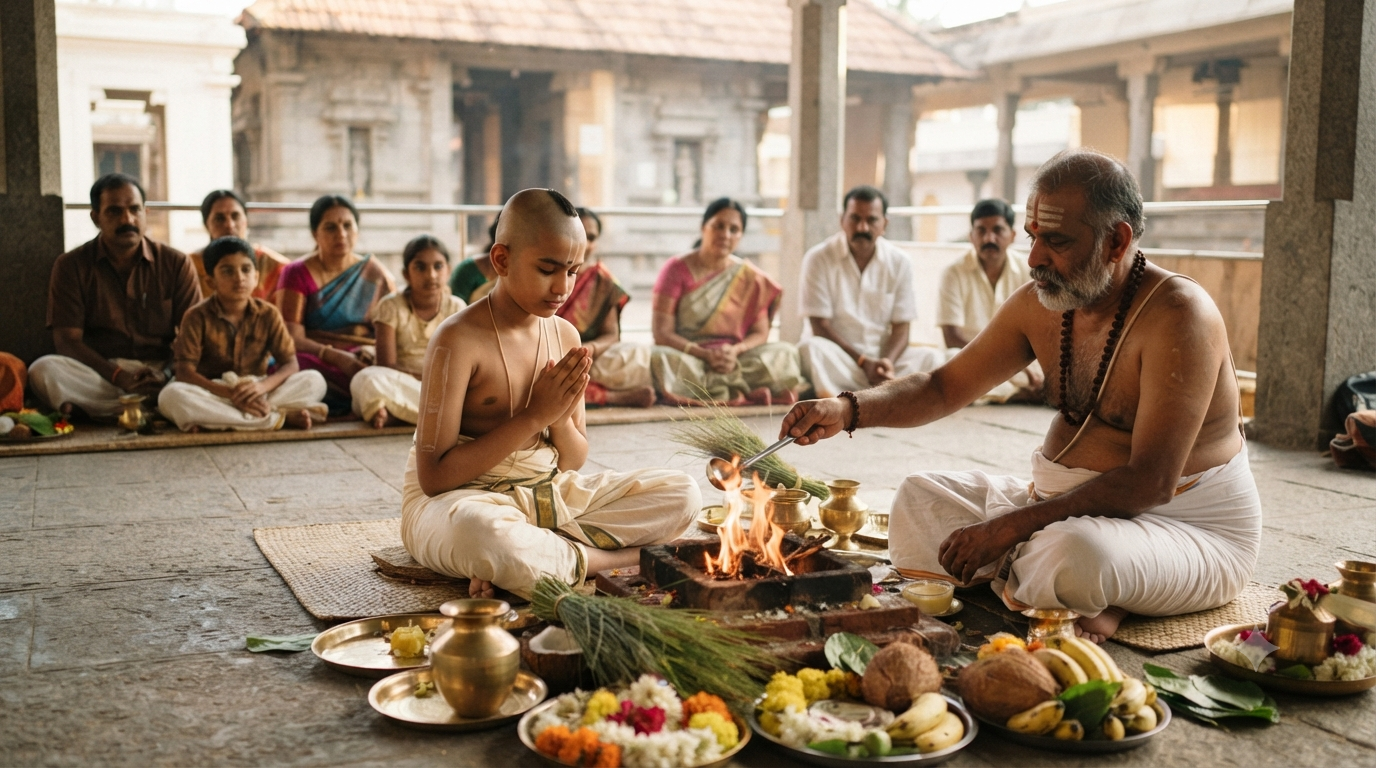
The Upanayanam procedure formally begins a student’s disciplined religious learning in many Hindu traditions. The sacred thread is its most visible symbol, but the deeper purpose is initiation into study, responsibility, mantra practice, and daily discipline. For families planning the ceremony, the safest approach is to follow their own acharya or qualified purohit because the exact sequence differs by Vedic shakha, sampradaya, region, and household custom.
Sri Vyasa Pooja is an independent devotional guide. We are not affiliated with any temple, mutt, trust, or priestly service, and we do not conduct ceremonies or accept bookings or payments.
Upanayanam Procedure at a Glance
- Meaning: Upanayana is traditionally understood as “leading near,” especially bringing the student near a teacher and sacred learning.
- Main purpose: initiation into disciplined study, dharma, and spiritual practice.
- Visible symbol: the yajnopavita, also called janeu, poonal, or sacred thread in different regions.
- Central initiation: Brahmopadesham, when Gayatri instruction is given according to the family tradition.
- Common supporting rites: purification, sankalpa, homa, yajnopavita dharanam, bhiksha, blessings, and instruction in daily practice.
- Important caution: no single online checklist is correct for every family because ritual names, mantras, dress, and order can vary.
The Vedic Heritage Portal, developed under the Indira Gandhi National Centre for the Arts, documents the close relationship between Vedic learning, ritual traditions, and disciplined study. Sanskrit lexicons also explain upanayana as leading near, introduction, or initiation. The ceremony therefore makes more sense as the beginning of a way of learning than as a one-day function.
What Is the Meaning and Significance of the Upanayanam Procedure?
Upanayanam marks the beginning of a disciplined student life in classical Hindu tradition. The student is symbolically brought near a guru, sacred learning, and a set of duties. The rite therefore joins education, spiritual responsibility, self-control, and continuity with a family’s religious tradition.
An IGNCA archive on ancient Indian education discusses Upanayana in connection with the teacher-pupil relationship and the beginning of studentship. This helps explain why many traditions describe the rite as a “second birth.” The phrase is spiritual and educational rather than physical.
The sacred thread carries several inherited interpretations. Some families connect its strands with the three debts, the three Vedas, or duties of thought, word, and action. These explanations are not identical across traditions, so families should ask their acharya which symbolism belongs to their own lineage.
Why the Sacred Thread Is Only One Part of Upanayanam
The sacred thread is important, yet it does not by itself explain the Upanayanam procedure. The thread accompanies instruction, vows, mantra initiation, and the start of regular religious discipline. When the event is reduced to “wearing the janeu,” the educational purpose of the samskara can disappear behind the visible symbol.
This distinction matters for families who have been away from traditional practice for a generation or two. Instead of buying a large samagri list first, identify the family’s gotra, Vedic branch if known, sampradaya, and inherited household customs. Then confirm the acharya or purohit who will guide the rite.
Once that is clear, the Upanayanam procedure becomes easier to organise and easier to explain to the child. The family can then prepare the ritual items, schedule, and follow-up teaching around one coherent tradition.
Upanayanam Procedure Step by Step
The Upanayanam procedure below gives a common planning framework found in many South Indian and broader Hindu traditions. It is not a mantra-by-mantra script. A qualified priest may add, omit, rename, or reorder steps because Grihya-sutra traditions and family paddhatis are not identical.
- Confirm the family tradition and officiant. Speak with an acharya or purohit who understands the family’s sampradaya. Share the gotra, Vedic shakha if known, and any inherited customs before fixing the ritual details.
- Choose the muhurta. The date may depend on age, janma nakshatra, tithi, season, weekday, and local panchangam rules. A generic “best date” copied from the internet may not fit every family.
- Complete preliminary rites. Many traditions begin with purification, sankalpa, Ganapati worship, and family blessings. Some also include Nandi or ancestor-related preliminaries.
- Prepare the student. A ritual bath and fresh traditional clothing are common. Some traditions also prescribe vapana or a particular form of hair preparation.
- Begin the homa and formal initiation. The officiant establishes the sacred fire and conducts the prescribed offerings. The student is gradually introduced to the symbols and discipline of brahmacharya.
Upanayanam Procedure: Sacred Thread, Gayatri and Bhiksha
The middle of the ceremony contains the actions most families recognise. Even here, the exact mantras, order, and person who gives instruction can differ. The family should therefore follow the officiating tradition rather than combine steps from several online videos.
- Yajnopavita dharanam. The sacred thread is placed in the prescribed manner while the officiant guides the student and family. This is the most visible moment, but it is not the whole initiation.
- Brahmopadesham. Gayatri instruction is transmitted according to the family tradition. The exact method is traditionally guided by the acharya, so an online article should not replace that private instruction.
- Bhiksha. In many traditions the initiated student asks the mother and close relatives for alms. The act symbolises humility, dependence on the household, and the responsibilities of student life.
- Daily-practice instruction. The student begins learning Sandhyavandanam, Gayatri japa, achara, and other duties expected in that lineage.
- Blessings and conclusion. Elders bless the student, while the family completes the closing rites, food offering, and hospitality according to local custom.
Which Upanayanam Procedure Steps Vary by Sampradaya?
Several parts of the Upanayanam procedure can change substantially between traditions. That variation is normal. Vedic shakha, sutra tradition, regional custom, and the family acharya can all shape the sequence, mantras, dress, and supporting rites.
| Ritual element | Common purpose | What may vary |
|---|---|---|
| Purification and sankalpa | Prepare the student and ritual space | Names, mantras, and preliminaries |
| Vapana or hair preparation | Ritual preparation in some traditions | Whether it occurs and how |
| Yajnopavita dharanam | Sacred-thread investiture | Associated mantras and actions |
| Brahmopadesham | Gayatri initiation | Who instructs and exact method |
| Bhiksha | Teach humility and student discipline | Words used and people approached |
| Post-initiation practice | Begin daily spiritual discipline | Sandhya method, recitation, and achara |
This is why two families may follow a recognisably valid Upanayanam procedure that does not look identical. A Tamil Smarta sequence, a Telugu Vaishnava sequence, and another regional paddhati may share a core purpose while differing in supporting details.
Who Traditionally Receives Upanayanam, and at What Age?
Classical ritual and dharma texts do not give one age rule for every Hindu family. Some well-known prescriptions place initiation around the eighth year for Brahmana boys, the eleventh for Kshatriyas, and the twelfth for Vaishyas, while textual schools differ on how age is counted and when delay is allowed. These are historical prescriptions, not a single modern rule.
Classical manuals also usually frame the rite around male students in the communities they address. Contemporary Hindu practice is more varied, and some families or institutions interpret initiation differently. If age, gender, or eligibility is uncertain in your tradition, ask the family acharya rather than relying on a universal internet claim.
If the usual childhood age has passed, do not assume the ceremony is impossible. Different lineages handle later initiation differently, so the correct next step is to ask a knowledgeable priest who follows the family tradition.
How Should Families Choose an Upanayanam Muhurta?
A suitable muhurta is normally chosen through the family’s panchangam tradition. The purohit may consider the student’s age, janma nakshatra, tithi, weekday, season, and local rules. Different schools can rank the same date differently, so disagreement between calendars does not always mean one is wrong.
Avoid websites that promise a universally “guaranteed” auspicious date without asking about the family tradition. Muhurta supports the ceremony, but it does not replace preparation or the student’s instruction. An appropriate date is useful only when the family is ready for the rite itself.
What Samagri Is Usually Needed?
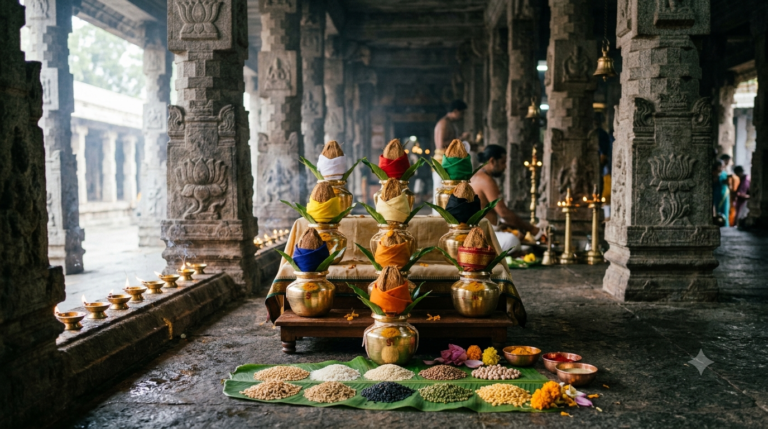
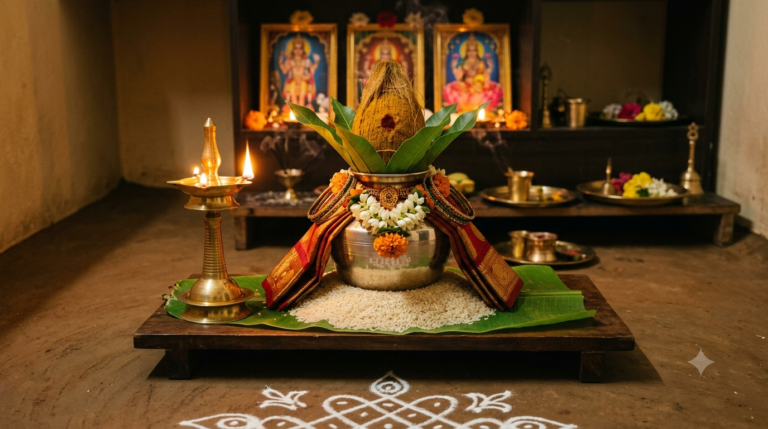
Samagri for the Upanayanam procedure follows the priest’s paddhati, so there is no universal shopping list. Most ceremonies use sacred-thread sets, darbha or kusha grass, flowers, fruits, akshata, sandal paste, lamps, ghee, homa materials, vessels, new clothes, and items for kalasha or fire worship.
Some traditions also use a danda, mekhala, kaupina, a deer-skin substitute, bhiksha cloth, special grass, or community-specific items. Ask the officiating priest for a written checklist before buying anything. This avoids duplicate purchases and keeps the ritual items consistent with the actual procedure.
If your family is still choosing an officiant, Sri Vyasa Pooja’s guide to online purohit booking and checks explains why sampradaya matching matters more than choosing only by price.
How to Prepare the Family Before the Ceremony
A smooth Upanayanam procedure starts with a short planning checklist. First confirm the gotra, Vedic shakha if known, family deity customs, and the tradition followed by close elders. Then give those details to the officiating priest before the muhurta and samagri list are finalised.
- Ask for the complete samagri list in writing.
- Confirm which rites happen before the main day.
- Ask whether the student needs special hair preparation, fasting, or dress.
- Arrange a quiet place for Brahmopadesham if your tradition requires privacy.
- Plan follow-up lessons in Sandhyavandanam and Gayatri practice.
- Keep the student rested and fed as the officiant permits.
The Upanayanam procedure can be tiring for a young child when many supporting rites are included. If the student has a medical condition, medication schedule, sensory difficulty, or dietary need, tell the priest in advance. Religious observance should never require skipping necessary medical care.
What Happens After the Upanayanam Procedure?
The most important part of the Upanayanam procedure begins after the guests leave. Traditionally, the initiate now has a daily discipline rather than a souvenir thread. Families should make sure the student actually learns the practices introduced during the ceremony, especially the Sandhyavandanam method and Gayatri japa taught by the acharya.
This is a practical gap that event-focused guides often miss. Families may spend heavily on food, photography, and decoration, then give the student only a rushed lesson. A better plan is to arrange follow-up teaching for several days or weeks, depending on the family tradition.
Upanayanam also sits within a larger sequence of life-cycle rites. Families reading about earlier childhood samskaras can also see Sri Vyasa Pooja’s guides to Namakaranam and Annaprasanam.
Common Upanayanam Mistakes to Avoid
The first mistake is assuming every video or blog shows the same Upanayanam procedure. It does not. Mixing unrelated mantras and customs from several traditions can create confusion, even when every individual step looks religiously familiar.
The second mistake is treating the sacred thread as the entire ceremony. The thread matters because it accompanies initiation, learning, and continuing discipline. Therefore, post-ceremony teaching deserves as much planning as the function itself.
The third mistake is buying a fixed package before checking the officiant’s paddhati. Ask who will conduct the rite, which tradition they follow, what samagri is included, and who will teach the student afterward. Sri Vyasa Pooja does not take ritual bookings or payments, so arrangements should remain directly between the family and the qualified priest or institution they choose.
Upanayanam Procedure: The Meaning Behind the Main Actions
The Upanayanam procedure becomes easier to understand when each action is read as education. The guru connection represents learning. The sacred thread represents responsibility, while bhiksha teaches humility and dependence within the student’s new discipline.
The ceremony has survived even though the old residential gurukula model is uncommon for most families today. The social setting changed, but the central idea remains recognisable: knowledge carries duties, and religious learning asks for regular practice rather than a one-day display.
That is the enduring logic of Upanayanam. It gives a family a formal moment to connect sacred learning with responsibility, memory, and discipline.
Before You Fix the Date
A meaningful Upanayanam procedure is not necessarily the longest or most expensive one. It should match the family tradition, explain the rite to the student, and continue into real practice after the event. Start with the right acharya or purohit, then let the samagri, sequence, and muhurta follow from that decision.
Most importantly, resist one-size-fits-all ritual claims online. Upanayanam has a shared core, but its details belong to living traditions. When in doubt, preserve the family sampradaya instead of mixing steps from several internet checklists.
Frequently Asked Questions
What is the Upanayanam procedure?
The Upanayanam procedure is a Hindu initiation sequence that commonly includes purification, sankalpa, homa, sacred-thread investiture, Brahmopadesham, bhiksha, blessings, and daily-practice instruction. The exact order varies by Vedic shakha, sampradaya, region, and family tradition.
What is the main significance of Upanayanam?
Its main significance is initiation into disciplined learning and spiritual responsibility. Traditionally, the student comes under the guidance of a guru and begins the duties expected by the family tradition. The ceremony therefore marks a beginning rather than an isolated celebration.
Is Brahmopadesham the most important part of Upanayanam?
In many traditions, Brahmopadesham is the central initiatory moment because Gayatri instruction is formally given to the student. However, the whole rite matters, including preparation, sacred-thread investiture, homa, vows, bhiksha, and the daily disciplines that follow.
Can Upanayanam be performed at home?
Yes, many families conduct the Upanayanam procedure at home or in a family hall under a qualified purohit, while others choose a temple or mutt. The venue matters less than following the correct family tradition and having suitable space for the rites being performed.
How long does Upanayanam take?
The Upanayanam procedure has no universal duration. Some families complete the main rite within part of a day, while others include previous-day preliminaries and extended homa. Ask the officiating priest for the schedule because the family’s paddhati determines the actual length.
What should the child learn after Upanayanam?
The student should learn the daily practices expected in the family tradition. These often include Sandhyavandanam and Gayatri japa as taught by the acharya. Follow-up instruction matters because the ceremony is meant to begin a discipline, not end with the function.
Can Upanayanam be performed at a later age?
Families and texts differ on later initiation, so there is no safe universal cutoff. If the customary childhood age has passed, consult a knowledgeable acharya or purohit from your tradition. They can explain the accepted path for that lineage.
Is Upanayanam only for boys?
Classical ritual manuals generally frame the rite around male students in the communities they address, but contemporary practice is not identical everywhere. Some families and institutions use broader initiation models. Follow the teaching of your own sampradaya rather than treating one modern answer as universal.
Why do websites show different Upanayanam steps?
Different websites often describe the Upanayanam procedure from one regional or sectarian tradition as though it were universal. The core purpose is recognisable across many communities, but the supporting rites, mantras, dress, and sequence can differ significantly. Your family’s own paddhati should take priority.