Narasimha avatar story is the account of Lord Vishnu appearing in a form that was neither simply human nor simply animal to protect Prahlada and end Hiranyakashipu’s tyranny. The climax is famous, yet its power comes from the exact conditions behind it. Narasimha does not ignore Brahma’s boon; instead, every detail of the avatar answers a limit that Hiranyakashipu believed had made him impossible to kill.
Independence note: Sri Vyasa Pooja is an independent devotional guide. We are not affiliated with any temple, matha, trust, or religious authority, and we do not take bookings, donations, or payments through this page.
Narasimha Avatar Story at a Glance
The Narasimha avatar story appears most fully in the seventh canto of the Srimad Bhagavatam. Hiranyakashipu gains extraordinary protections from Lord Brahma, becomes oppressive, and turns against his son Prahlada because the boy worships Vishnu. When the king challenges Prahlada’s statement that Vishnu is everywhere, the Lord appears from a pillar as Narasimha.
| Question | Essential answer |
|---|---|
| Who is Narasimha? | A man-lion form of Lord Vishnu |
| Who is Prahlada? | Hiranyakashipu’s son and a steadfast devotee of Vishnu |
| Why did Narasimha appear? | To protect Prahlada and end Hiranyakashipu’s oppression |
| Where did Narasimha appear? | From a pillar in the royal assembly hall |
| When was Hiranyakashipu killed? | At evening twilight, between day and night |
| What is the main source? | Srimad Bhagavatam, Canto 7, especially Chapters 3 to 10 |
In common Dashavatara lists, devotees remember Narasimha as Vishnu’s fourth avatar. The story joins fierce divine power with tender protection. Narasimha terrifies the tyrant, while Prahlada approaches the same form with trust.
Why Did Vishnu Take the Narasimha Avatar?
Vishnu takes the Narasimha form because Hiranyakashipu builds his boon around fixed categories. He asks for protection from death in ways that seem to cover person, place, time, position, and weapon. Therefore, the solution appears between those categories rather than breaking Brahma’s word.
The conflict begins earlier, after Vishnu’s Varaha avatar kills Hiranyakashipu’s brother Hiranyaksha. Hiranyakashipu then directs his hatred toward Vishnu. He performs severe austerities and seeks a boon from Lord Brahma because he wants a form of security close to immortality.
Brahma does not grant unconditional immortality. Instead, Hiranyakashipu asks for layered protections. Once he receives them, confidence hardens into arrogance, and he tries to dominate the worlds under his rule.
Before the Narasimha Avatar Story: Hiranyakashipu’s Boon
The turning point before the Narasimha avatar story is Hiranyakashipu’s carefully framed request. Srimad Bhagavatam 7.3 records the boon in detail. The protections concern who may kill him, where death may occur, when it may occur, and what means may be used.
What exactly did Lord Brahma grant?
Hiranyakashipu asks not to die inside or outside a residence, during day or night, on the ground or in the sky, by a weapon, or by a human or animal. The surrounding verses add further protections involving beings and powers. The text does not say that Brahma made him literally immortal.
| Protection sought | How Narasimha answers it |
|---|---|
| Not by a human or animal | Narasimha is a unique man-lion form |
| Not indoors or outdoors | The killing takes place at the doorway |
| Not during day or night | It happens at evening twilight |
| Not on earth or in the sky | Hiranyakashipu rests on Narasimha’s lap |
| Not by a weapon | Narasimha uses his nails |
This is why the avatar’s form is not decorative detail. The form itself becomes part of the answer. Time, place, posture, and method all follow the same pattern.
Prahlada: The Spiritual Centre of the Story
Prahlada is not merely a child waiting to be rescued. In the Bhagavata account, he is the spiritual centre because he remains devoted without adopting his father’s hatred. His calmness gives the narrative weight long before Narasimha appears.
What did Prahlada learn before birth?
Srimad Bhagavatam Canto 7, Chapter 7 says Prahlada heard spiritual instruction from Sage Narada while still in his mother Kayadhu’s womb. Narada sheltered Kayadhu while Hiranyakashipu performed austerities. Therefore, the text explains Prahlada’s devotion as rooted before his childhood education began.
Later, Hiranyakashipu sends Prahlada to teachers who educate the children of the asuras. Yet the boy continues to speak about Vishnu and devotion. His father sees that devotion as rebellion because it refuses the king’s demand for absolute loyalty.
How did Hiranyakashipu try to harm Prahlada?
The Bhagavata lists repeated attempts to kill Prahlada. They include elephants, snakes, poison, starvation, fire, water, severe cold and wind, falls from height, destructive spells, and crushing forces. Yet the narrative repeatedly presents Prahlada as unharmed.
Popular retellings often compress these ordeals into one or two scenes. However, the scripture spends substantial time on Prahlada’s teaching and his refusal to divide the world into friends and enemies. That contrast matters because Hiranyakashipu seeks outward control, while Prahlada represents inward steadiness.
The Pillar Moment in the Narasimha Avatar Story
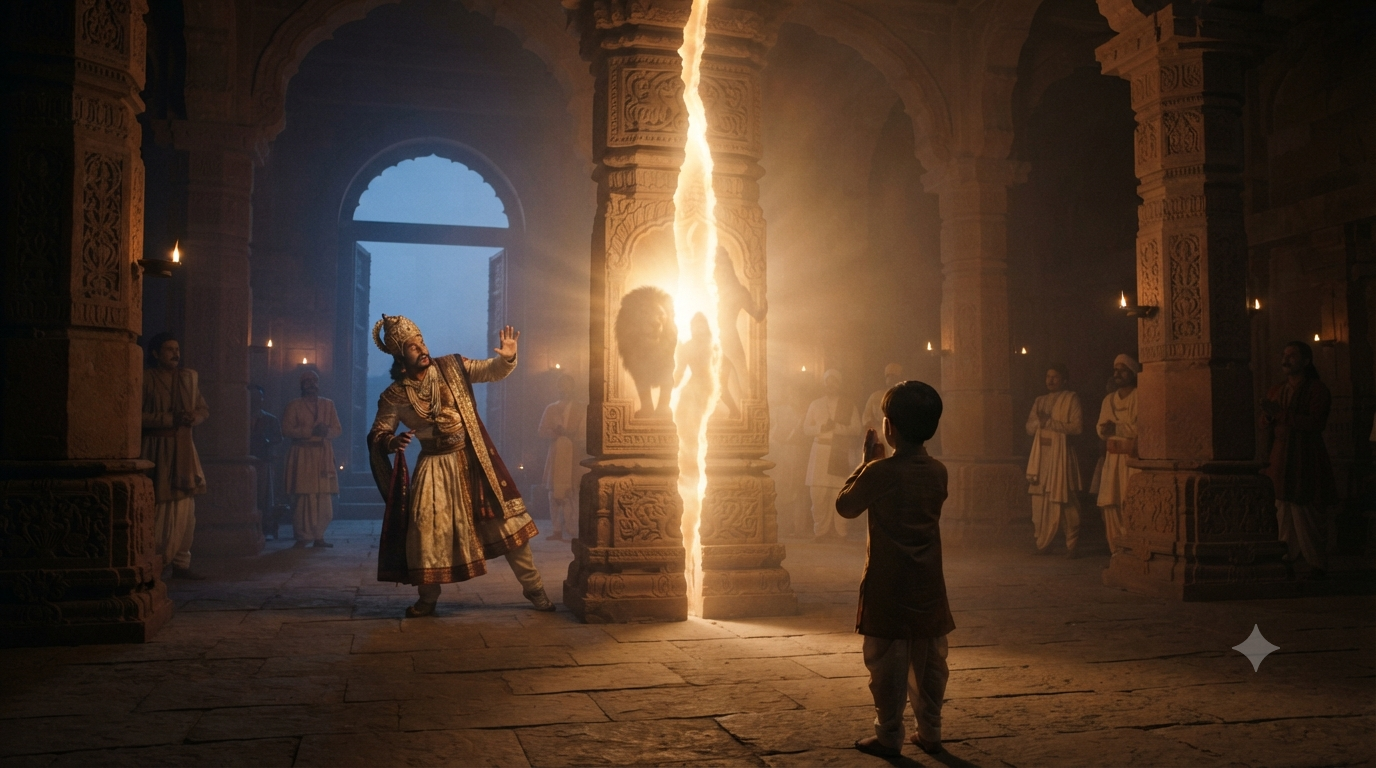
The most famous scene in the Narasimha avatar story begins when Hiranyakashipu demands to know where Prahlada’s Lord is. Prahlada maintains that the Lord is present everywhere. The king points to a pillar, challenges that claim, and strikes it in anger.
Srimad Bhagavatam 7.8 describes a tremendous sound from the pillar. Vishnu then manifests in a form that the observers cannot classify as either a man or a lion. Within the devotional logic of the text, the appearance directly confirms Prahlada’s statement that divine presence is not limited by the tyrant’s categories.
Narasimha and Hiranyakashipu fight, but the decisive moment comes in the evening. Narasimha takes the king to the doorway of the assembly hall, places him across his thighs, and tears him open with his nails. Each detail matters because it sits outside the protected categories.
How the Narasimha Avatar Story Answers Every Condition
The precision of the Narasimha avatar story is one reason the episode remains so memorable. Narasimha does not cancel Brahma’s promise. Instead, the narrative shows that Hiranyakashipu’s protections were extensive without being absolute.
- Neither an ordinary human nor an animal: Narasimha appears as a unique composite form.
- Neither day nor night: the decisive moment comes at twilight.
- Neither inside nor outside: the doorway is a threshold between both.
- Neither earth nor sky: Hiranyakashipu is held on Narasimha’s lap.
- No weapon: Narasimha uses his own nails rather than a conventional weapon.
For devotees, the structure carries a spiritual meaning beyond clever wording. Human power can look complete when it controls familiar options. Yet the story argues that reality exceeds the categories used to claim absolute control.
What Happened After Hiranyakashipu Was Killed?
The story does not end with Hiranyakashipu’s death. Srimad Bhagavatam 7.9 says Narasimha remains intensely angry, and the assembled devas hesitate to approach. Lord Brahma then asks Prahlada to go forward.
Prahlada approaches without fear and offers prayers. Narasimha responds with affection and places his hand on the boy’s head. The emotional arc now becomes clear because the same form that terrifies the oppressor becomes gentle toward the devotee.
Canto 7, Chapter 10 adds another important lesson. When Narasimha offers blessings, Prahlada does not turn devotion into a bargain for wealth or pleasure. Instead, he asks to be free from selfish desire, and he also prays for his father.
What Does the Narasimha Avatar Mean?
The Narasimha avatar represents the protection of devotion, the limits of pride, and the restoration of dharma in Vaishnava tradition. Hiranyakashipu masters the wording of his boon, yet he never masters his anger, fear, or ego. Therefore, the deeper failure occurs before the final battle.
Protection does not always appear gentle
Narasimha is among Vishnu’s fiercest forms, but the fierceness has a clear direction in this story. It ends oppression rather than threatening Prahlada. That distinction helps explain why devotees can associate Narasimha with both awe and protective compassion.
Prahlada wins without becoming like his father
Prahlada’s strength is not physical or political. He does not build an army or answer cruelty with cruelty. Instead, he remains steady in devotion, so his conduct creates a moral contrast with his father’s obsession with domination.
The threshold is the hidden symbol
The doorway is more than a convenient location. A threshold belongs fully to neither side, so it mirrors the avatar’s own in-between form. The same logic also appears in twilight, the lap, and the nails.
Popular Retellings and What the Bhagavata Purana Says
Modern versions often merge several Prahlada traditions into one continuous narrative. That may be meaningful devotionally, but source labels help readers understand what the Bhagavata Purana itself says. This distinction is especially useful around Holika and around claims of literal immortality.
Does Bhagavata Canto 7 name Holika?
Bhagavata Canto 7 clearly includes fire among the dangers used against Prahlada, but the chapter’s list does not name Holika in that episode. The familiar Holika Dahan story belongs to the wider Puranic, festival, and regional tradition around Prahlada and Holi. Therefore, it is better not to present every Holika detail as a direct quotation from Bhagavata Canto 7.
Did Hiranyakashipu receive literal immortality?
No. The Bhagavata account presents a network of conditions that make death seem nearly impossible. Brahma does not simply make Hiranyakashipu immortal. That distinction is essential because Narasimha’s appearance only makes sense against the exact limits of the boon.
Narasimha Beyond the Story: Worship and Sacred Places
Devotional traditions worship Narasimha in fierce, peaceful, yogic, and Lakshmi-associated forms. One sculpture or temple image should not be treated as the only correct appearance. Regional traditions developed different iconography while keeping the central identity of Vishnu’s man-lion form.
Sri Vyasa Pooja has separate guides to Narasimha Sahasranamam, Narasimha Jayanti worship at home, and the Nava Narasimha shrines of Ahobilam. Keeping those intents separate avoids turning one story page into a mixed worship, festival, and pilgrimage guide.
Ahobilam holds a particularly important place in South Indian Narasimha devotion, where tradition connects the landscape with the avatar and preserves nine Narasimha shrines. Simhachalam, Yadadri, Mangalagiri, Kadiri, and other temples also show how widely Narasimha worship developed across southern India.
Lessons Hidden Inside the Narasimha Avatar Story
The Narasimha avatar story offers more than a simple victory of good over evil. Its strongest lesson is that power without self-mastery remains fragile. Hiranyakashipu controls kingdoms, yet anger at his own child’s devotion exposes how little control he has over himself.
A second lesson is devotion without transaction. Prahlada does not worship Vishnu merely to escape danger, and after the danger passes he does not demand wealth. His response after Narasimha’s appearance separates bhakti from a simple exchange of prayer for reward.
Finally, the story presents divine protection as something that may arrive in an unexpected form. For devotees, that remains a matter of faith rather than a guarantee about worldly outcomes. As spiritual teaching, however, the episode encourages courage when familiar options seem closed.
Narasimha Avatar Story: Key Points to Remember
The Narasimha avatar story is as much about Prahlada’s unwavering devotion as Narasimha’s fierce appearance. Hiranyakashipu tries to make himself untouchable through layered protections, but those protections depend on categories that are not absolute.
Read the episode as a complete arc rather than only the pillar scene. The boon explains the form, Prahlada explains the purpose, and the prayers after the battle reveal the compassion behind the fury. Together, those parts explain why Narasimha remains one of Vishnu’s most powerful devotional forms.
Frequently Asked Questions
Who is Narasimha in Hindu tradition?
Narasimha is a form of Lord Vishnu with human and lion characteristics. Vaishnava tradition remembers him for protecting Prahlada and ending Hiranyakashipu’s oppression. His unusual form directly answers the conditions of the king’s boon.
Why did Vishnu become half man and half lion?
Hiranyakashipu had protection from death by a human or an animal. Therefore, Vishnu appears as Narasimha, a form that cannot be reduced to either category. The form lets Brahma’s boon remain meaningful while still allowing the tyranny to end.
Was Hiranyakashipu truly immortal?
No. The Bhagavata account describes a network of protections rather than unconditional immortality. Hiranyakashipu tries to cover likely causes, places, times, and agents of death, but the conditions still contain limits.
Why did Narasimha come out of a pillar?
Prahlada says that Vishnu is present everywhere, and Hiranyakashipu challenges whether that includes a pillar. When the king strikes it, Narasimha appears from the pillar. Within the devotional narrative, the scene validates Prahlada’s claim about divine presence.
How did Narasimha avoid breaking Brahma’s boon?
Narasimha acts between the boon conditions. He appears in a man-lion form, acts at twilight, uses the doorway, places Hiranyakashipu on his lap, and uses nails rather than a weapon. The episode therefore preserves Brahma’s word while ending Hiranyakashipu’s rule.
Did Holika appear in the Bhagavata version of Prahlada’s story?
Bhagavata Canto 7 lists fire among the dangers used against Prahlada, but that passage does not name Holika. The familiar Holika story belongs to the wider Puranic and festival tradition around Prahlada and Holi, so readers should distinguish the traditions rather than merge every detail into one source.
What happened to Prahlada after Narasimha appeared?
Prahlada approaches Narasimha, offers prayers, and receives the Lord’s affection. He later refuses to treat devotion as a bargain for material rewards and asks for freedom from selfish desire. The text then presents him as an exemplary devotee and ruler.
What is the main spiritual message of the Narasimha story?
The story teaches that arrogance and external power cannot create absolute security. It also celebrates steady devotion, courage, and divine protection in Vaishnava tradition. These are devotional interpretations rather than promises of guaranteed worldly outcomes.