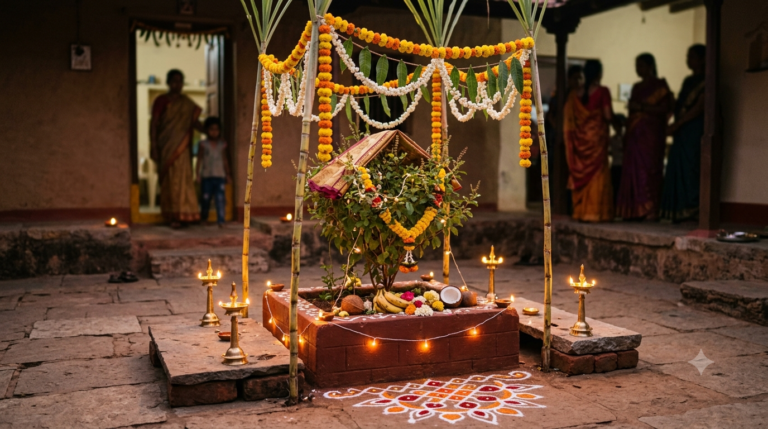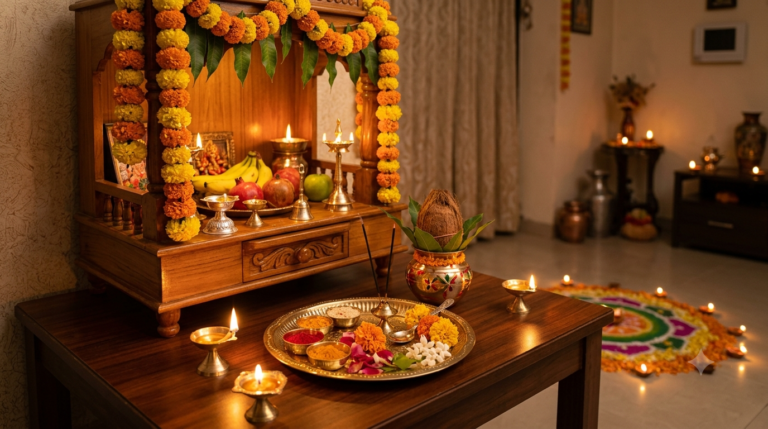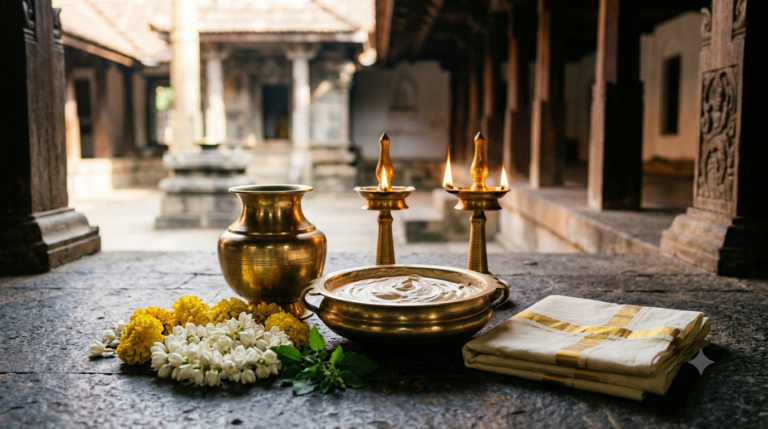
The Varalakshmi Vratam pooja vidhanam is simpler than its long Sanskrit name suggests. At its heart it needs only three things: a decorated pot, a nine-knot thread, and a devoted mind.
Yet one detail trips up thousands of families every year, and it is not the ritual. It is the date. Search online today and you will see August 8, 14, 21, and 28 all claimed for 2026. So let us settle that first, then walk through the full pooja step by step.
Sri Vyasa Pooja is an independent devotional guide. We are not affiliated with any temple or trust, and we take no bookings or payments. Please confirm timings with your family purohit or a trusted local panchang before you observe the vratam.
Varalakshmi Vratam at a glance
- 2026 date: Friday, 28 August 2026, per DrikPanchang and most widely-followed panchangs.
- Who observes it: mainly married women (sumangalis), though anyone may keep the vratam.
- Main object of worship: a kalasham decorated as the face of Goddess Varalakshmi.
- Best time: the evening Pradosh window is most favoured, while morning and midday Lagnas also work.
- Merit: the vratam is said to equal worshipping all eight forms of Lakshmi (Ashtalakshmi).
When is Varalakshmi Vratam in 2026?
Varalakshmi Vratam in 2026 falls on Friday, 28 August, according to DrikPanchang and the majority of South Indian panchangs. Families always keep the vratam on a Friday of the bright fortnight (Shukla Paksha) of the Shravana month. Because Shravana Purnima itself lands on Friday, 28 August this year, that Friday doubles as the vratam day.
So why do other sites disagree? A few reasons, and each is worth knowing before you plan.
The date confusion, corrected
Some pages still show 8 August 2026. That was actually the 2025 date, and those pages simply were not updated. A few others list 14 August, which does not match the Shravana Shukla Paksha calculation at all. You may also see 21 August, and this one is not careless.
The 21 August reading follows the stricter rule of “the Friday before Purnima.” Since the full moon falls on a Friday in 2026, that logic points to the previous Friday. Both readings have tradition behind them, so if your family sampradaya observes the Friday before Purnima, 21 August is valid for you. When in doubt, follow your kula purohit — that ruling always overrides a website.
Auspicious muhurat timings for the pooja
The evening twilight, or Pradosh Kaal, is traditionally the most powerful window for Lakshmi worship. That said, four Lagna windows are considered auspicious through the day, so you can choose whichever suits your household.
| Lagna window | Approx. time (reference) |
|---|---|
| Simha (morning) | 05:57 AM – 07:29 AM |
| Vrishchika (afternoon) | 12:05 PM – 02:23 PM |
| Kumbha (evening, Pradosh) | 06:09 PM – 07:37 PM |
| Vrishabha (midnight) | 10:37 PM – 12:33 AM |
These reference times are calculated for the Delhi region, so your city will differ by several minutes. Because Lagna and sunrise shift with location, always confirm the exact window for Hyderabad, Bengaluru, Chennai, or wherever you live using a daily panchang before you begin.
What is Varalakshmi Vratam and why it matters
Varalakshmi is the boon-granting form of Goddess Mahalakshmi, consort of Lord Vishnu. The word itself explains her grace, since “vara” means boon and “Lakshmi” is the goddess of prosperity. Devotees believe she emerged from the Kshira Sagara, the ocean of milk, during the great churning.
What makes this vratam special is its scope. Observing it once is held to equal worshipping all eight forms of Lakshmi together — wealth, grain, courage, victory, progeny, knowledge, prosperity, and royal grace. So a single Friday of the Varalakshmi Vratam pooja vidhanam carries the merit of eight separate observances, which is why so many families never miss it.
Varalakshmi Vratam pooja vidhanam: what you need (samagri)
Before the day arrives, gather everything the Varalakshmi Vratam pooja vidhanam calls for, so nothing interrupts the flow. Most items already sit in a South Indian kitchen or pooja shelf, and the rest are easy to buy at any local store.
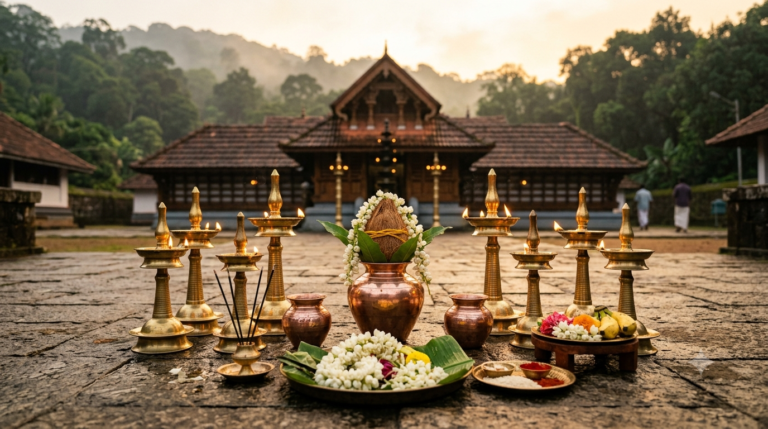
- A kalasham (brass or silver pot), plus raw rice to fill it
- A fresh coconut, mango leaves, and turmeric to smear on the coconut
- A Varalakshmi face plate or an idol, if your family uses one
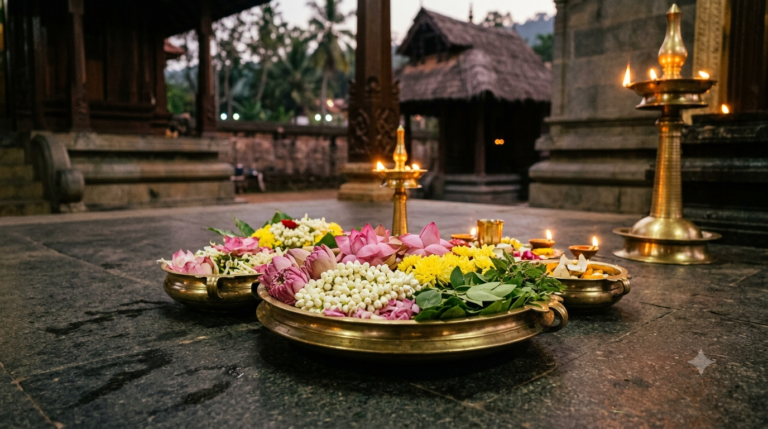
- Kumkum, haldi (turmeric), sandal paste, and akshata (turmeric-coated rice)
- The toram or dorak — a yellow thread for the nine-knot sacred string
- Flowers, bangles, a new blouse-piece or vastram, and betel leaves with areca nut
- Sweets and naivedyam such as payasam or pulihora, plus fruits
- A lamp, ghee, wicks, camphor, and incense
Varalakshmi Vratam pooja vidhanam: step by step
Here is the complete Varalakshmi Vratam pooja vidhanam in the order most South Indian families follow. Keep it unhurried, since devotion matters far more than speed.
- Wake early, bathe, and clean the pooja area. Draw a rangoli and place a wooden plank or raised seat for the kalasham.
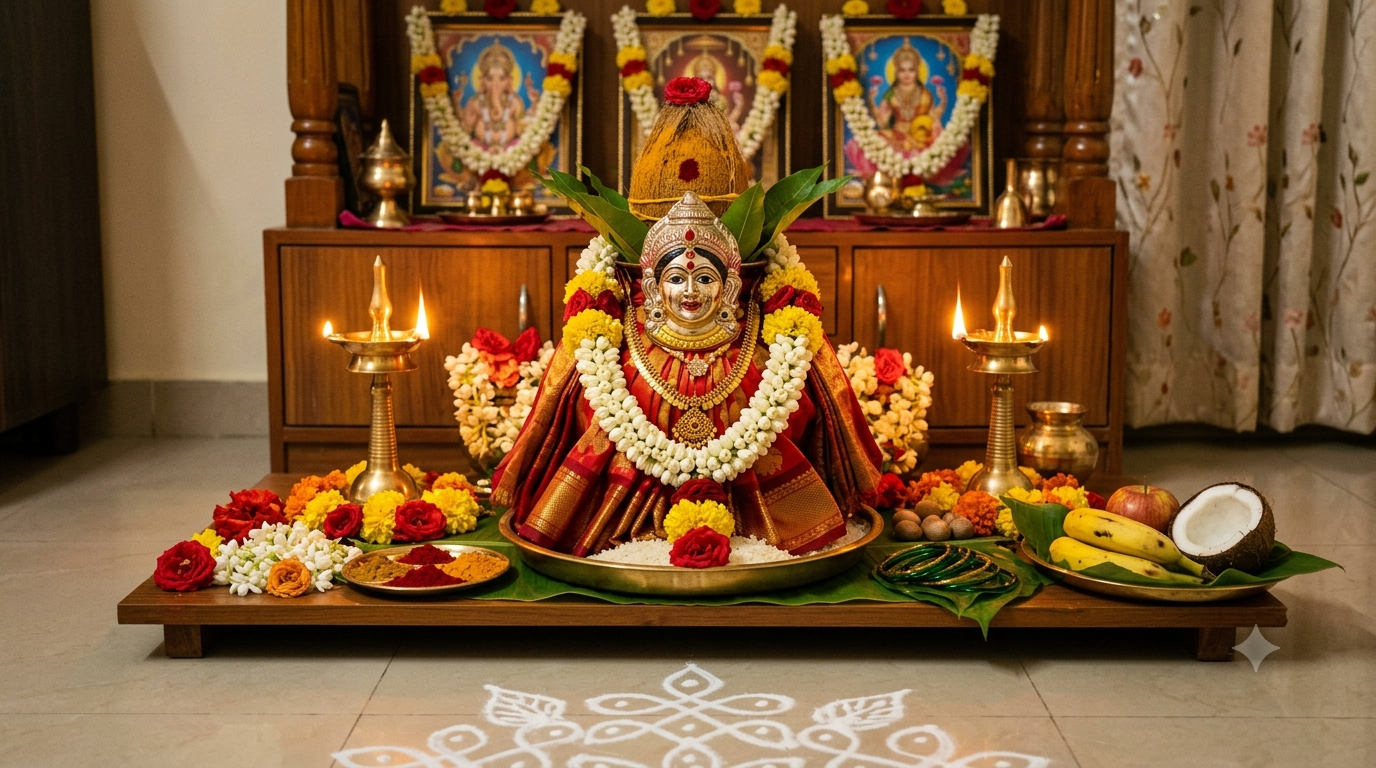
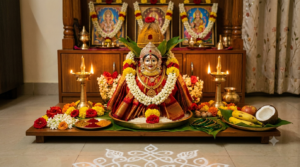
- Fill the kalasham with rice or water, add a coin, betel nut, and a few flowers, then place mango leaves around the rim.
- Set the turmeric-smeared coconut on top and tie a new cloth around the pot. Decorate it with kumkum, bangles, and the Varalakshmi face if you have one.
- Begin with a prayer to Lord Ganesha to remove obstacles, followed by sankalpam — a simple vow stating your name, gothram, and intention.
- Invoke the goddess into the kalasham and perform shodashopachara — the sixteen respectful offerings, from asanam and padyam to naivedyam and deepam.
- Worship the toram, then tie it on your right wrist. Married women often help tie it for one another.
- Recite the Sri Suktam and the Varalakshmi Ashtottara Shatanamavali, the 108 names, if you know them.
- Read the Varalakshmi Vrata katha aloud so everyone present hears the story.
- Offer aarti with camphor, then distribute prasadam and vayanam to the sumangalis who joined you.
Kalasham setup for the Varalakshmi Vratam pooja vidhanam
The kalasham is the living heart of the Varalakshmi Vratam pooja vidhanam, because you invoke the goddess into it rather than into a picture. Draw a small swastika on the pot before you decorate it. Many families paint eyes and a nose on the coconut or fix a metal face so the kalasham truly looks like Amma seated in the home.
Once she is invoked, treat the kalasham as an honoured guest. Offer water for the feet, a seat, clothing, ornaments, food, and light — each with a short prayer. This is the “guest of honour” logic that runs through almost every Hindu pooja.
The toram: nine knots of protection
The toram, also called dorak, is a yellow thread carrying nine knots, sometimes with nine turmeric pieces or small flowers. Women worship it alongside the goddess and then tie it on the right wrist. The nine knots stand for the goddess’s grace binding itself to the wearer for the year ahead.
You keep the thread on until it naturally wears away, or you remove it during the next year’s vratam. If it comes off early, there is no fault — the intention with which it was tied is what counts.
Mantra and the Charumathi katha
A simple, powerful mantra for the day is “Om Shreem Mahalakshmyai Namah,” which anyone can chant even without formal training. If you prefer a longer recitation, the Sri Suktam is the classic Vedic hymn to Lakshmi. Chant slowly, since clarity matters more than count.
The vratam’s story comes from the Skanda Purana. Goddess Parvati asked Lord Shiva for a vow that women could keep for family welfare, and he taught her this vratam.
In the tale, a devout woman named Charumathi of Kundinagaram received the goddess in a dream. She kept the vratam with other women, and abundance soon filled her whole town. Reading her katha during the pooja links your worship to that ancient promise of grace.
Fasting rules and a gentle safety note
Fasting on Varalakshmi Vratam is traditional but flexible. Some women keep a full fast until the pooja ends, while others take fruit, milk, or light sattvic food through the day. The shastras value your intention over strictness, so choose what your body allows.
If you are pregnant, elderly, diabetic, or unwell, please do not attempt a rigid nirjala fast. Eat lightly, stay hydrated, and complete the pooja comfortably — the goddess asks for devotion, not distress. When health is a concern, a doctor’s guidance always comes first.
Vayanam and tamboolam: sharing the blessing
After the pooja, married women exchange vayanam — a plate holding betel leaves, areca nut, a coconut, turmeric, kumkum, bangles, fruit, and small gifts. This giving is not a formality; it is a mutual blessing between sumangalis. The act keeps the community bond alive and spreads Lakshmi’s grace beyond one household.
The next morning, sprinkle the water from the kalasham around your home. If you used rice inside, cook it into the family meal so the goddess’s blessing enters everyone’s food.
Insider tips for the Varalakshmi Vratam pooja vidhanam
A few practical points make the day smoother, and experienced households swear by them.
- Prepare the kalasham decorations the night before, so the morning stays calm.
- Keep the coconut’s stalk pointing upward — many families consider this the correct, respectful placement.
- Buy toram thread and bangles early, because stocks vanish in the last week before the festival.
- If you cannot finish by evening, the Pradosh window itself is ideal — you are not late, you are on time.
For families who love these women-centred vows, the Swarna Gowri Vratha and the Gowri Tadiya pooja vratha vidhanam in Telugu follow a very similar spirit. And if you are mapping the year’s festivals, our Ugadi guide explains where the Shravana month sits in the Telugu calendar.
Performing Varalakshmi Vratam pooja vidhanam at home without a priest
You do not need a priest to keep this vratam, and most families never call one. The Varalakshmi Vratam pooja vidhanam suits the home, and a sincere sankalpam in your own words carries full validity. If you do not know your gothram, simply say “achyuta gothram” or offer the pooja in the name of your family — the goddess does not turn away devotion for a missing detail.
Keep a printed or phone copy of the katha and mantra beside you. Move at your own pace, involve the children, and let the pooja feel warm rather than rushed. That warmth, more than any perfect procedure, is what Varalakshmi blesses.
Before you go
Varalakshmi Vratam rewards devotion, not perfection. Fix the date first — Friday, 28 August 2026 for most, or the previous Friday if your family follows the “before Purnima” rule — then gather your samagri, decorate the kalasham with love, and keep the pooja unhurried. For anything time-sensitive, confirm your city’s muhurat on a trusted panchang. Do that, and the Varalakshmi Vratam pooja vidhanam becomes exactly what it was meant to be: a quiet, joyful welcome of the goddess into your home.
Frequently asked questions
What is the correct Varalakshmi Vratam 2026 date?
For most families the date is Friday, 28 August 2026, as given by DrikPanchang and mainstream South Indian panchangs. If your tradition keeps the Friday strictly before Purnima, then 21 August applies. Ignore the 8 August figure, since that was the 2025 date.
Can unmarried women or men perform Varalakshmi Vratam?
Yes. Although the vratam is traditionally kept by married women, unmarried women and men may also observe it. Goddess Lakshmi’s blessings are universal, so sincere devotion is what she looks for, not marital status.
Is fasting compulsory for the vratam?
No, fasting is traditional but not compulsory. You can keep a full fast, a partial fast with fruit and milk, or eat light sattvic food before the pooja. Those who are unwell, pregnant, or elderly should fast gently or not at all.
What time should I perform the Varalakshmi pooja?
The evening Pradosh window is most favoured, though morning and midday Lagna windows are also auspicious. Because timings shift by city, confirm the exact muhurat for your location on a local panchang. Sincere worship at any of these windows is accepted.
What do I need for the Varalakshmi Vratam pooja vidhanam?
The Varalakshmi Vratam pooja vidhanam needs a kalasham with rice, a coconut, mango leaves, turmeric, kumkum, the toram thread, flowers, bangles, betel leaves, sweets, and a lamp. Most of these already sit at home. Gather them a day ahead so the pooja flows smoothly.
How long do I keep the toram thread on?
Keep the toram on your wrist until it wears away naturally, or remove it during the next year’s vratam. If it slips off earlier, there is no fault. The devotion behind tying it is what carries the blessing.
What is vayanam and why is it given?
Vayanam is a gift plate of betel leaves, coconut, turmeric, kumkum, bangles, and small presents that married women exchange after the pooja. It works as a mutual blessing between sumangalis. The custom strengthens community bonds and shares the goddess’s grace.
Can I perform the vratam at home without a priest?
Yes, the vratam is made for home worship and needs no priest. A simple sankalpam in your own words, the katha, and a basic mantra are enough. Move at your own pace and let the pooja stay warm and unhurried.