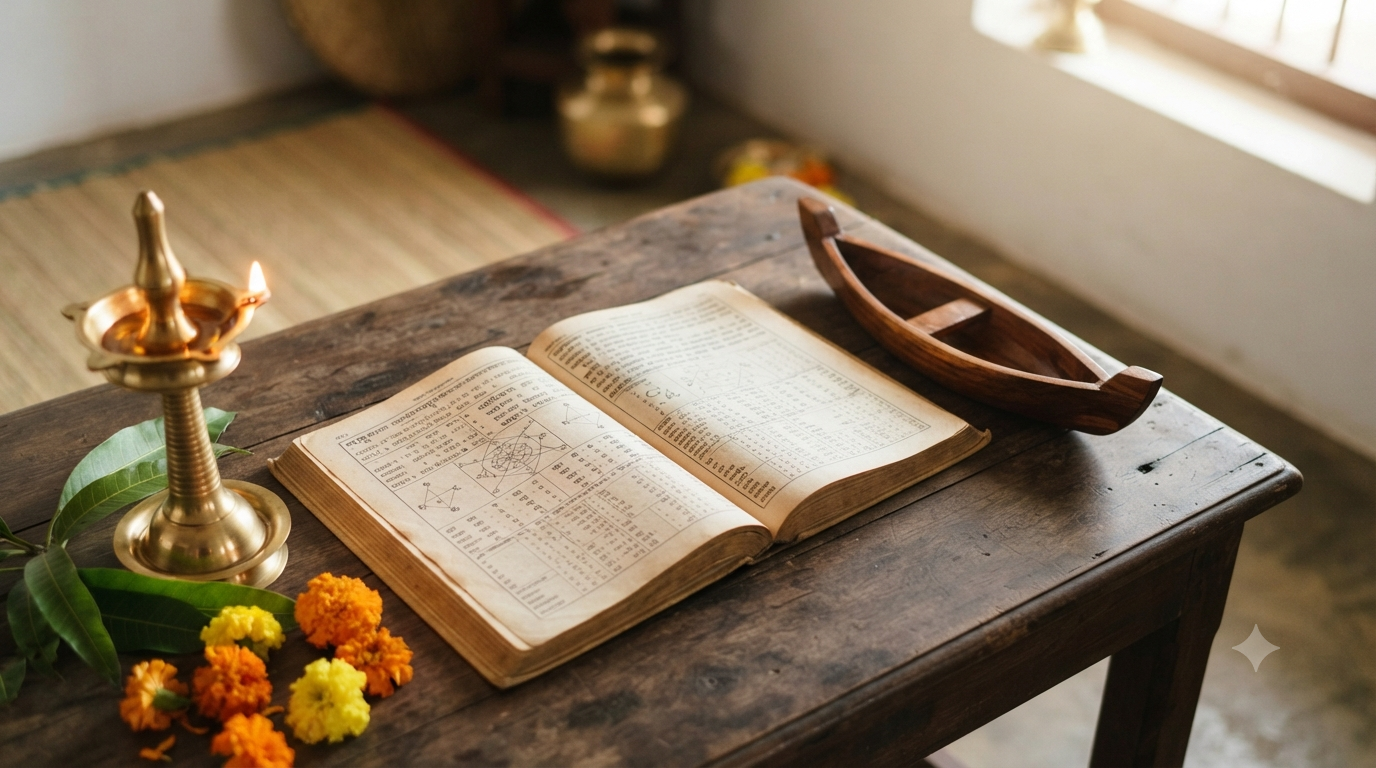
Plava Samvatsaram meaning begins with the Sanskrit word plava, which can refer to something that floats, such as a raft, boat, or small vessel. In the traditional Telugu and South Indian calendar, Plava is also the name of one year in the repeating sixty-year samvatsara cycle. Devotees often connect the word with the idea of crossing, transition, and moving safely through change.
Sri Vyasa Pooja is an independent devotional guide. We are not affiliated with any temple, mutt, peetham, trust, or panchangam publisher, and we do not accept bookings, donations, or payments. For ritual dates and current almanac details, use the original panchangam issued by the institution or tradition you follow.
Plava Samvatsaram Meaning at a Glance
Plava Samvatsaram meaning can be understood on two levels. First, plava has the literal Sanskrit sense of a float, raft, boat, or something that carries a person across water. Second, Plava serves as a formal year name inside the traditional sixty-year samvatsara sequence used in many South Indian panchangams.
- Word: Plava, written in Sanskrit and Telugu forms according to the script used by the panchangam.
- Literal sense: A float, raft, boat, or small vessel; the root also carries ideas linked with floating and movement.
- Calendar use: One named year in the recurring sixty-year samvatsara cycle.
- Traditional setting: Ugadi, Panchanga Sravanam, sankalpa, family records, and yearly ritual references.
- Belief context: Symbolic interpretations belong to Jyotisha and devotional tradition, not proven prediction.
Lexicographical sources based on Monier-Williams and Apte record plava with meanings connected to floating, a raft, a canoe, or a small boat. That makes the “crossing over” interpretation understandable, although symbolic yearly readings vary between traditions.
Plava Samvatsaram Meaning: What Does the Word Plava Actually Mean?
The clearest answer is that plava means something that floats or carries across water. Sanskrit dictionaries give senses such as raft, float, canoe, boat, and small ship. They also connect the word with swimming, floating, leaping, or movement, depending on grammatical form and textual context.
This literal meaning is more reliable than the many modern lists that assign one fixed prediction to the name. Some devotional writers interpret Plava as “crossing difficulties,” while others connect it with movement, transition, or recovery. Those interpretations are traditional readings, so they should not be presented as guaranteed outcomes.
If your purpose is linguistic, use the Sanskrit meaning first. If your purpose is ritual or Jyotisha, then read the symbolic interpretation within the panchangam tradition your family follows.
Why Is Plava Used as a Samvatsara Name?
A samvatsara is a named year in a traditional cyclical calendar system. Telugu and Kannada panchangams commonly use a cycle of sixty year names, with each name returning after the full cycle. Plava is one of those established names, so it appears in almanacs, ritual declarations, family notes, and temple calendars.
The year name gives a traditional identity to the period between one Ugadi and the next. This differs from a Gregorian year, because the samvatsara changes with the lunar New Year rather than on the first day of January. Therefore, a single Gregorian year can overlap portions of two different samvatsara names.
That distinction matters when reading old records. A document may mention only the samvatsara, lunar month, tithi, and nakshatra. In that case, the year name becomes one part of the evidence used to identify the ritual or birth date.
Plava Samvatsaram Meaning in the 60-Year Cycle
In the South Indian sixty-year sequence commonly printed in Telugu panchangams, Plava appears as the thirty-fifth samvatsara. It comes after Sharvari and before Shubhakrit. The sequence later continues through names such as Shobhakrit, Krodhi, Vishvavasu, Parabhava, and Plavanga.
| Sequence point | Samvatsara | Why it matters |
|---|---|---|
| Before Plava | Sharvari | Helps confirm the order in old panchangam lists |
| Plava | Plava | The focus year name discussed in this guide |
| After Plava | Shubhakrit | Confirms the next name in the common South Indian sequence |
| Later similar name | Plavanga | Must not be confused with Plava |
Regional calendar traditions can use year-name cycles in different ways, especially when comparing northern and southern systems. Therefore, use the sequence printed in the panchangam relevant to your region instead of assuming every Indian calendar labels a year identically.
Plava Samvatsaram Meaning in Ugadi Tradition
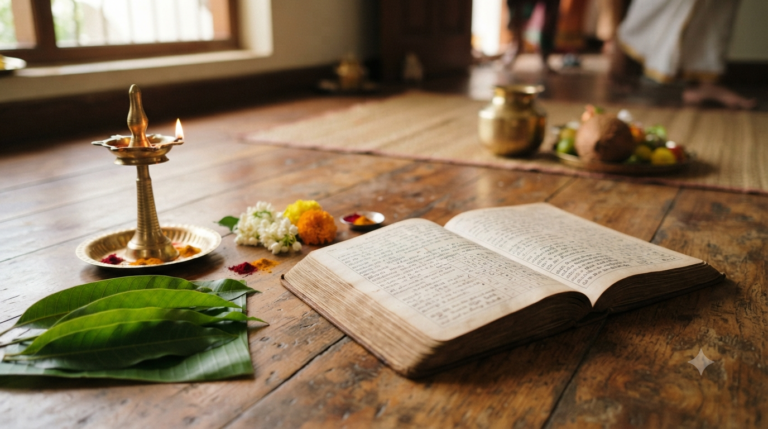
Plava Samvatsaram meaning becomes most visible during Ugadi because Ugadi marks the beginning of a new samvatsara in Telugu and Kannada tradition. Families clean the home, prepare festive food, perform worship, and listen to Panchanga Sravanam, the ceremonial reading of the new almanac.
During Panchanga Sravanam, the reader may explain the year name together with planetary positions, seasonal expectations, agriculture, rainfall, social conditions, and general rasi phala. These are part of a long-standing religious and astrological custom. They should be understood as traditional interpretation rather than scientific forecasting.
For more background, our guide to the significance of Ugadi explains why the festival marks renewal, while the Ugadi celebration procedure covers common household observances.
Plava Samvatsaram Meaning in a Panchangam
A panchangam does much more than print a year name. It records tithi, vara, nakshatra, yoga, karana, lunar months, festival observances, and often muhurta details. The samvatsara name appears as part of that larger calendar framework, so it should never be read in isolation.
Major religious institutions publish their own almanacs for devotees. Tirumala Tirupati Devasthanams has formally published a Plava Nama Samvatsara Telugu Panchangam, while Dakshinamnaya Sri Sharada Peetham, Sringeri maintains an official panchangam archive containing older editions.
Our separate Plavanama Samvatsara Sringeri Panchangam guide explains how to identify the genuine Sringeri archive. When checking any old PDF, confirm the publisher, samvatsara name, language, and regional tradition before relying on ritual timings.
Why Plava Is Mentioned in Sankalpa
Sankalpa is the formal statement of intention recited before many Hindu rituals. Depending on the tradition, it can identify the cosmic era, geographical setting, samvatsara, ayana, ritu, lunar month, paksha, tithi, weekday, and nakshatra before the devotee states the purpose of the worship.
The samvatsara name therefore works like one layer in a traditional timestamp. Saying Plava alone does not identify a complete date, but it narrows the calendar context. A priest then combines it with the other panchanga elements to place the ritual correctly.
This is why families may preserve a samvatsara name in birth notes or ceremony records. Even decades later, it can help reconstruct the traditional calendar setting when used with the remaining details.
Does Plava Have a Fixed Astrological Prediction?
No single prediction should be treated as the universal Plava forecast. Panchangam traditions may discuss annual themes through the samvatsara name, planetary rulership, Navanayaka positions, rainfall indicators, and other Jyotisha factors. Different schools can therefore emphasize different outcomes.
Some online pages simplify Plava into one promise, such as prosperity, wisdom, hardship, or recovery. That approach strips away the broader panchanga method. A responsible explanation separates the dictionary meaning of the word from the traditional annual reading produced by a particular astrologer or almanac.
Astrological yearly forecasts are matters of belief and interpretation. They should not replace professional advice for health, finance, law, or other high-stakes decisions.
Plava and Plavanga Are Not the Same
Plava and Plavanga are separate samvatsara names. They look similar in English transliteration, so people frequently mix them up when reading scanned panchangams or search results. However, they occupy different positions in the sixty-year list and should never be treated as interchangeable.
The linguistic meanings also differ. Sanskrit lexicons connect plava with floating, a raft, or a boat, while plavanga carries meanings linked with leaping and is also used for a monkey or ape in classical vocabulary. The shared opening letters do not make the two names identical.
Before using any almanac, read the full samvatsara name on the cover. This simple check prevents a surprisingly large number of calendar errors.
Plava Samvatsaram Meaning for Family Records
Plava Samvatsaram meaning can matter when a family record uses traditional calendar language instead of a modern date format. Birth notebooks, horoscope records, vrata notes, temple receipts, and ceremony documents may identify the samvatsara alongside tithi and nakshatra.
Because the sixty-year sequence repeats, the name must be combined with other evidence before identifying a modern calendar year. A samvatsara alone is not enough. The person’s age, lunar month, tithi, weekday, location, and family context can all help distinguish one cycle from another.
This becomes especially important for ceremonies linked to age milestones. When families prepare a Shashtiabdapoorthi or similar observance, a priest normally checks the current panchangam and the person’s birth details rather than relying on the repeated year name alone.
How to Read an Old Plava Panchangam Safely
An archived panchangam is useful for historical research, but it should not be treated as a current almanac. Follow a simple verification process before using an old Plava edition for family history or ritual research.
- Check the full year name. Make sure the cover says Plava and not Plavanga or another similar term.
- Identify the publisher. Prefer an original mutt, temple institution, or established panchangam publisher.
- Confirm the regional tradition. Telugu, Kannada, Tamil, and other calendars may organize observances differently.
- Match the location. Sunrise-based timings and some panchanga values vary by place.
- Use current material for current rituals. Do not copy an old muhurta, rahu kalam, or festival timing into present planning.
The safest habit is to treat an archive as evidence of the past. For a ritual you plan to perform now, use the latest edition issued for your tradition and location.
Common Misunderstandings About Plava
One common mistake is treating the word Plava as a guaranteed annual prediction. Its dictionary meaning does not automatically produce a fixed forecast. Another mistake is assuming every regional Hindu calendar uses the same samvatsara label in exactly the same way.
A third error is confusing Plava with Plavanga. The names are different, and a panchangam for one cannot substitute for the other. Finally, some readers treat a samvatsara as if it were identical to a January-to-December calendar year, although the Telugu year changes at Ugadi.
These distinctions may look small, yet they matter when checking a horoscope, sankalpa, family record, or archived panchangam. Always read the full calendar context instead of relying on a search snippet.
What the Traditional Meaning Can and Cannot Tell You
The traditional interpretation of Plava can add cultural meaning to Ugadi, Panchanga Sravanam, and family ritual memory. The image of a raft or boat naturally suggests movement and crossing. That symbolism can be spiritually meaningful without becoming a factual prediction about what must happen.
At the same time, the word cannot tell you a personal horoscope, a precise muhurta, or the outcome of an important decision. Those require other information, and some belong to faith rather than verifiable fact.
The most useful approach is therefore balanced. Plava Samvatsaram meaning is best understood through language, calendar tradition, and ritual context together. Consult the appropriate current panchangam whenever exact calendar details matter.
Plava Samvatsaram Meaning: Key Takeaway
Plava Samvatsaram meaning combines language, calendar tradition, and devotional interpretation. Literally, Plava can mean a raft, float, boat, or something that moves across water. Traditionally, it is also a named year within the South Indian sixty-year samvatsara cycle.
The symbolic idea of “crossing over” is meaningful in many devotional explanations, but it should remain clearly labelled as tradition. For ritual accuracy, always use the panchangam followed by your family, priest, mutt, or temple institution.
Frequently Asked Questions
What Is Plava Samvatsaram Meaning in Simple Words?
Plava Samvatsaram meaning comes from the Sanskrit word plava, which can mean a float, raft, canoe, boat, or small vessel. In the Hindu calendar context, Plava is also one of the named years in the recurring sixty-year samvatsara cycle.
Plava Samvatsaram Meaning: What Does Plava Symbolize?
Many traditional explanations connect Plava with crossing, movement, or passing through change because a raft carries someone across water. This is a symbolic devotional interpretation, not a guaranteed prediction about events.
Is Plava a Telugu Year Name?
Yes. Telugu panchangams use Plava as one of the samvatsara names in the traditional sixty-year cycle. The year name changes at Ugadi, so it is part of the Telugu New Year calendar framework.
What Number Is Plava in the 60-Year Cycle?
Plava is commonly listed as the thirty-fifth samvatsara in the South Indian sixty-year sequence used in Telugu panchangams. Regional calendar systems can differ in presentation, so the relevant panchangam should remain the final reference.
Are Plava and Plavanga the Same Samvatsara?
No. Plava and Plavanga are separate year names in the sixty-year sequence. Their spellings look similar, but they occur at different places in the cycle and should never be substituted for one another.
Why Is the Samvatsara Name Used in Sankalpa?
The samvatsara name forms one part of the traditional calendar description recited during sankalpa. It works together with the month, paksha, tithi, weekday, nakshatra, and other elements to identify the ritual time.
Can Plava Meaning Predict Personal Events?
No. A word meaning or general samvatsara interpretation cannot reliably predict a person’s individual future. Personal Jyotisha readings use additional birth and planetary information, and astrological claims should still be treated as matters of belief.
Where Should I Check an Authentic Plava Panchangam?
Use the archive of the institution or publisher that originally issued the almanac. Sringeri Sharada Peetham maintains an official panchangam archive, while TTD has also published Plava panchangam material for devotees.