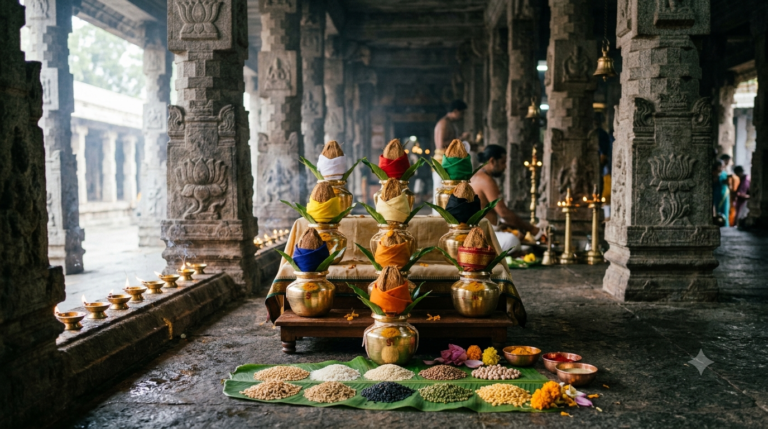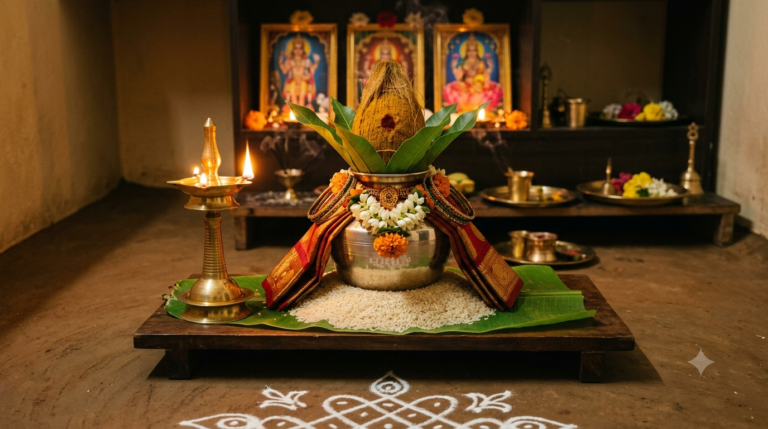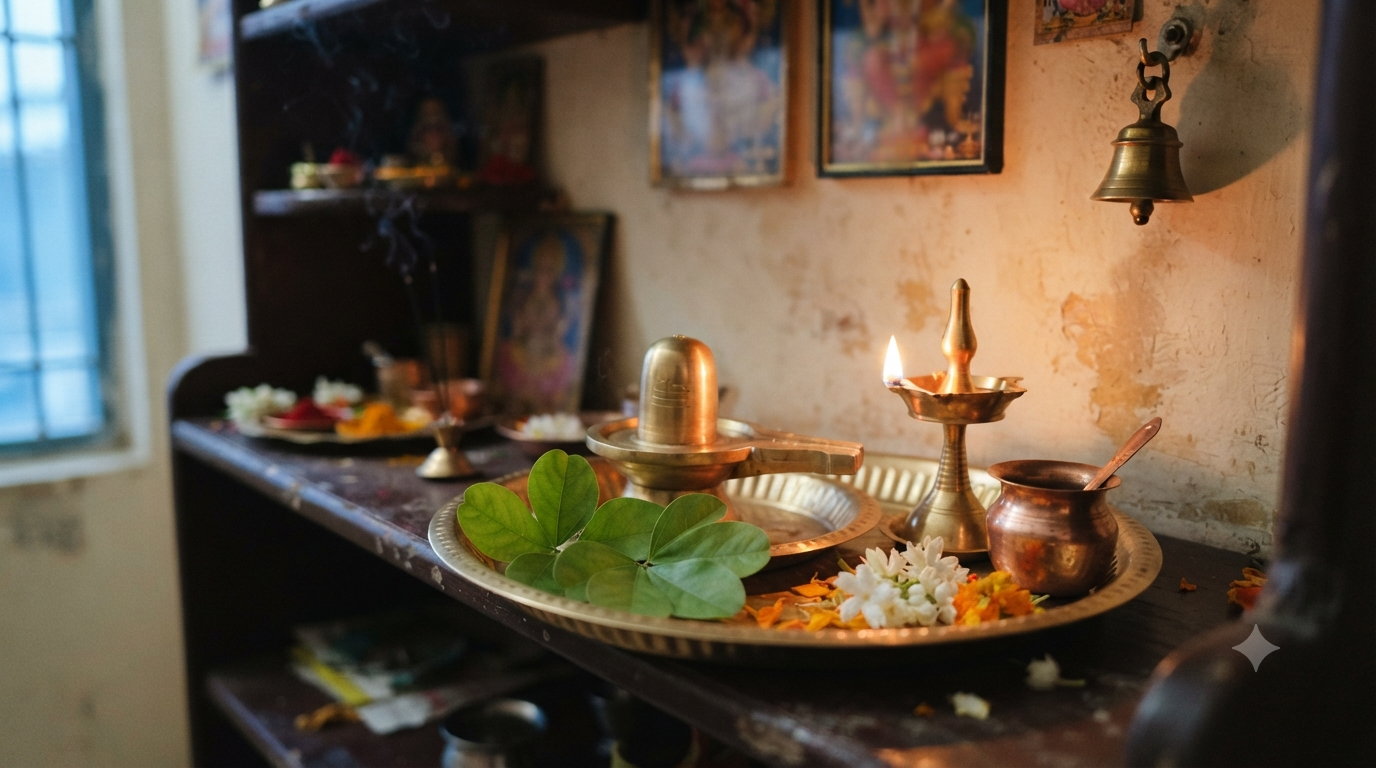
Most families who perform Pradosha Pooja at home get one detail wrong. It is rarely the mantra, and it is almost always the clock. Pradosham worship belongs to the short twilight that follows sunset, so a puja finished at four in the afternoon quietly misses the window it depends on. This guide gives you the correct hour, the samagri you actually need, the full step-by-step vidhi, and the small mistakes that spoil an otherwise sincere puja.
Sri Vyasa Pooja is an independent devotional guide. We are not the official website of any temple, trust, or government body, and we take no bookings, donations, or payments. For temple sevas, please use only the temple’s own official portal.
Pradosha Pooja at Home: Quick Facts
Use this short reference before you read the detailed vidhi below.
- Deity: Lord Shiva, worshipped along with Nandikeshwara.
- Day: Trayodashi, the thirteenth lunar day, twice in every lunar month.
- Hour: Pradosh Kaal, the twilight window tied to your local sunset.
- Core ritual: abhishekam, bilva leaves, a lit lamp, and mantra japa.
- Fast: either a full day-and-night fast, or one broken after the evening puja.
- Time needed: about 30 to 45 minutes for a simple home puja.
What Pradosham Actually Means
Plenty of pages split the word into “pra” and “dosha” and translate it as the removal of sins. That reading is devotional rather than linguistic, because the Sanskrit word pradosha simply means dusk, or the first part of the night. A few sites even trace the word to Hebrew, which it has no connection with at all.
So the name describes the hour, not the reward. That distinction matters practically, since it tells you the observance is anchored to a time of day rather than to a ritual formula. Once you understand that, the rest of the vidhi falls into place easily.
The best-loved story behind the day comes from the churning of the cosmic ocean. When the halahala poison rose and threatened creation, Shiva swallowed it, and Parvati held his throat so it could not descend. His throat turned blue, giving him the name Neelakantha. Tradition places that rescue at the pradosha twilight of Trayodashi, and the gods worshipped him in gratitude at that very hour.
When to Do Pradosha Pooja at Home
Do the main puja during Pradosh Kaal, the twilight window around sunset on Trayodashi. Drik Panchang defines that window as the period after sunset during which the Trayodashi tithi still prevails. Other panchangs stretch it from roughly ninety minutes before sunset to about an hour after. Follow whichever window your own city’s panchang prints.
Here is the part almost no guide explains. Because the window depends on the overlap between sunset and the tithi, it is not a fixed block of time. On Drik Panchang’s own Pradosham list, that usable overlap has run from under half an hour on some dates to nearly three hours on others.
So the familiar “one and a half hours around sunset” line is a rough average rather than a rule. On a short-window date, starting late can mean the tithi ends while you are still arranging the tray. Check the printed window first, then work backwards and keep everything ready before sunset.
Why Your City’s Pradosham Date Can Differ
Sunset drives the whole calculation, so two cities in the same state can observe Pradosham on different dates. When Trayodashi ends shortly before sunset in your town, the fast shifts to the previous day instead. Most calendar apps skip this step because city-wise computation is slow, and they publish one national list for everyone.
Always confirm the date for your own location before you fast. Our companion guide to Pradosha Vratam dates and Pradosh Kaal lists the year’s Pradosham days and explains the weekday types such as Soma and Shani Pradosham in detail.
What You Need for Pradosha Pooja at Home
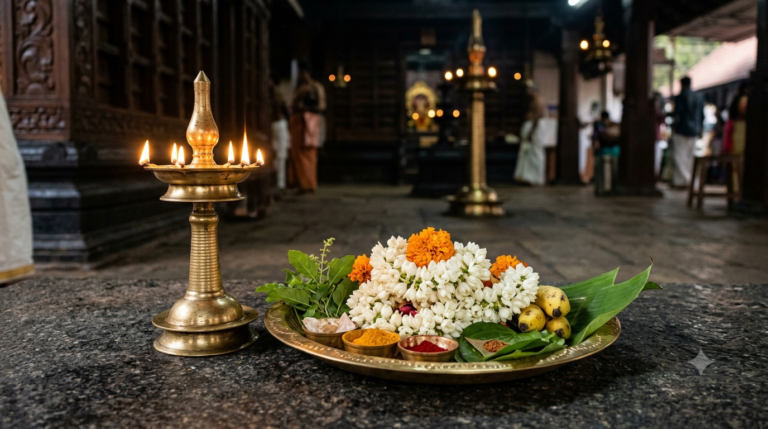
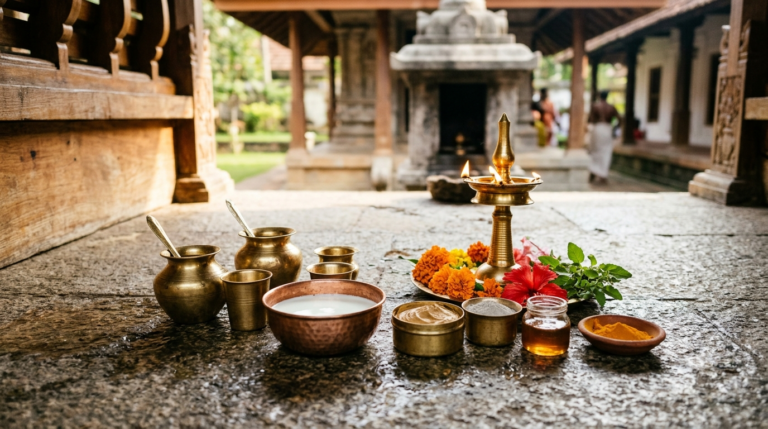
The samagri list for Pradosha Pooja at home is genuinely short. Shiva worship rewards simplicity, so nothing here needs a special shopping trip. Most households already own everything except the bilva leaves.
| Item | Why it is used | If you cannot get it |
|---|---|---|
| Bilva (bel) leaves | The offering tradition associates most closely with Shiva | One clean three-lobed leaf is enough; otherwise white flowers |
| Water in a small vessel | Jalabhishekam, the simplest and most complete abhishekam | Nothing needed, since plain water alone is fully valid |
| Milk, curd, honey, ghee, sugar | Panchamrita abhishekam on the lingam | Milk alone works when the rest is unavailable |
| Oil lamp with sesame oil or ghee | Lighting a lamp during the twilight window | A single wick in any clean lamp |
| Vibhuti and rudraksha | Worn by the devotee before the puja | Sandalwood paste on the forehead |
| Incense and camphor | Dhoopa, then the closing aarti | Incense alone is sufficient |
| Fruit or a light naivedyam | Offered before the fast is broken | A banana or a few dates |
Keep a wide plate or tray under the lingam so the abhishekam liquids collect neatly. That single habit makes the whole ritual easy in an apartment kitchen or a small pooja shelf.
How to Do Pradosha Pooja at Home, Step by Step
This is the sequence most South Indian households follow for Pradosha Pooja at home. Read it once fully before Trayodashi, because the evening itself moves quickly.
- Wake early, bathe, and wear clean clothes before you begin the day.
- Take a sankalpa, a short spoken vow to keep the day for Shiva.
- Do your usual morning pooja, then keep the day light and simple.
- Clean the pooja space in the afternoon and arrange the tray while there is still daylight.
- Bathe again about an hour before sunset, then apply vibhuti and sit facing north or east.
- When Pradosh Kaal begins, light the lamp first, then start the abhishekam with water.
- Follow with milk, curd, honey, ghee, and sugar if you are doing panchamrita, and finish with water again.
- Wipe the lingam dry, apply sandalwood paste, and place the bilva leaves with the smooth side down.
- Chant your chosen mantra, offer incense and the naivedyam, then complete the camphor aarti.
- Do a quiet pradakshina, sit for a few minutes, and break the fast afterwards if that is your vow.
Nothing in that list demands a priest. A householder performs the entire vidhi personally, which is precisely why the observance spread so widely.
Mantras to Chant During the Evening Puja
No mantra is mandatory for Pradosha Pooja at home. Om Namah Shivaya suits every devotee, since it needs no initiation and no Sanskrit training. Many families prefer Om Namo Neelakanthaya on Pradosham, because it recalls the blue throat and the poison the day commemorates. Both are appropriate, so choose the one you can repeat with attention.
The Maha Mrityunjaya mantra chanted 108 times is the classic longer option. Those trained in it also recite the Sri Rudram or the Pradosha Stotram after the abhishekam. If you lose count or stumble, simply continue, because steadiness of mind matters more than an exact tally.
What Tradition Says Not to Offer
Households across South India avoid a short list of items during Shiva worship. Tulsi leaves are kept aside, and so are ketaki and champa flowers, since each carries a story of a curse behind it. Kumkum and turmeric are also traditionally not applied to a lingam, and coconut water is not used for abhishekam.
Treat these as long-standing custom rather than as a pass-or-fail rule. The scriptural lists are shorter than the versions circulating online, and no honest tradition holds that a sincere puja is destroyed by one wrong leaf. Follow the custom your family follows, then let devotion carry the rest.
Pradosha Pooja at Home Without a Shiva Lingam
Yes, you can. A framed picture, a metal Shiva idol, or even a small clay lingam shaped by hand that evening all serve the purpose. What you cannot do is pour milk and water over a paper photograph, which is exactly where most first-timers get stuck.
When you have only a picture, place a small vessel of water in front of it and offer the abhishekam into that vessel while chanting. Many families instead set a betel nut or a turmeric cone on a plate as a symbolic lingam. A Narmada stone or a small brass lingam is worth acquiring later if the observance becomes regular for you.
Afterwards, pour the collected abhishekam liquid at the root of a garden plant rather than down the drain. Avoid the tulsi plant, since tradition keeps tulsi apart from Shiva offerings. That one small act of care is the mark of a household that understands the ritual.
What to Do If You Miss Pradosh Kaal
The merit of the observance is tied to the twilight window, so nothing else claims equal standing. That said, a missed window is not a failure, and there are sensible fallbacks. Work down this list in order.
- Still inside the window, but late: shorten the puja instead of skipping it. One lamp, water abhishekam, a bilva leaf, and eleven repetitions of Om Namah Shivaya complete it honestly.
- The window has closed: do the puja that night as an ordinary Shiva puja, without claiming Pradosham merit for it.
- You are travelling or unwell: light a single lamp wherever you are and chant. Tradition holds that Shiva accepts the lamp itself.
- You want the full ritual: visit a Shiva temple at the next Pradosham, when priests perform the Nandikeshwara abhishekam properly.
- You missed the day entirely: the next Pradosham arrives in roughly a fortnight, so simply keep that one.
There is no fee, no registration, and no booking involved anywhere in this. Anyone asking you to pay a private website for a “pradosham slot” is selling something the tradition never required.
Common Mistakes in Pradosha Pooja at Home
These are the errors that show up again and again in households new to the observance.
- Using a national date list: your city’s sunset decides the day, so verify it locally before fasting.
- Doing the puja in the morning: the morning worship is preparatory, while the twilight puja is the observance itself.
- Starting exactly at sunset with nothing ready: arrange everything an hour earlier, because short windows leave no margin.
- Fasting harder than your body allows: a vrat is a discipline, and it was never meant to be a medical risk.
- Paying a random site for a remote pooja: book sevas only through a temple’s own official portal, and never share card details with an unfamiliar page.
A Tip Most Guides Skip
When Ekadashi and Pradosham land on consecutive days, you can still keep both. Drik Panchang suggests a symbolic Ekadashi parana with water alone, after which the Pradosham fast simply continues. At a temple, remember the somasutra rule too: walk clockwise up to the abhishekam outlet, then turn back rather than stepping across it.
Fasting Rules and a Health Note
Fasting supports Pradosha Pooja at home, though it never replaces the evening puja. Two forms are both traditional, and the Skanda Purana describes each. Some devotees keep a strict fast through the day and night, including a vigil. Others fast from sunrise until the evening puja, then break it with fruit, milk, or a light sattvic meal.
Choose the version your body can sustain calmly. If you are pregnant, elderly, diabetic, on regular medication, or recovering from illness, keep a partial fast and continue drinking water. Speak with your doctor before attempting a long fast, since a vratam is an act of devotion and never a treatment for any condition.
Home Puja or Temple Visit?
Both are valid, so the choice is practical rather than spiritual. A home puja gives you the right hour without traffic, which matters when the window is short. A temple gives you the Nandikeshwara abhishekam and the procession that no household can replicate.
If you live near a Shiva temple, alternate between the two through the year. Devotees who observe other Shiva fasts often pair this with Karthika Somavaram Vratham, while Masa Shivaratri falls on the very next tithi each month.
Before Your Next Pradosham
Pradosha Pooja at home rewards two things above all: the right day for your city, and the right hour on that day. Fix both first, then keep the ritual itself simple, because the tradition was designed for households rather than specialists.
Prepare the tray in daylight, light the lamp as the window opens, and let the fast match your health rather than a stranger’s rulebook. Do that each fortnight and the observance becomes a quiet anchor in your calendar. For city-wise timings, a location-aware panchang remains the source worth trusting, and you can read more background on Lord Shiva there as well.
Frequently Asked Questions
What time should I start Pradosha Pooja at home?
Start as Pradosh Kaal opens, which is the twilight window tied to your local sunset on Trayodashi. Many panchangs print the exact minutes for your city. As a rough guide, be ready about thirty minutes before sunset, since some windows are unusually short.
Can I do Pradosha Pooja at home without a Shiva Lingam?
Yes. A picture, a metal idol, or a hand-shaped clay lingam all work. Offer the abhishekam into a vessel placed before a picture rather than pouring liquids over it. The tradition values sincerity far above the material of the image.
Is fasting compulsory for Pradosha Pooja at home?
No, fasting is recommended rather than compulsory. The evening puja during Pradosh Kaal is the essential part of the observance. Many devotees keep a partial fast, and anyone with a health condition should choose the lighter option.
Which mantra suits Pradosha Pooja at home?
Om Namah Shivaya suits everyone and needs no initiation. Om Namo Neelakanthaya is a popular Pradosham choice because of the halahala legend. Those trained in it may add the Maha Mrityunjaya mantra 108 times after the abhishekam.
Can women perform the Pradosham puja at home?
Yes, women observe Pradosham widely, and many households keep the fast together. There is no restriction on who may light the lamp or chant. Families follow their own customs around menstruation, so simply do what your household practises.
Do I need a priest for the puja?
No priest is needed for a home observance. The vidhi is deliberately simple, so a householder can complete it alone in under an hour. Engage a purohit only if you want an elaborate Rudrabhishekam, and arrange it through a temple or a known priest directly.
What if I forget and miss the twilight window?
Do a simple Shiva puja that night without claiming Pradosham merit, then keep the next one. Pradosham returns roughly every fifteen days, so nothing is permanently lost. Setting a phone reminder for the printed window solves this for good.
Why do calendars show different Pradosham dates?
Because the day depends on local sunset, the date can shift by one day between cities. When Trayodashi ends just before sunset, the fast moves to the previous day. A location-aware panchang gives you the correct date for where you live.