The Chandi Homam procedure is one of the most powerful fire rituals in the Shakta tradition, yet most online guides quietly skip its single most important rule. Many pages happily explain how to perform it at home. Experienced priests say the exact opposite. This guide walks you through the full ritual, its meaning, the best days, realistic costs, and where devotees actually get it done — so you finish reading with nothing left to search.
Sri Vyasa Pooja is an independent temple-guide website. We are not affiliated with any temple or trust, and we do not take bookings, donations, or payments. For any homam, please book directly through the temple’s official channel linked below.
The Ritual at a Glance
- What it is: a Vedic fire ritual to Goddess Chandi, a fierce form of Durga.
- Core text: all 700 verses of the Durga Saptashati, also called the Devi Mahatmyam.
- Main mantra: “Aim Hrim Klim Chamundaye Vichche”.
- Typical duration: about 5–6 hours for a Nava Chandi, while larger versions run 1–3 days or more.
- Best time: Navaratri, especially Ashtami and Navami, and also Tuesdays and Fridays.
- Setting: the full Chandi Homam procedure belongs in a Durga temple, not at home.
What Is Chandi Homam?
Chandi Homam is a Vedic fire ritual that invokes Goddess Chandi, the fierce and protective form of Goddess Durga. Throughout the ceremony, priests chant all 700 verses of the Durga Saptashati and pour offerings into the sacred fire. Devotees hold it to remove obstacles, gain protection, and invite prosperity.
The ritual draws its power from the Devi Mahatmyam, also called the Durga Saptashati. This text sits within the Markandeya Purana. Its verses narrate how the Goddess defeated Mahishasura, Shumbha, Nishumbha, and Raktabeeja. Because tradition treats each verse as a living mantra, an offering follows every recitation.
Devotees worship Chandi as the combined energy of Mahakali, Mahalakshmi, and Mahasaraswati. So the homam becomes an appeal to the complete power of the Divine Mother. This is why it ranks among the maha-homams, the great fire rituals kept for serious intentions.
The Chandi Homam Procedure, Step by Step
The Chandi Homam procedure follows a fixed sequence that experienced priests never rush. While small details vary by region and by mutt, the backbone stays the same. Here is how a typical ritual unfolds from start to finish.
- Anujna and Achamana: the priest seeks the Goddess’s permission, then purifies himself with sipped water and mantras.
- Pranayama and Sankalpa: controlled breathing steadies the mind, after which the sponsor takes a vow naming the purpose, place, and date.
- Ganapati Puja: priests honour Lord Ganesha first, since no ritual can start until he clears the obstacles.
- Punyahavachanam and Kalasha Sthapana: the priest sanctifies water and installs a sacred pot to invite the Goddess.
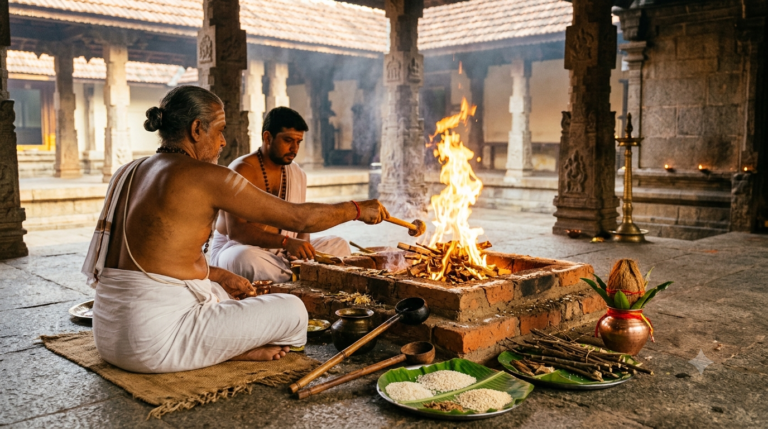
- Agni Prathishthapana: the priest kindles the fire in the homa kunda using camphor, dried coconut, and darbha grass.
- Navagraha and Digpalaka Puja: priests invoke the nine planets and the guardians of the eight directions for balance.
- Kanya and Suvasini Puja: the family honours young girls and married women as living forms of the Goddess.
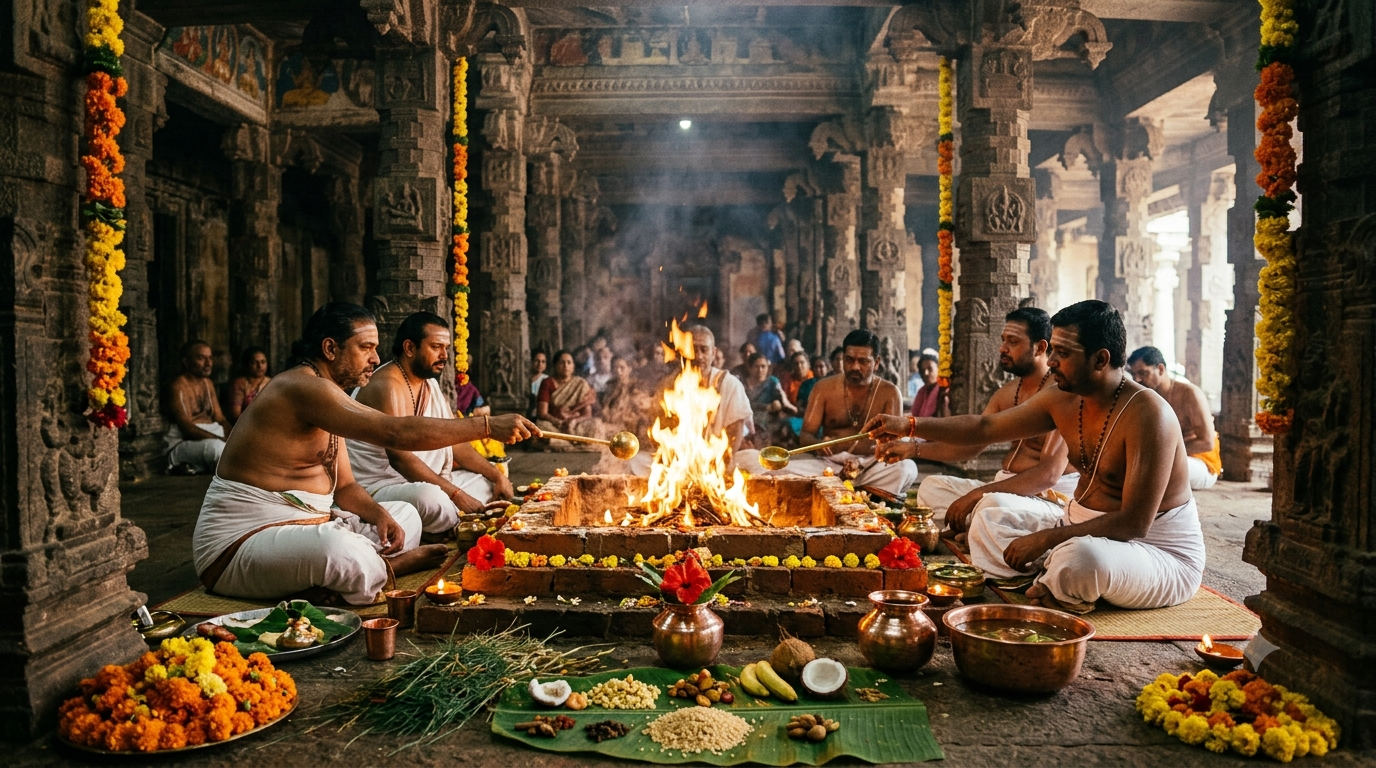
- Durga Saptashati Parayanam: priests chant all 700 verses and drop an ahuti into the fire with each one.
- Main Homam and Poornahuti: the grand final offering seals the ritual, followed by prayers of thanks.
- Rakshaa and Prasadam: the priest shares protective sacred ash, and blessed prasadam then goes to everyone present.
The heart of the whole ceremony is the Saptashati chanting. When each of the 700 verses meets its own offering, the fire and the mantra work together. This pairing is what makes the ritual so demanding to conduct correctly.
How Long Does the Chandi Homam Procedure Take?
A basic Chandi Homam procedure usually takes about five to six hours when priests perform a single Nava Chandi in one sitting. Larger versions stretch across several days. The exact length depends on how many times the Saptashati is chanted.
Here lies a myth worth correcting. Old texts describe Chandi Homam as a nine-day observance. Today most families complete it in one to three days, because a full nine-day rite needs many priests and heavy resources. Neither version is “incomplete” — the scale simply matches the intention and the budget.
Types and Their Scale
Tradition classifies the homam by how many times the Durga Saptashati is chanted. More recitations mean more priests, more days, and a higher cost. The table below sums up the main types at a glance.
| Type | Saptashati recitations | Typical scale |
|---|---|---|
| Nava Chandi | 9 times | 1 day, around 11 priests |
| Shata Chandi | 101 times | 2–3 days, 40–50 priests |
| Sahasra Chandi | 1,001 times | 4–5 days, 200–300 priests |
| Ayuta Chandi | 10,001 times | Week-long, 1,000+ priests |
For a single family, Nava Chandi is the usual choice, since it covers most personal needs in one day. Communities and large temples take on the Shata and Sahasra versions for collective welfare. So the type you pick should follow your intention, not just your budget.
Significance and Benefits Behind the Chandi Homam Procedure
Devotees believe the Chandi Homam procedure removes obstacles, clears negative energy, and grants courage, health, and prosperity. In the Shakta tradition, it stands among the strongest ways to seek the Divine Mother’s protection. These outcomes are matters of faith rather than guaranteed results.
Families often turn to it during hard phases — a stalled career, repeated setbacks, illness at home, or a long run of bad luck. Because the ritual invokes Durga in both her fierce and nurturing aspects, tradition links it to protection as well as growth. That said, it remains a spiritual practice, not a substitute for medical, legal, or financial help.
Astrologers sometimes suggest it as a parihara for certain doshas. When a horoscope points to such remedies, a Chandi Homam is one traditional option among several. You can explore related remedies in our guide to Kukke Subramanya dosha parihara poojas.
Best Days to Perform the Ritual
Navaratri is the most auspicious window, above all on Ashtami and Navami. Outside Navaratri, Tuesdays and Fridays suit the Goddess, while full-moon days in the Chaitra and Karthika months are also favoured. Priests prefer to begin after sunrise and finish before sunset.
Because good muhurtas fill fast during Navaratri, booking early truly matters. Most temples advise reserving a slot at least seven to ten days ahead. So fix the date first, then gather your materials.
Samagri and Dress Code
The samagri list is long, since the fire needs many specific offerings. Common items include ghee, sesame seeds, navadhanya (nine grains), darbha grass, camphor, dried coconut, fruits, jaggery, honey, turmeric, kumkum, betel leaves, and flowers. Temples usually supply these when you book the homam there.
The dress code stays traditional. Men wear a dhoti with an upper cloth, or a kurta, while women wear a saree or a salwar kameez with the pallu in place. Jeans, t-shirts, and casual wear are not allowed near the homa kunda.
Should You Perform Chandi Homam at Home?
Most experienced priests advise against performing Chandi Homam at home. It is an elaborate, high-energy ritual that needs several trained priests, a proper homa kunda, and precise chanting. A Durga temple is the recommended setting.
Smaller homams like Ganapati Homam can be done at home with one priest. Chandi Homam is different, because the sheer volume of chanting and the fierce energy invoked call for a controlled temple environment. So the safest and most traditional route is to arrange it at a Shakti temple rather than in a flat or house.
Where to Perform Chandi Homam
Several famous Durga temples run the complete Chandi Homam procedure through official channels. At the Srisaila Devasthanam, it is offered as a Paroksha (remote) seva, so even distant devotees can sponsor one. The Kanaka Durga temple in Vijayawada also conducts Chandika Homam among its sevas.
In Karnataka, the Mysore Chamundeshwari temple runs a Chandika Homam you can arrange online. Telangana devotees often choose the Alampur Jogulamba temple’s Chandi Homam, since it is one of the Ashtadasha Shakti Peethas. Kollur Mookambika stays popular for the larger Sahasra Chandi versions.
Tips Most Guides Skip
A little preparation makes the whole day smoother. These small points come from what regular sponsors learn the hard way.
- Ask how many priests will chant. A real Nava Chandi needs a group, so a “homam” run by one priest is usually a smaller puja instead.
- Confirm the Saptashati count. The number of parayanas decides whether you get a Nava, Shata, or Sahasra Chandi, and the price should match.
- Carry a box for the rakshaa. The priest hands you protective ash at the end, so bring a small clean container for it.
- Reach before the fire starts. The Sankalpa needs your name and gotra, so arrive early rather than midway through.
- Keep the official receipt. Book only through the temple counter or its official portal, and then hold on to the receipt.
Cost, Health, and Safety Notes
Cost varies widely, so treat any figure as indicative. A basic Nava Chandi at many temples runs roughly ₹15,000 to ₹30,000, while Shata and Sahasra versions climb into lakhs because of the priest count. Always confirm the current amount on the temple’s official portal before you commit.
A homam also carries real physical elements worth respecting. You sit close to an open fire for hours, in smoke and heat. So keep water handy, choose a ventilated spot, and take breaks when needed. Elderly devotees, pregnant women, and anyone with breathing or heart conditions should take extra care, and check with a doctor when in doubt.
One more caution deserves plain words. A homam is a faith practice, not a medical treatment. Never stop prescribed medicine or delay professional care in the belief that a ritual alone will cure an illness. Keep the two entirely separate.
Before You Book
The Chandi Homam procedure is elaborate, meaningful, and best handled by experienced priests at a Durga temple. Choose a Nava Chandi for personal needs, pick an auspicious day during Navaratri if you can, and reserve your slot early. Confirm the cost and timings directly with the temple. Above all, approach the ritual as devotion rather than a guaranteed fix, and let a qualified priest guide every detail.
Frequently Asked Questions
What is the main purpose of Chandi Homam?
Chandi Homam invokes Goddess Chandi to remove obstacles, clear negative energy, and seek protection, health, and prosperity. Devotees often perform it during difficult phases or for general welfare. The benefits are matters of faith and tradition, not guaranteed outcomes.
Can Chandi Homam be performed at home?
Most priests advise against it. The ritual needs several trained priests, a proper homa kunda, and long, precise chanting. Because of that, a Durga temple is the recommended and safer setting.
How many days does Chandi Homam take?
A Nava Chandi usually finishes in a single day, often within five to six hours. Larger Shata and Sahasra versions run two to five days. The old nine-day form is rare today.
Which is the best day for Chandi Homam?
Navaratri is the most auspicious time, especially Ashtami and Navami. Tuesdays, Fridays, and full-moon days in Chaitra and Karthika are also favoured. Priests prefer daytime, finishing before sunset.
How much does Chandi Homam cost?
A basic Nava Chandi at many temples ranges from about ₹15,000 to ₹30,000. Shata and Sahasra Chandi versions cost lakhs, since they use far more priests. Confirm the exact price on the temple’s official portal before booking.
Who can perform or sponsor Chandi Homam?
Both married and unmarried devotees can sponsor a Chandi Homam. There is no restriction based on marital status. Qualified priests carry out the actual chanting on your behalf.
What is chanted during the Chandi Homam procedure?
Priests recite all 700 verses of the Durga Saptashati, also called the Devi Mahatmyam. An offering goes into the fire with each verse. The core mantra is “Aim Hrim Klim Chamundaye Vichche”.
Is Chandi Homam the same as Chandika Homam?
Yes, Chandi Homam and Chandika Homam are the same ritual under different names. Some regions also call it Chandi Yagam or Devi Chandi Homam. All of them centre on the Durga Saptashati.