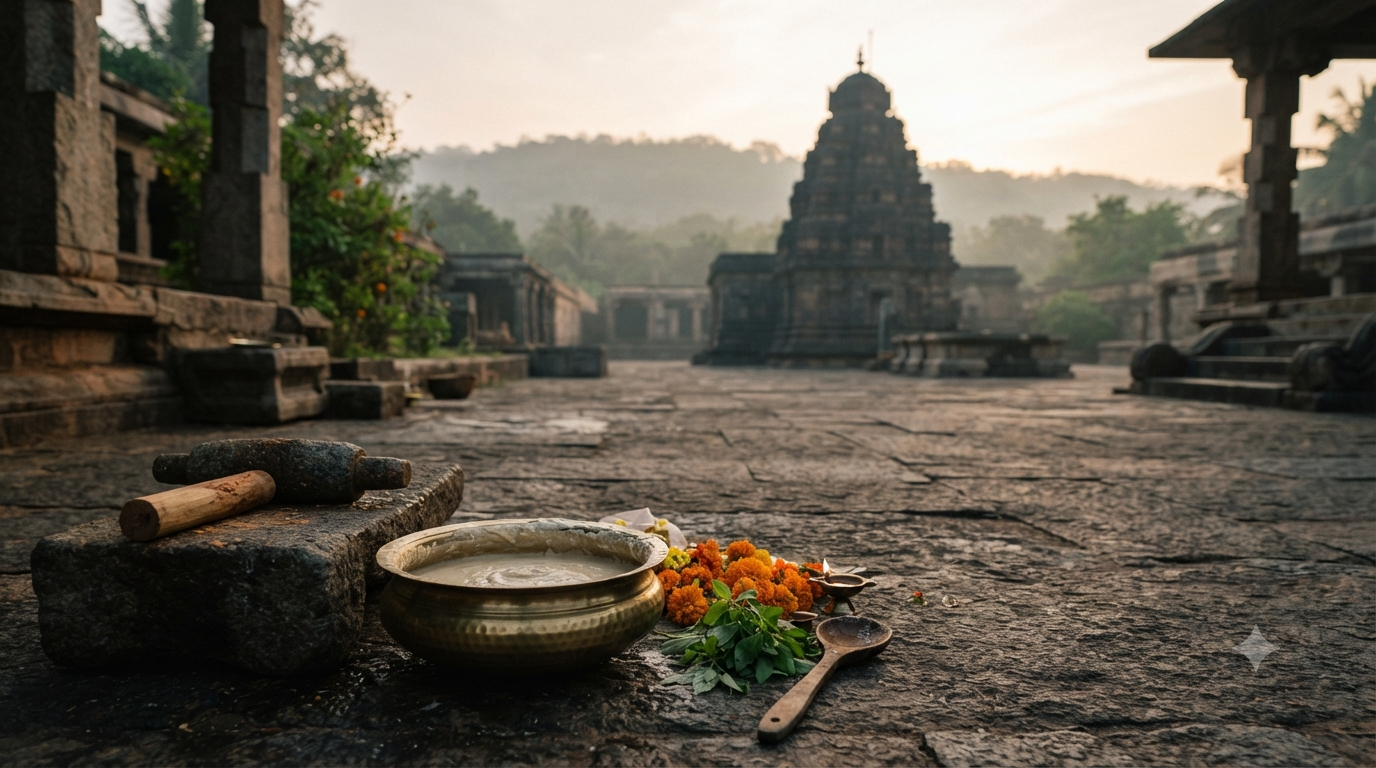
The significance of Simhachalam Chandanotsavam rests on one rare window each year. For most of the year the moolavar of Sri Varaha Lakshmi Narasimha Swamy stays sealed under chandanam, and because that layer runs thick, the deity looks more like a lingam than a sculpted murti.
Then, before dawn on Akshaya Tritiya, priests scrape the paste away, and the original stone form stands open for roughly twelve hours. Lakhs of devotees plan an entire year around those hours.
Independence note: Sri Vyasa Pooja is an independent devotional guide. We are not affiliated with, endorsed by, or the official website of Sri Varaha Lakshmi Narasimha Swamy Devasthanam. We take no bookings, sevas, donations or payments. Use the official portals linked in this article.
Significance of Simhachalam Chandanotsavam at a Glance
- In one line: the significance of Simhachalam Chandanotsavam is that the sandalwood comes off, once a year, for everyone to see.
- What happens: priests remove the covering and reveal the deity’s nijaroopam, or original form.
- When: on Akshaya Tritiya, in Vaisakha month, so it lands in April or May.
- How long: about 12 hours of nijaroopa darshanam, after which the paste goes back on.
- Where: Sri Varaha Lakshmi Narasimha Swamy Devasthanam, Simhachalam Hill, Visakhapatnam district, Andhra Pradesh.
- Scale: officials planned for well over a lakh of devotees in April 2026, so crowds dominate the practical planning.
- Who runs it: the Simhachalam Devasthanam board, under the Andhra Pradesh Endowments Department.
What Is the Significance of Simhachalam Chandanotsavam?
The significance of Simhachalam Chandanotsavam is that it is the only day devotees see the presiding deity’s actual carved form. Sandalwood paste hides the murti for the rest of the year. Priests lift that covering before sunrise on Akshaya Tritiya. Roughly twelve hours of nijaroopa darshanam follow, and then fresh chandanam goes back on.
That framing matters, because it separates this festival from every other utsavam in Andhra Pradesh. Elsewhere a festival adds something: a chariot, a wedding, a procession. Here the festival takes something away, and that subtraction is what pilgrims travel for.
The theology behind it is cooling. Devotees hold that sandalwood calms Narasimha’s ugra, or fierce, aspect. So the covering works as protection rather than concealment. Because the shell comes off only once, devotees count that sight as rare merit.
The Legends Behind the Significance of Simhachalam Chandanotsavam
Two stories explain the custom. One is puranic and one is historical, and the historical one is the more interesting of the pair.
The instruction Urvasi received
The sthala purana says the shrine Prahlada built fell into ruin over ages. Later, king Pururava and Urvasi located the buried idol and restored it. A divine voice then told them to cover the deity with sandalwood paste all year. It named one exception: the third day of Vaisakha.
Whether you read that as history or as revelation, the practice has held for centuries. That single exception clause is the whole significance of Simhachalam Chandanotsavam.
Why Ramanuja put the paste back
In the eleventh century, scholars disputed the shrine’s identity. A lingam-shaped deity in a complex with a gate called Bhairava Dwaram looked Shaiva to many. Ramanuja argued from the Pancharatra Agama that the murti was Vaishnava, and he won the debate.
He then ordered the paste removed permanently. Temple tradition records that the idol began to bleed during the work. Priests restored the paste, the bleeding stopped, and the annual rhythm survived untouched. Whatever you make of the account, it explains why nobody abolished the covering.
What the Nijaroopa Darshanam Actually Reveals
Here is where the significance of Simhachalam Chandanotsavam turns concrete, and where most pages online go wrong. Simhachalam’s moolavar is a composite Varaha–Narasimha murti. It is not a standard lion-headed Narasimha.
Scholarly descriptions record a boar’s head on a human torso, with a lion’s tail. The deity stands in tribhanga posture. Sridevi and Bhudevi flank it, each holding a lotus. The stone itself rises roughly two and a half feet, while the sandalwood build-up reaches about four feet.
The sculpture carries no carved ornaments or drapery, and historical vandalism damaged its limbs and face. The deity wears only four ornaments. These are a diamond-and-ruby thirunamam, an emerald chain, a hundred-tola gold bracelet and a golden crown.
So the twelve-hour darshan is not a scenic reveal of a decorated idol. Instead you see a plain, weathered, unusual stone that almost nobody sees. That plainness is exactly why devotees describe the moment as sobering.
Four Applications, One Removal: the Chandanam Calendar
A widely repeated error claims the temple applies sandalwood once a year at Chandanotsavam. That is wrong. Priests build the paste up in four stages across the year, while the removal happens only once, which is the detail almost every summary drops.
| Occasion | What happens | Month |
|---|---|---|
| Akshaya Tritiya | Covering removed, nijaroopa darshanam, first fresh application | April or May |
| Vaisakha Purnima | Second application | May |
| Jyeshta Purnima | Third application | June |
| Ashadha Purnima | Fourth application | June or July |
Each application uses four manugulu of chandanam. A manugu is an old Telugu weight of roughly 24 pounds. So one application runs to about 43 kilograms of sandalwood paste. Across four rounds the deity therefore takes on well over 150 kilograms in a year.
Temple literature records that the sandalwood traditionally comes from Srivilliputhur in Tamil Nadu. That detail explains why the temple treats the material as a major annual procurement, not a token offering.
How Chandanotsavam Day Unfolds, Hour by Hour
The published ritual sequence has stayed consistent for decades, although crowd-management timings shift year to year.
- Around 4:00 am: priests begin removing the sandalwood covering from the moolavar.
- By about 6:00 am: they finish the abhisheka and the prayers.
- After that: devotees enter the sanctum for nijaroopa darshanam. In heavy years the queues open far earlier than the temple’s normal hours.
- Through the day: darshan continues, while the temple suspends its usual daytime food offerings.
- Evening: bathing services begin, notably Chandanabhisheka and Sahasrakalasabhisheka with water from a thousand metal pots.
- Late evening: priests serve Balabhoga, Rajabhoga and the night offering together, making up for the offerings they omitted during the day.
- Then: they apply fresh chandanam, and the year-long covering begins again.
Because the day’s ritual load is unusual, the temple’s regular timings do not apply. Anyone planning around normal darshan hours is planning around the wrong schedule.
When Chandanotsavam Falls, and Why the 2027 Date Is Contested
Chandanotsavam follows Akshaya Tritiya, which falls on Shukla Paksha Tritiya in Vaisakha. Since that is a lunar tithi, the Gregorian date moves every year. In 2025 it fell on 30 April. In 2026 the Devasthanam observed it on Monday, 20 April.
For 2027 the panchangams do not agree. The Tritiya tithi runs from late morning on Saturday 8 May 2027 until about 9:03 am the next day, in Indian time. Sources applying a madhyahna rule place Akshaya Tritiya on 8 May. Drik Panchang and several India-baseline calendars place it on Sunday 9 May.
We are not publishing a single hard date for 2027, because two credible methods point to two different days. The Devasthanam announces the confirmed date each year, usually several weeks ahead. Treat 8–9 May 2027 as the window, then confirm before booking travel.
One further caution applies to every lunar festival date. Never carry last year’s date forward, since a leap month can shift a festival by roughly four weeks. Notice that 2025’s 30 April and 2026’s 20 April sit ten days apart. That gap is exactly why a copied date fails.
The Significance of Simhachalam Chandanotsavam for Devotees Today
Devotees associate Simhadri Appanna with the granting of progeny and the fulfilment of long-held wishes. Families who believe a child came through this prayer often name that child after the hill or the deity. In the Mukha mandapa stands the Kappam Stambham, a pillar devotees embrace while making such prayers.
These are matters of faith and Vedic tradition rather than verified outcomes, and the temple presents them that way. No ritual at Simhachalam replaces medical care. So treat fertility, health or recovery decisions as questions for a qualified doctor.
Historically the day carried civic weight too. At least forty inscriptions in the temple complex record gifts made on this occasion. That tells you the festival was already a fixture centuries ago.
What Competing Pages Get Wrong About the Significance of Simhachalam Chandanotsavam
Four errors circulate widely, and two of them can cost a pilgrim money. Together they blur a distinctive ritual into a generic temple-festival story.
- “The deity is lion-headed.” The murti is a Varaha–Narasimha composite, and that composite is the whole point of the shrine.
- “Sandalwood goes on once a year.” The temple applies it four times. Only the removal is annual.
- “The official site is simhachalamdevasthanam.net.” That domain sounds official, yet its own footer states it has no relation to any trust or organisation. It publishes exam results and general news updates.
- “Book Chandanotsavam VIP darshan here.” Any private page selling festival darshan is not the Devasthanam. Official channels alone handle nijaroopa darshan arrangements.
For anything transactional, use the Devasthanam’s own site at svlnsd.com. The Government of Andhra Pradesh temple portal at aptemples.ap.gov.in covers state-run temples. For tithi verification, Drik Panchang publishes Akshaya Tritiya timings year by year.
If You Plan to Attend: What Can Go Wrong
Chandanotsavam darshan is not guaranteed, and pretending otherwise helps nobody. Capacity stays finite while demand runs into lakhs. So the significance of Simhachalam Chandanotsavam earns you no slot by itself.
In 2026 the Devasthanam opened a paid nijaroopa darshan ticket window roughly a week before the festival. Reported tiers sat around ₹300 and ₹1,000. Those figures are indicative and change, so confirm current tiers on the official portal. Miss the short booking window and the paid route simply closes.
Access gets restricted too. Officials barred private vehicles from the hill in 2026 and ran APSRTC shuttle services instead. Assume similar restrictions, and plan for shuttle queues rather than parking.
If the paid route closes, three fallbacks remain. Join the free sarva darshan queue and budget several hours for it. Or attend the evening rituals instead, since Sahasrakalasabhisheka is itself a significant sight.
The third option is simply another day. Visit on an ordinary date for regular darshan, accepting that chandanam will cover the deity. For the ticketing mechanics, our guide on how to book Simhachalam darshanam tickets walks through the steps.
Notes From the Hill That Guides Rarely Mention
April and May on the Andhra coast are punishing, and the queue runs largely outdoors. Carry water, oral rehydration salts and a cap, because heat exhaustion is the most common medical problem on festival day.
Elderly pilgrims, pregnant women and anyone with a heart or blood-pressure condition should speak to a doctor first. A long queue in that heat is demanding, and so is the thousand-step climb from Bhairava Dwaram.
Mobile phones and cameras are generally not permitted inside, so plan a cloakroom stop. Wear traditional dress. Since staff keep the sanctum route moving on festival day, the darshan itself lasts seconds rather than minutes.
One quieter suggestion: consider Giripradakshina, on the Ashadha full moon. That circumambulation of the hill runs roughly 30 kilometres and draws a devoted crowd without the Chandanotsavam crush. For fuller background, see our Simhachalam temple history guide, and for route and stay logistics our Chandanotsavam travel guide.
Before You Go: the Significance of Simhachalam Chandanotsavam in Short
The festival justifies the effort, yet the day rewards preparation more than enthusiasm. Fix the date from the Devasthanam’s own announcement rather than from a blog. Sources dispute 2027 in particular, between 8 and 9 May. Watch for the ticket window, which opens late and closes fast.
Then set expectations honestly. You are queuing for a brief look at a small, damaged, extraordinary stone. For most devotees, that is precisely the point.
Frequently Asked Questions
What is the significance of Simhachalam Chandanotsavam in one line?
It is the only day each year when priests remove the sandalwood covering, letting devotees see the deity’s original form for about twelve hours. Every other day the murti stays hidden under chandanam.
When is Chandanotsavam 2027?
It falls on Akshaya Tritiya, which panchangams place on either Saturday 8 May or Sunday 9 May 2027. Because the sources disagree, wait for the Devasthanam’s announcement before you book travel.
How long does nijaroopa darshanam last?
Roughly twelve hours. Priests remove the covering around 4:00 am and finish the rituals by about 6:00 am. Devotees then enter until the evening services begin.
Is the Simhachalam deity Narasimha or Varaha?
Both, in one murti. Temple accounts describe a boar’s head on a human torso with a lion’s tail, in tribhanga posture. Hence the name Varaha Lakshmi Narasimha Swamy.
How much sandalwood goes on the deity?
Priests apply four manugulu each time, on four occasions a year. Since a manugu weighs about 24 pounds, that works out to roughly 43 kilograms per application and over 150 kilograms annually.
Can I book Chandanotsavam darshan online?
Arrangements vary by year. In 2026 a paid nijaroopa darshan ticket window opened about a week before the festival. Check the Devasthanam and Andhra Pradesh Endowments portals rather than third-party sites.
Can I drive up the hill on Chandanotsavam day?
Usually not. Officials restricted private vehicles in 2026 and ran shuttle buses instead, so plan for public transport and long queues.
Why does the significance of Simhachalam Chandanotsavam tie to Akshaya Tritiya?
The temple’s legend names the third day of Vaisakha as the single exception to the year-round covering. Akshaya Tritiya is that tithi, so the festival has always followed it.
Is Chandanotsavam a good day for a first visit?
Only if you specifically want the nijaroopa darshan. For a calm first visit, an ordinary weekday works far better, though chandanam will cover the deity.