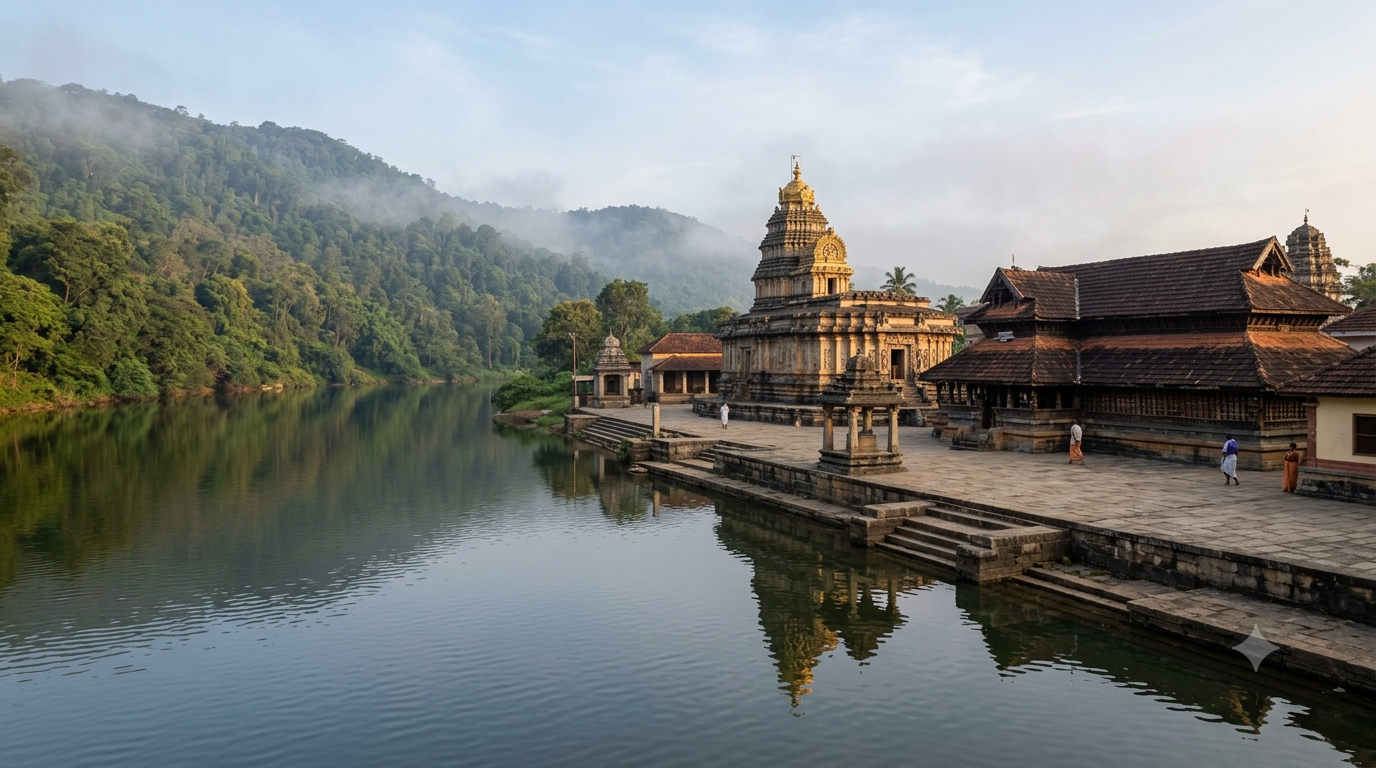
The Sringeri Sharada Peetham significance is simple to name yet easy to underestimate. This was the first monastery Adi Shankaracharya founded, and it still anchors the southern tradition of Advaita Vedanta today.
Because most guides stop at the frog-and-cobra legend, they miss the real story. This small hill town on the Tunga river became the spiritual heart of an entire philosophy. So this guide goes further, covering the deity, the unbroken Guru lineage, the Vedic learning, and what a visit actually involves.
SriVyasapooja.in is an independent devotional guide. We are not affiliated with, endorsed by, or the official website of the Sri Sharada Peetham, Sringeri, and we do not take bookings, donations, or seva payments. Please use the official Peetham portal linked below for current timings, sevas, and official information.
Sringeri Sharada Peetham at a glance
- What it is: the first and foremost of the four Amnaya Peethams established by Adi Shankaracharya, known formally as the Dakshinamnaya Sri Sharada Peetham.
- Where: Sringeri town, on the banks of the Tunga river, in Chikkamagaluru district, Karnataka.
- Founder and first Acharya: Adi Shankaracharya founded it in the 8th century CE and installed his disciple Sri Sureshwaracharya as the first Acharya.
- Presiding deity: Goddess Sharadamba, a form of Saraswati, worshipped for knowledge, learning, and the arts.
- Vedic seat: tradition assigns the Yajurveda and the Mahavakya “Aham Brahmasmi” to this southern Peetham.
- Current head: the 36th Jagadguru, Sri Sri Bharati Tirtha Mahaswami, with Sri Vidhushekhara Bharati as the designated successor.
What is the Sringeri Sharada Peetham?
The Sringeri Sharada Peetham is a Hindu monastery, or matha, that Adi Shankaracharya set up to preserve and spread Advaita Vedanta, the philosophy of non-duality. It sits beside the Tunga river in Karnataka and centres on the shrine of Goddess Sharadamba. Because it was the first of his four seats, it carries the title Dakshinamnaya, meaning the southern Amnaya.
Advaita Vedanta teaches that the individual self and the ultimate reality are, at the deepest level, one. Shankaracharya wanted institutions that would keep this teaching alive after him, so he founded four mathas in four directions. Sringeri became the southern pillar of that plan, and it has functioned without interruption since then.
Why did Adi Shankaracharya choose Sringeri?
Adi Shankaracharya chose Sringeri after a scene he witnessed on the Tunga riverbank. A cobra had spread its hood over a frog in labour, shielding it from the midday sun. Since even natural enemies showed such harmony here, the Acharya read the spot as unusually sacred and fixed on it for his first matha.
The place already carried deep roots when he arrived. Sringeri takes its name from Rishyashringa-giri, after Sage Rishyashringa, who lived here with his father Sage Vibhandaka. This sage performed the Putrakameshti yagna for King Dasharatha. The Ramayana links that rite to the birth of Lord Rama.
Because of that connection, Sringeri’s sanctity is said to predate the Ramayana itself. The Kappe Shankara shrine on the riverbank still marks the frog-and-cobra legend today. So the Sringeri Sharada Peetham significance draws on a sacred past that reaches well beyond Adi Shankara alone.
What gives the Sringeri Sharada Peetham significance in Advaita Vedanta?
The Sringeri Sharada Peetham significance in Advaita Vedanta rests on lineage, scholarship, and unbroken practice. Shankaracharya appointed Sri Sureshwaracharya, author of the Naishkarmya Siddhi, as its first Acharya. Since then a continuous chain of Gurus, called the Guru Parampara, has carried the teaching forward without a gap.
Tradition assigns the Yajurveda to Sringeri, along with the Mahavakya “Aham Brahmasmi,” which means “I am Brahman.” The Peetham became known as the Vyakhyana Simhasana, the Throne of Transcendental Wisdom. Its Acharyas wrote commentaries on the Vedas and expanded Shankaracharya’s own works. So the seat is not just a temple. It is a working school of philosophy, and its Acharyas are seen by devotees as living representatives of Adi Shankara himself.
Goddess Sharadamba: the presiding deity
Goddess Sharadamba, a form of Saraswati, is the presiding deity. Much of the Sringeri Sharada Peetham significance flows directly from her. Adi Shankara first installed a sandalwood image of the goddess over a Sri Chakra he carved on a rock. That simple shrine grew over the centuries into the temple pilgrims see today.
During the Vijayanagara era, two Acharyas transformed the shrine. The 12th Jagadguru, Sri Vidyaranya, and Sri Bharati Krishna Tirtha replaced the sandalwood murti with the present golden image. The early temple used a Kerala style of timber and tiled roof.
Later Acharyas rebuilt it in granite, and Sri Chandrasekhara Bharati consecrated the present structure in 1916. Because Sharadamba embodies knowledge, students and scholars have always treated Sringeri as their spiritual home.
The unbroken Guru Parampara
The lineage of Jagadgurus is one of the strongest reasons for the Sringeri Sharada Peetham significance in Hindu life. The Peetham counts an unbroken succession from Sri Sureshwaracharya down to the present 36th Jagadguru, Sri Sri Bharati Tirtha Mahaswami. In 2015, Sri Vidhushekhara Bharati was appointed as his successor-designate, so the chain continues into the next generation.
One Acharya changed the Peetham’s public role entirely. Sri Vidyaranya, the 12th Jagadguru, guided the founding of the Vijayanagara Empire in the 14th century. After that, the Peetham grew into a Mahasamsthanam, and rulers from Hyder Ali and Tipu Sultan to the Mysore Maharajas honoured its Acharyas as their Gurus. This mix of spiritual and civic authority is rare, and it explains why Sringeri carries weight far beyond Karnataka.
The four Amnaya Peethams compared
Sringeri makes fuller sense when you see it beside the other three seats Adi Shankaracharya founded. Each Peetham guards one direction, one Veda, and one Mahavakya, and each began under one of his chief disciples. The table below sets them side by side using the Sringeri Peetham’s own account.
| Peetham (direction) | Location | Veda | Mahavakya |
|---|---|---|---|
| Sringeri Sharada — Dakshinamnaya (South) | Sringeri, Karnataka | Yajurveda | Aham Brahmasmi |
| Dwaraka Sharada — Paschimamnaya (West) | Dwarka, Gujarat | Samaveda | Tattvamasi |
| Govardhana — Purvamnaya (East) | Puri, Odisha | Rigveda | Prajnanam Brahma |
| Jyotir Math — Uttaramnaya (North) | Badrinath, Uttarakhand | Atharvaveda | Ayam Atma Brahma |
Sringeri holds the southern seat and the Yajurveda, while Sri Sureshwaracharya served as its first head. Sources differ on the exact disciple assigned to each of the other three seats, yet Sringeri’s first Acharya is consistently recorded as Sri Sureshwaracharya.
Common myths that hide the Sringeri Sharada Peetham significance
Several errors circulate online, and each one blurs the Sringeri Sharada Peetham significance. Correcting them is where a careful guide earns its place, so here are the ones we see most often.
The Sringeri Mutt in Tirumala is not the Sharada Peetham
Many pilgrims confuse the two. The Sringeri Mutt near the museum in Tirumala is a branch guesthouse that offers rooms to devotees. The Sharada Peetham itself sits in Sringeri, Karnataka, hundreds of kilometres away. If you are looking for a stay near Lord Venkateswara, see our guide to the Tirumala Sringeri Mutt rooms instead.
Sringeri is not the Kashmir Sharada Peeth
The ancient Sharada Sarvajna Peetha in Kashmir is a separate historic site. Adi Shankara is linked to both, and the Sringeri Peetham even helped revive Sharada worship at Teetwal in recent years. Even so, the two institutions are distinct.
Kanchi Kamakoti is revered but counted separately
The four cardinal Amnaya Peethams are Sringeri, Dwaraka, Puri, and Jyotir Math. The Kanchi Kamakoti Peetham is another deeply respected Shankara institution, although tradition counts it apart from these four. We note this plainly rather than take sides.
The exact founding year is uncertain
Some pages state a precise date such as 820 CE. The Peetham’s own position is more careful. It records the founding as “more than twelve centuries ago,” in the 8th century, since the early records are incomplete.
Sringeri Sharada Peetham significance for devotees and students
For a visiting devotee, the Sringeri Sharada Peetham significance turns practical at the Sharadamba shrine. The most cherished ritual is Aksharabhyasa, the child’s first writing ceremony, when a little one traces their first letters with the goddess’s blessing. Because Sharadamba governs learning, parents travel from across India for this rite.
According to the official Peetham, Aksharabhyasa suits children aged roughly two-and-a-half to five years. The temple performs it on every day except Amavasya, so no advance booking is needed.
Parents simply bring a small slate and chalk. The current Seva Kanike listed by the Peetham is around 500 rupees. Older websites still quote 250 rupees, so confirm the amount on the official portal before you travel.
The Sharadamba temple generally opens around 6:00 AM and closes near 9:00 PM, with a long afternoon break. These hours shift on festival days and during Navaratri, so always check the current schedule. You can plan your dates with our Sringeri Sharada Peeta Panchangam guide for auspicious timings.
Festivals that reveal the significance
Festivals put the Sringeri Sharada Peetham significance on full display. Sharada Navaratri is the grandest, running for about eleven days, when the Shathachandi Homa Poornahuti crowns Mahanavami. A daily Durbar during Navaratri echoes the honour once paid by Vijayanagara kings.
Two more days matter especially for followers of this tradition. Shankara Jayanti marks the birth of Adi Shankaracharya with special Vedic rituals, while Guru Purnima, also called Vyasa Purnima, honours the Guru lineage. If you want to understand that guru-reverence more deeply, our note on the significance of Vedavyasa Jayanti connects the theme to Sage Vyasa. The Peetham also observes Chaturmasya during the monsoon, a four-month period of intensified practice.
What most guides get wrong about Sringeri
A few practical points rarely make it into the standard write-ups, yet they shape a real visit. Keep these in mind before you go.
- Two temples, not one: beyond the Sharadamba shrine, the 14th-century Vidyashankara temple honours Lord Shiva and rewards a slow, careful look at its stonework.
- Season matters: the Malnad hills draw heavy monsoon rain, so October to March is far more comfortable for temple visits and riverside walks.
- Timings drift: darshan and seva hours change on festival and Amavasya days, so treat any printed schedule, including ours, as a starting point only.
- Faith framing: devotees seek Sharadamba’s blessing for study and wisdom as a matter of tradition and devotion, not as a guaranteed academic result.
Before you plan your visit
The lasting Sringeri Sharada Peetham significance is continuity. One decision by Adi Shankaracharya, taken on a quiet riverbank, still shapes how millions relate to knowledge and non-duality. If you want the fullest experience, plan for the cooler months and allow time for both temples.
Always confirm every timing and seva fee on the official Sri Sharada Peetham website before you travel. Treat this page as a map, and let the Peetham’s own portal be your final word on dates and payments.
Frequently asked questions
What is the significance of the Sringeri Sharada Peetham?
It is the first of the four Amnaya Peethams that Adi Shankaracharya founded to preserve Advaita Vedanta. As the southern seat, it guards the Yajurveda, houses Goddess Sharadamba, and keeps an unbroken Guru lineage that stretches back to the 8th century.
Who established the Sringeri Sharada Peetham?
Adi Shankaracharya established it in the 8th century CE on the banks of the Tunga river. He installed his disciple Sri Sureshwaracharya as the first Acharya of the seat.
Which Veda is associated with Sringeri?
Tradition assigns the Yajurveda to the Sringeri Peetham, together with the Mahavakya “Aham Brahmasmi.” This links the southern seat to a specific stream of Vedic study among Smarta followers of Advaita.
Who is the current head of the Sringeri Sharada Peetham?
The current head is the 36th Jagadguru, Sri Sri Bharati Tirtha Mahaswami. Sri Vidhushekhara Bharati was named his successor-designate in 2015 and shares in the Peetham’s spiritual duties.
Is the Sringeri Mutt in Tirumala the same as the Sharada Peetham?
No. The Sringeri Mutt in Tirumala is a branch guesthouse for pilgrims near the museum. The Sharada Peetham itself is the main institution in Sringeri, Karnataka.
What are the Sharadamba temple timings?
The temple usually opens around 6:00 AM and closes near 9:00 PM, with a long afternoon break. Hours change on festival and Amavasya days, so confirm the current schedule on the official portal before you visit.
What is Aksharabhyasa at Sringeri?
Aksharabhyasa is the child’s first writing ceremony performed before Goddess Sharadamba. It suits children aged about two-and-a-half to five, runs on all days except Amavasya, and needs no advance booking, though you should bring a slate and chalk.
Why did Adi Shankaracharya choose Sringeri?
He chose it after seeing a cobra shelter a frog in labour on the Tunga riverbank. That harmony between natural enemies convinced him the spot was sacred enough for his first matha.