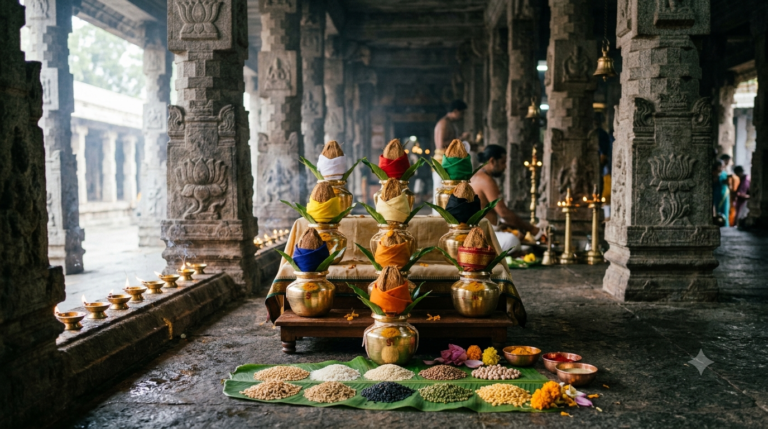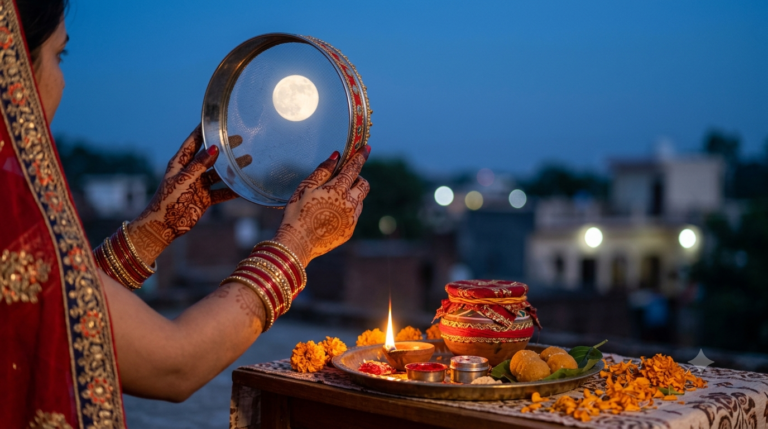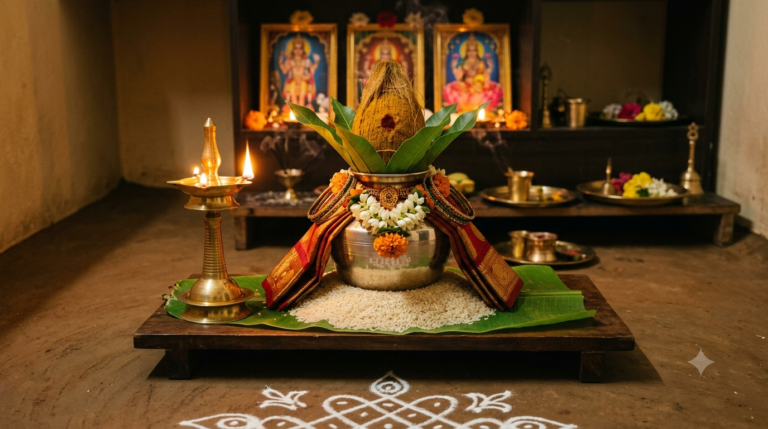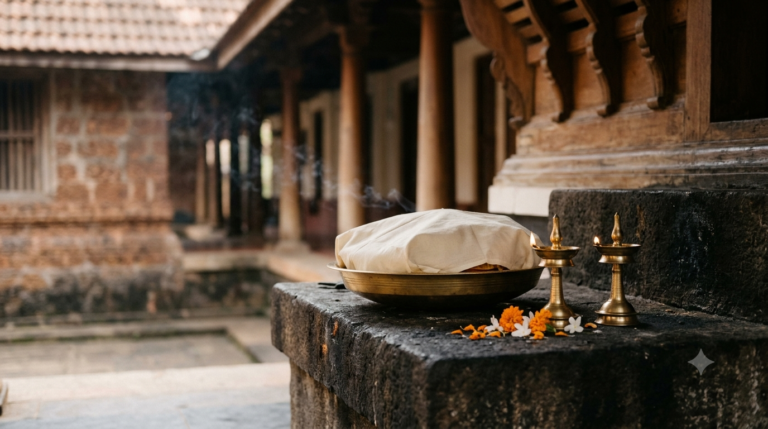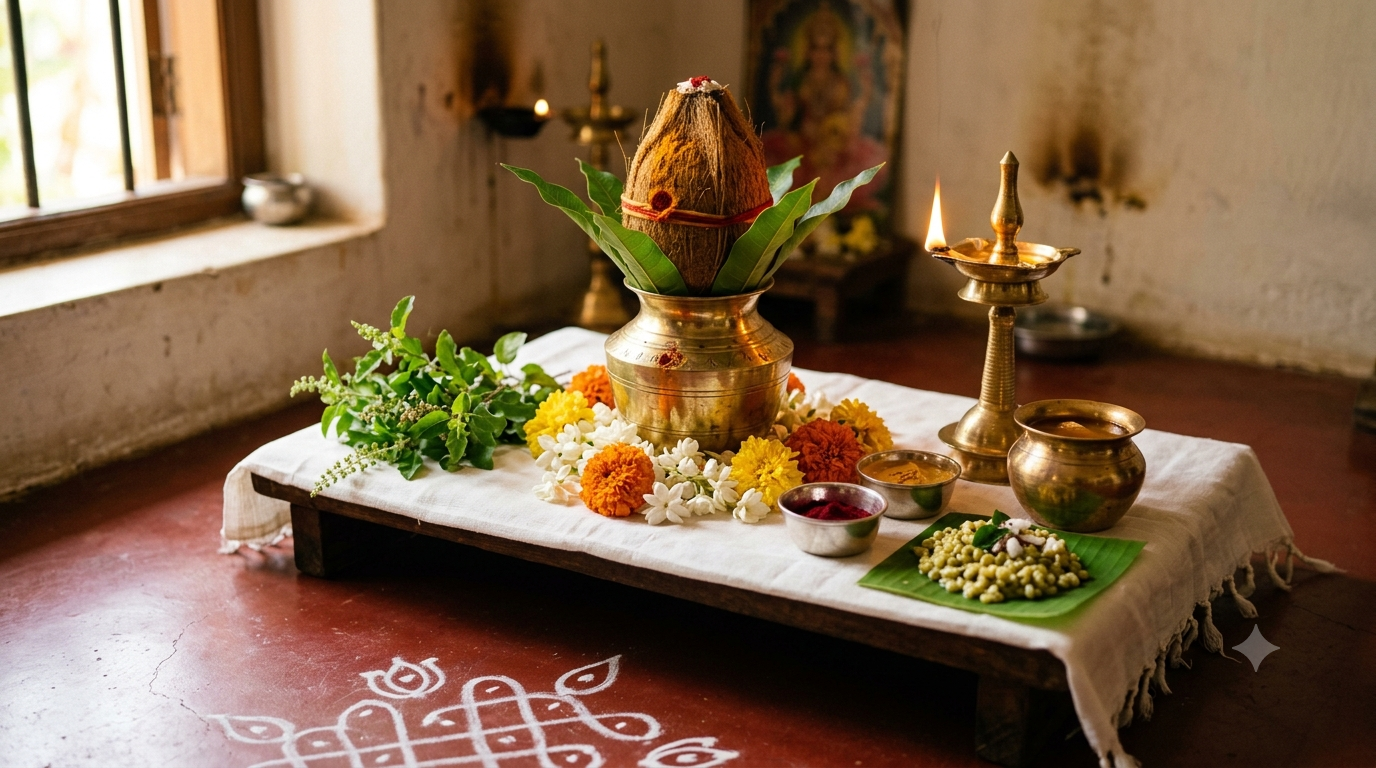
The Rama Navami pooja vidhanam that most South Indian families follow at home is shorter than people expect, yet its timing is unforgiving. Lord Rama was born at midday, so the worship belongs to the madhyahna window rather than the early morning. In 2027 that window shuts early, because the Navami tithi ends at roughly 1:20 PM Indian time on 15 April. Begin late and you are effectively keeping the ritual on Dasami instead.
Sri Vyasa Pooja is an independent devotional guide. We are not affiliated with, endorsed by, or the official website of any temple, trust or Devasthanam mentioned here. We do not accept bookings, sevas, donations or payments. Use the official temple portals linked below for every reservation.
Rama Navami Pooja Vidhanam at a Glance
Here is the whole Rama Navami pooja vidhanam compressed into one block, so you can plan before reading the detail below.
- Next date: Thursday, 15 April 2027 (Chaitra Shukla Navami).
- Navami tithi: begins about 3:23 PM on 14 April, ends about 1:20 PM on 15 April, Indian time.
- Puja window: madhyahna, roughly 11:00 AM to 1:20 PM in most Indian cities during 2027.
- Core naivedyam: panakam, vadapappu and chalimidi in Telugu homes; neer majjige and kosambari in Karnataka and Tamil Nadu.
- Fast type: traditionally eight prahars, from sunrise to the next sunrise, though most families keep a single-day phalahara fast.
- Cost at home: nothing beyond samagri. No genuine temple charges a fee for a household puja.
When Is Rama Navami in 2027?
Rama Navami falls on Thursday, 15 April 2027. The festival always lands on Navami, the ninth tithi of the bright fortnight of Chaitra, and it closes the nine days of Chaitra Navratri that open with Ugadi on 7 April 2027. Because the tithi must prevail at midday, the observed date can differ from the day the tithi first begins.
That distinction matters when you schedule the Rama Navami pooja vidhanam in 2027. The Navami tithi actually starts on the afternoon of 14 April, well after midday has passed. Since Navami does not cover the madhyahna hours on the 14th but does cover them on the 15th, Indian panchangams place the festival on 15 April.
Why the 2027 Date Jumps Almost Three Weeks Later
Lunar festivals normally creep about eleven days earlier each year. Rama Navami 2026 fell on 26 March, so a quick guess would put 2027 somewhere in mid-March. That guess is wrong by nearly a month, and the reason is an extra lunar month.
The Hindu year running through 2026 carried an Adhika Masa, an intercalary month inserted from 17 May to 15 June 2026 as Adhika Jyeshtha. A thirteenth month absorbs the accumulated drift, so every festival after it shifts forward by roughly a lunar month instead of backward by eleven days.
| Year | Rama Navami date | Shift from previous year |
|---|---|---|
| 2026 | 26 March | Normal backward shift |
| 2027 | 15 April | Forward, after Adhika Jyeshtha Masa |
| 2028 | 3 April | Normal backward shift resumes |
This single fact quietly ruins a lot of festival calendars. If a page carried last year’s date forward by subtracting eleven days, it will show mid-March 2027 and it will be wrong. Always recompute a lunar date for the specific year rather than offsetting it.
The Madhyahna Window and the Deadline Most Guides Skip
Madhyahna is the middle portion of the Hindu day, lasting about six ghatis or two hours and twenty-four minutes. Its midpoint marks the moment tradition assigns to Rama’s birth. For most Indian cities in mid-April, that band sits roughly between 11:00 AM and 1:30 PM.
Here is where 2027 becomes unusual for anyone timing the Rama Navami pooja vidhanam. The Navami tithi ends around 1:20 PM Indian time, so the tithi expires before the madhyahna band itself closes. The practical answer is simple: start the sankalpam by 11:00 AM and finish the naivedyam before 1:00 PM. Confirm your own city timing on a panchangam such as Drik Panchang, since sunrise shifts the window by up to half an hour across India.
Rama Navami Pooja Vidhanam: What You Need Before You Start
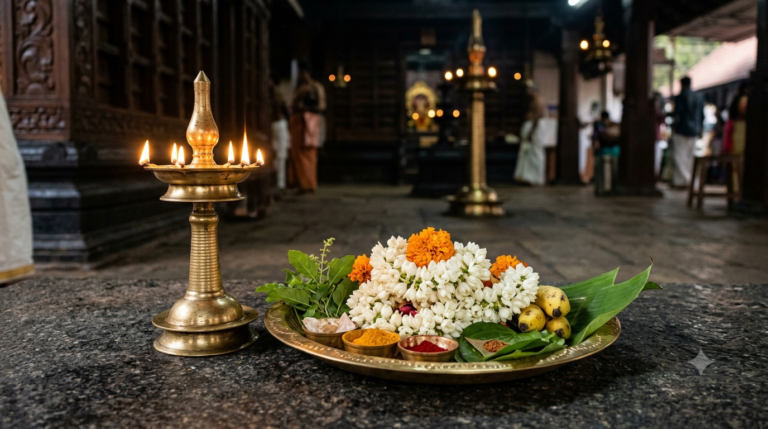
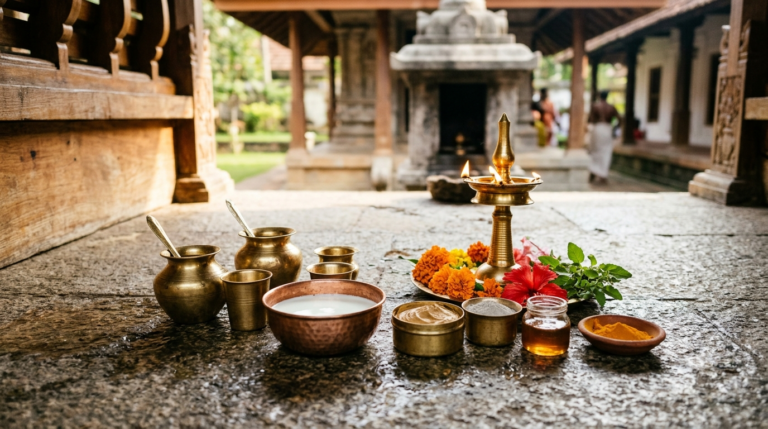
The Rama Navami pooja vidhanam needs very little that a South Indian kitchen does not already hold. Gather everything the previous evening, because scrambling for cardamom at noon costs you the muhurtam.
| Item | Quantity | Why it matters |
|---|---|---|
| Photo or idol of Sita, Rama, Lakshmana and Hanuman | 1 set | The four together represent the complete parivara worshipped on this day |
| Kalasham with water, mango leaves, coconut | 1 | Invokes the sacred rivers before the main upacharas |
| Jaggery, dry ginger powder, black pepper, cardamom | 200 g jaggery, 1 tsp each | The four ingredients of panakam |
| Green moong dal (pesara pappu) | 1 cup | Soaked overnight for vadapappu |
| Rice flour and jaggery | 1 cup each | For chalimidi, the third traditional offering |
| Tulasi leaves, flowers, sandalwood, kumkum | As available | Standard upacharas for any Vishnu worship |
| Ghee lamp, incense, camphor | 1 set | Deepam, dhoopam and the closing harati |
Tulasi deserves a mention because Rama is a Vishnu avatara, so tulasi is essential rather than optional. Many households also keep a copy of the Sundara Kanda or the Rama Raksha Stotram beside the altar.
Rama Navami Pooja Vidhanam Step by Step at Home
Follow this order and the complete Rama Navami pooja vidhanam takes forty to sixty minutes. Nothing here requires a priest, although families who prefer Vedic recitation often invite one.
- Bathe and clean the puja space. Wash the altar, draw a muggu at the threshold, and drape a fresh cloth over the platform before sunrise.
- Arrange the deities. Place Sita, Rama, Lakshmana and Hanuman on the cloth, with the kalasham to the right. Decorate with flowers and a mango-leaf thoranam.
- Perform achamanam and Ganapati puja. Sip water thrice, then invoke Ganapati briefly so the main ritual proceeds without obstruction.
- Take the sankalpam. Hold water and akshata in your right palm, state your name, gotra, the place and the tithi, and declare your intent. Do this after 11:00 AM so it falls inside madhyahna.
- Offer the shodashopachara. Sixteen services follow in sequence: avahanam, asanam, padyam, arghyam, achamaniyam, snanam, vastram, yagnopavitam, gandham, pushpam, dhoopam, deepam, naivedyam, tamboolam, neerajanam and mantra pushpam.
- Recite the parayanam. Chant the Rama Raksha Stotram, the Rama Ashtottara Shatanamavali, or a portion of the Sundara Kanda while the lamp burns.
- Offer the naivedyam. Present panakam, vadapappu and chalimidi together, sprinkle water around the plate, and offer it before 1:00 PM.
- Close with harati and distribution. Light camphor, circle it thrice, then share the panakam with everyone in the house and with neighbours.
Families in Andhra Pradesh and Telangana often add a small Sita Rama Kalyanam at home, tying a symbolic mangalsutra during the same window. A detailed sixteen-step sequence also appears on the Drik Panchang puja vidhi reference.
Panakam, Vadapappu and Chalimidi Explained
These three offerings define the naivedyam stage of the Rama Navami pooja vidhanam in Telugu households. The trio is not interchangeable with what neighbouring states prepare. Getting the distinction right marks a family that actually keeps the tradition.
Panakam is a jaggery drink flavoured with dry ginger powder, crushed black pepper and cardamom. Vadapappu is simply green moong dal, soaked and drained, kept plain without any tempering. Chalimidi is a soft sweet of rice flour and jaggery, worked together with a splash of water and cardamom.
Karnataka and Tamil Nadu homes serve a slightly different set. There the accompaniments are kosambari, a moong dal salad with cucumber and coconut, and neer majjige or neer mor, a thin spiced buttermilk. Both traditions share the same underlying logic.
Why Pepper and Dry Ginger Belong in Panakam
Devotees offer panakam to Rama as a bridegroom’s welcome drink, since Telugu weddings still open with a glass of it. The connection runs directly to Sita Rama Kalyanam, celebrated on this very day across Andhra Pradesh temples.
There is a seasonal reason too. Chaitra marks the start of real heat across the Deccan, and jaggery with pepper and dry ginger works as a traditional cooling preparation. Temples prepare it in large pots and distribute it into cupped palms after the midday harati.
Fasting Rules, and Who Should Adjust Them
Fasting sits alongside the Rama Navami pooja vidhanam rather than inside it. Classical texts prescribe an eight-prahar fast running from sunrise to the following sunrise. Most families keep something gentler: no grains until the madhyahna puja concludes, then a phalahara meal of fruit, milk and the naivedyam itself.
The fast comes in three recognised forms. Naimittika is occasional and desireless, nitya is lifelong, and kamya is undertaken for a specific wish. Choose whichever suits your household rather than assuming the strictest version is compulsory.
A practical caution matters here. Anyone with diabetes should treat panakam carefully, because it is a concentrated jaggery drink. Pregnant women, elderly devotees, children and anyone on regular medication should eat and drink normally through the day. Please consult your doctor before attempting a full-day fast if you have any medical condition, since devotion never requires risking your health.
What If You Cannot Reach the Madhyahna Window?
Rama Navami 2027 falls on a Thursday, so many devotees will be at work when the tithi ends at 1:20 PM. The honest answer is that the midday window is preferred, not guaranteed, and there are ranked alternatives.
- Best option: perform an abbreviated puja at home before leaving, completing sankalpam and naivedyam between 11:00 AM and 1:00 PM.
- Second option: ask a family member at home to offer the naivedyam within the window while you keep the fast and chant wherever you are.
- Third option: complete the full puja in the evening after returning. The tithi has passed, so treat it as devotional worship rather than the tithi-bound ritual.
- Temple option: attend the Kalyanam at a nearby Rama temple, where priests perform the ritual inside the correct muhurtam regardless of your schedule.
What genuinely does not work is shifting the Rama Navami pooja vidhanam to the morning of 14 April because the tithi began that day. Navami had not started at midday on the 14th, which is precisely why the panchangam moved the festival to the 15th.
Rama Navami Pooja Vidhanam Mistakes Families Repeat
After years of reading festival pages, the same handful of errors keep resurfacing. A few of them can cost you the muhurtam entirely.
- Treating 12:00 noon as madhyahna. The Hindu midday depends on local sunrise and sunset, so it rarely coincides with clock noon.
- Carrying last year’s date forward. This is the adhika masa trap, and in 2027 it produces an error of nearly a month.
- Tempering the vadapappu. The moong dal stays plain and raw. Adding oil and mustard turns it into a different dish.
- Skipping tulasi. Rama is a Vishnu avatara, so tulasi belongs in the offering.
- Paying a website to perform an online Rama Navami puja. No temple outsources household worship, and several fake portals collect money and personal data during festival season.
That last point deserves emphasis. A household puja costs nothing beyond samagri, while genuine temple sevas are booked only on the temple’s own government portal. Anyone asking for an advance transfer to a private account is not a temple.
Temple Kalyanam: Bhadrachalam, Vontimitta and Beyond
The Rama Navami pooja vidhanam kept at home has a public counterpart. Bhadrachalam in Telangana, often called Dakshina Ayodhya, hosts the most famous Sri Sita Rama Kalyanam of the year during its Brahmotsavam fortnight. Devotees fill the Godavari banks well before the midday muhurtam.
Vontimitta in Andhra Pradesh holds a second celebrated Kalyanam at the Kodandarama Swamy temple, administered by Tirumala Tirupati Devasthanams. Our guides to Bhadrachalam online pooja booking and the Vontimitta Brahmotsavam schedule cover seva rates and dates in detail.
Book any temple seva only through the official Devasthanam portal for that temple, or through the TTD official website for Tirumala and Vontimitta. Slots for Rama Navami open weeks ahead and close quickly, so plan early if you intend to travel.
Before You Begin the Rama Navami Pooja Vidhanam
Mark Thursday, 15 April 2027 and work backwards from 1:00 PM rather than forwards from sunrise. Soak the moong dal the previous night, make the panakam fresh that morning, and take the sankalpam once madhyahna opens around 11:00 AM. If your city panchangam differs by twenty minutes, trust the local one.
The Rama Navami pooja vidhanam asks for very little money and a great deal of attention. That balance is the point. For the wider Chaitra calendar that this festival closes, see our note on the significance of the Ugadi festival and its 2027 date.
Frequently Asked Questions
What time should the Rama Navami pooja vidhanam start?
Perform the Rama Navami pooja vidhanam during madhyahna, the middle portion of the Hindu day, which runs roughly from 11:00 AM to 1:30 PM in most Indian cities. In 2027 the Navami tithi ends near 1:20 PM, so finish the naivedyam before 1:00 PM. Check your city panchangam, because sunrise shifts the window slightly.
Can I perform the Rama Navami pooja vidhanam without a priest?
Yes. The household ritual needs no priest at all. A family member takes the sankalpam, offers the sixteen upacharas, recites a stotram and presents the naivedyam. Families who want full Vedic recitation may invite a purohit, but that is a preference rather than a requirement.
Why does Rama Navami 2027 fall in April instead of March?
An Adhika Masa, the extra lunar month of Adhika Jyeshtha, ran from 17 May to 15 June 2026. That thirteenth month pushes subsequent festivals forward by roughly a lunar month. As a result Rama Navami moves from 26 March 2026 to 15 April 2027 rather than shifting eleven days earlier.
What is the difference between vadapappu and kosambari?
Vadapappu is the Andhra and Telangana offering: green moong dal soaked, drained and kept completely plain. Kosambari is the Karnataka version of the same idea, mixed with grated cucumber, coconut and a light seasoning. Both accompany panakam on Rama Navami.
Is fasting compulsory on Rama Navami?
No. Fasting is traditional but voluntary, and it comes in occasional, lifelong and wish-based forms. Many families simply avoid grains until the midday puja finishes. Anyone with a medical condition should eat normally and consult a doctor before attempting a strict fast.
Can the Rama Navami pooja vidhanam be done in the evening?
Tradition places the ritual at midday because that is the hour assigned to Rama’s birth. Evening worship remains meaningful devotionally, though it falls outside the tithi in 2027. If your schedule allows only the evening, keep the fast during the day and perform the puja when you can.
What do I offer if I cannot make chalimidi?
Panakam alone is sufficient. Chalimidi and vadapappu enrich the offering, yet the essential naivedyam is the jaggery drink. Fresh fruit, jaggery or plain cooked rice also serves when the kitchen is short of time.
Do temples charge for Rama Navami darshan?
General darshan on Rama Navami is free at Rama temples, including Bhadrachalam and Vontimitta. Only specific sevas and special-entry tickets carry a fee, and those are listed on each temple’s official portal. Treat any private site demanding payment for ordinary darshan as fraudulent.