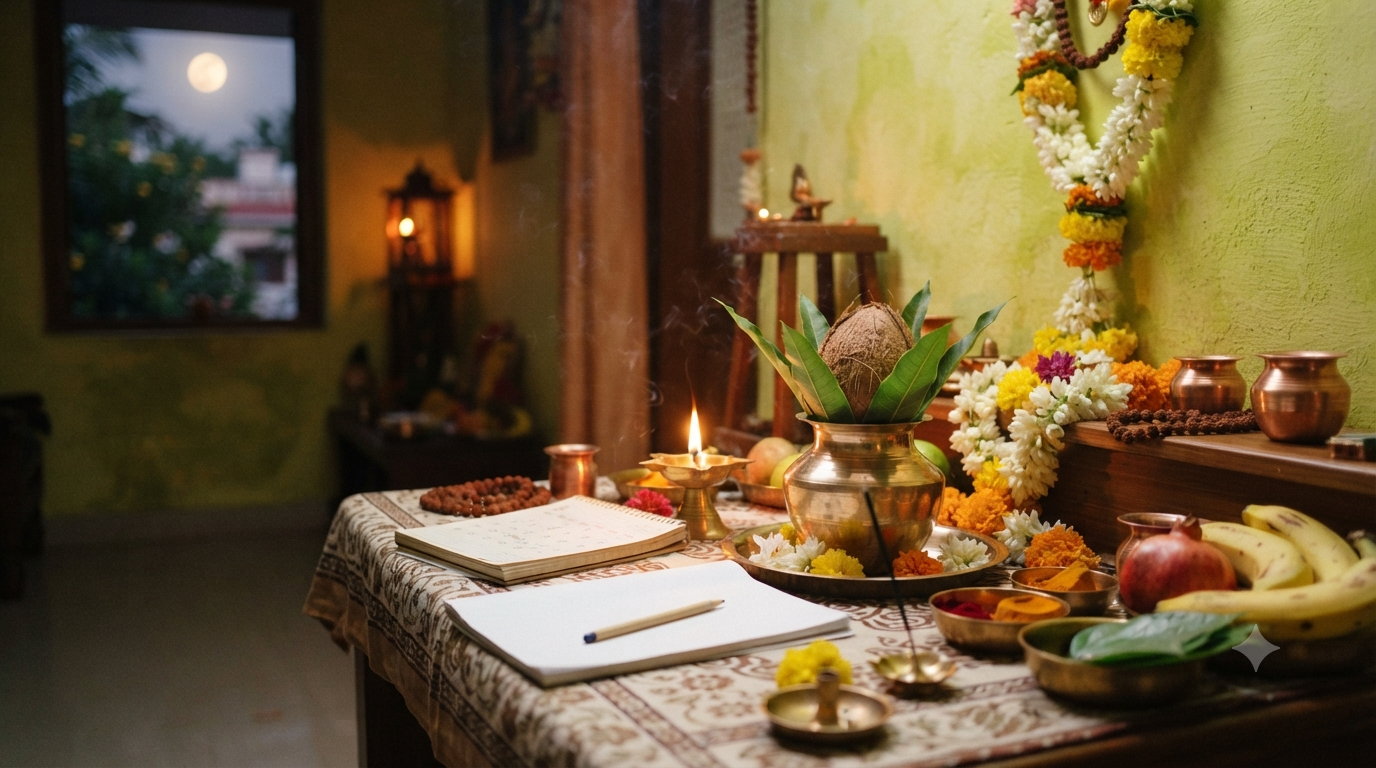
Satyanarayana Vratam dates do not stay on the same Gregorian date every year because the observance follows the Hindu lunar calendar. Most families choose Purnima or Pournami, yet the correct civil date can shift by location, tithi start time, and family tradition. This evergreen guide shows how to identify the right day without relying on an old yearly table.

The key rule is simple: check the Satyanarayana Puja date for your own city, then confirm that Purnima tithi is active during the time you plan to worship. A copied calendar image can become outdated, while a location-based Panchang remains useful every year.
Sri Vyasa Pooja is an independent devotional guide. We are not affiliated with, endorsed by, or the official website of any temple or trust, and we do not accept bookings, donations, or payments.
Satyanarayana Vratam Dates at a Glance
- Most common day: Purnima or Pournami, the full-moon tithi.
- Fixed Gregorian date: none; the civil date changes every month and every year.
- Location: essential, because tithi start and end times vary by place.
- Morning or evening: both are used; many families prefer evening worship.
- Other suitable days: family traditions may choose Ekadashi or important household occasions.
- Best source: use a live city-based Panchang rather than an old static list.
Drik Panchang specifically separates its Purnima fasting calendar from its Satyanarayana Puja calendar because the selected civil date can differ. It also advises users to set their location before noting the date. That distinction is the main reason an evergreen page should teach the calculation method instead of hard-coding one year’s dates.
What Day Is Satyanarayana Vratam Usually Performed?
Satyanarayana Vratam is most commonly performed on Purnima, the full-moon tithi. However, it is not limited to one compulsory day. The official Sri Veera Venkata Satyanarayana Swamy Devasthanam at Annavaram notes that Ekadashi is considered auspicious and that devotees also perform the vratam on other convenient days.
This means two ideas can be true at once. Purnima is the most familiar monthly choice, while the ritual itself is not locked to one date. Families may also perform it after a housewarming, wedding, anniversary, fulfilled vow, or another important occasion according to local custom.
For the meaning, katha, offerings, and fuller ritual background, read our Satyanarayana Vratam guide. This page stays focused on dates and timing so both articles serve different search intents.
How to Find Satyanarayana Vratam Dates Every Year
The most reliable method is to use a live Panchang that lets you select both year and city. Do not start with a generic full-moon list, because the Satyanarayana observance can fall on a neighbouring civil date when Purnima begins late on the previous day.
- Open a Satyanarayana date calendar. Use a reliable source such as Drik Panchang’s Satyanarayana Puja calendar.
- Set your city. Choose the place where the puja will actually happen, not a distant metro by default.
- Select the year. Use the current year or the future year you are planning for.
- Read the Purnima start and end times. Note whether the tithi crosses midnight or ends before evening.
- Choose the worship window. Match the tithi with your family’s morning or evening practice.
- Confirm special-event timing. For a housewarming or wedding, coordinate the vratam with the event muhurta and your family purohit.
Following these steps makes Satyanarayana Vratam dates future-proof. You only need to refresh the live Panchang lookup, not rewrite the article each January. The same method also works if you are planning several months ahead.
Why Can Satyanarayana Vratam Dates Differ by One Day?
Satyanarayana Vratam dates can differ by one civil day because a Hindu tithi does not begin at midnight. Purnima may start in the afternoon, evening, or night and continue into the next date. Different observance rules then decide which civil day receives the vratam label.
Drik Panchang warns that its general Purnima list may not always match its Satyanarayana Puja list. The site explains that Purnima fasting itself can move depending on when the tithi begins on the previous day. Therefore, copying only the words “Purnima date” can lead to a wrong Satyanarayana date.
Location adds another layer. A tithi start or end time shown for Delhi should not automatically be used in Vijayawada, Chennai, London, or New York. The astronomical event is shared, yet the local clock time changes. Always set the actual city before deciding.
What should you check before choosing between two dates?
Check three things: your city, the Purnima tithi window, and the worship time your family follows. If Purnima spans two civil dates, see which date contains your intended puja period. When the choice still feels unclear, follow your family Panchang or ask your purohit rather than combining rules from several regions.
Purnima and Pournami: Are They the Same?
Yes. Purnima, Poornima, Pournami, and Pournima are regional spellings for the full-moon tithi. North Indian calendars commonly use Purnima, while South Indian calendars often use Pournami. The underlying lunar phase is the same, although regional month names and observance conventions can differ.
This spelling issue matters in search because families may look for “Satyanarayana Pournami date” even when another calendar uses “Satyanarayan Purnima.” Do not assume two pages describe different rituals simply because the spelling changes.
The safest approach is to identify Shukla Purnima first, then apply your regional Panchang. That keeps the date logic consistent across Telugu, Kannada, Tamil, Marathi, Hindi, and other household traditions.
Do Satyanarayana Vratam Dates Always Fall Once a Month?
Usually, families who follow the monthly Purnima pattern get one main opportunity in each lunar month. However, a Hindu lunar year can contain an Adhika Masa, or intercalary month. In such a year, the calendar can show an additional full-moon observance within the Gregorian year.
This is another reason not to publish a permanent table that promises exactly twelve dates every year. The number of Purnimas visible within January to December can change depending on how the lunar months align with the solar year.
If you observe the vratam monthly, use the Panchang’s year selector and work from the full list it generates. Do not copy last year’s twelve dates and shift them forward by a few weeks. Lunar dates must be calculated again for each year.
Is Evening the Best Time for Satyanarayana Puja?
Many families prefer evening Satyanarayana Puja because devotees can complete the katha and then break the fast with prasadam. Drik Panchang also describes evening worship as a common and suitable choice. However, it states that morning worship is possible as well.
The correct answer therefore depends on whether the required tithi is active. If Purnima ends before evening, a morning observance may better match the tithi. If Purnima begins late in the day, the evening window may become more relevant.
Avoid turning “evening is preferred” into “evening is compulsory.” Family sampradaya, local Panchang practice, and the purpose of the vratam can all affect the schedule. For an important household ceremony, coordinate the date and time before inviting guests.
Satyanarayana Vratam Dates for Housewarming and Family Events
Satyanarayana Vratam dates do not need to be restricted to the monthly Purnima when the family is observing the ritual for a special occasion. The Annavaram temple’s official history says devotees perform the vratam on convenient days as well, while also noting the importance of Ekadashi.
For a griha pravesh, wedding-related ceremony, anniversary, or fulfilled vow, the event date may therefore guide the schedule. However, do not assume that any convenient clock time automatically becomes a muhurta. If the event itself needs an auspicious time, check that separately.
This distinction prevents a common planning mistake. The Satyanarayana Vratam can be spiritually appropriate on many days, but a housewarming muhurta or wedding muhurta follows its own rules. One ritual should not silently replace the calendar requirements of another.
Quick Reference: What Changes and What Stays the Same?
| Item | Changes over time? | What to do |
|---|---|---|
| Gregorian date | Yes | Check the selected year |
| Purnima start/end time | Yes | Set your city |
| Weekday | Yes | Do not use last year’s weekday |
| Purnima/Pournami principle | No | Use it as the main monthly reference |
| Morning or evening choice | Depends on tithi and custom | Check the active tithi window |
| Family tradition | Usually stable | Follow your household practice |
This table is the core reason the page can remain evergreen. The rule stays stable, while the civil date and tithi time change. Update only those volatile details if you later decide to add a short current-year module.
Common Mistakes When Checking Satyanarayana Vratam Dates
- Using an old year’s screenshot: lunar dates do not repeat on the same Gregorian dates.
- Using a generic Purnima list: the Satyanarayana observance date can differ from the fasting label.
- Ignoring the city: tithi start and end times are location-sensitive.
- Assuming midnight decides the tithi: Hindu lunar dates do not follow civil midnight boundaries.
- Mixing regional rules: a North Indian calendar convention may not match a Telugu household tradition.
- Forcing evening worship: check whether Purnima is still active before fixing the time.
- Assuming there are always twelve dates: an Adhika Masa year can change the annual count.
A final mistake is to treat a date page as a booking service. A home Satyanarayana Vratam needs no booking through this website. For temple-based services, use only the temple’s official website or authorised official portal.
Fasting and Health Safety
Some devotees fast until the puja and prasadam are complete, while others follow a lighter family practice. Fasting is a devotional choice, not a medical treatment, and the level of strictness should reflect your health.
If you are pregnant, elderly, diabetic, managing low blood pressure, or taking regular medication, speak with a qualified medical professional before a strict fast. Do not stop prescribed medicines to maintain a ritual fast. A lighter observance can preserve the devotional intention without creating avoidable risk.
If your family also follows Ekadashi as a preferred Vishnu observance, our Ekadashi fasting rules guide explains the separate food and parana rules. Do not automatically apply those rules to every Satyanarayana Vratam.
How to Keep This Satyanarayana Vratam Dates Page Evergreen
Satyanarayana Vratam dates should be maintained as a method page rather than a permanent yearly calendar. Keep the URL, title, and main explanation unchanged. Then link readers to a live Panchang where they can select their own year and city.
If you later want current-year search traffic, add a small clearly dated section near the top with that year’s dates. Update only that section each year, and remove it when it becomes stale. Do not put the year into the URL, because the evergreen slug should continue accumulating search equity.
This structure also avoids competing too heavily with the site’s broader Satyanarayana Vratam article. The evergreen ritual page answers meaning, katha, prasadam, and procedure. This page answers one narrower question: how to find the correct Satyanarayana date now or in any future year.
Before You Fix the Date
The safest way to use Satyanarayana Vratam dates is to remember that the vratam follows tithi, not a fixed Gregorian date. Start with the Satyanarayana Puja calendar for your year, set the exact city, and then check whether Purnima covers your planned worship time.
If your family observes the vratam on Ekadashi or another important occasion, that can also fit established practice. Keep family tradition and local Panchang rules together instead of mixing advice from several regions. Once you follow that method, this guide remains useful year after year.
Frequently Asked Questions
Do Satyanarayana Vratam dates change every year?
Yes. Satyanarayana Vratam dates change because the observance follows lunar tithi rather than a fixed Gregorian date. Purnima moves through the civil calendar each year. Always select the required year and your city in a reliable Panchang before fixing the puja date.
Is Satyanarayana Vratam always on Purnima?
No. Purnima is the most common monthly choice, but the vratam is not limited to Purnima. The official Annavaram temple notes that Ekadashi is auspicious and devotees also perform the vratam on other convenient days. Family occasions can therefore influence the date.
Why does one Panchang show a different date?
The difference usually comes from tithi boundaries, location, or observance rules. Purnima can start on one civil date and end on the next. Check the start and end times for your city instead of comparing only the date printed in the heading.
Can I perform Satyanarayana Puja in the morning?
Yes. Morning worship is possible when the relevant tithi is active. Evening is a common preference because families can complete the katha and then take prasadam, but it is not the only acceptable time. Follow your household practice and local Panchang.
Can I perform the vratam if I miss Purnima?
Yes. Missing one Purnima does not prevent you from performing Satyanarayana Vratam later. You may choose another suitable day according to family tradition, Ekadashi practice, or an important household occasion. A priest can help if the vratam is tied to another muhurta.
Do Satyanarayana dates differ outside India?
Yes, the local clock times differ by time zone and location, so the selected civil date can also change. Use the city where the puja will occur. Do not copy an India-based timing if you are observing the vratam in another country.
Should I use a Purnima calendar or a Satyanarayana calendar?
Use the Satyanarayana Puja calendar when available. A general Purnima calendar is useful for understanding the tithi, but it may label the observance differently. Drik Panchang itself separates these calendars and warns that the dates can differ.
Can I save one list of dates and reuse it every year?
No. Reusing a fixed list is the main error this evergreen guide is designed to prevent. Keep the method, not the dates. Each year, select the new year and your city in a live Panchang, then note the current Purnima tithi windows.