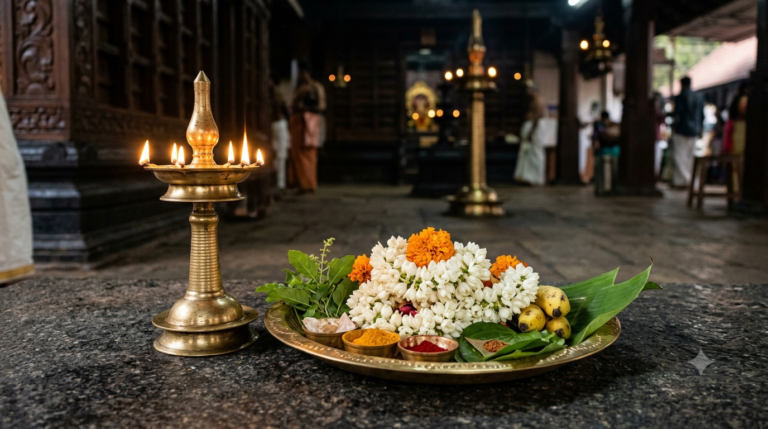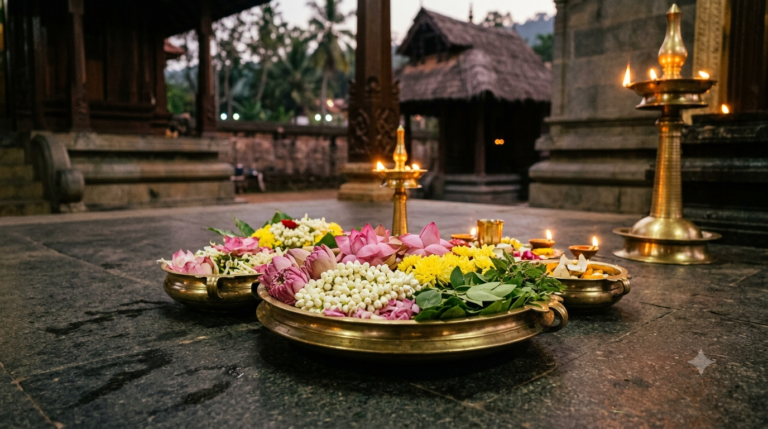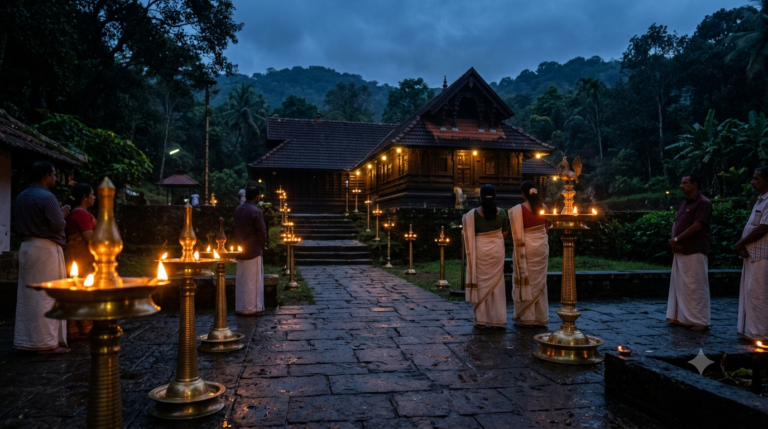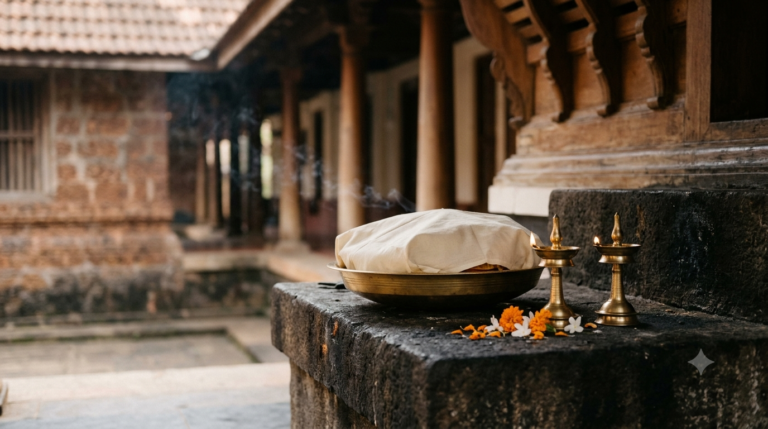
Padmanabhaswamy Temple darshan timings run in seven short, fixed windows, and the sanctum closes firmly between them. That one detail decides whether your visit works. Reach the gate at 7:05 AM and the 6:30 AM window has already shut. Most pages also drop an entire mid-morning slot.
Many then repeat a “VIP darshan pass” that the temple’s own portal does not sell. Below are the verified Padmanabhaswamy Temple darshan timings, the dress code staff actually apply, and the offerings you can book online.
Sri Vyasa Pooja is an independent information guide. We are not affiliated with Sree Padmanabhaswamy Temple, its trust, or the erstwhile Travancore royal family. We also do not accept bookings, donations or payments. Please arrange every offering through the temple’s own official channels.
Padmanabhaswamy Temple Darshan Timings at a Glance
Sree Padmanabhaswamy Temple stands inside East Fort, Thiruvananthapuram, and it is one of the 108 Divya Desams. Because the deity reclines, you view Lord Padmanabha through three separate doors rather than in one frame.
- Seven daily windows between 3:30 AM and 7:20 PM, with a long afternoon closure.
- Ordinary darshan is free. There is no entry ticket and no paid queue.
- Hindus only: staff may ask you to declare your faith at the gate.
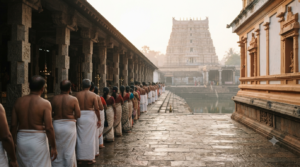
- Strict traditional dress: mundu or dhoti for men, saree or set-mundu for women.
- No phones, cameras or footwear inside; use the cloakroom near the East Gate.
- Online booking covers vazhipadu offerings and donations only, never a darshan slot.
Kerala Tourism, the Government of Kerala’s official tourism department, publishes the worship schedule. It lists five morning windows and two evening windows. Since every window is short, Padmanabhaswamy Temple darshan timings shape your whole day here.
Padmanabhaswamy Temple Darshan Timings: Every Slot, Verified
The Padmanabhaswamy Temple darshan timings below follow the worship schedule published by Kerala Tourism. Treat them as the regular-day pattern, because the temple adjusts hours during festivals and special rituals.
| Session | Timing | What it suits |
|---|---|---|
| Nirmalya Darshanam | 3:30 AM – 4:45 AM | The calmest darshan of the day |
| After Usha Pooja | 6:30 AM – 7:00 AM | Short window, fills fast |
| Mid-morning | 8:30 AM – 10:00 AM | The longest and most practical slot |
| Late morning | 10:30 AM – 11:10 AM | Often missed by other guides |
| Midday | 11:45 AM – 12:00 PM | Only fifteen minutes, so arrive early |
| Evening | 4:30 PM – 6:15 PM | Deeparadhana atmosphere |
| Night | 6:45 PM – 7:20 PM | Last darshan before closing |
In plain terms, the sanctum stays shut from roughly midday until the late afternoon. Therefore a visit planned for 2 PM cannot work on an ordinary day.
Why Padmanabhaswamy Temple darshan timings are listed two ways
Kerala Tourism lists the evening session as 4:30 PM to 6:15 PM. Many travel pages state 5:00 PM instead. Both figures circulate widely, so reach East Fort by about 4:15 PM. If the doors open later, you lose nothing but a short wait in a pleasant courtyard.
Choosing between the Padmanabhaswamy Temple darshan timings
Choose 3:30 AM if you want silence and the shortest queue of the day. Choose 8:30 AM if you travel with family, because it is the longest window. Avoid the 11:45 AM window unless you already stand at the gate, since fifteen minutes disappear quickly. Slot choice here rewards planning far more than luck.
Padmanabhaswamy Temple Darshan Timings Are Real, the VIP Ticket Is Not
Dozens of pages describe a ₹500 VIP pass and a ₹150 special darshan ticket. Some add an 8:30 PM night slot with a QR-coded entry ticket. We checked the temple’s own booking portal in August 2026, and none of that appears there.
The portal handles single-day vazhipadu, multi-day vazhipadu, E-Kanika donations and prasadam despatch. Those invented tickets usually sit beside otherwise accurate Padmanabhaswamy Temple darshan timings, which is exactly why readers trust them.
In other words, no online queue ticket exists. Ordinary darshan stays free, and nobody reserves it in advance. Closer access comes only through sponsored offerings, which the temple lists openly at fixed rates.
How to spot a fake booking site
Fake portals thrive on this confusion, and they usually demand an upfront “processing fee” first. Check three things before you pay.
- The domain must be the temple’s own, not a lookalike.
- The rates should match the official vazhipadu list.
- No darshan entry fee exists here at all, so nobody should charge one.
Dress Code and Entry Rules, As They Are Applied
The dress code at this shrine is stricter than at most temples, and staff do enforce it at the entrance. Yet the rule has softened in one practical way that older articles miss entirely.
What men and women wear
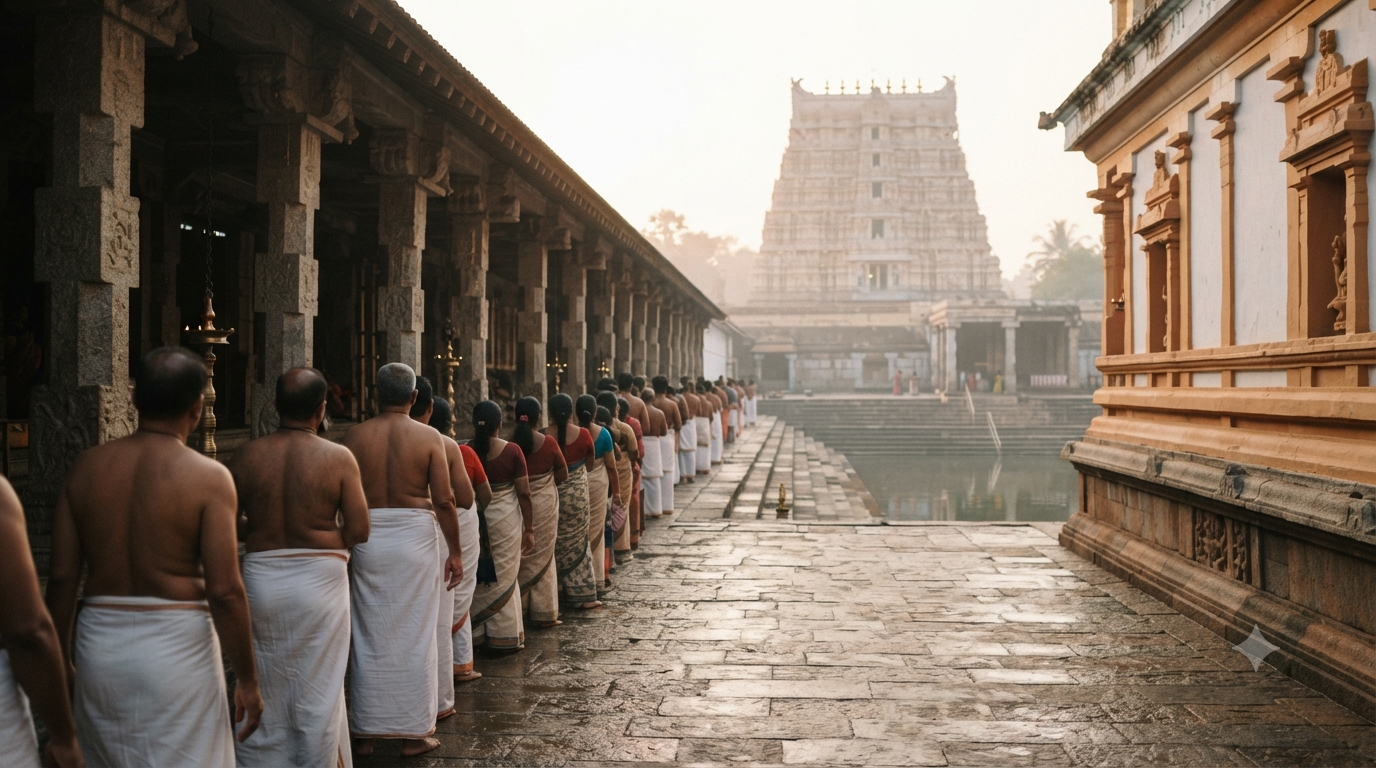
Men wear a mundu or dhoti around the waist, reaching the ankles, with no shirt, vest or t-shirt. An angavastram over the shoulder is acceptable. Dhotis are available on rent near the entrance if you arrive unprepared.
Women wear a saree, a set-mundu (mundum neriyathum), a half-saree, or a skirt with a blouse. Temple custom does not treat a salwar kameez on its own as proper attire.
The change most guides have not updated
Kerala Tourism notes that temple authorities now allow a dhoti over pants or a churidar. That single concession spares many devotees a wasted trip. Still, treat it as a courtesy rather than a right, and carry proper attire if you can.
If you arrive in the wrong clothes
Rental dhotis near the gate are the first fallback, although the stalls get crowded before the 8:30 AM window. Missing a window is the real risk, because Padmanabhaswamy Temple darshan timings do not stretch for latecomers. So change during a longer session, then return for the next one.
Three-Door Darshan: What You Actually See
The main idol measures about 18 feet. Its makers formed it from 12,008 salagramas brought from the banks of the Gandaki river in Nepal. Because of that length, no single door reveals the whole form.
Through the first door you see the head and chest. The second door reveals the hands, while the third shows the sacred feet. Devotees therefore move along the Ottakkal Mandapam, a platform cut from one huge stone slab. You see the Lord in three stages.
Around you sit details worth pausing over. A gold-plated dhwaja stambha rises roughly 80 feet, while murals show Vishnu, Ganapati, Gaja Lakshmi and Narasimha. The corridor rests on 365 and a quarter carved granite pillars. Outside lies Padma Theertham, the lotus tank that gives the precinct its calm.
Poojas, Sevas and What They Cost
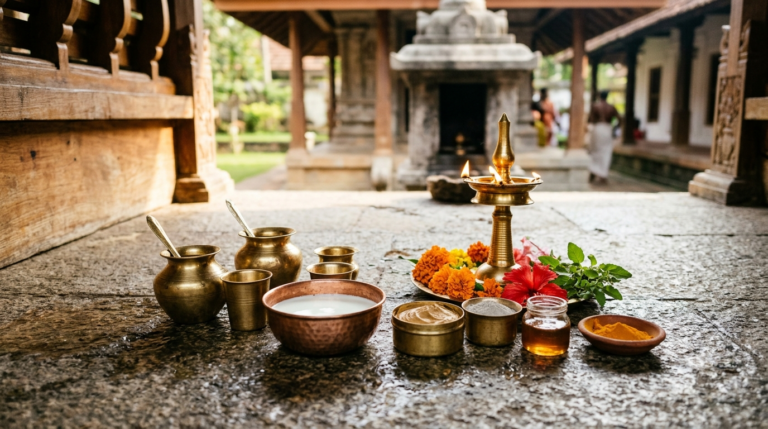
The temple publishes vazhipadu rates openly on its booking portal. We checked the figures below in August 2026. Rates change, so confirm the current amount before you pay.
| Offering | Rate | Note |
|---|---|---|
| Ashtothararchana | ₹20 | Simplest archana |
| Sahasranamarchana | ₹30 | Most archanas sit at this rate |
| Neyvilakku / Special Seva | ₹50 | Ghee lamp offering |
| Annadanam (one person) | ₹101 | Feeding sponsorship |
| Palpayasam (1 litre) | ₹200 | Collected inside the temple |
| Nirmalyam to Deeparadhana | ₹3,000 | Entry for 3 devotees |
| Nirmalyam to Usha Pooja | ₹4,000 | Entry for 4 devotees |
| Suvarna Darshan | ₹20,000 | Entry for 6 devotees |
| Udayasthamana Pooja | ₹25,000 | Entry for 6 devotees |
This is the real answer to “how do I get closer darshan”. A sponsored vazhipadu such as Nirmalyam to Usha Pooja at ₹4,000 admits a named group, whereas no ₹150 shortcut ticket exists. Ordinary devotees pay nothing at all.
Collecting your prasadam
Collect payasam offerings inside the temple at Palpayasapura, North Nada, between 8:30 AM and 10:30 AM. The Sreekaryam office by the South Gate hands out unniyappam, ottayada and valsan from 7:30 PM to 8:30 PM. Carry your receipt, and bring your own vessel for the payasam.
How Festivals Change Padmanabhaswamy Temple Darshan Timings
Two ten-day festivals dominate the year. Alpashy Utsavam falls in the Malayalam month of Thulam, around October and November. Painkuni Utsavam falls in Meenam, around March and April. Each begins with the Kodiyettu flag hoisting and ends with the Aarat procession to Shankhumukham beach.
On these days the usual Padmanabhaswamy Temple darshan timings shrink, since special rituals take priority. Festival visitors should therefore plan for longer waits and confirm the day’s schedule locally.
Murajapam and Lakshadeepam
The rarest event here is Murajapam, a 56-day cycle of Vedic chanting held once in six years. The most recent cycle began on 20 November 2025. It closed with Lakshadeepam on 14 January 2026, Makara Sankranti day, when a lakh of oil lamps lit the precinct.
Following that six-year rhythm, the next Lakshadeepam falls around January 2032. Because the temple announces the dates through a formal proclamation, treat that as a projection until the trust confirms it.
Planning Your Day Around Padmanabhaswamy Temple Darshan Timings
Plan your travel backwards from the window you have chosen. The temple sits in East Fort, in the middle of Thiruvananthapuram city. Thiruvananthapuram Central railway station is a short auto ride away, and the international airport is also close. City buses stop at East Fort, which is within walking distance of the gopuram.
Leave phones, cameras and bags at the cloakroom near the East Gate before you join the queue. There are no washrooms inside the complex, although paid facilities operate outside the entrance. Since the corridor walk runs a few hundred metres, allow twenty to thirty minutes inside on a normal day.
Comfort and health notes
Early slots mean standing barefoot on stone for a while, and the granite turns hot by late morning. Elderly devotees should note one limit: a wheelchair goes only up to the temple entrance, not in front of the sanctum. If you are fasting, pregnant, or managing a medical condition, eat sensibly beforehand. Also consult your doctor before a long fast, because nothing is available inside.
What Regular Devotees Do Differently
Reach the gate about thirty minutes before a window opens, since the queue forms outside and moves in one push. Keep a few small notes handy, because a table inside the corridor issues archana tickets. Book payasam vazhipadus online in advance, as counter queues eat into your darshan slot.
Do not treat Nirmalya Darshanam as merely “early”. You see the previous night’s flowers and ornaments still on the deity. That is why devotees value it above the busier windows. Also budget a few minutes for the Thiruvambadi Sree Krishnaswamy shrine inside the same complex, which many visitors miss.
Before You Go
Pick one window from the Padmanabhaswamy Temple darshan timings above, then build the day around it. Carry proper attire, leave your electronics at the cloakroom, and remember that ordinary darshan costs nothing. If you want a sponsored pooja, book it on the temple’s own portal instead of any third-party site promising a pass.
Before you travel, check Kerala Tourism’s temple page and the temple’s official vazhipadu booking portal. Planning a wider Kerala circuit? Our guide to Vadakkunnathan Temple vazhipadu and darshan covers a similar counter-first system. The Rameshwaram morning darshan guide helps if you continue along the coast.
Frequently Asked Questions
What are the Padmanabhaswamy Temple darshan timings today?
On a regular day the Padmanabhaswamy Temple darshan timings are 3:30–4:45 AM, 6:30–7:00 AM and 8:30–10:00 AM. The remaining windows run 10:30–11:10 AM, 11:45 AM–12:00 PM, 4:30–6:15 PM and 6:45–7:20 PM. The sanctum closes between sessions, and festival days shift the pattern.
Is there an entry fee for darshan?
No. Ordinary darshan is free, and there is no paid queue ticket. Money changes hands only for vazhipadu offerings, sponsored poojas and donations, all of which carry published rates.
Can I book Padmanabhaswamy Temple darshan online?
You cannot book a darshan slot online. The temple’s official portal handles single-day and multi-day vazhipadu bookings, E-Kanika donations and prasadam despatch only. Any site selling a “VIP darshan ticket” for this temple is not the official channel.
Who is allowed inside the temple?
The temple permits entry to Hindus only, in keeping with long-standing tradition. Staff may ask you to affirm your faith at the main gate. This applies to Indian and foreign devotees alike.
Can men wear pants with a dhoti over them?
Kerala Tourism records that temple authorities now allow a dhoti worn over pants or a churidar. That concession spares many devotees a wasted trip. Even so, a plain mundu without an upper garment remains the expected attire for men.
Which Padmanabhaswamy Temple darshan timings are quietest?
Nirmalya Darshanam at 3:30 AM is the quietest window of the day. Weekday mid-mornings come next, while weekends, Ekadashi days and festival periods draw the heaviest crowds. If you observe Ekadashi fasting, expect a much longer queue on that day.
Do Padmanabhaswamy Temple darshan timings change on festival days?
Yes. During Alpashy Utsavam and Painkuni Utsavam the usual windows shrink, because processions and special rituals take priority. Rare events such as Murajapam alter the pattern for weeks. Confirm the day’s schedule locally before you travel.
Can I take my phone or camera inside?
No. Deposit phones, cameras and footwear before entry, and expect tight limits on photography inside. A cloakroom operates near the East Gate for this purpose.
How long does darshan take?
Allow twenty to thirty minutes inside on an ordinary weekday, including the corridor walk and the three-door darshan. On weekends and festival days it can stretch well beyond an hour. Sponsored vazhipadu groups follow a separate, shorter route.