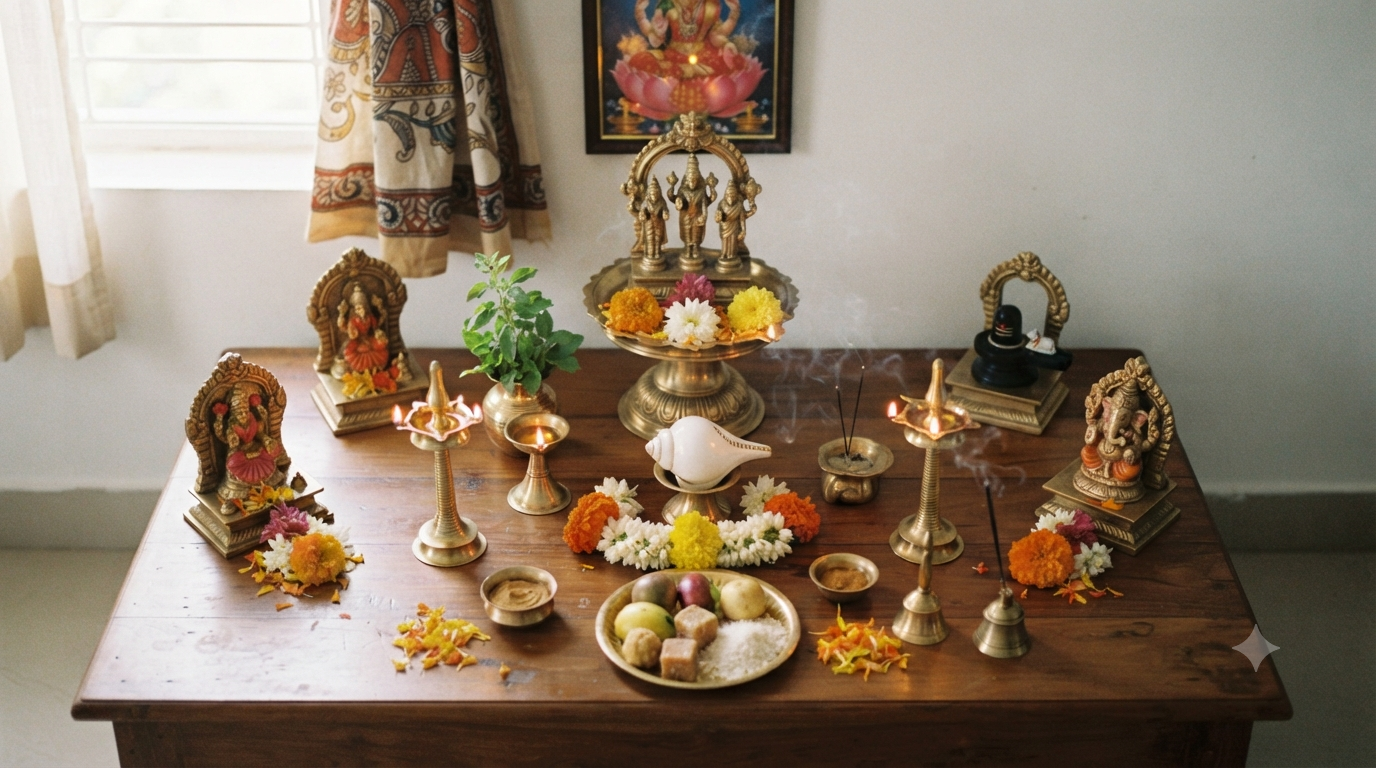
Vishnu Panchayatana Puja is the Vishnu-centred form of Panchayatana worship, with Lord Vishnu in the middle and Shiva, Ganesha, Surya and Devi honoured around Him. It belongs mainly to the Smarta Panchayatana tradition, so it should not be confused with five forms of Vishnu or with a separate Vaishnava temple rite. This guide explains the traditional altar layout, a practical home sequence, suitable offerings and the points beginners should confirm with their own family acharya or purohit.
Sri Vyasa Pooja is an independent devotional guide. We are not a temple, mutt or religious authority, and we do not accept pooja bookings, donations or payments. Family paddhatis differ, so inherited practice and guru instruction should take priority over any general online guide.
Vishnu Panchayatana Puja at a Glance
- Central deity: Lord Vishnu.
- Other four deities: Shiva, Ganesha, Surya and Devi.
- Traditional framework: Panchayatana worship associated especially with the Smarta tradition.
- Classical Vishnu-centred layout: Vishnu in the centre, Shiva in the north-east, Ganesha in the south-east, Surya in the south-west and Devi in the north-west.
- Simple home form: clean altar, lamp, sankalpa, respectful offerings to all five deities, naivedya and harati.
- Important caution: detailed mantras, nyasas, abhisheka rules and Shaligrama worship can depend on family lineage and initiation.
The central idea is easy to miss. Panchayatana does not mean that five unrelated gods are placed together casually. Rather, the chosen Ishta Devata occupies the centre while the other four major deities receive honour within a structured fivefold altar.
What Vishnu Panchayatana Puja Actually Means
In Vishnu Panchayatana Puja, Vishnu becomes the central focus of the five-deity arrangement. The other four seats belong to Shiva, Ganesha, Surya and Devi. A passage traditionally cited from the Narada Purana describes Vishnu in the middle with Vinayaka, Surya, Shiva and the Goddess outside the centre. The Kanchi Kamakoti presentation of the Narada Purana provides useful textual background.
Panchayatana worship is strongly associated with Adi Shankaracharya and later Smarta practice. However, the five-shrine idea itself is older than Shankara. Archaeological and architectural evidence shows Panchayatana layouts from earlier periods, which is why it is more accurate to say that Shankara is traditionally linked with systematising or popularising the practice rather than simply inventing it.
This distinction also prevents a common SEO-era mistake. Vishnu Panchayatana is not a ritual involving five Vishnu avatars. It is a Panchayatana arrangement in which Vishnu holds the central place.
Traditional Vishnu Panchayatana Puja Altar Layout
The clearest traditional Vishnu-centred arrangement places Vishnu in the centre. Shiva occupies the north-east, Ganesha the south-east, Surya the south-west and Devi the north-west. An Indira Gandhi National Centre for the Arts study records this same Vishnu-centred sequence in its discussion of Panchayatana worship and temple planning.
| Position | Deity | Role in Vishnu-centred setup |
|---|---|---|
| Centre | Vishnu | Ishta Devata and principal seat |
| North-east | Shiva | One of the four surrounding deities |
| South-east | Ganesha | One of the four surrounding deities |
| South-west | Surya | One of the four surrounding deities |
| North-west | Devi | One of the four surrounding deities |
Use cardinal directions only if you can establish them correctly. Do not copy a diagram by left and right alone because the worshipper’s facing direction can reverse what appears on a page. If your family has an inherited arrangement, keep that family order rather than changing it to match a generic internet diagram.
Which sacred forms represent the five deities?
Traditional Panchayatana sets may use natural sacred stones instead of sculpted murtis. The commonly described set uses a Shaligrama for Vishnu, Bana Linga for Shiva, Sonabhadra stone for Ganesha, sphatika for Surya and Swarnamukhi stone for Devi. Some households instead use established images or murtis according to family practice.
Beginners should not assume that buying five stones online automatically creates a proper Panchayatana altar. Shaligrama worship in particular carries detailed rules in several traditions. Therefore, if your household does not already maintain such worship, ask a trusted family priest or acharya before adopting a sacred-stone set.
Samagri for a Simple Vishnu Panchayatana Puja
A simple home puja needs fewer items than many commercial lists suggest. Keep the altar clean and use items your family normally offers. The goal is orderly worship, not an oversized shopping list.
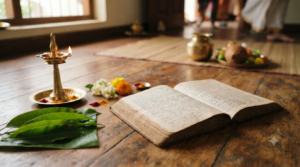
- A clean Panchayatana peetham, tray or altar surface.
- The five established deity forms, pictures or traditional sacred representations used by your family.
- A brass or clay lamp with ghee or suitable oil.
- Clean water in a small vessel with spoon.
- Chandan or sandal paste, kumkum and akshata where customary.
- Fresh flowers suitable for the deities.
- Incense, if your household uses it.
- Fruit or a simple sattvic naivedya.
- Tulasi for Vishnu where available and permitted by family custom.
- A separate small plate for offerings and harati.
Do not force one leaf or flower on every deity simply for convenience. Families often keep deity-specific offering rules. For example, Vishnu worship commonly centres on tulasi, while Shiva worship may use bilva. When in doubt, plain clean flowers and respectful namaskara are safer than inventing a specialised offering rule.
Vishnu Panchayatana Puja Vidhanam Step by Step
This Vishnu Panchayatana Puja sequence is a simple household outline rather than a substitute for a full paddhati. It suits readers who want to understand the order before learning their family’s exact mantras. If your home follows a formal Smarta nitya-puja procedure, keep that procedure and use this section only as a map.
- Prepare yourself and the altar. Bathe, wear clean clothes and clean the pooja space. Arrange the five deities in the established Vishnu-centred order before you begin.
- Light the lamp. Begin with a steady lamp and a quiet mind. Many households also ring the bell at the start.
- Perform achamana and purification according to your practice. If your family has taught specific achamana mantras, use them. Otherwise, do not improvise Vedic formulas from random online sources.
- Make the sankalpa. State that you are performing Vishnu-centred Panchayatana worship with devotion. Formal sankalpa wording can include place, tithi, gotra and purpose when your family tradition requires it.
- Offer preliminary respect to Ganesha. Many puja paddhatis begin with Ganapati remembrance before the main worship. In Panchayatana, Ganesha also receives His own place among the five deities.
Main Worship of the Five Deities
- Honour the five deities. Begin with Vishnu as the central deity, then worship the surrounding deities in the sequence your family teaches. Offer water, gandha, flowers, incense, lamp and naivedya in an orderly manner.
- Perform archana or nama-smarana. Use the nama-mantra, ashtottara or stotra taught in your home. A beginner can keep the practice simple rather than mixing advanced mantras from different sampradayas.
- Offer naivedya. Place a clean vegetarian offering before the deities. Follow your household custom for water, tulasi and distribution of prasada.
- Show harati. Complete the main worship with deepa or camphor harati if that is your practice. Then offer namaskara and spend a few moments in silent prayer.
- Conclude according to family custom. Some paddhatis include specific concluding mantras and upacharas. Do not casually perform an invented visarjana for permanently worshipped household deities.
Should beginners perform Shodashopachara?
Beginners can learn the meaning of Shodashopachara, the sixteenfold form of hospitality offered to a deity, but they need not imitate a complex manual without guidance. The exact list and sequence can vary between paddhatis. A shorter, sincere daily form is often more practical until a family priest teaches the fuller procedure.
In a full worship, the upacharas commonly include welcoming the deity, offering a seat, water, bathing, dress or symbolic cloth, fragrance, flowers, incense, lamp, food and respectful conclusion. However, mantras and details should come from your lineage because this is where online copy-and-paste guides often become unreliable.
Simple Mantras for Vishnu Panchayatana Puja
The safest rule is to use the mantra your guru, parent or family priest has taught. Do not combine initiated mantras, bija mantras and Vedic passages from unrelated online sources. For simple nama-smarana, households often use respectful deity names rather than advanced ritual formulas.
| Deity | Simple respectful nama-smarana | Common devotional option |
|---|---|---|
| Vishnu | Sri Mahavishnave Namah | Vishnu Sahasranama or a family Vishnu stotra |
| Shiva | Sri Mahadevaya Namah | Shiva nama-smarana taught in the family |
| Ganesha | Sri Ganapataye Namah | Ganesha nama or stotra |
| Surya | Sri Suryaya Namah | Aditya nama-smarana |
| Devi | Sri Devyai Namah | Devi nama or stotra used in the household |
If you want a Vishnu-focused recitation after the puja, Vishnu Sahasranamam is a familiar devotional choice for many families. However, it is an added stotra practice, not a replacement for the five-deity structure of Panchayatana worship.
Vishnu Panchayatana Puja and Shaligrama Worship
Vishnu Panchayatana Puja is often illustrated with a Shaligrama at the centre, but that does not mean every beginner should obtain one. A Shaligrama is a sacred aniconic form of Vishnu with its own inherited worship rules in many homes. Therefore, treat it as a living devotional tradition rather than a decorative ritual object.
If your family already worships a Shaligrama, follow that established discipline. If it does not, speak with a qualified acharya before beginning regular Shaligrama worship. This is especially important because Sri Vaishnava, Madhva and Smarta households can differ in theology, ritual vocabulary and daily worship procedure.
A framed Vishnu image or an established household murti can still help a beginner understand the Panchayatana arrangement, but do not label a new setup as your family’s formal nitya-puja unless your tradition supports it.
What Vishnu Panchayatana Puja Is Not
Several look-alike terms cause confusion, so this section matters as much as the ritual steps. Vishnu Panchayatana is a five-deity worship framework with Vishnu central. It is not the same as Pancharatra temple worship, Sri Vaishnava Thiruvaradhana, five Vishnu avatars or a generic “five gods” decorative altar.
- Not Pancharatra: Pancharatra is a distinct Vaishnava Agamic tradition with its own theology and ritual system.
- Not five Vishnu forms: Shiva, Ganesha, Surya and Devi remain the four surrounding deities.
- Not merely temple architecture: “Panchayatana” can also describe a central shrine with four subsidiary shrines, but that architectural meaning is related rather than identical to domestic puja.
- Not a commercial homam package: the daily household form can be simple and does not require a paid event or elaborate samagri kit.
For a related distinction, our guide to Pancha Bhootha Lingas and Shiva Panchayatana explains why the five-element Shiva pilgrimage and Panchayatana worship should not be treated as the same concept.
Daily, Weekly or Occasional Practice?
Panchayatana can function as a regular household worship framework, especially in families that inherit it. However, frequency depends on the household’s sampradaya and capacity. A short daily lamp, flower and nama-smarana practice can be more sustainable than attempting a long ritual and then abandoning it.
Some families reserve fuller worship for Fridays, Ekadashi, Purnima or other customary days. Others perform a daily nitya-puja. There is no need to attach a made-up universal weekday to Vishnu Panchayatana because traditional practice varies.
If your devotional focus is specifically a Vishnu vrata rather than Panchayatana, Satyanarayana Vratam follows a different ritual intention and should be learned as its own observance.
Mistakes to Avoid in Vishnu Panchayatana Puja
- Copying the altar by screen position instead of direction. Use north-east, south-east, south-west and north-west, because left-right diagrams can flip with orientation.
- Mixing different sampradaya manuals. One page may use Smarta steps while another uses Sri Vaishnava or Tantric mantras. The result can be internally inconsistent.
- Assuming every sacred stone has the same rules. Shaligrama, Bana Linga and other traditional forms carry their own customs.
- Buying a large ritual kit before learning the order. Start with the established household altar and simple offerings.
- Treating spiritual benefits as guaranteed outcomes. Panchayatana worship is a devotional discipline, not a promise of wealth, health or problem-free life.
- Ignoring family tradition. When a parent, acharya or purohit has taught a specific order, that living tradition should guide the household practice.
Why Devotees Value Vishnu Panchayatana Puja
Devotees value Vishnu Panchayatana Puja because it keeps Vishnu at the devotional centre while giving a defined place to four other major deities. Within the Smarta framework, this creates an integrated form of worship without erasing the worshipper’s chosen focus. The value is therefore theological and devotional, not transactional.
The practice also trains consistency. Cleaning the altar, arranging offerings, reciting names and concluding with gratitude can create a disciplined daily rhythm. Families may also value it as inherited samskara, especially when the same Panchayatana set passes through generations.
Traditional texts and teachers may describe spiritual merit from such worship. Those claims belong to faith and sampradaya, so they should not be presented as scientifically guaranteed results.
Key Points Before You Begin
Vishnu Panchayatana Puja is best approached as a structured tradition, not as a ritual assembled from search snippets. Keep Vishnu in the centre, honour the four surrounding deities in the correct positions, and start with a simple form you can perform consistently. Then learn the fuller paddhati from a trustworthy family or lineage source.
Most importantly, do not confuse Vishnu-centred Panchayatana with Pancharatra, Sri Vaishnava daily aradhana or five Vishnu forms. That single correction prevents many of the errors repeated in generic pooja pages.
Frequently Asked Questions
What is Vishnu Panchayatana Puja?
Vishnu Panchayatana Puja is a five-deity worship arrangement with Lord Vishnu in the centre. Shiva, Ganesha, Surya and Devi occupy the four surrounding positions. It belongs mainly to the Panchayatana framework associated with Smarta household worship.
Where should Shiva be placed in Vishnu Panchayatana?
In the traditional Vishnu-centred arrangement recorded in Panchayatana sources, Shiva occupies the north-east. Ganesha is in the south-east, Surya in the south-west and Devi in the north-west. Follow an inherited family layout if your lineage teaches a specific variation.
Can I perform Vishnu Panchayatana Puja at home?
Yes, families that follow Panchayatana worship can perform it at home. A beginner should keep the worship simple and use established household images or forms. For formal nitya-puja, sacred stones or advanced mantras, learn the procedure from a qualified acharya or purohit.
Is a Shaligrama compulsory for Vishnu Panchayatana?
No universal beginner rule makes a newly acquired Shaligrama compulsory. Traditional Panchayatana sets often represent Vishnu with a Shaligrama, but Shaligrama worship has its own disciplines. If your family does not already follow that practice, seek lineage guidance before adopting it.
Is Vishnu Panchayatana the same as Pancharatra worship?
No. Vishnu Panchayatana is a five-deity Panchayatana arrangement with Vishnu in the centre, while Pancharatra is a distinct Vaishnava Agamic tradition. The names sound similar, but their ritual frameworks and theological settings are different.
Which five deities are worshipped in Panchayatana Puja?
The standard five are Vishnu, Shiva, Devi, Surya and Ganesha. The central deity changes according to the worshipper’s chosen Panchayatana form. In Vishnu Panchayatana, Vishnu takes the central seat while the other four remain around Him.
Do I need a priest for daily Panchayatana worship?
Not necessarily for a simple household practice that your family already knows. However, a priest or acharya is helpful when starting formal nitya-puja, learning Shodashopachara, handling Shaligrama worship or using mantras that require proper instruction.
Can I use pictures instead of sacred Panchayatana stones?
Many explanatory sources describe both iconic images and aniconic sacred forms within Panchayatana practice. For a beginner, established household pictures or murtis can be a practical learning setup. Still, formal family worship should follow the objects and rules recognised by that household’s tradition.