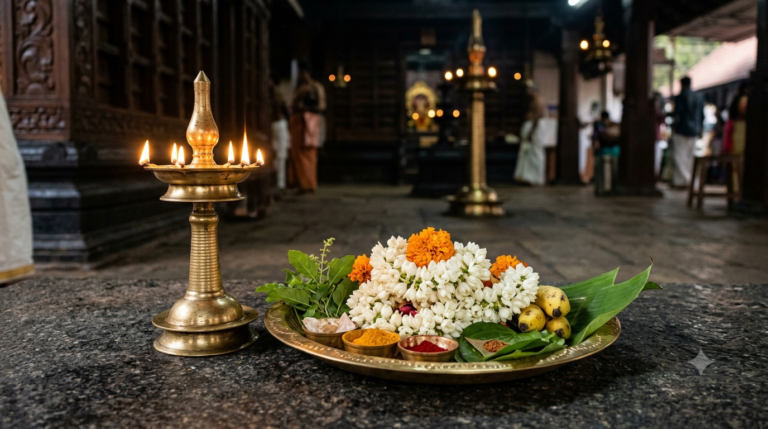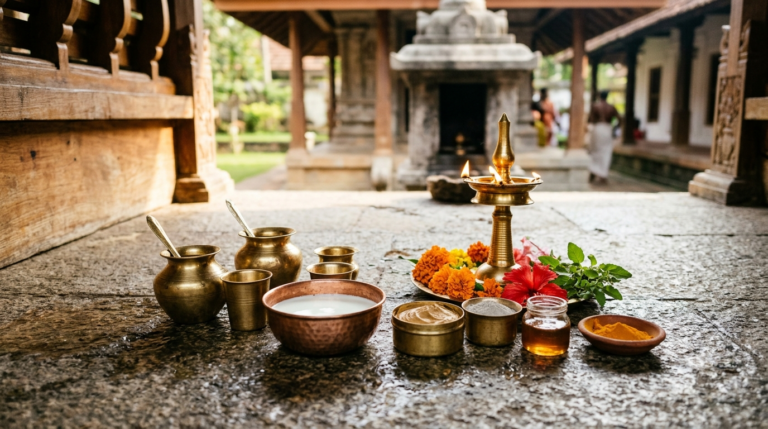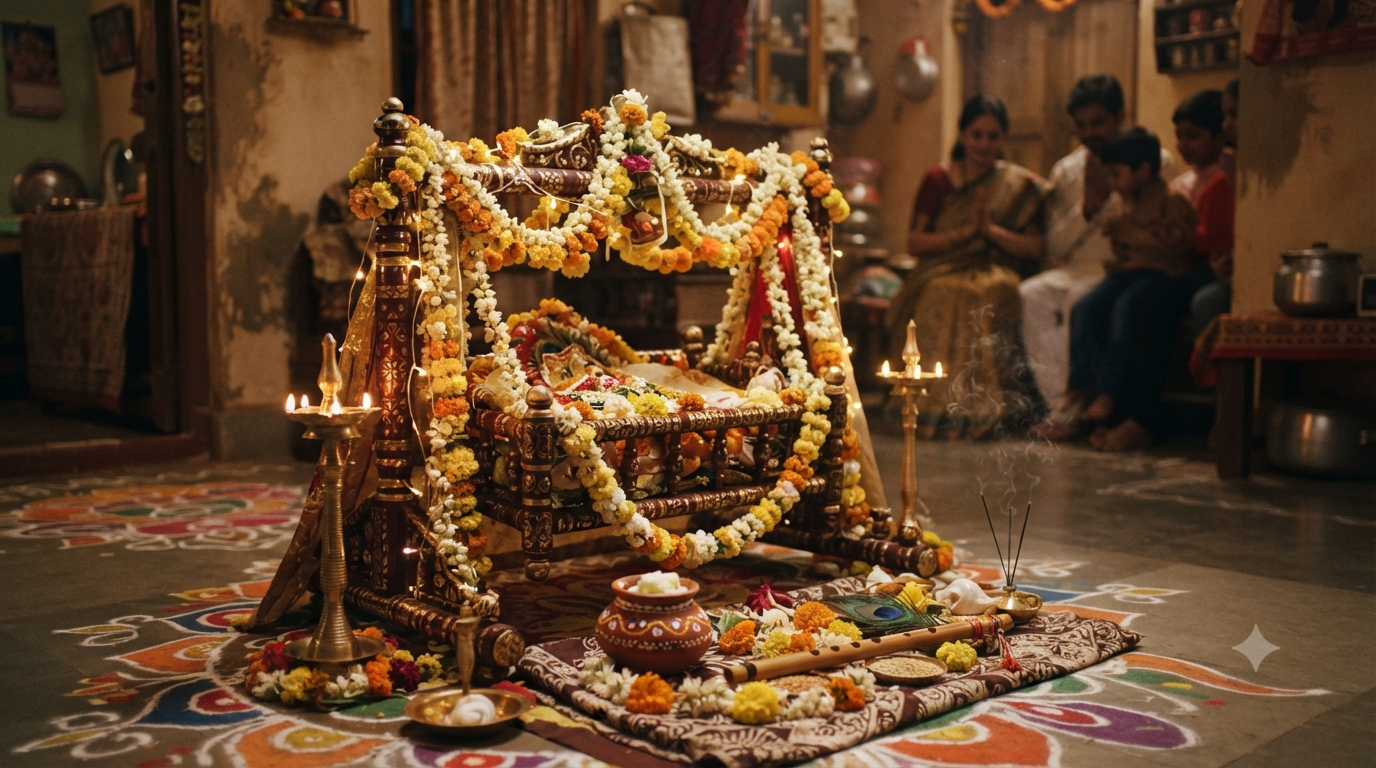
Krishna Janmashtami significance goes far beyond marking the birthday of Lord Krishna. The festival brings together the story of his birth in Mathura, the promise of dharma, the tenderness of Bala Krishna worship, fasting, midnight prayer and joyful regional customs. Because Janmashtami follows a lunar calendar, its Gregorian date changes each year, while local traditions may also differ.
Sri Vyasa Pooja is an independent devotional guide. We are not affiliated with any temple, matha, trust or official religious body. We do not accept pooja bookings, donations or payments, so use the official or institutional sources linked below for local festival schedules.
Krishna Janmashtami Significance at a Glance
Krishna Janmashtami celebrates the appearance of Lord Krishna, worshipped in many Hindu traditions as an avatar of Lord Vishnu and as the divine teacher of the Bhagavad Gita. The night combines devotion and celebration because devotees remember both the danger surrounding Krishna’s birth and the hope associated with his life and teachings.
- What it celebrates: the birth of Lord Krishna to Devaki and Vasudeva in Mathura.
- When it falls: on Krishna Paksha Ashtami in Shravana or Bhadrapada, depending on the lunar calendar system.
- Main time of worship: around Nishita Kaal, the traditional midnight period linked with Krishna’s birth.
- Common observances: fasting, bhajan, kirtan, scripture reading, Bala Krishna worship, arati and midnight celebration.
- Regional names: Janmashtami, Gokulashtami, Sri Krishna Jayanti, Krishnashtami and Ashtami Rohini.
- Important caution: the exact date, Nishita time and parana time should be checked for your city and tradition each year.
What Is Krishna Janmashtami?
Krishna Janmashtami is the annual Hindu festival that commemorates the birth of Lord Krishna. Devotees observe it on the Ashtami tithi of Krishna Paksha. In the amanta calendar this falls in Shravana, while the purnimanta calendar calls the same lunar period Bhadrapada. The festival usually falls in August or September.
The name itself connects birth and lunar timing: janma means birth, while ashtami means the eighth tithi. However, the observance is not only about a calendar date. It is also a devotional remembrance of Krishna as child, protector, friend, teacher and guide.
For current local timing, use a trusted panchang such as the Krishna Janmashtami reference at Drik Panchang. Do not copy a previous year’s muhurat into a new festival season.
Krishna Janmashtami Significance in the Birth Story
The Krishna Janmashtami significance becomes clearer through the traditional birth narrative. Devaki and Vasudeva were held in Mathura by King Kamsa after a prophecy warned that Devaki’s eighth child would bring about his downfall. Krishna was born during the night, and Vasudeva carried the infant away to safety in Gokul.
In devotional interpretation, this story places hope inside a moment of fear and confinement. Krishna’s appearance does not begin in a palace or during peaceful times. Instead, the story begins under oppression, which is why many devotees read the festival as a reminder that dharma can re-emerge even when circumstances look darkest.
The child Krishna later becomes the cowherd of Vrindavan, the king associated with Dwarka and the charioteer who teaches Arjuna in the Bhagavad Gita. Janmashtami therefore remembers a birth, but it also points toward the wider spiritual role Krishna plays in Hindu tradition.
Why does midnight matter on Janmashtami?
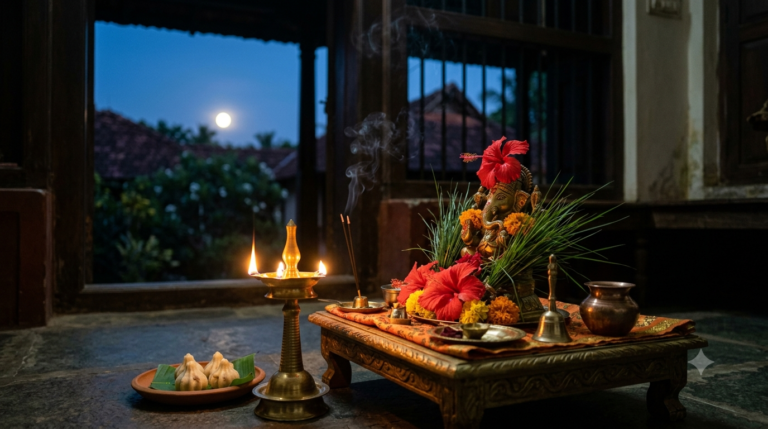
Midnight matters because Krishna’s birth is traditionally remembered during Nishita Kaal, the deep-night period around local midnight. Many temples and homes build the day’s observance toward this moment with kirtan, bhajan, scripture recitation and Bala Krishna worship. ISKCON also describes its Janmashtami celebrations as leading to a midnight service.
This does not mean one fixed clock time works everywhere. Nishita Kaal depends on location, so a timing copied from Delhi, Hyderabad or Mumbai may not match another city. Check a local panchang before planning a time-sensitive household ritual.
The Spiritual Meaning Behind Janmashtami
The festival’s spiritual meaning rests on several connected ideas: dharma, bhakti, hope, self-discipline and remembrance. These are not promises of material rewards. Instead, they are devotional themes drawn from the way Krishna is understood across scripture and worship traditions.
Dharma and the purpose of divine appearance
One of the clearest scriptural links comes from Bhagavad Gita 4.7, where Krishna speaks about manifesting when dharma declines and adharma rises. The Gita Supersite at IIT Kanpur provides the Sanskrit verse with several established translations and commentaries.
For devotees, this gives Krishna Janmashtami significance a moral dimension. The festival can become a yearly reminder to examine one’s own conduct, not only to celebrate a sacred event. Dharma begins with ordinary choices about honesty, duty, restraint, compassion and responsibility.
Bhakti through the child form of Krishna
Janmashtami also centres on Bala Krishna, the child form of the deity. Families may place a small Krishna image or vigraha in a cradle, decorate the altar, sing lullabies or bhajans, and offer simple naivedyam. The mood is intimate because the divine is approached with affection rather than distance.
This child-centred devotion explains customs such as tiny Krishna footprints drawn toward the pooja room. They symbolically welcome Krishna into the household. Such customs differ by family and region, so they should be treated as devotional traditions rather than compulsory rules for everyone.
When Is Janmashtami Observed Each Year?
Janmashtami follows the Hindu lunar calendar, so its Gregorian date changes every year. Drik Panchang identifies the observance with Krishna Paksha Ashtami of Shravana in the amanta system and Bhadrapada in the purnimanta system. The festival therefore cannot be made evergreen by preserving an old August or September date.
There is another layer of variation. Smarta and Vaishnava traditions may apply different rules when Ashtami tithi, Rohini Nakshatra and Nishita Kaal overlap across two civil dates. In some years the observance can differ by a day between communities.
That is why an evergreen guide should explain the rule rather than hard-code an expired muhurat. Check your city’s panchang each year, then follow your family or sampradaya tradition. The site’s Udupi Krishna Temple guide also shows why local institutional calendars can differ from a general all-India date.
How Janmashtami Is Celebrated Across India
Janmashtami has a shared devotional core, yet the visible customs vary widely. Some regions focus on midnight temple worship, while others emphasise child-Krishna decoration, dramatic retellings or the next day’s community celebration. This diversity is part of the festival rather than a contradiction.
| Custom | Meaning | Where it is commonly seen |
|---|---|---|
| Midnight worship | Marks Krishna’s birth at Nishita Kaal | Homes and Krishna temples across India |
| Jhula or cradle | Honours Bala Krishna as the divine child | North and South Indian households |
| Bhajan and kirtan | Collective devotional singing and remembrance | Temples, mathas and community gatherings |
| Dahi Handi | Recalls Krishna’s playful butter-stealing stories | Especially associated with Maharashtra |
| Tiny Krishna footprints | Symbolically welcomes Krishna into the home | Common in many South Indian households |
| Rasa or Krishna Lila | Dramatic retelling of Krishna’s life and leelas | Mathura-Vrindavan and several regional traditions |
ISKCON describes Janmashtami as a day of music, drama, dance and chanting that builds toward midnight worship. Other temples follow their own paddhati, schedule and fasting rules. For that reason, use institutional announcements only for that institution, not as a universal rule for every Hindu household.
Fasting, Puja and the Midnight Celebration
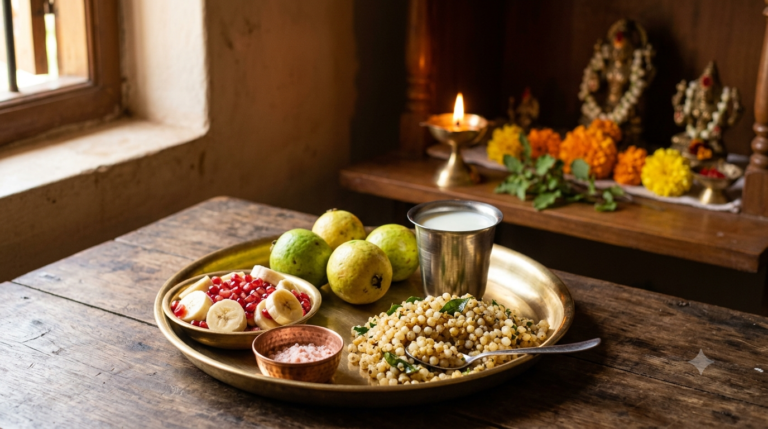
Fasting is common on Janmashtami, but the level of strictness differs by tradition and physical capacity. Some devotees take fruit, milk and water. Others follow a stricter fast. A household may also keep a lighter observance while focusing on prayer, nama japa and the midnight celebration.
Do not treat a waterless fast as a test of devotion. Children, elderly people, pregnant women, people with diabetes, anyone taking regular medicines and those with health conditions should avoid strict fasting unless it is medically safe for them. Religious practice should not replace medical advice or prescribed treatment.
The fast-breaking rule also needs nuance. Some modern household traditions break after the midnight birth celebration, while stricter vrata traditions may prescribe parana on the next day after specific tithi and nakshatra conditions. Check your sampradaya or local panchang instead of assuming one method is compulsory for everyone.
If your main need is the step-by-step ritual, use the site’s separate Janmashtami puja vidhi guide. Keeping the ritual procedure on that page prevents this significance article from competing with it for the same search intent.
Krishna Janmashtami Significance in Home Worship
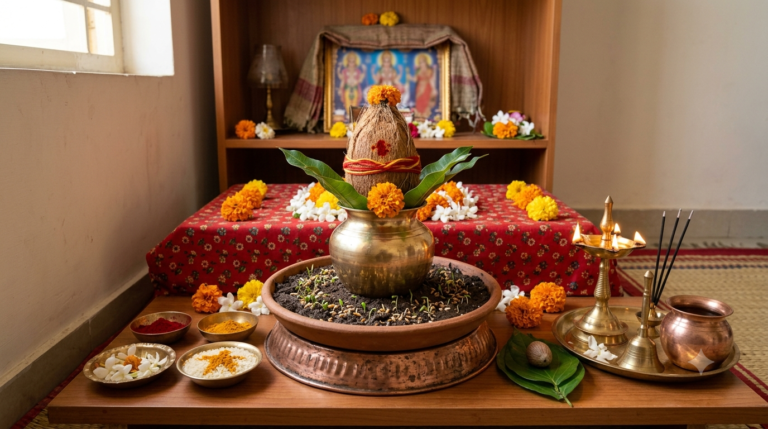
For a household, Krishna Janmashtami significance often becomes most personal through simple acts of preparation and remembrance. Cleaning the pooja space, arranging flowers, lighting a lamp, preparing a sattvic offering and singing Krishna nama can make the festival meaningful without turning it into a complicated ritual checklist.
A Bala Krishna vigraha may receive abhishekam if the image is suitable for bathing. A framed picture or delicate decorative idol should not be soaked. In that case, symbolic worship with flowers, lamp, incense and naivedyam is enough.
Families can also read the Krishna birth narrative, recite a familiar passage from the Bhagavad Gita or spend time in bhajan. The strongest evergreen principle is consistency: follow one trusted family or sampradaya method instead of mixing several contradictory online procedures on the same night.
Why Old Janmashtami Dates and Timings Should Not Be Reused
An old Janmashtami article can become misleading even when the ritual explanation remains sound. The festival date changes each year because the lunar tithi moves against the Gregorian calendar. Nishita Kaal also changes by city, while sectarian rules can create a one-day difference in some years.
This is why the 2021 date and muhurat from the earlier draft do not belong in an evergreen article. They are historical data, not reusable guidance. The safer approach is to explain how the date is determined and send readers to a current panchang for the year they are observing.
The same principle applies to Dahi Handi. It is strongly associated with the day after Janmashtami in Maharashtra, but local event schedules can vary. A community programme should be checked with the organiser rather than inferred from an old calendar.
What Janmashtami Teaches Beyond the Festival Night
The Krishna Janmashtami significance is strongest when the festival becomes more than an annual ritual. Krishna’s life is remembered in many roles, yet several themes connect them: courage under pressure, devotion without show, intelligent action and responsibility toward dharma.
- Hope can begin in difficult conditions. The birth story starts in confinement, yet it leads toward liberation and protection.
- Devotion can be joyful. Janmashtami combines fasting and discipline with music, dance, cradle worship and celebration.
- Dharma needs action. The Bhagavad Gita does not present spirituality as escape from duty, so remembrance should shape conduct.
- Tradition allows diversity. Regional names, dates and customs differ, yet devotees still recognise the same central festival.
- Simplicity is enough. A sincere household observance does not require an expensive altar or elaborate list of offerings.
These lessons also explain why Janmashtami continues to remain relevant outside a temple setting. The celebration connects family memory, scripture, music, food, discipline and moral reflection in one night.
Krishna Janmashtami Significance: Common Misunderstandings
Several ideas get repeated online as if they were universal rules. They are not. Correcting them makes the Krishna Janmashtami significance easier to understand without turning one regional custom into a rule for everyone.
- “Janmashtami is always in Bhadrapada.” That wording reflects the purnimanta calendar. In the amanta system, the same observance falls in Shravana.
- “Everyone must break the fast at midnight.” Parana practice differs. Some households break after midnight worship, while stricter traditions continue until the prescribed next-day window.
- “Dahi Handi is the main ritual everywhere.” It is especially prominent in Maharashtra. Other regions emphasise different customs.
- “One national muhurat works for every city.” Nishita Kaal is location-sensitive, so local timing matters.
- “A complete puja requires every listed item.” Household practice varies. A simple, coherent worship routine is better than a rushed checklist copied from several sources.
Before You Observe Janmashtami
Use this evergreen guide for meaning, context and the logic behind the festival. Then check your city’s current date and Nishita time on a trusted panchang. If your family follows a specific Vaishnava, Smarta or regional tradition, keep that method first.
Most importantly, separate the permanent meaning from the changing calendar. The birth story, dharma, bhakti and midnight remembrance remain central, while the civil date and muhurat must be refreshed every year. That distinction keeps both devotion and information accurate.
Krishna Janmashtami Significance: Frequently Asked Questions
Why is Krishna Janmashtami celebrated?
Krishna Janmashtami is celebrated to commemorate the birth of Lord Krishna. Devotees also connect the festival with dharma, bhakti and Krishna’s later teachings in the Bhagavad Gita. The observance therefore combines remembrance of the birth story with prayer, fasting, music and moral reflection.
What is the main Krishna Janmashtami significance?
The main Krishna Janmashtami significance is the remembrance of Krishna’s divine appearance and the restoration of dharma. For many devotees, the festival also symbolises hope emerging in dark circumstances because Krishna’s traditional birth story begins under imprisonment and threat.
Is Janmashtami in Shravana or Bhadrapada?
Both descriptions can be correct because Hindu lunar calendars use different month systems. Drik Panchang places Janmashtami in Shravana under the amanta system and Bhadrapada under the purnimanta system. The observance refers to the same Krishna Paksha Ashtami period.
Why is Janmashtami celebrated at midnight?
Devotees celebrate at midnight because Krishna’s birth is traditionally associated with Nishita Kaal. Temples and homes may spend the evening in bhajan, kirtan or scripture reading, then perform the main birth celebration around the local midnight worship period.
Is fasting compulsory on Janmashtami?
Fasting is a common devotional practice, but its strictness varies by tradition and health. A person who cannot safely fast may choose a lighter observance, prayer and sattvic food. Children and medically vulnerable people should not attempt a strict waterless fast without suitable medical guidance.
What is the difference between Janmashtami and Gokulashtami?
Janmashtami and Gokulashtami usually refer to the same annual celebration of Krishna’s birth. The preferred name varies by region and tradition. Sri Krishna Jayanti, Krishnashtami and Ashtami Rohini are other names used in different parts of India.
Is Dahi Handi part of Janmashtami?
Dahi Handi is closely associated with Janmashtami, especially in Maharashtra. The event recalls stories of young Krishna and his love of butter and curd. However, it is a regional public celebration rather than a compulsory ritual in every Janmashtami tradition.
Can Janmashtami be celebrated at home without a priest?
Yes. Many families celebrate at home with a lamp, flowers, Krishna nama, bhajan, simple naivedyam and midnight prayer. Formal mantra procedures vary by tradition, so households can keep a simple method they understand or follow guidance from their family priest or sampradaya.