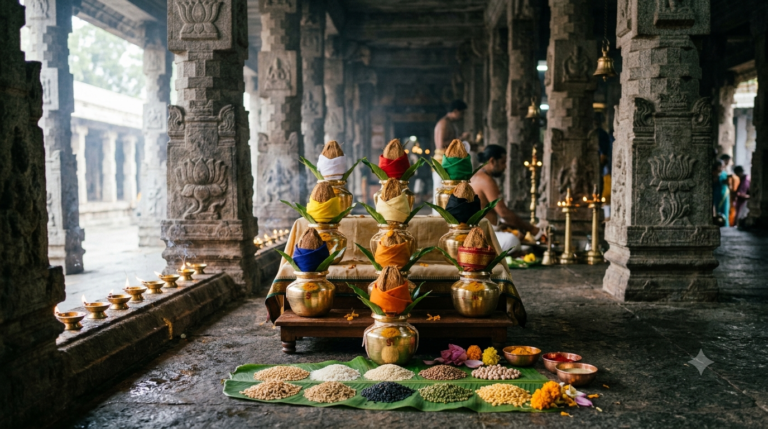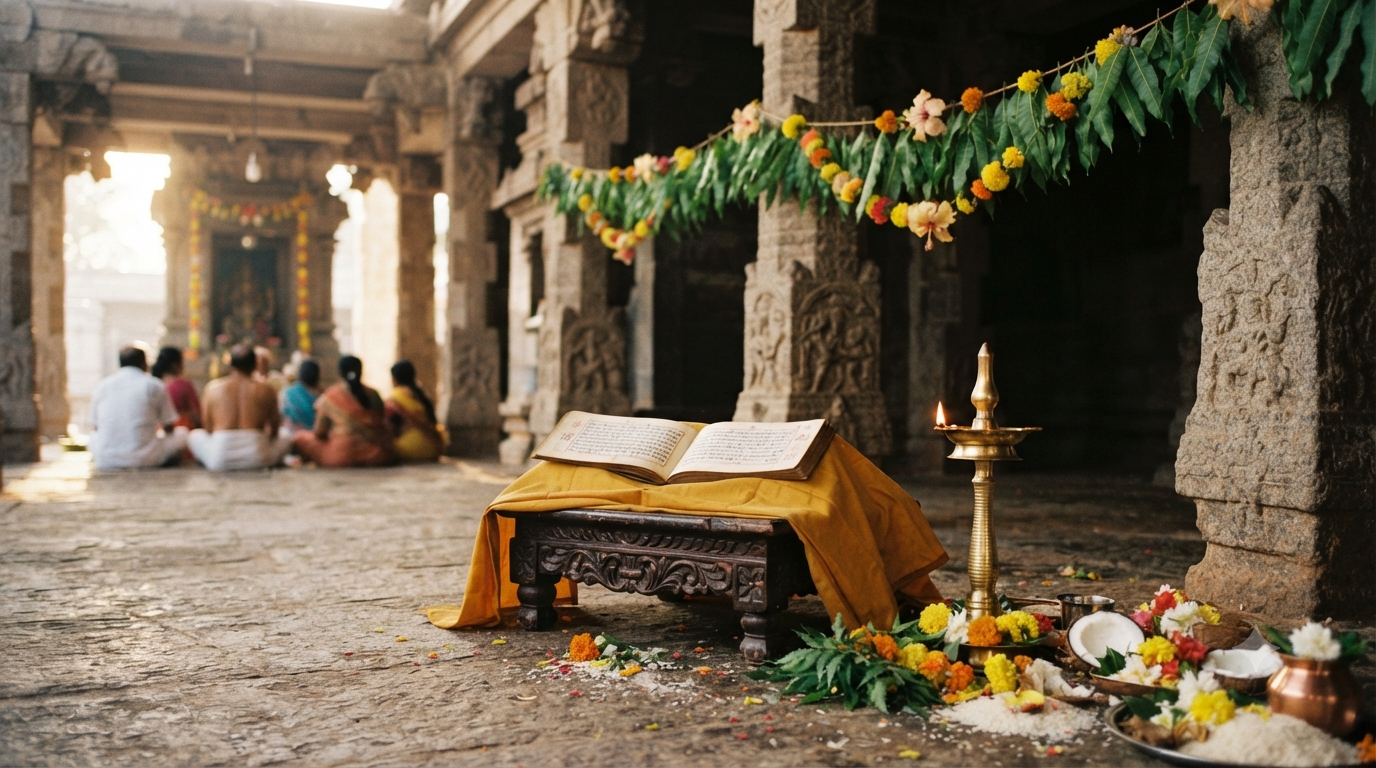
Plava Nama Samvatsara was the Telugu year that began on 13 April 2021 and closed on 1 April 2022. Because search results rarely age out, that finished year still surfaces for people hunting this season’s panchangam. So a family fixes a wedding muhurtam from a four-year-old almanac and never notices. This guide sets the record straight: what the year was, where it sits in the sixty-year cycle, and which samvatsara is actually running today.
Sri Vyasa Pooja is an independent devotional guide. We are not affiliated with any mutt, peetham or temple trust, and we take no bookings, donations or payments. Panchangam downloads and seva bookings happen only on the official portals we link below.
Plava Nama Samvatsara at a Glance
- Telugu year: Sri Plava Nama Samvatsara (శ్రీ ప్లవ నామ సంవత్సరం)
- Started: Ugadi, Tuesday 13 April 2021 (Chaitra Shukla Padyami)
- Ended: 1 April 2022, the day before Shubhakrit Nama Samvatsara began
- Position in the cycle: 35th of the 60 samvatsaras, inside the Vishnu group
- Previous Plava year: 1961–62 · Next Plava year: 2081–82
- Running now (2026–27): Parabhava Nama Samvatsara, from 19 March 2026
What Plava Nama Samvatsara Means
The name comes from the Sanskrit word plava, which means a float, a raft or a boat — anything that carries you across water. Traditional panchangam commentaries therefore read the year as one of drifting and crossing over, rather than one of firm ground. Astrologers often paired it with themes of movement, displacement and slow recovery.
Treat those readings as tradition, not forecast. Samvatsara phala is a devotional and Jyotisha custom, so it describes a mood the elders assign to a year. It is not a verified prediction, and no reputable pandit presents it as one.
Why the Vishnu group matters
The sixty names split into three blocks of twenty. The first twenty, Prabhava to Vyaya, belong to Brahma. The next twenty, Sarvajit to Parabhava, belong to Vishnu, while the last twenty, Plavanga to Akshaya, belong to Shiva.
Plava is the 35th name, so it falls in the Vishnu block. That detail matters to Madhva and Sri Vaishnava households, since many sankalpas and vrata resolutions name the presiding deity of the year alongside the samvatsara.
When Plava Nama Samvatsara Started and Ended
Plava Nama Samvatsara ran from Tuesday 13 April 2021 to Friday 1 April 2022. The year opened on Chaitra Shukla Padyami, the tithi that always carries Ugadi, the Telugu and Kannada New Year. Shubhakrit Nama Samvatsara then took over on Saturday 2 April 2022.
Anyone quoting a Plava year date outside that window has mixed up two almanacs. That is the single most common error in old panchangam posts still floating around.
Why Ugadi 2021 fell as late as 13 April
Ugadi normally lands between mid-March and early April. In 2021, though, it slipped all the way to 13 April, which is unusually late. The reason was an adhika masa — an extra lunar month inserted to keep the lunar year aligned with the solar one.
That extra month was Adhika Ashwina Masa, which ran from 18 September to 16 October 2020. Once a thirteenth month enters the calendar, every lunar date after it shifts by roughly a full month. So Plava Nama Samvatsara started nearly three weeks later than the previous year’s Sharvari, which had begun on 25 March 2020.
This is exactly why last year’s dates must never be carried forward. Recompute them, because a leap month silently breaks the whole list.
Which Telugu Year Is Running Now?
As of today the running Telugu year is Parabhava Nama Samvatsara, the 40th in the cycle, which began at Ugadi on Thursday 19 March 2026. It continues until Ugadi 2027. Sringeri Sharada Peetham itself refers to the current Chaturmasya observance as falling in the Parabhava samvatsara, which is about as authoritative a confirmation as you can get.
The next year, Plavanga Nama Samvatsara, begins on Wednesday 7 April 2027. Plavanga is the 41st name and opens the Shiva block of twenty.
Plava and Plavanga are not the same year
These two names sit six years apart, yet they get swapped constantly. Plava is 2021–22. Plavanga is 2027–28. A panchangam labelled “Plavanga” will not give you a single correct tithi for 2021, and a Plava-year almanac is useless for planning 2027.
The mix-up is worth watching because Ugadi 2027 falls on 7 April, and Ugadi 2021 fell on 13 April. Both are late-April-leaning dates, so a careless reader sees “April, Plav-something” and stops checking. Always confirm the full name and the Gregorian span printed on the cover.
Regional naming adds one more wrinkle. North Indian Vikram Samvat calendars run a different samvatsara sequence, so the same Gregorian year can carry a different name there. The names in this guide follow the South Indian Shalivahana Shaka reckoning used across Andhra Pradesh, Telangana and Karnataka.
Where Plava Nama Samvatsara Sits in the 60-Year Cycle
The table below places Plava Nama Samvatsara among its neighbours, with each Ugadi start date verified against panchangam sources. Note how the Gregorian date swings by nearly a month from year to year, since the calendar is lunisolar rather than fixed.
| No. | Samvatsara | Ugadi start | Telugu year |
|---|---|---|---|
| 34 | Sharvari | 25 March 2020 | 2020–21 |
| 35 | Plava | 13 April 2021 | 2021–22 |
| 36 | Shubhakrit | 2 April 2022 | 2022–23 |
| 37 | Shobhakrit | 22 March 2023 | 2023–24 |
| 38 | Krodhi | 9 April 2024 | 2024–25 |
| 39 | Vishvavasu | 30 March 2025 | 2025–26 |
| 40 | Parabhava | 19 March 2026 | 2026–27 |
| 41 | Plavanga | 7 April 2027 | 2027–28 |
To restate the key figures in plain text: Plava is the 35th samvatsara, it began on 13 April 2021, and the current year Parabhava is the 40th, which began on 19 March 2026.
Born in Plava Nama Samvatsara? What That Means for Your 60th
The cycle repeats every sixty years, so your samvatsara comes back once in a lifetime. Anyone born between 13 April 2021 and 1 April 2022 was born in Plava. Their Shashtiabdapoorthi, the sixtieth-year ceremony, therefore falls in the next Plava year — 2081–82.
Working backwards is the more useful calculation. The previous Plava ran from 1961 to 1962, so people born in that window reached their sixtieth samvatsara during 2021–22. Many families performed the ritual then, and some postponed it because of pandemic restrictions.
If you are planning a delayed ceremony now, the traditional practice is to fix a fresh muhurtam from the current panchangam rather than the old one. Temples across the south conduct the ritual, and our guide to Shashtiabdapoorthi temples and halls in Coimbatore covers how the booking usually works.
Panchangam Editions Published for Plava Nama Samvatsara
Every major mutt and publisher brings out its own almanac just before Ugadi. For Plava Nama Samvatsara, the widely used editions in 2021 included the following.
- Sringeri Sharada Peetham — released in Kannada, Tamil and Telugu, and archived on the Peetham’s own downloads page. Our Sringeri Plavanama panchangam guide explains how to read it.
- Sri Raghavendra Swamy Mutt, Mantralayam — issued in Kannada, Sanskrit, Tamil and Telugu, in print and PDF. See our Rayara Mutt Plava panchangam page for details.
- Ontikoppal (Mysore) Panchangam — the Kannada almanac most Karnataka households follow.
- Telugu gantala panchangams — Mulugu, Nemani, Gudimella and the TTD edition, all sold in book stalls before Ugadi.
Download only from the publishing institution. The Sringeri archive sits on the official Sringeri panchangam page, and Tirumala Tirupati Devasthanams (TTD) sells its almanac through tirumala.org. Third-party sites that ask for payment or personal details before releasing a “free” PDF are best avoided.
How to Read Any Samvatsara Panchangam
- Confirm the samvatsara on the cover. The name and the Gregorian span are printed on the front. If they do not match your year, stop there.
- Find the Ugadi entry. This fixes the first day and the presiding planets for the whole year.
- Check the festival list. Regional traditions differ, so compare against your family’s usual practice.
- Use the muhurtam tables. Weddings, griha pravesham and namakaranam each have their own auspicious windows.
- Read the daily panel. Tithi, nakshatram, varjyam, durmuhurtam and rahu kalam are listed per day.
Panchanga sravanam on Ugadi day covers the same ground aloud. Government broadcasters and temples both host readings, and the practice remains central to how Ugadi is observed across the Telugu states.
If the Plava Nama Samvatsara Panchangam Is Nowhere Online
Old editions do disappear. Mutts archive only a few years on their sites, and publishers rarely keep PDFs of a finished year. So there is no guarantee that a 2021–22 almanac is still downloadable.
When the file has gone, these fallbacks actually work:
- Write to the mutt directly through the contact page on its official site — branches often hold unsold print copies.
- Ask at a temple library or a Sanskrit college, since both keep bound back-runs.
- Use a panchangam calculator set to the date and place you need, because tithi and nakshatram can be computed for any past date.
- Ask your family purohit, as most retain their own copies for jataka work.
If none of these produce the exact edition, accept it and move on. For a birth-detail question, a computed panchangam for that date and location gives the same tithi and nakshatram the printed book would have shown.
What Most People Get Wrong About Samvatsara Names
After years of correcting these pages, the same four errors keep repeating.
- Treating the name as a calendar year. A samvatsara straddles two Gregorian years, so “Plava 2021” is shorthand, not a full answer.
- Copying last year’s Ugadi date forward. An adhika masa can shove it by a month, as 2021 showed.
- Trusting listicles that misalign name and year. Several widely shared pages still label 2026 as Vishvavasu, though Vishvavasu was 2025–26 and 2026–27 is Parabhava.
- Assuming one date fits all regions. Tamil Puthandu and Kerala Vishu follow a solar reckoning, so they do not move with Ugadi at all.
One more habit worth building: check the modified date on any page quoting a samvatsara. If it has not been touched since 2021, its “this year” is almost certainly not yours.
Key Points Before You Decide
Plava Nama Samvatsara belongs to 2021–22 and nothing else. It was the 35th name in the sixty-year cycle, it opened on 13 April 2021 after a leap month pushed Ugadi late, and it ended on 1 April 2022. For anything you are planning today, use the Parabhava panchangam, and switch to Plavanga after 7 April 2027. When a date really matters, confirm it against the printed almanac your family follows and, if in doubt, ask your purohit before fixing the muhurtam.
Frequently Asked Questions
Which year was Plava Nama Samvatsara?
Plava Nama Samvatsara was the Telugu year 2021–22. It began at Ugadi on Tuesday 13 April 2021 and ended on 1 April 2022. Shubhakrit Nama Samvatsara followed it from 2 April 2022.
What does the name Plava mean?
Plava is a Sanskrit word for a float, raft or boat, so traditional commentaries read the year as one of crossing over and drifting. These readings belong to Jyotisha custom and devotional tradition rather than to any verified forecast.
Which samvatsara is running in 2026?
Parabhava Nama Samvatsara is running now. It started at Ugadi on Thursday 19 March 2026 and continues until Ugadi 2027. Parabhava is the 40th name in the cycle and the last of the Vishnu group.
Is Plavanga the same as Plava?
No, they are different years six apart. Plava was 2021–22 and Plavanga is 2027–28, beginning on 7 April 2027. Because the names look alike, always check the Gregorian span printed on the almanac cover.
Why did Ugadi 2021 fall on 13 April?
An adhika masa, the extra lunar month Adhika Ashwina from 18 September to 16 October 2020, shifted every later lunar date by about a month. Ugadi therefore moved from 25 March in 2020 to 13 April in 2021.
What number is Plava in the 60-year cycle?
Plava is the 35th of the sixty samvatsaras that run from Prabhava to Akshaya. It sits in the middle block of twenty names assigned to Vishnu, which spans Sarvajit through Parabhava.
When is the next Plava Nama Samvatsara?
The next Plava Nama Samvatsara falls in 2081–82, because the cycle repeats every sixty years. The previous one ran from 1961 to 1962, so people born then completed their sixtieth samvatsara during 2021–22.
Where can I download the Plava year panchangam now?
Try the publishing institution’s own downloads page first, since mutts such as Sringeri archive past editions. If the file has been removed, contact a branch, check a temple library, or compute the tithi you need with a panchangam calculator.