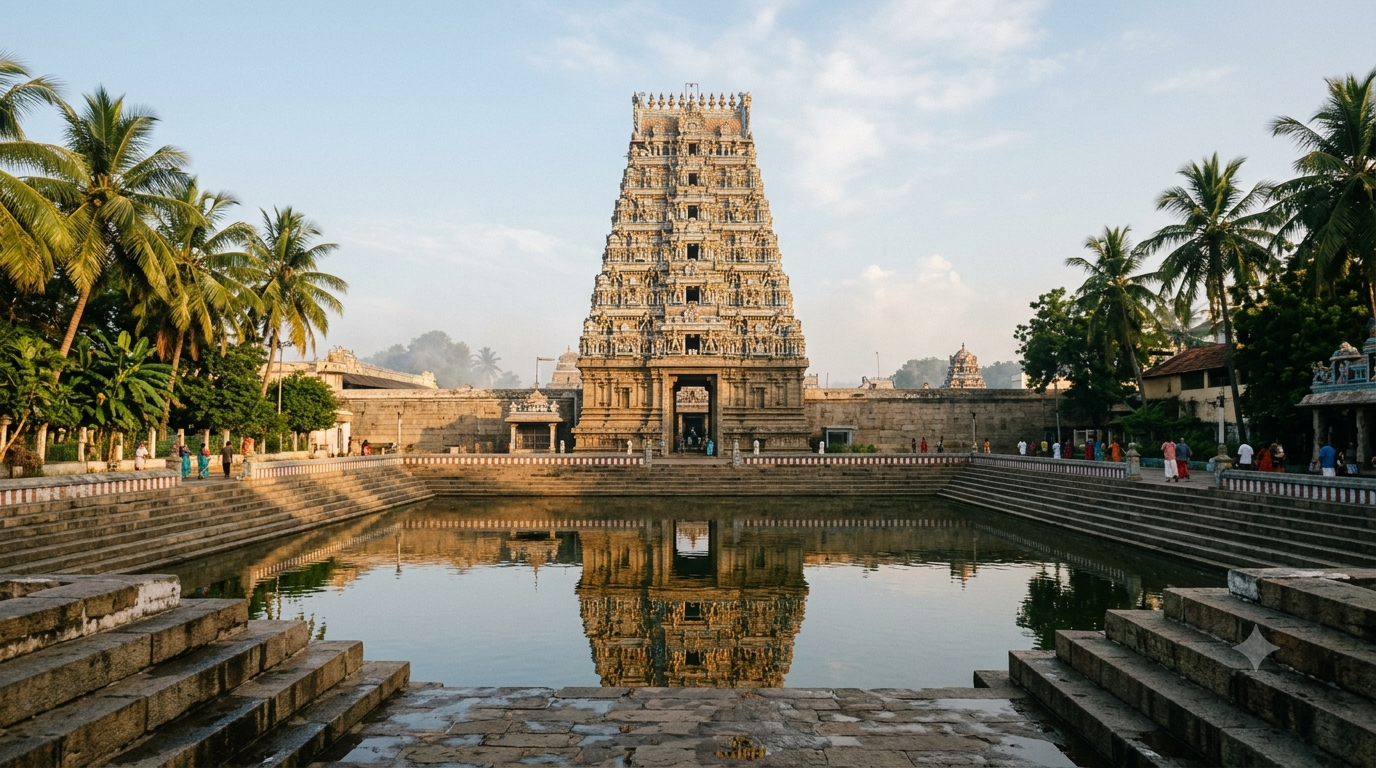
The most famous Tamil Nadu Vishnu temples are not just old shrines. They are living centres of the Sri Vaishnava tradition, where devotees still sing the same Tamil hymns the Alvar saints composed over a thousand years ago.
If you are planning a pilgrimage, you want accurate darshan timings and a sensible route. You also want honest guidance that keeps you away from fake booking sites. This guide gives you exactly that, temple by temple, with practical notes you can act on today.
Sri Vyasa Pooja is an independent devotional guide. We are not affiliated with any temple, the HR&CE department, or any trust, and we take no bookings, donations, or payments. Always use each temple’s official portal for reservations and confirmed timings.
Tamil Nadu Vishnu temples at a glance
- Tamil Nadu holds the largest share of the 108 Divya Desams, the sacred Vishnu shrines praised by the Alvars.
- Srirangam Ranganathaswamy is the foremost Divya Desam and the largest working Hindu temple in the world.
- Most of these temples give free general darshan, so beware of sites charging an upfront “booking fee”.
- The best travel window runs from October to March, when the weather stays cool and comfortable.
- Timings shift on festival days, so confirm on the official HR&CE page before you travel.
Why Tamil Nadu has the most Vishnu temples in India
Tamil Nadu holds the largest cluster of Divya Desams for a simple reason. The twelve Alvar poet-saints who glorified these shrines were themselves Tamil, so they praised more temples in their own homeland.
Of the 108 Divya Desams, around 84 lie within the state. The rest spread across Kerala, Andhra Pradesh, North India, and two celestial realms. Because tradition sets the count, some lists place the figure between 82 and 86.
Each Divya Desam is a temple the Alvars praised in the Nalayira Divya Prabandham, a canon of 4,000 Tamil verses. For a shrine to qualify, its main deity must be Vishnu, with an adjoining shrine for Goddess Lakshmi. This shared thread links the famous Tamil Nadu Vishnu temples, even though their architecture and legends differ widely.
Most famous Tamil Nadu Vishnu temples to visit
The temples below are the ones most pilgrims prioritise. They earn their place through spiritual weight, easy access, and living traditions. Verified darshan windows appear for each, but you should always reconfirm before a long journey.
Srirangam Ranganathaswamy Temple, Tiruchirappalli
Srirangam is the first and foremost of the 108 Divya Desams. So no list of Tamil Nadu Vishnu temples is complete without it. The temple sits on a river island between the Kaveri and Kollidam rivers.
It sprawls across roughly 156 acres, with 21 gopurams and seven concentric enclosures. Here Lord Vishnu reclines as Ranganatha on the serpent Adisesha. General darshan usually runs from about 6:00 AM to 9:00 PM, with midday and evening closures for rituals.
Free-darshan queues can stretch for hours on weekends, so many devotees choose the paid quick-darshan option instead. During Vaikunta Ekadasi in Margazhi, the Paramapada Vasal or “gateway to heaven” opens, and lakhs pass through it. Check official details on the Srirangam temple HR&CE portal, and our Srirangam accommodation guide covers where to stay.
Varadaraja Perumal Temple, Kanchipuram
Varadaraja Perumal Temple anchors the Vishnu Kanchi half of Kanchipuram. Vaishnavas revere it as one of the region’s holiest shrines. The temple is famous for Athi Varadar, a sacred fig-wood idol.
Priests keep the idol submerged in the temple tank, and they bring it out for public darshan only once every forty years. The last darshan drew enormous crowds in 2019, so the next one falls around 2059.
Darshan runs about 6:00 AM to 12:30 PM, then 3:30 PM to 8:30 PM. Because the temple stands on the Hastagiri hillock, you climb a short flight of steps to the sanctum. For confirmed timings and sevas, see our Kanchipuram Varadaraja darshan guide.
Parthasarathy Temple, Triplicane, Chennai
The Parthasarathy Temple in Triplicane is one of Chennai’s oldest shrines. Pallava rulers built it in the 8th century. The temple honours Krishna as Parthasarathy, the charioteer of Arjuna.
Its presiding idol is unusual, since it wears a moustache and carries only a conch. The area’s old name, Thiruvallikeni, comes from the sacred lily tank beside the temple. Darshan hours are broadly 6:00 AM to 12:00 noon, then 4:00 PM to 9:00 PM, with extended evening hours on Saturdays.
General entry is free, while special darshan tickets stay modestly priced. Because the temple sits in the heart of the city, you can reach it easily by bus, metro, or the Tiruvallikeni MRTS station.
Srivilliputhur Andal Temple, Virudhunagar
Srivilliputhur is the birthplace of Andal, the only female Alvar, and of her foster-father Periyalvar. Devotees worship Vishnu here as Vatapatrasayi. The towering rajagopuram is so iconic that it appears on the Tamil Nadu state emblem.
The temple’s Aadi Pooram festival, marking Andal’s birth, fills the town every July or August. Darshan generally runs about 4:00 AM to 1:00 PM, then 4:00 PM to 8:30 PM, though festival days differ.
Since the shrine lies about 80 km from Madurai, most pilgrims pair it with a Madurai trip. Our Srivilliputhur Aadi Pooram guide explains the festival timing in detail.
Sarangapani and Oppiliappan Temples, Kumbakonam
Kumbakonam is a temple town, and its Sarangapani Temple is the sixth of the 108 Divya Desams. The 173-foot rajagopuram is the tallest tower in the town, and Sarangapani himself reclines beneath an ornate vimana.
General darshan is free here. Importantly, you book sevas only at the temple counter, because there is no official online booking. Nearby at Thirunageswaram stands the Oppiliappan Temple.
Devotees worship Vishnu there as Oppiliappan, with his consort Bhudevi. Darshan is free, and both shrines pair naturally into a single Kumbakonam visit. Since timings can shift with local rituals, confirm at the counter or on the Tamil Nadu HR&CE portal on the day.
Comparison of key Tamil Nadu Vishnu temples
The table below summarises the flagship shrines, so you can plan at a glance. Treat the timings as indicative, since each temple can change them for festivals and special sevas.
| Temple | Town / District | Deity | Usual darshan hours |
|---|---|---|---|
| Ranganathaswamy | Srirangam, Tiruchirappalli | Ranganatha (reclining Vishnu) | 6 AM–9 PM (closures) |
| Varadaraja Perumal | Kanchipuram | Varadaraja (Devarajaswamy) | 6 AM–12:30 PM, 3:30–8:30 PM |
| Parthasarathy | Triplicane, Chennai | Krishna as Parthasarathy | 6 AM–12 PM, 4–9 PM |
| Andal / Vatapatrasayi | Srivilliputhur, Virudhunagar | Vatapatrasayi & Andal | 4 AM–1 PM, 4–8:30 PM |
| Sarangapani | Kumbakonam, Thanjavur | Sarangapani (Aravamudhan) | Morning & evening sessions |
How to plan your Tamil Nadu Vishnu temples trip
Rather than chasing scattered shrines, group the famous Tamil Nadu Vishnu temples into natural circuits. The Cauvery delta around Kumbakonam, Thanjavur, and Srirangam holds the densest cluster.
A three-day delta loop covers Srirangam, Sarangapani, and Oppiliappan comfortably. Chennai and Kanchipuram form a second easy pairing in the north. Down south, the Nava Tirupati circuit strings together nine Vishnu temples along the Thamiraparani river near Tirunelveli.
Because those nine sit close together, dedicated pilgrims often finish them in a day or two. If the classic Ranganatha trail draws you, the Pancharanga Kshetrams along the Kaveri connect Srirangam with sister Ranganatha shrines in one themed journey.
When you fix your itinerary, build in buffer time for the midday closures that most temples observe. Since queues swell after 9:00 AM, an early start almost always means a calmer darshan. Keep a spare hour for prasadam, gopuram photos, and a slow walk through the outer corridors.
Best time to visit and what to carry
The ideal season for the famous Tamil Nadu Vishnu temples runs from October to March, when the coastal heat eases. Avoid April to June if you can, because midday floors and long queues turn genuinely tiring. Weekday mornings stay the calmest windows almost everywhere.
Dress modestly in traditional attire, since several temples enforce a dress code at the entrance. Carry water, especially for the sprawling Srirangam complex, where you may walk a fair distance and wait a while.
If you are elderly, pregnant, or managing a health condition, take the paid quick-darshan queue. Pace the day gently, rather than rushing several temples at once. A calm plan protects both your health and your mood.
Common myths and booking scams to avoid
The biggest trap around Tamil Nadu Vishnu temples is the fake “online booking” portal. Many of these temples, including Sarangapani, run no online seva booking at all. So any site demanding an advance fee for one is almost certainly a scam.
General darshan at most of these shrines is simply free. Outdated timings are the second common problem, because aggregator pages copy old hours and rarely update them.
Always cross-check against the official HR&CE page for the specific temple. A genuine official portal sits on a government domain, and it never asks for an upfront “processing fee” for free darshan.
Finally, ignore rumours that Kanchipuram’s Athi Varadar appears every year. That darshan happens only once in about forty years, and the next is not due until roughly 2059. Treating such claims with caution protects both your money and your travel plans.
What most temple guides miss
Most listicles stop at names and photos. Yet the practical details matter far more on the ground. Here are the points seasoned pilgrims rely on.
- Reach the gate before opening, because the first darshan of the day is the fastest and most peaceful.
- Keep phones silent near the sanctum, since staff strictly enforce this at Srirangam.
- Sanctums often bar photography, so check the signage rather than assume.
- Carry small change for archana tickets, as counters rarely handle large notes quickly.
- Pair nearby shrines, because Kumbakonam and Tirunelveli reward clustered visits more than single stops.
Before you go
Tamil Nadu’s Vishnu temples reward planning, so lock your route, confirm timings, and start early. Srirangam alone justifies a trip. Yet the delta and southern circuits let you see many Divya Desams in one journey.
Above all, verify every changeable detail on the official portal, and never pay an advance “booking fee” for a free darshan. Approached with a little care, this is one of the most rewarding pilgrimages in India.
Frequently asked questions
How many Vishnu temples are there in Tamil Nadu?
Tamil Nadu holds the largest share of the 108 Divya Desams, with roughly 84 of them within the state. Beyond the Divya Desams, the state has hundreds of other Vishnu shrines, so the true total runs into the thousands.
Which is the most famous of the Tamil Nadu Vishnu temples?
Srirangam Ranganathaswamy Temple is the most famous, ranked as the foremost of the 108 Divya Desams. It is also the largest working Hindu temple in the world, covering about 156 acres near Tiruchirappalli.
Are darshan and entry free at these temples?
General darshan is free at most of these temples, including Sarangapani and Oppiliappan. Some, like Srirangam and Parthasarathy, offer optional paid quick-darshan tickets that speed up access during busy hours.
Can I book sevas online for these temples?
It depends on the temple. Srirangam offers some online facilities, but several shrines such as Sarangapani accept seva bookings only at the counter. So treat any site charging for “online booking” there with suspicion.
What is the best time to visit Tamil Nadu Vishnu temples?
The best window is October to March, when the weather stays pleasant for travel and darshan. Weekday mornings are calmest, while April to June can turn uncomfortably hot for long queues.
What is special about the Athi Varadar at Kanchipuram?
Athi Varadar is a fig-wood idol of Varadaraja Perumal that priests keep submerged in the temple tank. They bring it out for public darshan only once in about forty years, with the last event in 2019.
How should I dress for these temples?
Wear modest, traditional clothing, since many temples enforce a dress code at the entrance. Men often prefer dhotis, and women sarees or salwar. Remove your footwear before entering.